Category: Thomas Jones

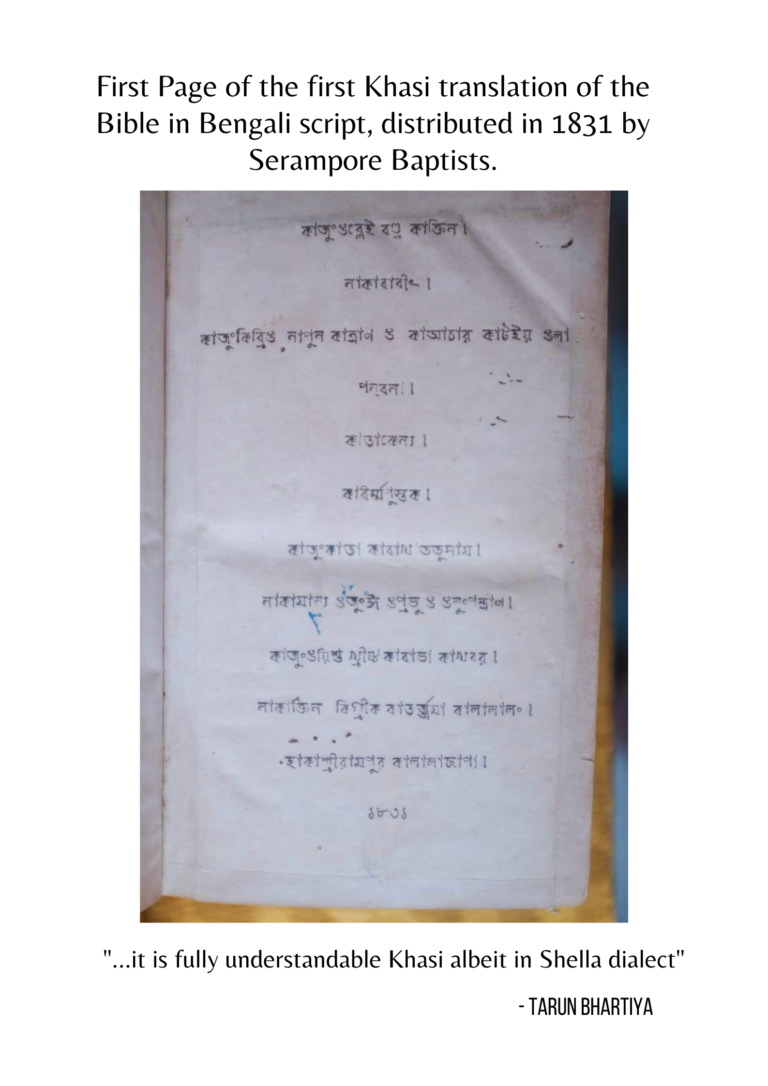
  • First Page of the first Khasi translation of the Bible in Bengali script, distributed in 1831 by Serampore Baptists.

    Thank you @tarunbhartiya for an informative and interesting contribution on the first Khasi translation of the Bible in the Bengali script! 🙏🙏 And what's more, there was a Khasi woman who helped William Carey in translating the Bible! 😃😃

    In @tarunbhartiya 's own words:

    "I so desperately want to know the name of the Khasi Lady – wife of the rajah/ chieftain who impressed Dr. William Carey with her intelligence and helped him translate the New Testament into Khasi. What was she doing in Calcutta/ Serampore in 1810s? How did she learn English? Was she literate (most probably yes)? Did William Carey talk to her about the Christian faith? Did she meet Krishna Pal who was planning to come to Pandua?"

    These and so many other questions arise when we read about the journey of the translations of the Bible into Khasi.

    You can read more in the following links:

    🟡https://theshillongtimes.com/2023/06/22/colonialism-and-mission/

    🟡https://www.placefortruth.org/blog/krishna-pal-the-first-baptist-convert-in-india

    🟡https://cherrapunjee.com/welsh-influence-in-cherrapunjee/

    🟡https://www.loc.gov/item/02014074/

    🟡https://books.google.co.in/books/about/Welsh_Missionaries_and_British_Imperiali.html?id=3JV6zQEACAAJ&redir_esc=y

    🟡https://books.google.co.in/books/about/The_History_of_the_Welsh_Calvinistic_Met.html?id=i6hGAQAAMAAJ&redir_esc=y

    🟡https://raiot.in/how-to-not-to-remember-thomas-jones/

    🟡https://raiot.in/was-thomas-jones-the-father-of-khasi-alphabet/

    🟡 Photographs are from the photographic project called "Unaddressed Picture Postcards from Khasi Jaintia Hills" by Tarun Bhartiya.

    https://indianexpress.com/article/lifestyle/art-and-culture/a-new-series-of-picture-postcards-explores-conversion-among-the-khasi-people-7575007/lite/

    #khasibible #khasitranslation #khasialphabet #williamcarey #thomasjones #khasichristian #khasihistory #speakyourroots #speakyourrootschallenge #talklocal

  • Ki laitylli ki daw ba u Rev. Thomas Jones u jied ïa ki dak Roman na ka bynta ka alphabet Khasi

    In writing the Khasi language, Thomas Jones chose the Roman scripts for three important reasons:

    (a) The difficulty of learning a hundred or more difficult sounds and signs when compared to the 22 letters A B C D E G NG H I J K L M N O P R S T U W Y.

    (b) The Bengali scripts used by the Serampore Mission in their translation of the New Testament, and by Alexander Lish for his readers, had not proved successful. He stated "after years of labour and much expense, not only among the Khasis is able to read a page of the books he used, or to understand a paragraph of some of the more simple sayings in the English language".

    (c) The Khasis generally "had a superstitious terror of Bengali letters, firmly believing that if they tried to form a letter that they would be struck by blindness…or suffer a fatal illness. The above reasons quelled all the doubts and misgivings of his critics in India and in Wales. (Cf. KAS Souvenir 150: p. 12).

    Ka jingthoh jong u William Pryse, u mishoneri jong ka Welsh mission ha Sylhet, i kumba ka pashat jingmut sha kawei pat ka daw, balei sha u Thomas Jones u mon ïa ki dak Roman. Ong u Pryse:

    The Roman characters have been adopted in preference to the Bengali characters, not from a conviction of the superior utility of the former, but simply because they were found already in use amongst the natives.

    Kum ban shu pynbud ïa ki jingkren bad ki jingpuson shaphang ka ktien Khasi bad ki alphabet Khasi, kane ka dei ka sla ba la sot na ka kot U Thomas Jones bad Ka Pyrthei Saitsohpen ba la thoh da i Babu S. S. Majaw. Ka long kaba sngew myntoi ban ïoh ki jingtip kum kine. Khublei Shibun @carey_lynz ba phi la phah ïa kane ka dur! 🙏🙏😃

    As a follow up to our conversations and thoughts about the Khasi language and the Khasi alphabet, here is a page from the book U Thomas Jones bad Ka Pyrthei Saitsohpen by S. S. Majaw. It is interesting and beneficial to know about all this.

  • Musings on Thomas Jones Day by Naomi C. Nonglait, Ph.D.

    I remember my father told me once that he used to write in the Bengali Script. I never understood why he had to write in a script of another language. By then I was learning to read and write in my own Khasi language. It was only years later that I understood this change.

    Rev. William Carey and Alexander Lish had used the Bengali Script for the Khasi Language. It was one of the most challenging and colossal task of their time. However, Thomas Jones felt the need to change the Bengali Script to the Roman Script. It was with much thought that he realised that most of the Khasis could not understand even a paragraph of translation. Since this was the case, he started with the Roman script to create the sounds of the Khasi language which was much less complex as compared to the Bengali Script.

    We have to be reminded here that what Thomas Jones had done in the past did not go without harsh criticism. He was criticised from many quarters especially from the officer-in-charge of the East India Company. The Khasis were also apprehensive and not happy with the change since they were used to the Bengali Script. It can also be understood that the Khasis had a lot of trading with the Bengalis, so maybe knowing the Bengali language and script was advantageous to them. However, this did not deter Thomas Jones to give up on his dream. There were others such as Dr. Duff, Jacob Tomlin and William Lewin (Majaw 38) who wholeheartedly supported him. This brought up many questions to my mind. One of them being how much support would we give to change? If it was not because of Thomas Jones' vision, the spoken word would not have gained the permanence given by ink and paper. Not that I am undermining the oral tradition, but because of the lack of storytellers and the dying art of storytelling, I realize that without the alphabet, I would not have been able to go back, to remember again those stories that intrigued me as a child.

    Source:

    • U Thomas Jones Bad Ka Pyrthei Saitsobpen by S. S. Majaw (2011)

    Suggested Reading:

    • Anne Jones (1812-1845) Ka Missionary Kynthei Kaba Nyngkong Ha Ri Khasi Jaintia by Dr. B. Ps. Toi

    • Welsh Missionaries and British Imperialism: The Empire of Clouds in North-East India by Andrew J. May (2012)

    Khublei Shibun @carey_lynzba phi la phah ïa ki jingpuson bad ki jingpule sani jong phi shaphang ka histori jong ki dak thoh Khasi kiba la pynmih da u Rev. Thomas Jones. 😄🙏

    Thank you @carey_lynz for sending your thoughts and research on the history of the Khasi alphabet established by Rev. Thomas Jones. 😄🙏

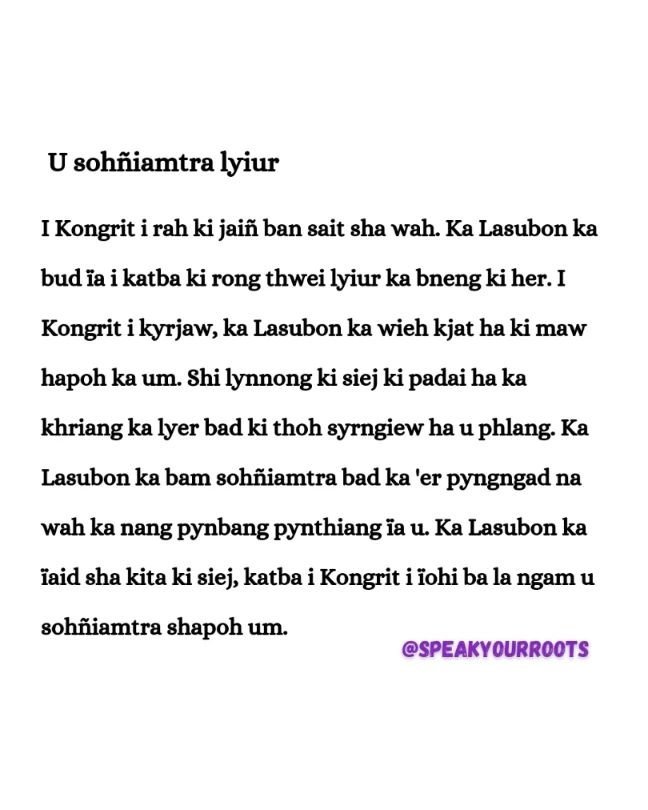
  • U Sohñiamtra Lyiur/ The Summer Orange
    I Kongrit i rah ki jaiñ ban sait sha wah. Ka Lasubon ka bud ïa i katba ki rong thwei lyiur ka bneng ki her. I Kongrit i kyrjaw, ka Lasubon ka wieh kjat ha ki maw hapoh ka um. Shi lynnong ki siej ki padai ha ka khriang ka lyer bad ki thoh syrngiew ha u phlang. Ka Lasubon ka bam sohñiamtra bad ka 'er pyngngad na wah ka nang pynbang pynthiang ïa u. Ka Lasubon ka ïaid sha kita ki siej, katba i Kongrit i ïohi ba la ngam u sohñiamtra shapoh um.

    Mynta ka sngi kaba dei ka 22 tarik u Jylliew, ka dei ka Thomas Jones Day. Ban kynmaw ïa ka jingwan jong ki dak thoh hapdeng jong ngi ki Khasi, la sah dak da ka jingïathuhkhana lyngkot.

    "U Sohñiamtra Lyiur" ka dei ka jingïathuhkhana lyngkot ne ka microfiction. Ki microfiction ki dei ki jingïathuhkhana kiba don 50-300 tylli ki kyntien. Kane ka jingïathuhkhana ka don 95 tylli ki kyntien.

    🟡 Sngewbha sa ïathuh ka mut aïu kane ka jingïathuhkhana ha ki comments! 😃😄 Phi sngewthuh kumno ïa ka?

    🟡 Kumno ngin pynkylla sha ka Khasi ïa ka kyntien "microfiction"? Ngi lah ban ong "ka jingïathuhkhana rit-ria"?

    Today the 21st of June is Thomas Jones Day. Thomas Jones was a Welsh Presbyterian missionary who established the Khasi alphabet. We commemorate the arrival of the written word in the Khasi community by posting a piece of microfiction.

    "U Sohñiamtra Lyiur" or "The Summer Orange" is microfiction of 95 words.

    🟡 Please tell us your interpretation of the story in the comments! 😃😄