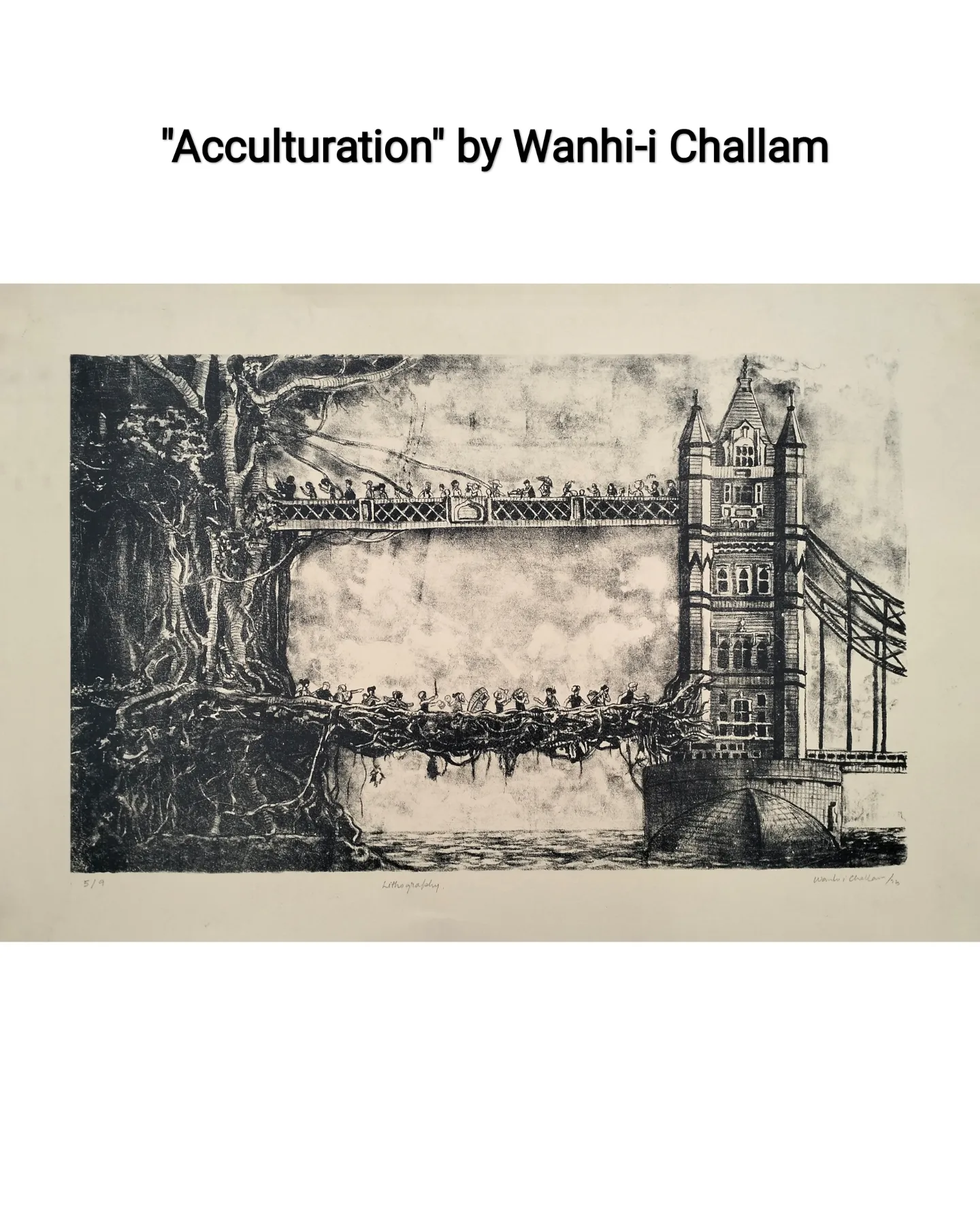
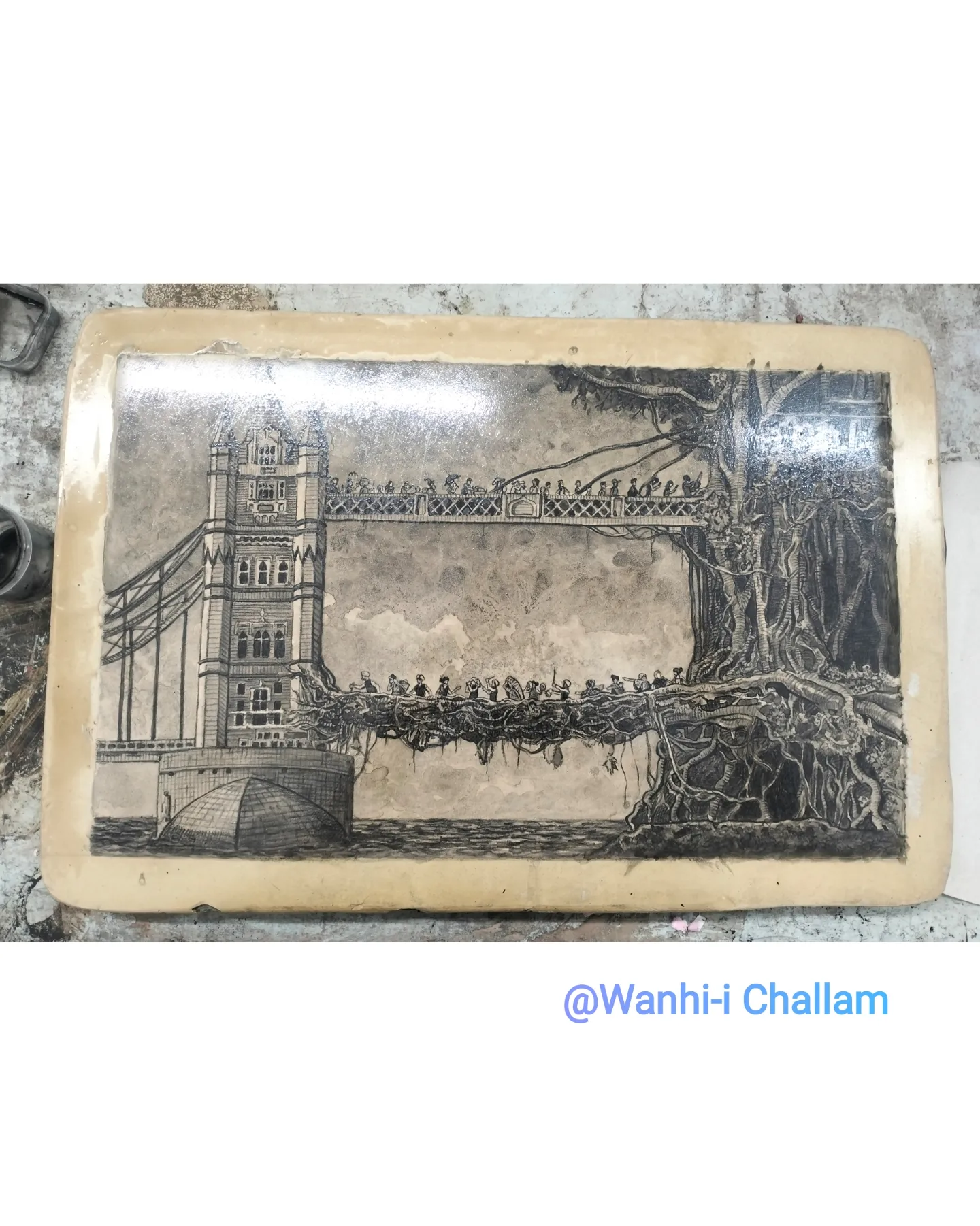
"Acculturation" is a lithography print by artist Wanhi-i Challam
He says:
The work is a lithography print that explores the effects of cultural assimilation and acculturation on the traditional values, language, religion, plants, animals, and ethnic values of the Khasi people. The print depicts two bridges – the root bridge of Nongriat representing Khasi origins, the relationship between Khasi culture and nature, metaphorically it also represents the "tangnoob tangjri" (as it is believed from the folklores that the Khasi people descend to earth through the golden ladder) and the Tower Bridge of the UK representing Western culture and lifestyle and the other cultures of the world, and also the effect that the Britishers brought on the Khasi culture and tradition when they ruled India. Bridges symbolize connections and, in this case, it symbolizes the connection between two different cultures and the impact of one on the other. There is no significant reason behind why I chose those two bridges specifically, instead I chose them because I found the structure and appearance interesting and used just as a representation of my idea.
Joining the two bridges through this composition I try to portray how the Khasi people have adapted to Western culture and other cultures by adopting their lifestyle, values, religion, and language. If observed closely one can see the details where the indigenous people tread towards the tower bridge wearing their cultural dress, moving in the order from the most elderly folks, younger generation and then to the youngest daughter. As they move forward entering the tower bridge, some carry indigenous items and crafts with them, others perform cultural dance, and activities. When coming back from the tower bridge to the root bridge, everyone is dressed in western fashion, the order of their movement is random, the first person carries with him a chainsaw, symbolizing the harm caused to nature due to the demands of urbanisation and civilisation. Some are looking down at their phones as they walk back, while others carry with them the luxuries the western culture offers.
Society brings people of different cultures together, and for them to live in harmony, it is crucial to have practices that facilitate such harmonious living. In fact, history shows that adopting elements from other cultures has always been present from generation to generation. It has happened in the past and is happening in the present, with or without our consciousness and it will continue to happen in the future too and we can't help to change that because the world is constantly changing. Each generation develops new lifestyles, technology grows exponentially, knowledge doubles, and culture also changes. Acculturation and assimilation will always occur, and nothing stays the same.
But should we neglect the importance, values and essence of our own culture? To me the loss of culture, cultural practices and tradition is the loss of identity and origin and that is concerning if we don't even know about our origin and about our own people. The Khasi culture emphasizes a deep respect for nature and a strong sense of place and belonging, which aligns with modern notions of nature conservation and sustainable use of natural resources. From a philosopher point of view there are infinite ways to live our life, and yes, we can choose any path we want.
However, our culture's perspective on life is one of the most compelling and admirable ways of living. It is crucial to be aware of how much we are influenced by other cultures and adopt their ways of life, but we should strive to preserve the essential values and essence of our own culture that have been passed down through generations.
The beauty and significance of "Acculturation" by Wanhi-i Challam is deep and multi-layered, embodying crucial lessons for the Khasi-Pnar community.
Khublei Shibun @wanhii.psd ba phi la ai lad ban post ïa kane ka kam jong phi kaba itynnat bad kaba kit jingmut haduh katta katta 😄🙏
Wanhi- i Challam is an artist from Jowai, Meghalaya. Currently, he is pursuing his Bachelor of Fine Arts at Kala Bhavana, Visva Bharati in the Graphics Arts/ Print Making Department.