Tag: indigenousphilosophy

  • Acculturation by Wanhi-i Challam

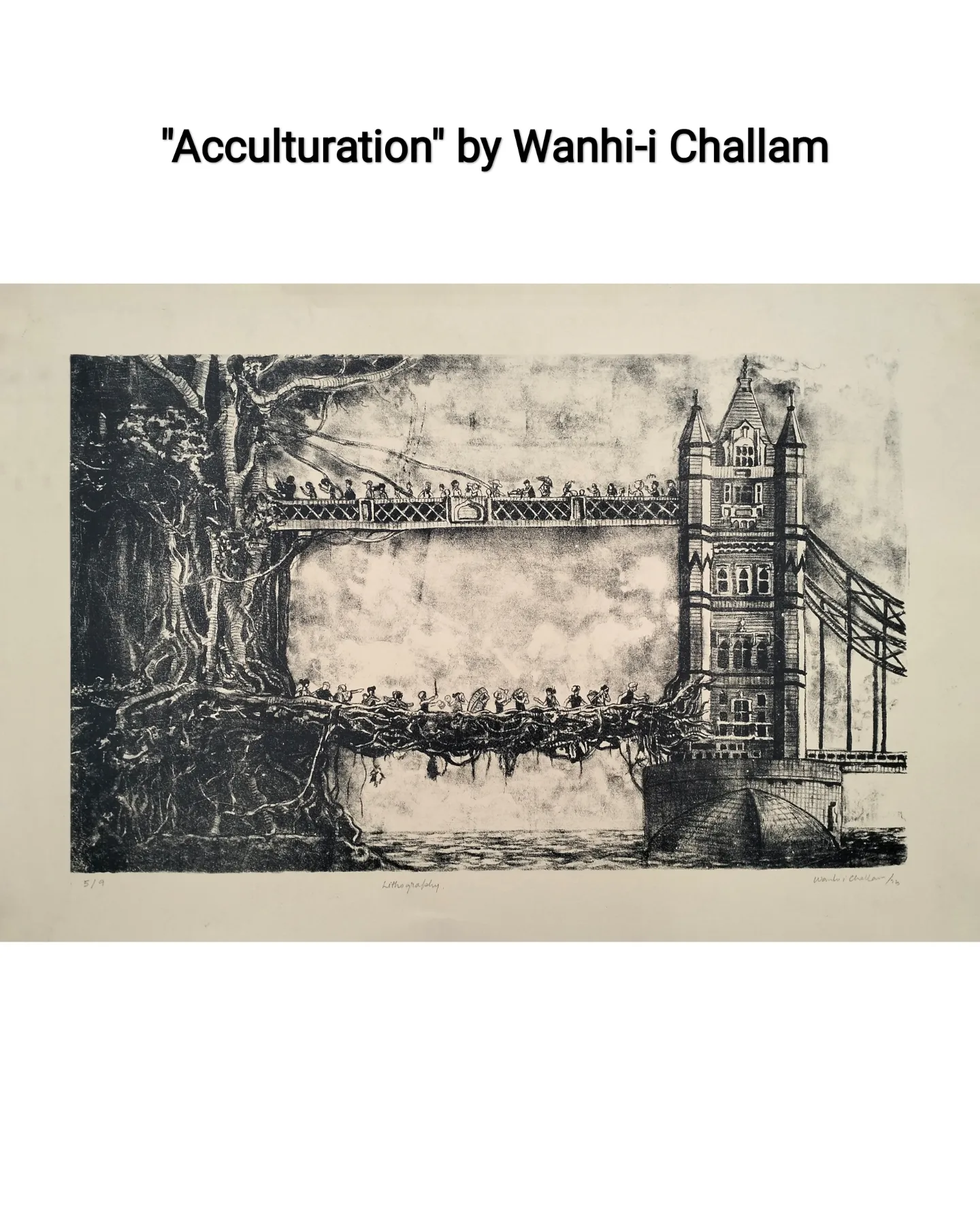
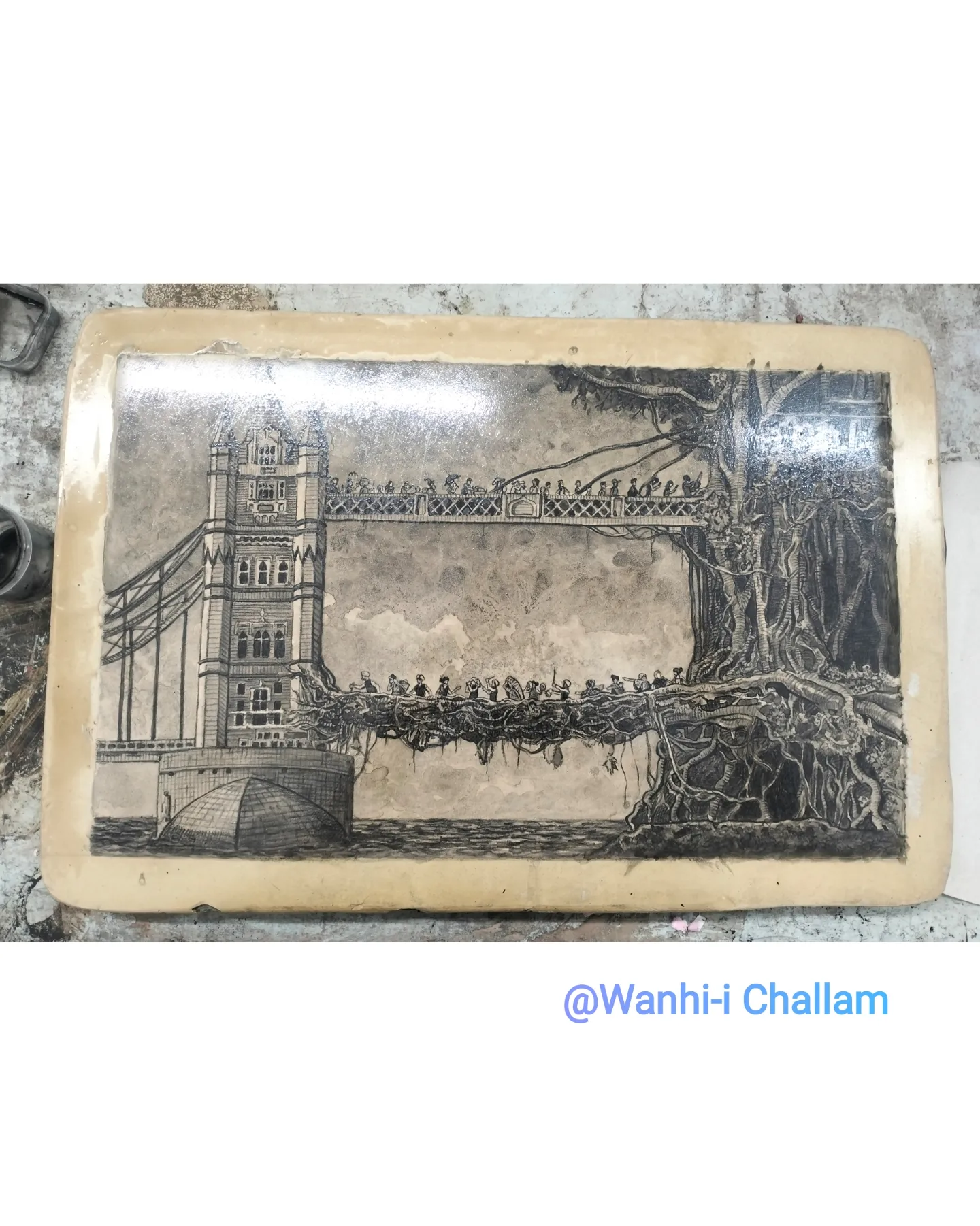
    "Acculturation" is a lithography print by artist Wanhi-i Challam

    He says:

    The work is a lithography print that explores the effects of cultural assimilation and acculturation on the traditional values, language, religion, plants, animals, and ethnic values of the Khasi people. The print depicts two bridges – the root bridge of Nongriat representing Khasi origins, the relationship between Khasi culture and nature, metaphorically it also represents the "tangnoob tangjri" (as it is believed from the folklores that the Khasi people descend to earth through the golden ladder) and the Tower Bridge of the UK representing Western culture and lifestyle and the other cultures of the world, and also the effect that the Britishers brought on the Khasi culture and tradition when they ruled India. Bridges symbolize connections and, in this case, it symbolizes the connection between two different cultures and the impact of one on the other. There is no significant reason behind why I chose those two bridges specifically, instead I chose them because I found the structure and appearance interesting and used just as a representation of my idea.

    Joining the two bridges through this composition I try to portray how the Khasi people have adapted to Western culture and other cultures by adopting their lifestyle, values, religion, and language. If observed closely one can see the details where the indigenous people tread towards the tower bridge wearing their cultural dress, moving in the order from the most elderly folks, younger generation and then to the youngest daughter. As they move forward entering the tower bridge, some carry indigenous items and crafts with them, others perform cultural dance, and activities. When coming back from the tower bridge to the root bridge, everyone is dressed in western fashion, the order of their movement is random, the first person carries with him a chainsaw, symbolizing the harm caused to nature due to the demands of urbanisation and civilisation. Some are looking down at their phones as they walk back, while others carry with them the luxuries the western culture offers.

    Society brings people of different cultures together, and for them to live in harmony, it is crucial to have practices that facilitate such harmonious living. In fact, history shows that adopting elements from other cultures has always been present from generation to generation. It has happened in the past and is happening in the present, with or without our consciousness and it will continue to happen in the future too and we can't help to change that because the world is constantly changing. Each generation develops new lifestyles, technology grows exponentially, knowledge doubles, and culture also changes. Acculturation and assimilation will always occur, and nothing stays the same.

    But should we neglect the importance, values and essence of our own culture? To me the loss of culture, cultural practices and tradition is the loss of identity and origin and that is concerning if we don't even know about our origin and about our own people. The Khasi culture emphasizes a deep respect for nature and a strong sense of place and belonging, which aligns with modern notions of nature conservation and sustainable use of natural resources. From a philosopher point of view there are infinite ways to live our life, and yes, we can choose any path we want.

    However, our culture's perspective on life is one of the most compelling and admirable ways of living. It is crucial to be aware of how much we are influenced by other cultures and adopt their ways of life, but we should strive to preserve the essential values and essence of our own culture that have been passed down through generations.

    The beauty and significance of "Acculturation" by Wanhi-i Challam is deep and multi-layered, embodying crucial lessons for the Khasi-Pnar community.

    Khublei Shibun @wanhii.psd ba phi la ai lad ban post ïa kane ka kam jong phi kaba itynnat bad kaba kit jingmut haduh katta katta 😄🙏

    Wanhi- i Challam is an artist from Jowai, Meghalaya. Currently, he is pursuing his Bachelor of Fine Arts at Kala Bhavana, Visva Bharati in the Graphics Arts/ Print Making Department.
  • Ka Rngiew: A perspective from Dr. Margaret Lyngdoh, University of Tartu, Estonia

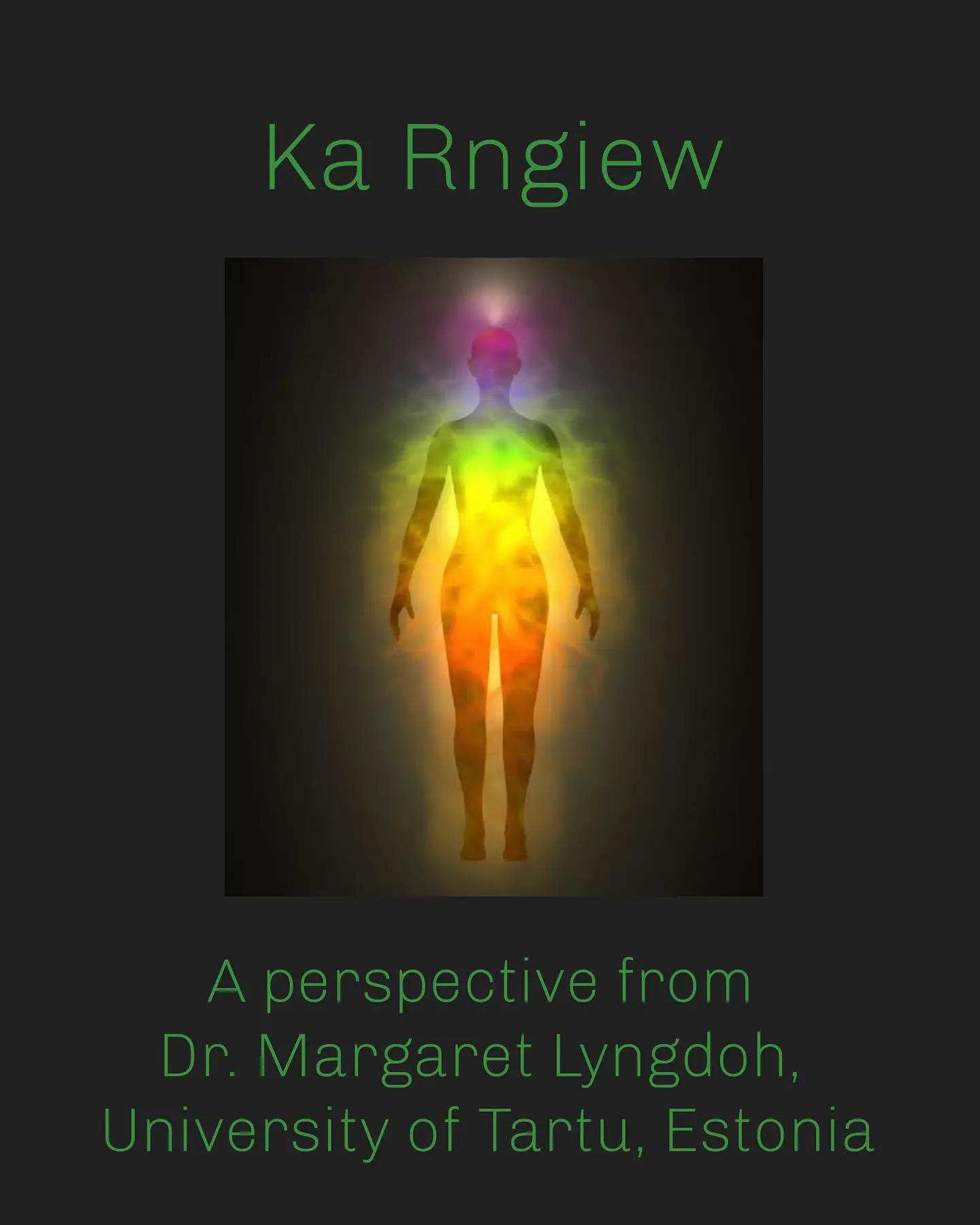
    In the Christian worldview, a person is made of the body, mind, and soul. In the traditional Khasi perspective, a person is made up of met, mynsiem, and rngiew. While met is the body, mynsiem is breath. Rngiew is what invests a body with personhood and it stays with a person through life. It is the quality that allows a person to remain impervious to the evil eye or ka sabuit. Thus the term longbriew means the nature of being "human" or the nature of an entity who is endowed with rngiew.

    There is no English word to approximate this Khasi concept. In its simplest explanation, rngiew is what makes a person human. Further, the Khasi word for breath, mynsiem has been adapted to fit the Western idea of the "soul" or even, "spirit". I cite, Lyngdoh, Margaret (2021). "Landscapes of Enchantment and their Usage: A Critical Case-Study from the Khasi Ethnic Community, Northeast India'' in Graham Harvey and Opinderjit Kaur Takhar (Ed.). "Religion and Senses of Place'' UK: Equinox Publications. (Religion and The Senses) [forthcoming]:

    A being is made up of Ka met (lit. body). ka mynsiem (lit. breath) and ka rngiew. To ‘be' a human being (longbriew), the Supreme Being must clothe the being with a rngiew. I will quote my interlocutor, Sweetymon Rynjah on this, "Ka Rgiew ka dei ka bor maia ba kynja Blei, ba u Blei u la pynkup, pynphong ia u briew ha ka jingwan longbriew jong u' (20 November 2015)".

    I paraphrase: The Rngiew is an ability that is god-like, that the Supreme Being clothes or invests a being with when he/she comes out of the womb initially divine, and then whatever he/she acquires or achieves in a lifetime is dependent on him-/her-self. The rngiew stays with a person through life and is reflected in the person's being and stature. If their (jinglong mynsiem) personality, spirit, essence, strength of character, nature, principles, moral fortitude etc. are in line with, 'Ka tip briew ka tip blei and ka tip hok tip sot' (lit. living a good life in accordance with the Covenant decreed by the Supreme Being), then their rngiew is strong and protects them from those who desire ill or harm to befall upon them.

    All humans and non-humans have rngiew. Ryngkew or guardian deities, have rngiew. This gives a sense of agency to a human or non-human entity. But clans also have rngiew, and in different contexts this can mean different things. But a strong rngiew of a clan can protect a clan from extinction. When we refer to the clan in this context, we use the words “longkur longkha". But rngiew is always a strong, positive quality that remains with humans, places, non-humans (like ancestors and guardian deities) all their lifetime. The first ancestress, Iawbei also has rngiew, especially because they have to look after the well being of a clan and further it's progress and prosperity. Even though we live in a state of rapid transitions, we cannot forget these core Khasi indigenous concepts because this is an essential part of our longbriew manbriew!

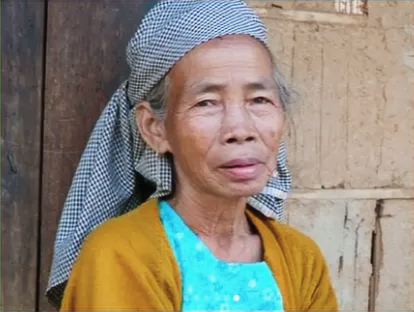
    In the photo is Kre Makri, who is a Khruk, a female weretiger, from Raid Nonglyngdoh, Ri Bhoi. Her rngiew transforms into a tiger and roams around in the alternate reality, Ramïa, where notable ancestors also live. She said that while the male weretiger or sansaram (lit. five clawed) has the function of holding on the laws of the ryngkew, the female weretiger, ka khruk, has the sacred function of holding of the rngiew of the clan. The photo was taken by me and this was in the winter of 2012.

    Dr. Margaret Lyngdoh @lieng_makaw gives us what she has found in her research from the approach of Folkloristics about "Ka Rngiew", showing us that it is a far reaching concept which sheds light on the well-being of the individual, the clan and our worldview as Khasi-Jaiñtia society. Thank you @lieng_makaw ! 😀🙏

    The post on "Ka Rngiew" posted on the 5th of August 2021, garnered a lot of attention and also counter-reaction that has proved fruitful in our understanding of this unique Khasi concept. The expression and discussion of different points of view is something that is important for indigenous culture to thrive.

    No part of this material may be reproduced in any form without the consent of the author. All material for this content has been collected through primary fieldwork.