Tag: indigenouspoetry

  • Ka Tlang Ka La Wan da i Dari Kupar Kharwar

    Ka Tlang ka lah wan!

    Ka Tlang ka lah wan;

    Ka jingtyrkhong ka lah sdang,

    Ki borti ki tin um lah sdang sei;

    Ban tong um na shyngiar na thwei,

    Ki khiew phiang ki tin um ha la rong baitynnad;

    Ïeng ap pali bad ki lok,

    Oh! katno jingsngewtynnad,

    la ki khanatang khana kai ngi ïa shahskhor ïasngap;

    Ban pyn myllen ïalade katba ka um kam pat dap,

    Ngi shah ïa ka khriat bad jingpjah ka tlang;

    Khlem jingsalia ngi leit tang ha ïing ban ïa biang,

    Haba la sawa bolbaring kit um bad sha

    wah sha shyngiar ki ïa mareh bran;

    Dei hangta keiñ ngi ïa sngewthuh ba ka tlang ka lah wan!

    – Dari Kupar Kharwar

    "Ka Tlang ka lah wan!" is an original Khasi poem written by @dari_kupar 😄
    Khublei Shibun for sending your poem! 🙏

    @dari_kupar is a Life Coach at Avenues, Shillong. He is an avid photographer who tries to tell stories with pictures that he finds on most of his searching and inspiration deep in the woods, up in the mountain, on the side of a stream, a tiny tea shop in the city, on the buzzing street and busy market. He’s a wanderer who is not lost, tangba shu bakla lynti ha khep ha khep 😅😂 He also finds inspiration in music, books and the people he meets.
    .
    .
    .
    .
    Mynta ka taïew ngi kynmaw ïa ka lyngkhuh sngi ïap jong u myllung ba radbah ka ri Khasi u Soso Tham ha ka 18 tarik u Nohprah 1940, da kaba ngin post ïa ki poitri ba lah noh synniang da ki paralok followers jong ngi. ✏️✒️📃

    Ai ba ka jingshem mynsiem, ka jingshemphang bad ka jingieit ri jong u myllung Soso Tham, kan long ruh ka jingïohkynti jong ngi ka ban pynkhlaiñ ïa ngi kum ka jaitbynriew. 🏞️🌄

    This week we commemorate the death anniversary of Khasi Poet Laureate U Soso Tham, on the 18th of December 1940, by posting poetry that has been generously contributed by our dearest followers. ✏️✒️📃

    May the inspiration, conviction, wisdom and love for the Khasi land and people of the poet U Soso Tham be our inheritance that strengthens us as a community. 🏞️🌄

  • “Tyrkhang Iwbih” da Victor G. Bareh

    Sha 'tiewmatïong la nga peit

    Ha khet ki diengbah ba'm kot kheit;

    Jingpynhiar mynsiem thiang ba'n iw

    H'u tyrkhang nga dem khohsiew.

    Ha thaiñ ba ki lyer pyngngad

    Ki dang suh sieng khlem blad,

    Lem bad tyrkhang jong ki lum bad ki wah,

    Junom ban im ngam ngiah.

    Ko tyrkhang ba pynkrih

    Ïa ki lyer jingiwbih

    Ha ri ba puri blei ki ieit,

    Ba me suh ki thied hapdeng shrah 'dew-kulong,

    Pansngiat ïa me ngan pynphong.

    Rongphong pyrthei kim larkam

    Ïa me ba ngan pynspong ka nam;

    Jynhaw jinglong jingim ba thiang

    Ba me pynsieng, ka la biang.

    Sha dohnud sakma pynpar

    Ïa ki sur jingphawar,

    Ba khun ka ri b'la rah soitan sha rngai,

    Sha rympei kin wan phai.

    'Tiew-tynrai jong ka ri,

    Ba dang wan beh ha ngi

    Ïa ki lyer sotti juk hyndai,

    Ï'u klong snam jingieit la ri ïai kynshait,

    Ha lhop pyrthei b'un ym stait.

    Sha ri u bnai bad ka sngi,

    Kum me, ngam don thapniang ba'n jngi;

    Ïa me, ieh wat khang ba ngan bud

    Tang da ki sur ka dohnud.

    Da bor ba'm i ka khmat briew,

    Ïa jingmut to kyntiew,

    Na lyndet lyoh ïa ki sap ba ngan kem,

    Hangne ba eh ba ngan shem.

    'Tiew tyrkhang ba pynher

    Khlem kut shuh ïa ki lyer

    Ba'n pynsieng iwbih ïa ka bneng,

    Ïa longrynieng ban tor jong nga iai pyndap

    Da jingpyrkhat ba'm ïap.

    "Tyrkhang Iwbih" by established Khasi poet Victor G. Bareh is moving because of the affinity and connection that the poet experiences from a sweet smelling fern.

    Mynta ka taïew ngi kynmaw ïa ka lyngkhuh sngi ïap jong u myllung ba radbah ka ri Khasi u Soso Tham ha ka 18 tarik u Nohprah 1940, da kaba ngin post ïa ki poitri ba lah noh synñiang da ki paralok followers jong ngi. ✏️✒️📃

    Ai ba ka jingshem mynsiem, ka jingshemphang bad ka jingieit ri jong u myllung Soso Tham, kan long ruh ka jingïohkynti jong ngi ka ban pynkhlaiñ ïa ngi kum ka jaitbynriew. 🌄🏞️

    This week we commemorate the death anniversary of Khasi Poet Laureate U Soso Tham, on the 18th of December 1940, by posting poetry that has been generously contributed by our dearest followers. 📃✒️✏️

    May the inspiration, conviction, wisdom and love for the Khasi land and people of the poet U Soso Tham be our inheritance that strengthens us as a community. 🏞️🌄

  • “Ka Thong” da Magdalene Laloo

    Na ri ki rngai ka wan pasiaw,

    Ïa mynsiem ka khring ban jop thiaw.

    Jingiwbih ki sang ban sam lyngba,

    Jingsawa ki kshaid ba sngewphylla.

    Ka ud ka kyang ka wan paw shynna

    Da ki khana ha ka por nylla.

    Ka khring ïa ka mynsiem

    Ba ïa ka ban buddien,

    Ïa takma ksiar haba kut ban shem,

    Ban ïeng hi triang da jingkyrmen.

    Da ryntieh jingieid ki khnam jingshlur,

    Ha madan thma shakhmat ban tur.

    La snam ka jaw, jingmong ka sat,

    Jingeh ki tynrah, mynsiem nangjwat,

    Ha kliar u lum Lama ban kaweh,

    Pat ïoh jingjop, khlem pat sangeh.

    Khlem jingrem haba kut ban iohi jingshai,

    Kan wan tyngshaiñ na ri ki rngai.

    Today we have an original Khasi poem entitled"Ka Thong" by @magdalene11_06_01 Khublei Shibun for sending your inspiring poem! 😄🙏 @magdalene11_06_01 is pursuing her Bachelor's degree in Mathematics 🤓👍

    Mynta ka taïew ngin kynmaw ïa ka lyngkhuh sngi ïap jong u myllung ba radbah ka ri Khasi u Soso Tham ha ka 18 tarik u Nohprah 1940, da kaba ngin post ïa ki poitri ba lah noh synniang da ki paralok followers jong ngi. ✏️📃✒️

    Ai ba ka jingshem mynsiem, ka jingshemphang bad ka jingieit ri jong u myllung Soso Tham, kan long ruh ka jingïohkynti jong ngi ka ban pynkhlaiñ ïa ngi kum ka jaitbynriew. 🏞️🌄

    This week we commemorate the death anniversary of Khasi Poet Laureate U Soso Tham, on the 18th of December 1940, by posting poetry that has been generously contributed by our dearest followers. 📃✒️✏️

    May the inspiration, conviction, wisdom and love for the Khasi land and people of the poet U Soso Tham be our inheritance that strengthens us as a community. 🏞️🌄

  • “Naiwieng” by Badondor Diengdoh

    Naiwieng

    Ka jngum thylli U Naiwieng

    nalor suiñbneng

    ka pyrshang ban kjit noh ïa ka

    kyrteng jong phi napoh

    shadem jong nga.

    Ka lah mo ban ban leh kumta-

    lehse ka bishni ne?

    Haba hangne nga lah ngam

    naduh ryndang

    shaduh shiteng sla khyndew,

    ban poi sha kliar slakjat

    ka mynsiem jong phi.

    Teng teng haba nga per

    harud ka um,

    bad par hapoh ki syrngiew maw

    kum ka tyngab ba shah dung

    da u ñiuhkseh, ban leit phai noh

    sha la skum bad ka jingkletnoh;

    bad 'la u ksaiñ ha shyntur-

    nga khie biang pat ryngkat

    bad ki jingkynmaw.

    Sngew tieng haba wat ka um

    ka kjit ïa ki jingmut thwei.

    Sngew par ñiangkhriat

    haba teng teng wat u rnga u

    sah ïong, u sah bthi-

    tangba ka kamra ka syaid

    bad ka rhem tang da ka um.

    Sngew thylli

    ban dei u briew,

    ban dei u mrad,

    ban dei u jingthaw

    uba long kum u maw

    hapoh krem;

    ban shah pruid dak

    hapdeng bad hapoh ka dum-

    wat la tang hapoh san

    ne shiphew kam,

    ka syaid bad ba shai

    ka pynsmiej ia nga.

    Ban klet noh te ka suk,

    lada don ki jingpynbyrngia:

    ka ding ka phalang ïa ka

    lawei kaba khlem urlong;

    ka mat bam duh shi syndon-

    teng teng ka ding ka

    hap ban bam,

    khnang ba kan ïai

    im harud ka um.

    Ban klet noh ruh ka jynjar,

    lada ka jingkynjah jong ka miet

    ka lynñiar lyngba ki khlur

    kiba phi ju kdew bad pyni ïa nga

    ha ki por ba dang dei u briew

    uba dap tang da ka jingkmen suda.

    – Badondor Diengdoh

    Mynta ka taïew ngi kynmaw ïa ka lyngkhuh sngi ïap jong u myllung ba radbah ka ri Khasi u Soso Tham ha ka 18 tarik u Nohprah 1940, da kaba ngin post ïa ki poitri ba lah noh synniang da ki paralok followers jong ngi. ✒️📃✏️

    Ai ba ka jingshem mynsiem, ka jingshemphang bad ka jingieit ri jong u myllung Soso Tham, kan long ruh ka jingïohkynti jong ngi ka ban pynkhlaiñ ïa ngi kum ka jaitbynriew. 🌄🏞️

    This week we commemorate the death anniversary of Khasi Poet Laureate U Soso Tham, on the 18th of December 1940, by posting poetry that has been generously contributed by our dearest followers. ✏️📃✒️

    May the inspiration, conviction, wisdom and love for the Khasi land and people of the poet U Soso Tham be our inheritance that strengthens us as a community. 🌄🏞️

    Today we have an original Khasi poem entitled " 'Naiwieng" by Badondor Diengdoh @a_pocketful_of_plums
    Khublei Shibun for sending your beautiful poem! 😄😄

    @a_pocketful_of_plums says: "A great poem will reel you into its world and capture your imagination…Poetry needs to be read and absorbed. Most poems need to be read many times. A finished poem is always half finished. It only becomes complete with the interpretation of the reader…Ultimately, I hope to write poetry for the individual, for identity and for the community…"

  • Jngai na pyrthei da i Bhu Ianz

    JNGAI NA PYRTHEI KHLEM JINGKHUSLAI – NGAN SUH BEIT

    WIAW SHABA NGEN U BNAI

    KHLEM ARTATIEN NE JINGPYRWA – LA STANG NE RBEN KA PLA

    BAN LAIT NA JINGTYRHA MYNSIEM – HA PNEH RAM-EW AI

    NGAN SUHSIENG

    KHOP KHOP HA LA JINGLONG SHI SUR – NGAI LYNGNGAI HA

    JINGMUTDUR

    NGAN KLET LUT KHOIT IA SPAH BAD PHEW – TANG

    JINGKYNMAW BA NGAN KYNSHEW

    JNGAI NA BAROH RUH NGAM SNGEWPHER – JINGDIAW NGAN

    PIAM HA LA KI SNER

    LAIT TANG JINGMUT HA SUIÑ BAN PER – SET SLUNG LADE

    SHA KI HAJAR MER

    "Jngai na pyrthei" an original Khasi poem by @bhu_ianz ✒️📃 Thank you for the poem! 🙏

    The poem expresses a brave yearning for an escape and a freedom from the human world ☀️🌙💫

  • “Pahsyntiew” by Indari S. Warjri

    I heard of your beauty

    Blushing daughter of the deities

    Sheltered in your cave of chastity

    No man dare explore.

    A dark cascade rises from

    your shoulders

    But a tender lily

    Should not be bruised by

    hostile rocks.

    Your slender hand will stretch

    Towards the flower in the man's hand

    For in his hand man hold

    Unnamable delight.

    And you became mine,

    sweet maiden.

    O be the mother of my sons!

    But also the warm nest for

    my love.

    O children, may you be noble

    May you possess the

    strength of rocks

    May you protect the weak

    May you be suckled on knowledge

    For the celestials beckon

    And I must return.

    The sons became men, royal in stature

    Having wisdom gifted by the gods

    They came to rule the misty hills;

    To dwell in pinewood mansions

    Where carpets of clouds

    And cloaks of rain

    Conserve the forests of the Khasi hills.

    O mother, giver of life,

    See your sons-the syiems.

    "Pahsyntiew" by @indariwarjri based on the legend of Ka Pahsyntiew 🌹

    Indari S. Warjri (Associate Professor) is Head of the Department of English, St. Mary's College, Shillong.

    The Legend of Ka Pahsyntiew has been published in English, in the book Around the Hearth: Khasi Legends (Folktales of India) by Kynpham Sing Nongkynrih. The book is published by Penguin Books.

  • “Jar I hok – Jngai nei thok – Kamai ia ka hok” da Daohi Manar

    Phet jngai na ka bamsap, phet jngai na ka bamsap

    Ileh Cha kamni, sa du i wöm ioo tipsap-tiptap?

    Jar jar lei hok, u ia k'bai-kyrha

    Ileh Cha kamni, dap da ki jingeh suda?

    Kylli oa pûn na nga

    Wa angnood iei jingkylla…

    Chirup u ieiñ tylli, Myllin noh i sniawpher u wi ia ka wi

    U rah iei roi i par, thrang i hei jingim

    Ka wait iong i tip i stad, kani toh u chim

    Ham sniaw salajong, Toa iyn-ia pûnku pûnkynrong

    Khlem niaw, Wei khlem da thaw

    U wa lieh, wa stem, wa soo ne wa u iong

    "Jar I Hok, Jngai nei Thok, Kamai ia ka Hok" is an original Pnar poem by @xdtnoahjupejackllthmanar

    The poem speaks of bringing about a change in society, through truth, unity and a thirst for knowledge. A change that is for the greater good of all. A change that creates an awareness of not only our rights but also our duties as a community and as citizens of the state and country.

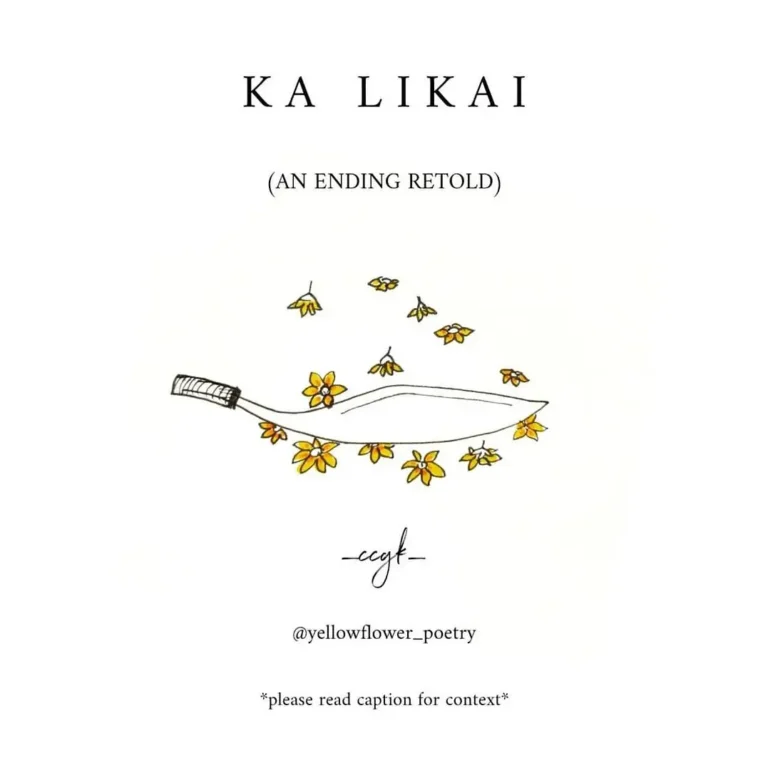
  • “Ka Likai (An Ending Retold)” by Clarissa Giri

    Calmly by the fire,

    She sits staring at the flames before her.

    Ember sparks burn freckles on weathered

    floorboards,

    Restless charcoal crackle uneasily in the dpei,

    While vapour fumes from her drenched

    kyrshah.

    Smoke and ash cling to her damp hair,

    A hot tear makes its way down her cheek,

    The wait glistens bloody at her heel,

    And she watches the shadows form on the

    wall before her

    As her ancestors dance for war.

    The rueful dish cooked to perfection,

    She feeds him a mouthful of this concoction-

    A stew of his own fingers; there will be no

    leftovers.

    How he tossed her daughter's tiny fingers like

    refuse in the shang-kwai,

    No. This butcher will devour his.

    There is a Khasi folktale about a widow named Likai who had a daughter whom she loved more than life itself. She was remarried after some time, to a man who later turned out to be abusive and dangerous and who eventually murdered her only daughter, while Likai was toiling in the fields. He butchered her and cooked a stew with the remains which Likai ate unknowingly. She found out after her meal when she was about to consume "kwai", a combination of betel leaf, lime and areca nut (a traditional edible) where she saw the remains of her daughter's fingers in the "shang-kwai" (areca nut basket).

    This caused a cacophony of chaos in her, driven by immense heartbreak and in a rage she ran after the man with a "wait" (a Dao or large bladed knife). Being unable to find him, in her madness-driven rage and being unable to endure life because of such a tragedy, Likai threw herself off of a waterfall. The waterfall is named after her fall "Noh Ka Likai" falls (Literally, Where Likai Jumped).

    This poem is a twist on that ending, as folktales go, there is always an ending of "What if?" and in this one there is no mention about what happened to the murderer and if ever he was given what he deserved. In this poem, I ask what if Likai found her daughter's murderer cowering in the forests of "Sohra" (Cherrapunji), and she was able to avenge her daughter before deciding upon her own fate?

    "Dpei" – hearth, "Kyrshah" – traditional khasi apron

    Caption and original artwork by @yellowflower_poetry