Tag: jaiñtia

  • Khaisap

    Ka ktien Pnar "Khaisap" ka dei ka ktien ka bym don kum ma ka ha ka ktien Khasi 😄

    Kyrmen ba ka jingbatai ïa kane ka ktien ka la shai bad ka long kaba khaisap! Lada phi kwah bynrap shuh, sngewbha thoh ha ka bynta ki comments.

    🟡 Baroh ki jingbatai ha ka Pnar, Khasi bad English la thoh da ka @speakyourroots

    .

    .

    .

    The Pnar word "Khaisap" does not have a Khasi equivalent 😄

    Hopefully the explication given is clear and satisfactory. If you want to add more to understanding the word, please mention it in the comments section.

    🟡 Explication in Pnar, Khasi and English by @speakyourroots

    #khaisap #pnarlanguage #pnardialect #pnarpeople #jaiñtia #jaiñtiahills #khasilanguage #khasilanguageconservation #speakyourroots #speakyourrootschallenge #talklocal

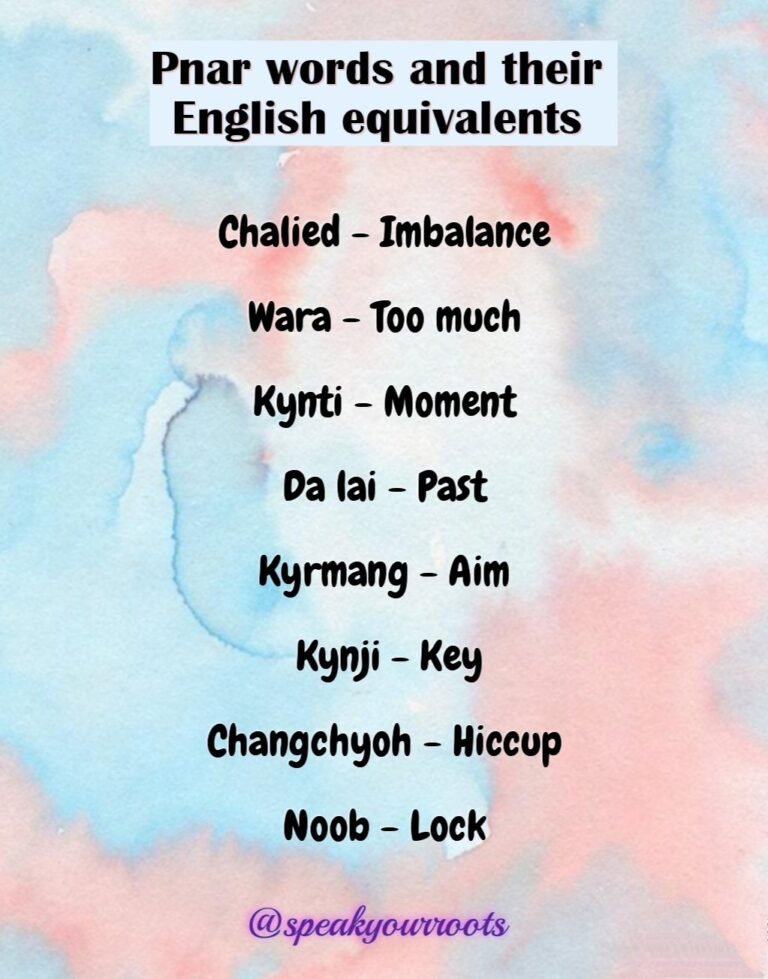
  • Pnar words and their English equivalents

    Kine ki dei ki kyntien Pnar kiba la phah da i @xdtnoahjupejackllthmanar 😄

    Khublei Chibōn wa phah phi ya kini ki kyntien Pnar, yow tip i wei yow nang i u pynemkam ha ka klam ktien Pnar. 🙏🙏

    Here are a few Pnar words and their English equivalents sent by @xdtnoahjupejackllthmanar

    🟡 Source: Pnar-English Dictionary by Sajeki Passah (2013)

    #pnarlanguage #pnarwords #pnarlanguageconservation #jaiñtiahills #jowai #indigenouslanguages #indigenouslanguageconservation #speakyourroots #speakyourrootschallenge #talklocal

  • United Nations Declaration on the Rights of Indigenous Peoples (UNDRIP) (Khasi translation)

    Sngewbha ñion ha ka link hapoh ba phin lah ban pule ïa KA DULIR UNITED NATIONS HALOR KA HOK KI TRAI MULUK-TRAI JAKA

    https://grassrootshillong.org/publications/

    Ïa ka United Nations Declaration on the Rights of Indigenous Peoples (UNDRIP), ngi dei ban tip bad ban pule bniah bha ïa ka. ✍️🤓

    Khublei Shibun Kong @joypathaw ba phi la phah ïa kane ka jingpynkylla sha ka Khasi lyngba ka sengbhalang @grassrootshillong . Ngi ai khublei bad kitbok kitrwiang ïa ki kam jong phi bad jong ka seng. 👏👏👏

    The United Nations Declaration on the Rights of Indigenous Peoples (UNDRIP) is a legally non-binding resolution passed by the United Nations in 2007. It delineates and defines the individual and collective rights of Indigenous peoples, including their ownership rights to cultural and ceremonial expression, identity, language, employment, health, education, and other issues. Their ownership also extends to the protection of their intellectual and cultural property. The Declaration "emphasizes the rights of Indigenous peoples to maintain and strengthen their own institutions, cultures and traditions, and to pursue their development in keeping with their own needs and aspirations." It "prohibits discrimination against indigenous peoples," and it "promotes their full and effective participation in all matters that concern them and their right to remain distinct and to pursue their own visions of economic and social development".

    The goal of the declaration is to encourage countries to work alongside indigenous peoples to solve global issues, such as development, multicultural democracy, and decentralization.

    On Thursday, September 13, 2007, the United Nations voted by a vast majority of 144 in favor (4 against, 11 abstained) of the Declaration.

    Source: https://en.m.wikipedia.org/wiki/Declaration_on_the_Rights_of_Indigenous_Peoples

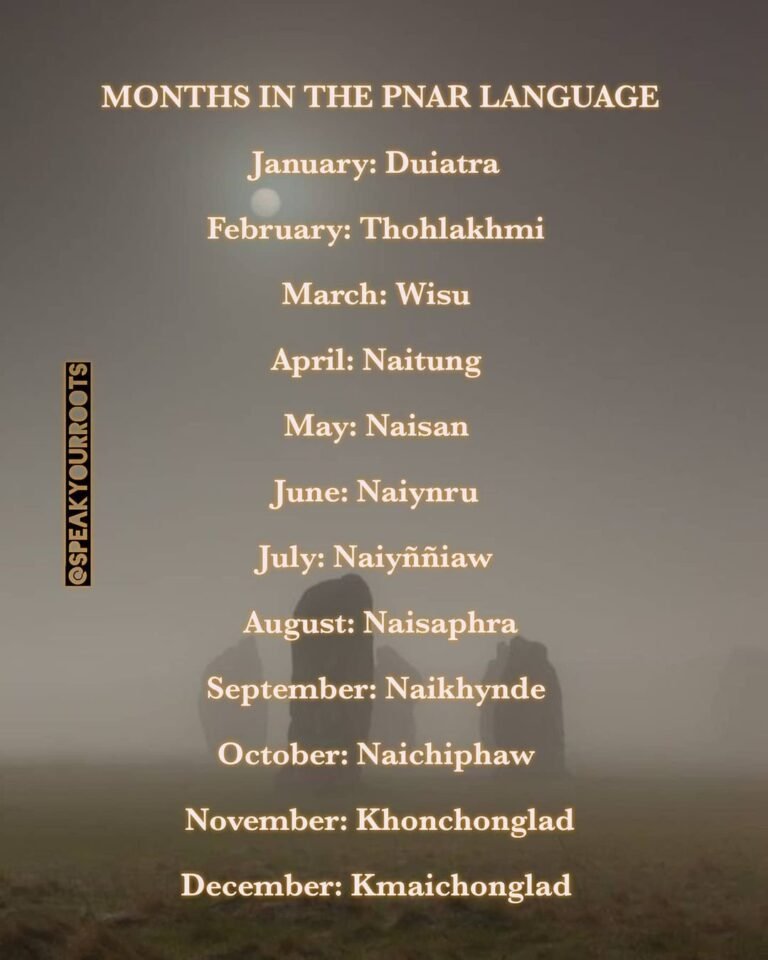
  • Months of the year in the Pnar language

    January: Duiatra

    February: Thohlakhmi

    March: Wisu

    April: Naitung

    May: Naisan

    June: Naiynru

    July: Naiyññiaw

    August: Naisaphra

    September: Naikhynde

    October: Naichiphaw

    November: Khonchonglad

    December: Kmaichonglad

    These are the months of the year in the Pnar language. 📆📆 The Pnar/ Jaiñtia language is mostly spoken in the Jaiñtia Hills District of Meghalaya.

  • “Peit Cheitai Cheitu” da Saweini Laloo

    Dang step dang step, chong u woh Ephrin

    Ha ka ben kawa rong soo

    Ka kot khubor ha kti beit, hajan

    Peit u cheitu, peit u cheitai

    Man da dep pure u

    Te chong u chi slem

    Peit u ia ki bru

    Wa lai cheitai cheitu

    Oh Papun o! Oh Papun o!

    Khana ia nga yi ioo phi cheitai?

    Ki jingmut u ioosar cha jngai

    Ham kylli jingkylli ware o ksu

    Peit cheitai, peit cheitu

    Wa lai ki kari wa ki bru

    Dang step, dang step, chong u woh wa ka ksu u

    Ha ka ben kawa rong blue

    Ka kot khubor ha kti ïong o

    Peit ki waroh arngut cheitai, cheitu.

    Original Pnar poem: "Peit Cheitai Cheitu" by @nini_sasa_23 😄😄 Thank you for the poem!

    This is a quaint and evocative poem about her "Papun" (grandfather) reading his newspaper in the veranda and then spending hours observing and ruminating on passersby and cars. 🌻🌻💞💞

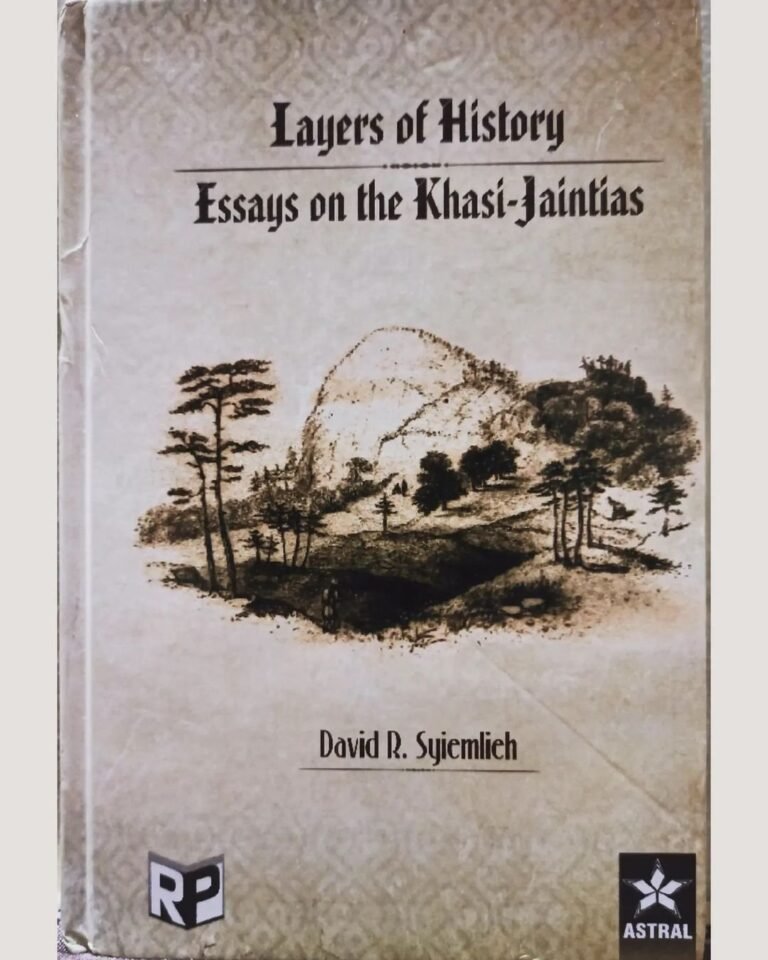
  • Layers of History: Essays on the Khasi-Jaintias by David R. Syiemlieh

    Layers of History: Essays on the Khasis-Jaiñtias (2015) by David R. Syiemlieh.

    David R. Syiemlieh is a retired Professor of History from North-Eastern Hill University, Shillong, Meghalaya. He has also served as the Chairman of the Union Public Service Commission of India.

    The seventeen essays in this collection relate to the Khasi-Jaiñtias of Meghalaya in North-East India and cover a time span from their pre-colonial past, through the colonial era and into more contemporary times.

    The book is published by Regency Publications and is available on amazon.in

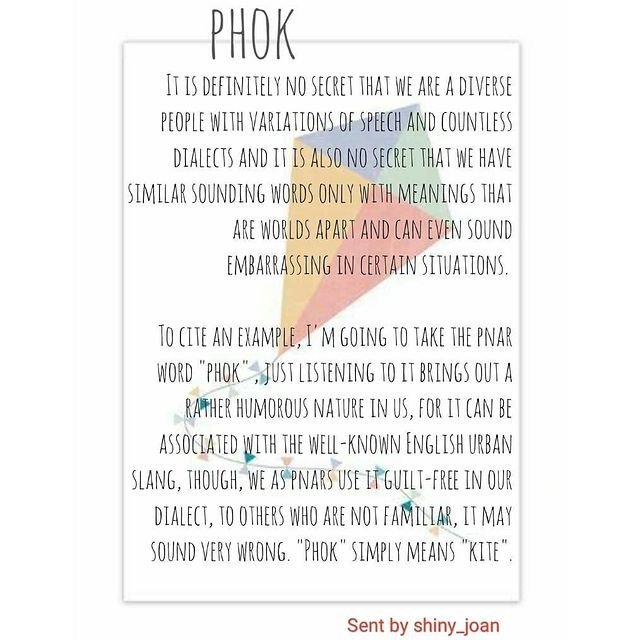
  • Phok

    It is definitely no secret that we are a diverse people with variations of speech and countless dialects and it is also no secret that we have similar sounding words only with meanings that are worlds apart and can even sound embarrassing in certain situations. To cite an example, I’m going to take the pnar word "Phok". Just listening to it brings out a rather humorous nature in us, for it can be associated with the well-known English urban slang, though, we as Pnars use it guilt-free in our dialect, to others who are not familiar, it may sound very wrong. '"Phok" simply means "kite”.

    The word "Phok" in the Pnar language means "Kite". Thank you @shiny_joan for sending this! 😄😄

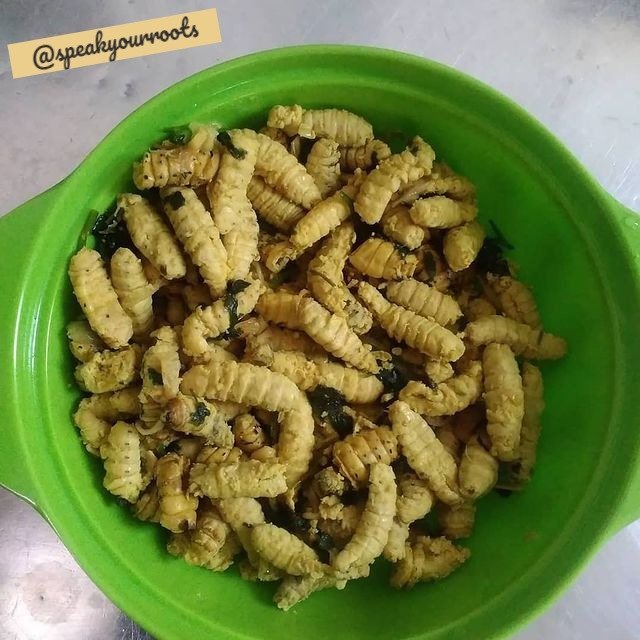
  • U ñiang ryndia

    "U ñiang ryndia" or the mulberry worm is a Jaiñtia delicacy that many might cringe to see. But for those who have the taste buds for it, u ñiang ryndia conjures a distinctive native feel.

    As a simple meal it can be boiled and then mixed with onion, ginger and salt.

    It can also be made into a more elaborate curry with onion, garlic, neiiong/ naiiong (black sesame/ black til), turmeric and then garnished with garlic leaves and coriander.

    U ñiang ryndia is available in the summer months!