Tag: khasialphabet

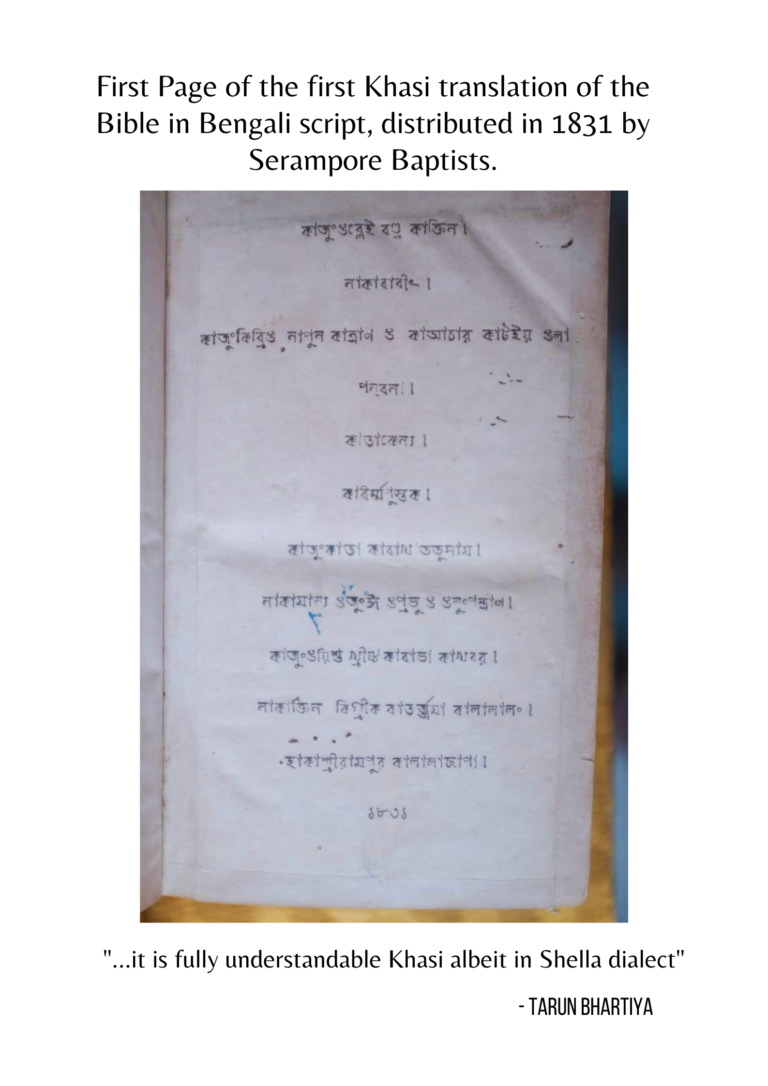
  • First Page of the first Khasi translation of the Bible in Bengali script, distributed in 1831 by Serampore Baptists.

    Thank you @tarunbhartiya for an informative and interesting contribution on the first Khasi translation of the Bible in the Bengali script! 🙏🙏 And what's more, there was a Khasi woman who helped William Carey in translating the Bible! 😃😃

    In @tarunbhartiya 's own words:

    "I so desperately want to know the name of the Khasi Lady – wife of the rajah/ chieftain who impressed Dr. William Carey with her intelligence and helped him translate the New Testament into Khasi. What was she doing in Calcutta/ Serampore in 1810s? How did she learn English? Was she literate (most probably yes)? Did William Carey talk to her about the Christian faith? Did she meet Krishna Pal who was planning to come to Pandua?"

    These and so many other questions arise when we read about the journey of the translations of the Bible into Khasi.

    You can read more in the following links:

    🟡https://theshillongtimes.com/2023/06/22/colonialism-and-mission/

    🟡https://www.placefortruth.org/blog/krishna-pal-the-first-baptist-convert-in-india

    🟡https://cherrapunjee.com/welsh-influence-in-cherrapunjee/

    🟡https://www.loc.gov/item/02014074/

    🟡https://books.google.co.in/books/about/Welsh_Missionaries_and_British_Imperiali.html?id=3JV6zQEACAAJ&redir_esc=y

    🟡https://books.google.co.in/books/about/The_History_of_the_Welsh_Calvinistic_Met.html?id=i6hGAQAAMAAJ&redir_esc=y

    🟡https://raiot.in/how-to-not-to-remember-thomas-jones/

    🟡https://raiot.in/was-thomas-jones-the-father-of-khasi-alphabet/

    🟡 Photographs are from the photographic project called "Unaddressed Picture Postcards from Khasi Jaintia Hills" by Tarun Bhartiya.

    https://indianexpress.com/article/lifestyle/art-and-culture/a-new-series-of-picture-postcards-explores-conversion-among-the-khasi-people-7575007/lite/

    #khasibible #khasitranslation #khasialphabet #williamcarey #thomasjones #khasichristian #khasihistory #speakyourroots #speakyourrootschallenge #talklocal

  • Ki laitylli ki daw ba u Rev. Thomas Jones u jied ïa ki dak Roman na ka bynta ka alphabet Khasi

    In writing the Khasi language, Thomas Jones chose the Roman scripts for three important reasons:

    (a) The difficulty of learning a hundred or more difficult sounds and signs when compared to the 22 letters A B C D E G NG H I J K L M N O P R S T U W Y.

    (b) The Bengali scripts used by the Serampore Mission in their translation of the New Testament, and by Alexander Lish for his readers, had not proved successful. He stated "after years of labour and much expense, not only among the Khasis is able to read a page of the books he used, or to understand a paragraph of some of the more simple sayings in the English language".

    (c) The Khasis generally "had a superstitious terror of Bengali letters, firmly believing that if they tried to form a letter that they would be struck by blindness…or suffer a fatal illness. The above reasons quelled all the doubts and misgivings of his critics in India and in Wales. (Cf. KAS Souvenir 150: p. 12).

    Ka jingthoh jong u William Pryse, u mishoneri jong ka Welsh mission ha Sylhet, i kumba ka pashat jingmut sha kawei pat ka daw, balei sha u Thomas Jones u mon ïa ki dak Roman. Ong u Pryse:

    The Roman characters have been adopted in preference to the Bengali characters, not from a conviction of the superior utility of the former, but simply because they were found already in use amongst the natives.

    Kum ban shu pynbud ïa ki jingkren bad ki jingpuson shaphang ka ktien Khasi bad ki alphabet Khasi, kane ka dei ka sla ba la sot na ka kot U Thomas Jones bad Ka Pyrthei Saitsohpen ba la thoh da i Babu S. S. Majaw. Ka long kaba sngew myntoi ban ïoh ki jingtip kum kine. Khublei Shibun @carey_lynz ba phi la phah ïa kane ka dur! 🙏🙏😃

    As a follow up to our conversations and thoughts about the Khasi language and the Khasi alphabet, here is a page from the book U Thomas Jones bad Ka Pyrthei Saitsohpen by S. S. Majaw. It is interesting and beneficial to know about all this.

  • Musings on Thomas Jones Day by Naomi C. Nonglait, Ph.D.

    I remember my father told me once that he used to write in the Bengali Script. I never understood why he had to write in a script of another language. By then I was learning to read and write in my own Khasi language. It was only years later that I understood this change.

    Rev. William Carey and Alexander Lish had used the Bengali Script for the Khasi Language. It was one of the most challenging and colossal task of their time. However, Thomas Jones felt the need to change the Bengali Script to the Roman Script. It was with much thought that he realised that most of the Khasis could not understand even a paragraph of translation. Since this was the case, he started with the Roman script to create the sounds of the Khasi language which was much less complex as compared to the Bengali Script.

    We have to be reminded here that what Thomas Jones had done in the past did not go without harsh criticism. He was criticised from many quarters especially from the officer-in-charge of the East India Company. The Khasis were also apprehensive and not happy with the change since they were used to the Bengali Script. It can also be understood that the Khasis had a lot of trading with the Bengalis, so maybe knowing the Bengali language and script was advantageous to them. However, this did not deter Thomas Jones to give up on his dream. There were others such as Dr. Duff, Jacob Tomlin and William Lewin (Majaw 38) who wholeheartedly supported him. This brought up many questions to my mind. One of them being how much support would we give to change? If it was not because of Thomas Jones' vision, the spoken word would not have gained the permanence given by ink and paper. Not that I am undermining the oral tradition, but because of the lack of storytellers and the dying art of storytelling, I realize that without the alphabet, I would not have been able to go back, to remember again those stories that intrigued me as a child.

    Source:

    • U Thomas Jones Bad Ka Pyrthei Saitsobpen by S. S. Majaw (2011)

    Suggested Reading:

    • Anne Jones (1812-1845) Ka Missionary Kynthei Kaba Nyngkong Ha Ri Khasi Jaintia by Dr. B. Ps. Toi

    • Welsh Missionaries and British Imperialism: The Empire of Clouds in North-East India by Andrew J. May (2012)

    Khublei Shibun @carey_lynzba phi la phah ïa ki jingpuson bad ki jingpule sani jong phi shaphang ka histori jong ki dak thoh Khasi kiba la pynmih da u Rev. Thomas Jones. 😄🙏

    Thank you @carey_lynz for sending your thoughts and research on the history of the Khasi alphabet established by Rev. Thomas Jones. 😄🙏

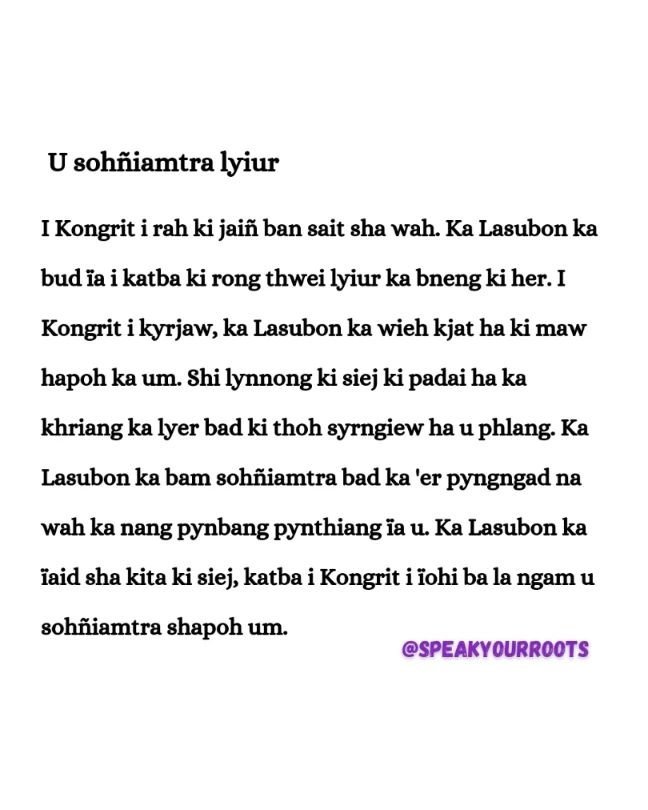
  • U Sohñiamtra Lyiur/ The Summer Orange

    I Kongrit i rah ki jaiñ ban sait sha wah. Ka Lasubon ka bud ïa i katba ki rong thwei lyiur ka bneng ki her. I Kongrit i kyrjaw, ka Lasubon ka wieh kjat ha ki maw hapoh ka um. Shi lynnong ki siej ki padai ha ka khriang ka lyer bad ki thoh syrngiew ha u phlang. Ka Lasubon ka bam sohñiamtra bad ka 'er pyngngad na wah ka nang pynbang pynthiang ïa u. Ka Lasubon ka ïaid sha kita ki siej, katba i Kongrit i ïohi ba la ngam u sohñiamtra shapoh um.

    Mynta ka sngi kaba dei ka 22 tarik u Jylliew, ka dei ka Thomas Jones Day. Ban kynmaw ïa ka jingwan jong ki dak thoh hapdeng jong ngi ki Khasi, la sah dak da ka jingïathuhkhana lyngkot.

    "U Sohñiamtra Lyiur" ka dei ka jingïathuhkhana lyngkot ne ka microfiction. Ki microfiction ki dei ki jingïathuhkhana kiba don 50-300 tylli ki kyntien. Kane ka jingïathuhkhana ka don 95 tylli ki kyntien.

    🟡 Sngewbha sa ïathuh ka mut aïu kane ka jingïathuhkhana ha ki comments! 😃😄 Phi sngewthuh kumno ïa ka?

    🟡 Kumno ngin pynkylla sha ka Khasi ïa ka kyntien "microfiction"? Ngi lah ban ong "ka jingïathuhkhana rit-ria"?

    Today the 21st of June is Thomas Jones Day. Thomas Jones was a Welsh Presbyterian missionary who established the Khasi alphabet. We commemorate the arrival of the written word in the Khasi community by posting a piece of microfiction.

    "U Sohñiamtra Lyiur" or "The Summer Orange" is microfiction of 95 words.

    🟡 Please tell us your interpretation of the story in the comments! 😃😄

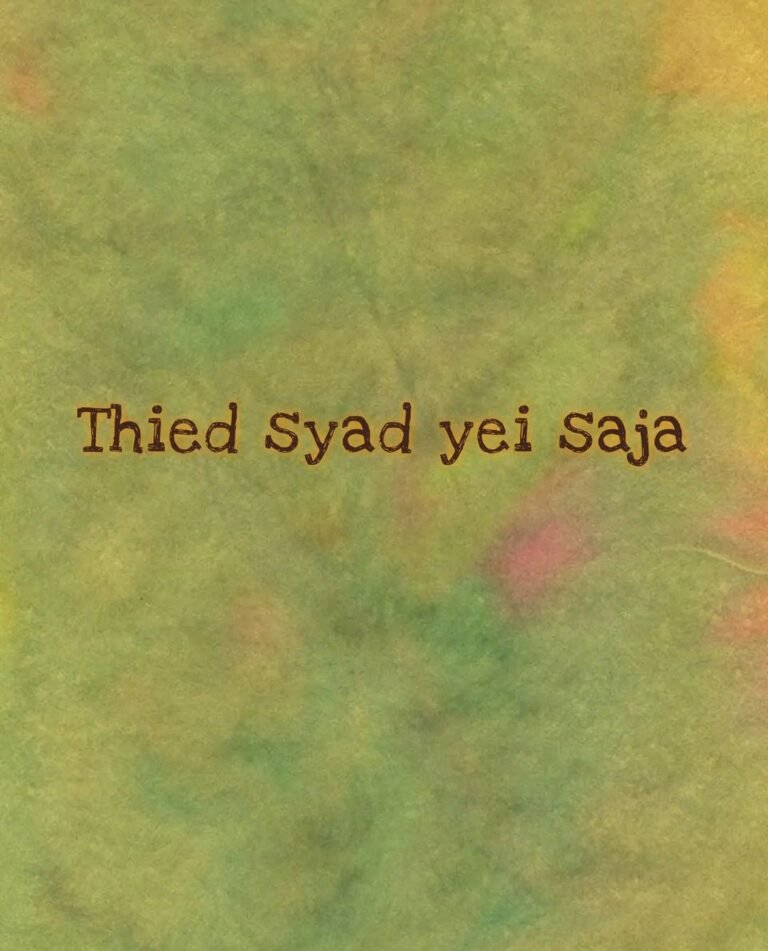
  • Thied Syad Yei Saja

    I oŋ "Thied syad yei saja" toh i kûntien pharchi wajōh sñau bha i na ki waheh, khamtam na ka Bei u Pa, hawa sneiñ wa krō ki ya ki khon. I mut yoŋ katai ka pharchi man i kamni ne, "Hawa leh iwon-iwon i wûm yahap wei rukom im, i wûm yōsuk ka yuŋ ka sem, i wûm bha, i wa bōh yei manbru ha i eh i khor, i wa datip chua, ne i wa yæ u wanrah yei ma hadien habōd".

    Kani ka kûntien, "Thied syad yei saja" hei sñauthōh yoŋ ŋa lailaŋ ko kam ka kûntein pharchi wa oŋ "Pan yei k'yoh, yoh dei hiaw" i wa mut hawa pan kwah, tæ daw wiar wei wa kwah. I jōh hi wa ka kûntien, "Thied syad yei saja" natlor wa da tip yei syad dor yoŋ i eh ne i saja wa yaŋ, katte leh chlur biej beit, khlem da pûrkhat chua u thied.

    Ban sngewthuh shuh shuh, Nga kwah ban batai da khasi, Haba Ong "Thied syad yei saja" ka mut ba "thied rem ïa ki jingjynjar". Balei ki rem ne syad, namar lah bun palat kita ki jingkynjar.

    Ka jingong "Thied syad yei saja" ka dei ka jingong Pnar kaba la pynkylla sha ka Khasi kum "Thied rem ïa ka saja" (ne ka jingjynjar). Kane ka jingong ka dei ka pharshi kaba mut kumne: Haba leh ïa kano kano ka bym sngew ïahap bad ka rukom im, ka bym sngewtynnat ha ïing ha sem, kaba pynpoi sha ka jingeh bad jingshitom, kaba la tip shuwa ba ka lah ban wanrah ïa ka jingma hadien habud.

    Ka "Thied rem ïa ka saja" ka long kum ka pharshi "Pan ïa ka jyrhoh, ïoh da ka sahiaw". Ka dei kumjuh ka jingmut ha kaba ka jingpankwah ka pynsohsat shisha ïa ngi. Ngi thied rem ïa ka jingjynjar nalor ba la tip ba kan eh ïa ngi ban shah ïa ka, tangba ka la ap lypa. Ngi long shlur beij khlem da pyrkhat ne thew ïa ka erïong erngit kaba la ap ïa ngi.

    The Pnar phrase "Thied syad yei saja" literally means "to buy expensive trouble". This phrase describes a situation where we do something that fits wrongly with our way of life, knowing that our family values go against it, knowing that it will lead to hardship and suffering in the future, but we readily do it.

    This is related to the word "pankwah" which is a combination of two words "pan" meaning ask and "kwah" meaning want. So we deliberately ask and want something that will bring pain and trouble. "Thied syad yei saja" implies a foolish courage that backfires. What the phrase may also be suggesting is a kind of self-sabotage that some of us may have experienced.

    The Pnar phrase "Thied syad yei saja" is loaded with deep meaning. It speaks of the complexity of human nature, riddled with strength and weakness. 💙❤️

    Khublei Chibōn @xdtnoahjupejackllthmanar for helping with this 😄🙏

    🟡 Khasi translation and English explication by @speakyourroots

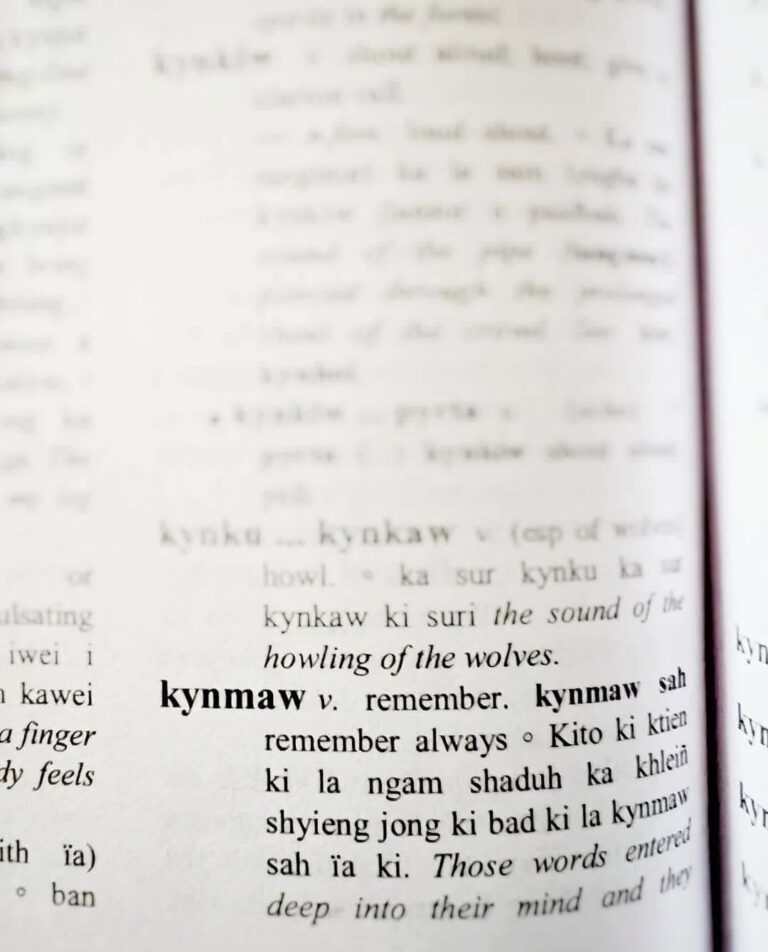
  • Kynmaw

    How do I explain the word? "Ka ktien".

    Say it. Out loud. Ka ktien. The first, a short, sharp thrust of air from the back of your throat. The second, a lift of the tongue and a delicate tangle of tip and teeth.

    For I mean not what's bound by paper. Once printed, the word is feeble and carries little power. It wrestles with ink and typography and margins, struggling to be what it was originally. Spoken. Unwritten, unrecorded. Old, they say, as the first fire. Free to roam the mountains, circle the heath, and fall as rain.

    We, who had no letters with which to etch our history, have married our words to music, to mantras, that we repeat until lines grow old and wither and fade away. Until they are forgotten and there is silence.

    How do I explain something untraceable? The perfect weapon for a crime. Light as pine dust. Echoing with alibis. Conjuring out of thin air, the ugly, the beautiful, the terrifying.

    Eventually, like all things, it is unfathomable. So, how do I explain?

    Perhaps it's best, as they did in the old days, to tell a story.

    ……………………….

    I was asked recently, what's your favourite word in Khasi? Usually, I find "favourite" questions very difficult–favourite book, song, movie. So many, I reply helplessly, it's impossible to pick just one. But not this time. It came to me easily, immediately, and while there are many delicious words in Khasi (rympei, the hearth; 'lap praw praw, rain on a tin roof), this one is closest to my heart.

    Kynmaw.

    To remember.

    And not merely because of its rich and resonant meaning, but also because of its etymology. For the longest time, the people of these hills nourished an oral culture–one replete with song and story–and while there were attempts to "give" the languages here a script (using the Bengali alphabet), it was the British missionaries who succeeded. In particular a missionary named Thomas Jones, who travelled to Sohra in 1841, at a time when conversion to Christianity was at its slow beginning. What would help was to disseminate the word of God through the Bible–except how to publish an edition in a scriptless language?

    Today, in Meghalaya, is Thomas Jones Day. And so we remember him. For his diligence and good deeds, of which there were many–how complicated are our colonial histories!–but I choose to remember also how the languages here, at heart, are languages of the wind, the

    mountains, and waterfalls and forests. How they once sprung from land and tongue and remained untethered to page and pen and ink.

    How did we remember? Through song and story, of course, and stone. We computed our histories through stone–choosing to raise monoliths to mark lives and events and relationships. And so even our word for remember-kynmaw–means to "carry like stone". Here, remembering is not taken lightly. It is borne on our backs like stone–unwavering even in the face of (colonial) beliefs that the oral is light and frivolous and inauthentic. The spoken is as much true as the written. When we have no preservatory documents, remembering, to kynmaw, becomes all the more pressing, more important. The spoken does not forget."

    Khublei Shibun @janicepariat for your beautiful and profound thoughts! 🤗❤️🙏

    The era of the spoken word and of Khasi orality is vast, moving in the many sunrises and sunsets of history. This history which is our heritage pleads to be preserved as we move forward.

    As it is the course of things, we were given the Khasi alphabet by Welsh missionary, Rev. Thomas Jones. The Khasi alphabet has brought us to another chapter in Khasi orality, as our stories, teachings and values are transcribed onto paper. Yet as Janice Pariat has asserted, ban kynmaw ka long kaba kongsan, ban kynmaw ka long kaba kumba ngi dei ban long, namar ïa ka ktien la thaw, la shon nyngkong ha ki jylliew ka pyrkhat ka pyrdaiñ; la thaw la shon ïa ka ktien ha ki tyllun u thylliej bad ka shyntur. Kumba ki ong ki longshuwa, ka ktien kaba tam. Ka ktien ka long kaba maïan, ka ktien ka long kaba nylla!

    📸 All photos are from @janicepariat 🙏

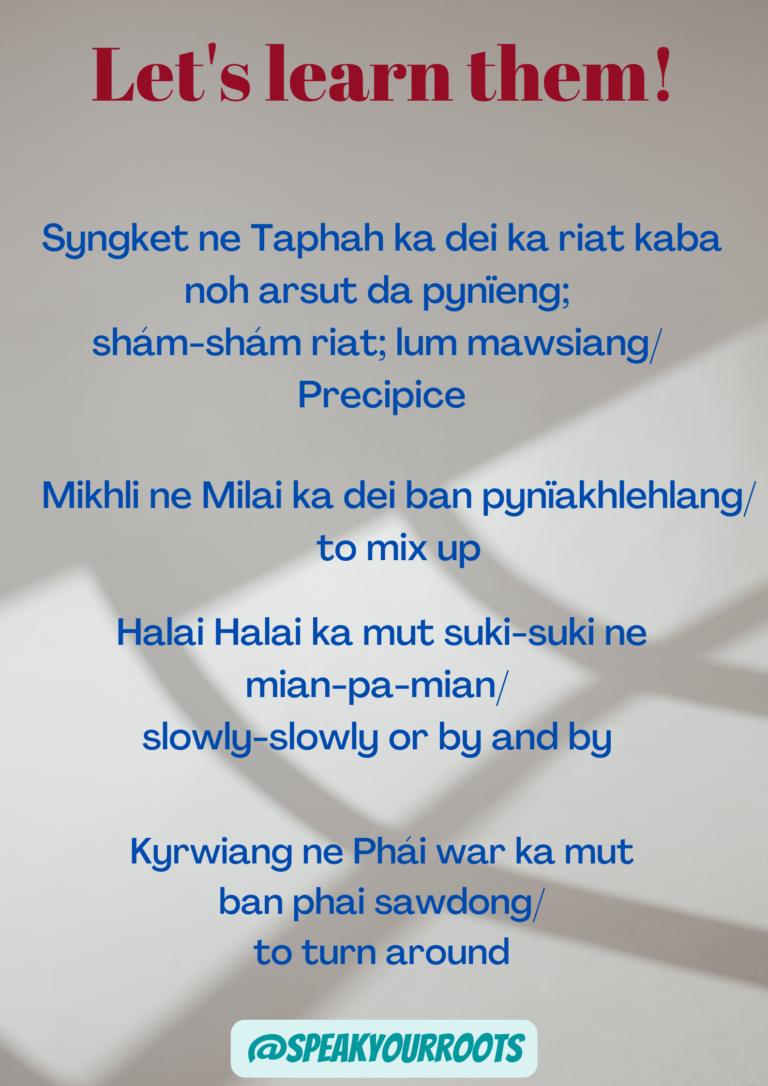
  • Lets learn them!

    Syngket ne Taphah ka dei ka riat kaba noh arsut da pynïeng; shám-shám riat; lum mawsiang/ Precipice

    Mikhli ne Milai ka dei ban pynïakhlehlang/ to mix up

    Halai Halai ka mut suki-suki ne mian-pa-mian/ slowly-slowly or by and by

    Kyrwiang ne Phái war ka mut ban phai sawdong/ to turn around

    Ngi hap ban ïa leh ban kren ne ban thoh da ki kyntien ki ban pynïar ïa ka ktien Khasi. Ki symboh kiba kynshew man ka sngi kin kyrbah ïa ka jingmut bad jingleh jong ngi 😄🙏

    Here are some Khasi words which we can try to use everyday. Grain collected everyday will sustain our thoughts and actions 🌾🌬️

  • To “G” or not to “🥚”

    😁😂🤡 To "G" or not to "🥚"

  • Literature and education among the Khasis: Excerpt from E. Weston Dkhar

    The following are two excerpts from the introduction of the book Primary Education in the Khasi and Jaiñtia Hills: Its Socio-Cultural Roots and Early History (1993) written by E. Weston Dkhar and published by Sevenhut S. Enterprise, Shillong.

    Regarding the education of the people we have but one traditional version explaining why the ancient Khasis failed to possess a written literature. According to tradition, the Khasis had a book or literature. While crossing the river to meet God for instruction in certain rites and duties, the man of the Plains or U Dkhar (as the Khasis generally call him), tied the book on the crown of his head, while the Khasis swallowed it to preserve it in his belly and that was the simple reason why he did not have a written literature. This version has close resemblance and similarity to the traditional version of the Tribes of Rwong and Lisu inhabiting the North-Eastern part of Indo-Burma, adjacent to the Red Chinese, who had long been isolated from the rest of the world by mountain barriers and thick forests. In explaining why they failed to possess a written literature, they too relate that long ago they had had in possession a book written on cow-hide; but it was eaten up by a hungry dog while an old man, the custodian, was drying it in the sun: and that explains why they failed to have any literature at all.

    Some writers assume that this entire absence of literature clearly suggest a long period of isolation from more civilized races. The statement in all probability holds little truth: for, the Khasis since time immemorial had intermingled with other civilized races of India either through commercial activities or political contacts. The absence is absolutely due to the fact that the Khasis believed wholeheartedly that it was just the same thing for him to have the book in his belly as in his hand. Moreover, our forefathers had a peculiar belief that "We Khasis are a special people: others must read to understand, while we have an infallible guidance from within.'' They went also to the extent that “We Khasis need no education, as we have 'Swallowed' all knowledge.”

    The Khasis had for a long long time acquainted themselves with the knowledge of many different branches of arts and sciences. with the handicap of not knowing about the art of writing and reading they yet marvellously advanced in the science of astronomy, medicine and metallurgy. Regarding astronomy, the Khasis of yore created a number of interesting stories about the stars and heavenly bodies like the sun and the moon. The story of the Sun and Moon and their subjugation to periodical eclipse, is one of the most interesting. Naming of some stars was also attempted at, for example, U Lur Mangkara – Pole Star, U Lur Step – Morning star, U Lurdihduma – Comet, U Lur Ruhsyiar – The Great Bear, Ka Lynti Phan – Milky Way, U Lur Tynriew – Little Bear etc. Sometimes they forecast the weather with the help of some stars as their barometer. In the field of medicine they discovered many wild herbs and natural substances which cured many kind of diseases. Besides, they knew the art of weaving and spinning, and the art of erecting monuments, monoliths, memorial stones and cromlechs.

    Since time immemorial the Khasis were highly advanced in monographic literature. One can witness the monographic pictures on the rock at Dainthlen Falls where the Khasis are believed to have killed a huge demoniac python long time ago which had created a great havoc in the history of the Khasi race. At the Durbar (Assembly) at Synrang Jyrteh, believed to be the meeting place of, many nations and nationalities, it was decided to cut the python into pieces and each one would eat his allotted share of the python's flesh so that the creature instantly died according to an oracle. To celebrate the victory they carved on the rock pictures of that grand occasion, which remains intact even today.

    Continuing with the story of how the Khasis lost their script, here are excerpts from the introduction of the book Primary Education in the Khasi and Jaiñtia Hills: Its Socio-Cultural Roots and Early History (1993) written by E. Weston Dkhar and published by Sevenhut S. Enterprise, Shillong.

    The excerpts discusses the significance of the story of the lost script and the innate knowledge and wisdom of the Khasis, with monographic pictures appearing on the rock at Daiñ Thlen Falls, Sohra.

    E. Weston Dkhar is a prolific author of several books focussing on Khasi folklore and history.

  • Nga Kynmaw/ I Remember

    That is why the Khasi stories always begin with "When man and beasts and stones and trees spoke as one…." This shows the Khasi world view, that sees the universe as a cosmic whole that receives its animation and force from the one living truth, their God, U Blei.

    Around the Hearth, Kynpham Sing Nongkynrih

    They say that long before the written word arrived in the mystical hill state of Meghalaya in Northeast India, an ancestor lost the manuscript that contained the religious and philosophical scripts of the Khasis as dictated by God. Descending from the great summit after meeting God, the ancestor came across a raging and turbulent river. He clenched the manuscript between his teeth as he tried to swim, but being from the hills, he was not adroit at swimming such torrid waters. He bobbled midstream and the manuscript was reduced to mush, which he swallowed. He managed somehow to return home empty-handed, and recounted his plight to his clansmen, assuring them that he could still recite God's word to them. The clans convened a council of members where the ancestor instructed them on the laws and teachings of God. It was from here, they say again, that the Khasi traditions of storytelling originated. Bah Kynpham Sing Nongkynrih's Around the Hearth: Khasi Legends brings alive the history and traditions of Khasi storytelling. The Khasis developed a script only as recently as 1842, thanks to Welsh missionary Thomas Jones. Their language and tradition of oral storytelling, though, has survived for centuries among a people of soft yet strong disposition who believe supremely in the symbiotic relationship between nature and man. Who live in the shelter of clouds above pine trees, lush green mountains, and share songs and poetry warmly around the fires of their hearth.

    "Nga Kynmaw/ I Remember" sent by Randeep Baruah @rondeview_ 💭🗯️💬Thank you Sir for this valuable reminder on the oral tradition of the Khasis! 🙏🙏

    Taking his inspiration from Around the Hearth: Khasi Legends (Folktales of India)(2007) written by Kynpham Sing Nongkynrih, Randeep talks about the story of the lost of script of the Khasis that he recounts from Nongkynrih's book. It is a story that cements the power of story-telling and the art and truth contained in the oral tradition. May the words we speak echo the spirit of our forefathers, who with a wisdom of the ages laid down the roots of our intrinsic bond with nature.

    Randeep Baruah is a writer and communications designer.

    Picture credit: @rondeview_