Tag: khasiclans

  • U ‘Suidnia

    U 'Suidnia u dei u Kñi rangbah jong kano kano ka kur uba leit nyngkong eh sha ka Mawbah (maw buh shyieng jong kano kano ka kur) bad uba sumar sukher ïa kiba haïing hasem, ki para ki pyrsa kiba la ïap.

    U Sib Charan Roy, u pyndonkam da ka ktien "U 'Saidnia" bad u ong ba u 'Saidnia u dei u Kñi nyngkong, uba dei u khun ka Ïawbei. U ïoh ïa ka nam "'Saidnia" ba u dei uba nang ban ïasaid, uba donbor bad don hok ban ïasaid hakhmat U Blei bad ka Hukum na ka bynta la ka kur ka jait. Kane ka jingbatai jong u Sib Charan Roy, ka pyni ba man la ka kur ka don la u jong u jong U 'Saidnia. Kaba donkam ban tip ka long ba u Sib Charan Roy u khlem pynshai lada u " 'Saidnia" u dei uba dang im ne uba la bam kwai ha dwar u Blei.

    Hynrei u Homiwell Lyngdoh pat u da ong shai ba ïa u Kñi nyngkong jong kano kano ka kur ka jait, ynda u la ïap na kane ka pyrthei, ki khot ïa u, "U 'Suidnia". Ka niam ka rukom ki Khasi ka kham ïadei bad ka jingbatai jong u Homiwell Lyngdoh. Ym ju ïohsngew ba ïa u kñi ba dang im, ba dang korbar ïa ka kam kur ban khot "U 'Suidnia". Pynban ki ju khot u Kñi-rangbah. Nalor kata katba tip, ym ju don "Suidnia" palat na uwei, katba ki kñi pat ki bun.

    "U 'Suidnia is the spirit of the first grand maternal uncle of a clan whose remains are the first to be kept in "Mawbah", which is a megalithic chamber tomb or dolmen of a clan. "U 'Suidnia watches over his relatives, nephews and nieces who have passed away.

    Sib Charan Roy uses the word "U 'Saidnia" saying that "U 'Saidnia" is the spirit of the first grand maternal uncle of a clan, who is the son of "Ka Ïawbei". "U 'Saidnia possesses the ability to intercede, has authority and also possesses the right to intercede with God and the divine commandment on behalf of his clan. This explanation by Roy shows that each clan has its own "U 'Saidnia". What should be noted is that Roy does not clarify whether "U 'Saidnia" has passed away or not, or as Khasis say "to eat betel nut at the door of God".

    However, Homiwell Lyngdoh says clearly that when the first grand maternal uncle of a clan has passed away, he comes to be known as "U' Suidnia". The indigenous faith of the Khasis is more in tune with the explication of Homiwell Lyngdoh. It is not usually heard that a living

    maternal uncle who is in charge of the clan's affairs be called "U 'Suidnia". Instead they are called "Kñi rangbah" or the head maternal uncle. Besides this, as is known, there can be only one man who receives the title of "U 'Suidnia" while maternal uncles are many.

    "Ka Ïawbei", "U Thawlang" bad "U 'Suidnia" ki dei lai ngut ki longshuwa manshuwa jong ki kur kiba bun na ngi ngim tip ki dei mano. Kine ki ai ha ngi ïa ka jingtip shaphang ka kur ka jait bad ka jinghiarpateng kaba ngi kum ki Khasi ngi kheiñ kordor bha. 👪🧑‍🤝‍🧑👬

    "Ka Ïawbei", "U Thawlang" and "U 'Suidnia" are three ancestors of clans, of whom many of us are unable to trace in our family trees. These individuals give us significant knowledge of our clans and lineage, which Khasis hold as critically valuable. 👪🧑‍🤝‍🧑👬

    🟡 Sources: Rev. Ïarington Kharkongor and Philomena Kharakor RNDM
    🟡 Collated and translated by @speakyourroots
  • “Ka Um Bad Ki Deiriti Ha Ka Meirisawkun” (Water and Culture In the Environment) (Volume II, 2008)

    Ïa kine la sot na ka lynnong "Ka Um bad Ka Tynrai ki Kyrteng Kur" (Water and Origin Of Clan Names) na ka kot Ka Um bad ki Deiriti ha ka Meirisawkun by Dondor Giri Nongkhlaw (2008):

    Katkum u Spiton Kharakor (1981) ha ka kot jong u "Ki Khun ki Ksiew a Hynñiewtrep" la shem ba don ki kur ba la ïoh kyrteng na ka um, ka wah, ka myn bad ka am.

    Ki kur ba la sdang da ka 'um' na khmat ki don khadlai kur bad kine ki long ka kur Umbah, Umblah, Umdong, Umdoh, Umdor, Umdung, Umyiap, Umladkur, Umlong, Umsong, Umsohbar, Umthlu bad Umwai.

    Ki kur ba la sdang da ka ktien 'wah' ki don khaddar kur bad kine ki long ka kur Wahksi, Wahksing, Wahlang, Wahlang mawleiñ, Wahlang pahsyntiew, Wahlang ryntathiang, Wahrait, Wahrih, Wahrit, Wahshah, Wahshrieh bad Wahspeh.

    Ki kur ba la sang da ka 'am' na khmat ki don shiphew kur bad kine ki long ka kur Amkhlaw, Amkhlow, Amksang, Amkoi, Amded, Amdep, Amora, Amse bad Amwai.

    Nangta sa ki kur ba sang da ka 'myn' ki don jin haduh arphew hynñiew kur bad kine ki long ka kur Mynbah, Mynbon, Mynkseh, Mynieng, Mynjar, Mynnar, Myniar, Mynrap, Mynriang, Mynrieng, Mynriem, Mynring, Mynsang, Mynskut, Mynsni, Mynso, Mynso-shangpung, Mynsong, Myntdu, Mynteng, Mynthang, Mynthliang, Mynthlong, Mynthlu, Mynthong, Mynthui bad Myntlang.

    Ban sngewthuh ïa kane ka jingïasnoh ka kyrteng kur bad ki jnit ka mariang bad ruh bad ki deiriti ngin ïa shim tang kawei ar tylli ki kur kum ka nuksa.Tharai, lada ngi shim da ka kur Amkhlaw, Umyiap, Wahksing bad Mynthlong ka biang ban ïa batai bad pyni nia.

    Kat kum ka tyllong kyntien ka kur Amkhlaw ka long ka kyntien ba la oh na ka 'am' bad 'khlaw'. Kane ka pyni ba ka kur ka don jingïadei bad ka um bad ka khlaw. Baroh ar, ka um ne am bad khlaw, ki dei ki jnit ka meirisawkun, kaba mut, lehse, ba ka kur Amkhlaw ka long ka kur kaba la buhai nyngkong ha ka jaka ba jan ka um bad ka khlaw.

    Ka kur Umyiap, katkum ka tyllong kyntien, ka thew ka um bad u shyiap kiba baroh ar ki long ki jnit ka meirisawkun, ha kaba lah ban long ba kine ki kur ki la buhai nyngkong ha ki jaka ba don ka um bad u shyiap.

    Nangta, ka kur Wahksing, katkum ka tyllong kyntien, ka long ka kur ba la ïoh kyrteng na ka wah bad ka ksing. Hangne, ka wah ka long ka jnit jong ka meirisawkun, katba ksing pat ka dei ka bynta jong ka deiriti. Kumta kane ka kur ka la oh kyrteng kur na ka wah bad ka ksing. Hangne ksing ka thew ïa ka deiriti put deiriti tem.

    Nangta ka kur Mynthlong, ka pyni ba ka kur ka long kaba pyndonkam um, kaba pyndonkam thlong ruh. Hangne thlong ka thew ïa ka deiriti dung kum ka dung kba, dungnei, dungsoh bad ter ter. Namarkata ngi donkam ban nang ïaleh ban wad ban thud ïa ki kyrteng, ïa ki jingmut bad thymmei ki kyrteng kur.

    The following is taken from the chapter entitled "Ka Um bad ka Tynrai Ki Kyrteng Kur" (Water and Origin of Clan Names) from the book Ka Um bad ki Deiriti ha ka Meirisawkun by Donor Giri Nongkhlaw (2008).

    Nongkhlaw cites Spiton Kharakor (1981) from his book Ki Khun Ki Ksiew u Hynñiewtrep where he discusses how some clans received their names from the words "um", "wah", "myn" bad "am".

    The clan names that start with the word "um" are 13 in number and some of them are Umbah, Umsong, Umyiap and Umthlu.

    The clan names that start with the word "wah" are 12 in number and some of them are Wahlang, Wahrait, Wahshrieh and Wahksing.

    The clan names that start with the word "am" are 10 in number and some of them are Amkhlaw, Amkoi, Amdep and Amksang.

    Finally, the clan names that start with the word "myn" are 27 in number and some of them are Mynring, Mynsong, Mynrieng and Mynthlong.

    To understand the connection between the clan name and the elements of nature, Nongkhlaw looks at four clans to discuss this.

    The clan name Amkhlaw comes from the words "am" and "khlaw". This shows that this clan must have settled near "um" or "am" which is water and "khlaw" which is forest.

    The clan name Umyiap refers to "um" that is water and "shyiap" which is sand. This shows that the clan must have settled in a place which has water and sand.

    The clan name Wahksing comes from the words "wah" which means river and "ksing" which means drum. "Wah" is connected to the environment and "ksing" is related to the tradition of music.

    Finally, the clan name Mynthlong comes from the words "myn" which is connected to the use of water and "thlong" which is the traditional mortar for pounding and grinding used by the Khasis. The mortar is a symbol for the traditions of pounding rice, sesame seeds, fruits and others.

    Ka Um Bad Ki Deiriti Ha Ka Meirisawkun (Water and Culture On the Environment)(Volume II, 2008) by Dondor Giri Nongkhlaw is such an interesting book with great information on the intrinsic value of water and the environment to Khasis! 🌅🌅

    🟡 English translation by @speakyourroots

  • The Khasi State Formation (Mario Pathaw)

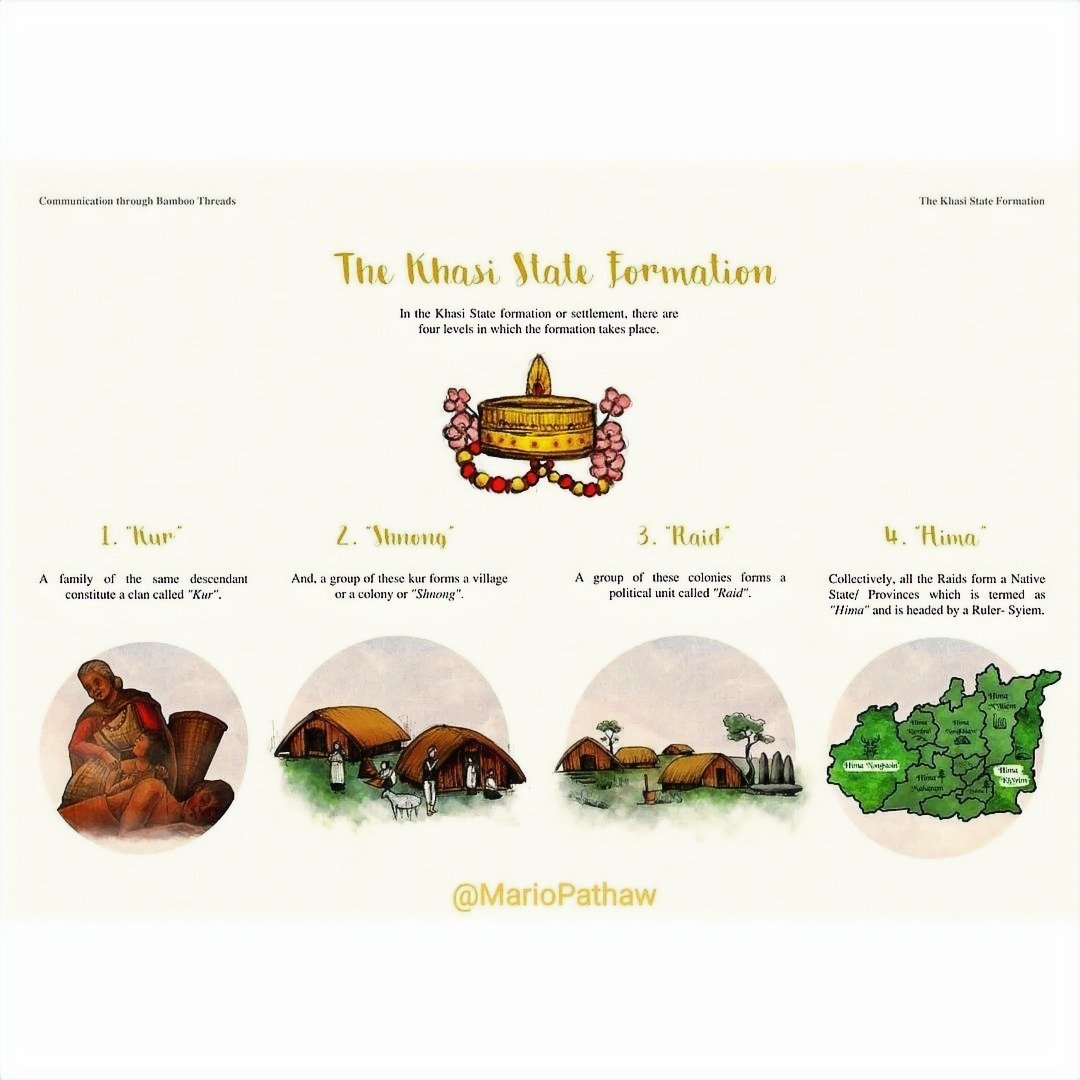
    The Khasi State Formation

    In the Khasi State formation or settlement, there are four levels in which the formation takes place

    1. Kur: A family of the same descendant constitutes a clan called "Kur"

    2. Shnong: A group of these kur forms a village or a colony or "Shnong"

    3. Raid: A group of these colonies forms a political unit called "Raid"

    4. Hima: Collectively, all the Raids form a Native State/Provinces which is termed as "Hima" and is headed by a Ruler-Syiem

    Kur – Ka kur ka dei ka jingïadei jong ka doh ka snam, ha kaba ïa kane ka jingïadei la kheiñ na ka liang jong ka kmie da ka jingai ïa kajuh ka jait. Ka kur ka bat bad tehsong ïa ki longïing longsem.

    Shnong – Ka shnong ka dei ka jaka kaba kynthup ïa ki katto katne tylli ki ïing.

    Raid – Ka raid ka kynthup ïa ki shnong kiba hap hapoh ka jingkhmih jong uwei u nongsynshar.

    Hima – Ka hima ka kynthup ïa baroh ki raid kiba don lang ha ka shi jaka.

    "Ka kur" comprises of a Khasi clan which determines lineage, and whose clan name is taken from the female relatives.

    "The Khasi State Formation" is an art piece by @mario_pathaw 😃😃 It explains from the beginning how the Khasi polity is created.

    Khublei Shibun @mario_pathaw for this beautiful illustration! 🙏🙏🌲🌲

    🟡 Please zoom in to read