Tag: khasioraltradition

  • Musings on Thomas Jones Day by Naomi C. Nonglait, Ph.D.

    I remember my father told me once that he used to write in the Bengali Script. I never understood why he had to write in a script of another language. By then I was learning to read and write in my own Khasi language. It was only years later that I understood this change.

    Rev. William Carey and Alexander Lish had used the Bengali Script for the Khasi Language. It was one of the most challenging and colossal task of their time. However, Thomas Jones felt the need to change the Bengali Script to the Roman Script. It was with much thought that he realised that most of the Khasis could not understand even a paragraph of translation. Since this was the case, he started with the Roman script to create the sounds of the Khasi language which was much less complex as compared to the Bengali Script.

    We have to be reminded here that what Thomas Jones had done in the past did not go without harsh criticism. He was criticised from many quarters especially from the officer-in-charge of the East India Company. The Khasis were also apprehensive and not happy with the change since they were used to the Bengali Script. It can also be understood that the Khasis had a lot of trading with the Bengalis, so maybe knowing the Bengali language and script was advantageous to them. However, this did not deter Thomas Jones to give up on his dream. There were others such as Dr. Duff, Jacob Tomlin and William Lewin (Majaw 38) who wholeheartedly supported him. This brought up many questions to my mind. One of them being how much support would we give to change? If it was not because of Thomas Jones' vision, the spoken word would not have gained the permanence given by ink and paper. Not that I am undermining the oral tradition, but because of the lack of storytellers and the dying art of storytelling, I realize that without the alphabet, I would not have been able to go back, to remember again those stories that intrigued me as a child.

    Source:

    • U Thomas Jones Bad Ka Pyrthei Saitsobpen by S. S. Majaw (2011)

    Suggested Reading:

    • Anne Jones (1812-1845) Ka Missionary Kynthei Kaba Nyngkong Ha Ri Khasi Jaintia by Dr. B. Ps. Toi

    • Welsh Missionaries and British Imperialism: The Empire of Clouds in North-East India by Andrew J. May (2012)

    Khublei Shibun @carey_lynzba phi la phah ïa ki jingpuson bad ki jingpule sani jong phi shaphang ka histori jong ki dak thoh Khasi kiba la pynmih da u Rev. Thomas Jones. 😄🙏

    Thank you @carey_lynz for sending your thoughts and research on the history of the Khasi alphabet established by Rev. Thomas Jones. 😄🙏

  • Different kinds of stories

    On the 27th of September 2021, a question was asked about the difference between Khanatang, Puriskam-Purinam and other forms of Khasi stories.

    These are the responses:

    Folktales are Ki Khanaparom

    Myths are Ki Khanatang

    Legends are Ki Khanapateng

    Fairytales and Fables are Ki Puriskam-Purinam

    It may be noted that these may have different names in different dialects.

    Understanding our oral tradition requires that we understand the different types of stories that our forefathers put forth, to articulate a history and a culture. 🌲🌾🍂

    Khublei Shibun @lieng_makaw and @lurstepkharlyngz for your responses! 🙏🙏

    If anyone wants to add more, please feel free to mention them in the comments section.

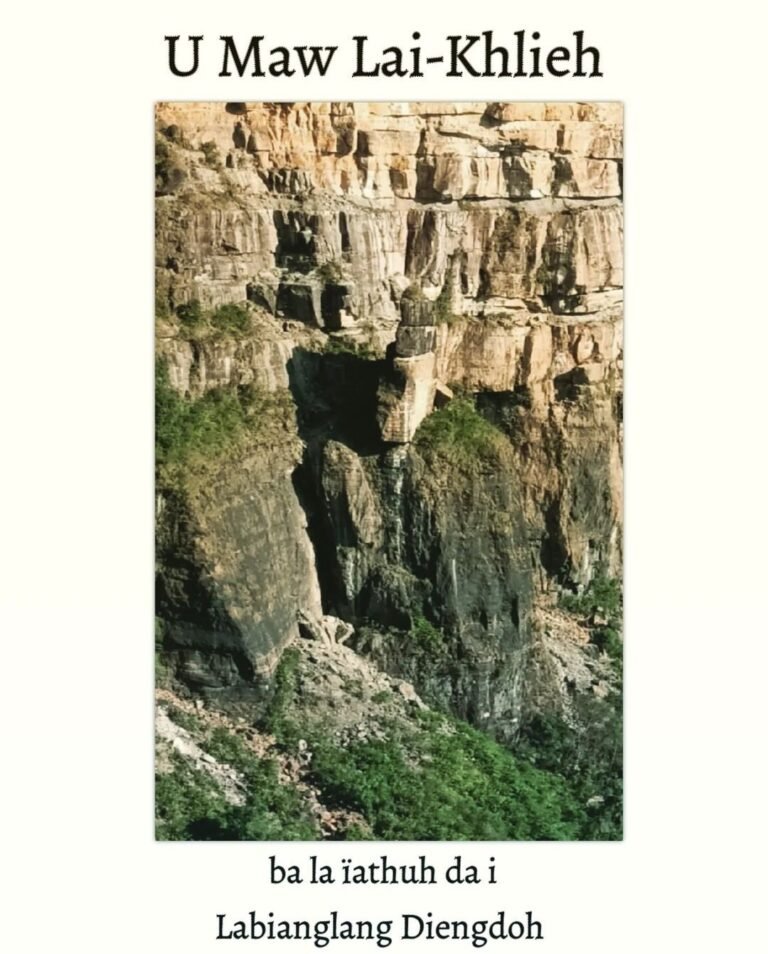
  • U Maw Lai-Khlieh told by Labianglang Diengdoh

    U Maw Lai-Khlieh

    ba la ïathuh da i

    Labianglang Diengdoh

    Mynba dang lung ka sngi u bai, ha ka por ba ki briew ki dang hok, dang shida, la don kawei ka shnong kaba paw nam ha ka akor ba bha bad ha ka jingjur u slap. Ym tang ha ka akor, ka burom hynrei na ka ruh la mih bun ki simpah, ki simsong, ki kaitor, ki myllung, ki mawbynna. Ka don ruh ha ka shibun ki puriskam, ki purinam, ki khanatang ki ba dang iai kynud haduh mynta mynne ha ki lum-ki wah, ki khlaw-ki btap kum ka Noh-Ka Likai, U Khoh Ramhah bad kumta ter-ter. Kata ka shnong kaba don am kadei ka Shnong Sobra. Napdeng kine ki khana kiba lah paw, lah bna hapdeng jong ngi u khun Khasi-khara bad kiwei de ki jaitbynriew, dang don kiwei pat ki khana ki ba don ha lyndet jong ki ia ka jingjia ba sngew triem bad ba sngew ngiew ban sngap. Ka wei napdeng kita ki khana kaba ngi la iohsngew pateng kadei shaphang U Maw-Lai Khlieh.

    U 'Maw-Lai Khlieh', u dei u wei na ki maw u ba don ha shiteng jong ka 'Riat-Mawiew' kaba don ha shnong Sohra. Ia une u maw ngi lah ban iohi narud surok, na u lum jngoh kulai lane u lum jingkhmih kulai. Lah ban iohi ruh na ka 'law-kyntang jong ka Hima Syiem Sohra (Madan Shad Seng-Khasi). Katkum ka jingiathuh jong ki longkpa-longkni, ki tymmen hyndai, ba ha uta u Maw-Lai Khlieh la don u Paia Ksiar bad u don la ka pharshi sha lyndet jong u.

    Ha ka por ba ki phareng ki dang synshar ia ka ri jong ngi baroh kawei, la ong ba ha kawei ka sngi, ar ngut ki shipai phareng ki la leit ban iaid kai pyngngad sha kata ka Riat Mawiew ban leit jngoh kai ia uta u maw. Hadien ba ki la poi ha kata ka jaka bad haba ki dang jngoh ban peit kai ia uta u Maw-Lai Khlieh, uwei u shipai u la iohi ba don ka jingthaba bapher na uta u maw. Kata ka jingthaba ka la kthik ia ka mynsiem jong u ban kwah ban hiar bad ban peit ba kadei kaei kata ka jingthaba. Kumta, khlem da artatien bad khlem da sngap ia ka jingkhang jong uta uwei pat u shipai, u la hiar bad u khlem da wan phai shuh. Uta u paralok jong u, haba u lah iohi ba um shim la wan phai shuh u lah her bran-bran ban leit iathuh sha ka sorkar phareng ia kaei kaba la jia.

    Ka Sorkar phareng marsien tip ia kata ka jingjia, ka la phah wad bniah ia kaei kata ka jingthaba kaba mih na uta u maw. Ka la phah ia ki briew jong ka ba kin wad bad kylli na ki trai shnong shaphang uta u maw. Ynda ki la ioh jingtip ba ha uta u maw la don uta u Paia Ksiar, mar-mar khlem pynslem ia ka por ka la phah sa ia lai ngut ki shipai ban hiar bad ka da kyntu ruh ba kin da tih dyngkhong ia uta u Paia Ksiar. Kumta, kita ki phareng ki la hiar bad marsynpoi ha uta u maw, la wan mih uwei u bsein uba don lai tylli ki khlieh bad u ta u bsein u la bam ia arngut kita ki shipai phareng. U ta u shipai u ba la lait phet im, u la kiew pynsted shalor bad u la phet ban leit iathuh ia kaei kaba la jia bad iohi.

    Ka Sorkar Phareng, hadien jong kata ka jingjia, ka la wad da ka buit-ka bor ba kumno kan ioh ban pyniap ia uta u bsein. Kumta ka la phah pynap da ka sapoh, ka kyiad, u buiam, da kaba pyrkhat ba uta u bsein un bam, un buaid bad ba kin iohi ban pyniap ia u da ka basuk. Ha ka step kaba bud ynda ki shipai ki la hiar ban leit ban pyniap ia uta u bsein, ki la lyngngoh ngain hadien ba ki iohi ba ka bam ka dih ka lah lut hynrei kim shim la lap satia ia u bsein. Kita ki shipai phareng ki la pyrkhat ba uta u bsein u la iap bad kumta ki la sdang ban tih ia uta u Paia Ksiar. Katba ki dang tih kynsan-kynsan uta u bsein u la mih biang bad u la bam duh noh syndon ia ki.

    Ka Sorkar Phareng haba ka lah ioh jingtip ia kata ka jingjia, sa shisien ka la kyntu biang ia ki briew jong ka ba kin wad jingtip na ki trai shnong da kumno pat ban ioh lad ban pyniap ia uta u bsein u ba don lai tylli ki khlieh. Ka Sorkar Phareng hadien ka jingwad bniah ka ba jur ka la ioh jingtip ba uta u dei u 'lei lum uba ju wan ha ka dur jong u bsein ban iada ia ka jingsniew ne ka jingshah pynjulor jong uta u Paia Ksiar namar wei ba la tih ia uta u Paia Ksiar, uta u Maw-Lai Khlieh ruh yn twa yn kyllon bad ka pyrthei ruh kan sa wai. Kumta ka sorkar Phareng kam banse bad shu ieh shrah noh ia ka jingkwah rhah jong ka ia uta u Paia Ksiar.

    Kumta, kane khana ka shu sahkut noh tang hangne bad haduh mynta mynne dang don ki ba dang ngeit ba uta u Paia Ksiar u dang neh haduh mynta lem bad uta u bsein u ba ker ba da ia u, ha uta u Maw-Lai Khlieh.

    When the sun and the moon were still young and when mankind was honest and simple in his ways, there was a town which was well-known for its refined manners and also for the heavy rain which fell there. There also arose from this town musicians, artists, poets and individuals of integrity. The town possessed an array of legends, folktales and myths which continue to echo in its rivers and streams, in its forests and groves like Ka Nohkalikai and U Khoh Ramhah and others. This well-known town is the town of Sohra. From these stories of the Khasi community which tell of gruesome events which have been heard, there are other stories terrifying to listen to. One of these stories is the story about U Maw-Lai Khlieh or the three headed stone.

    U Maw-Lai Khlieh is a boulder which stands midway on Ka Riat Mawiew which is a gorge in Sohra. One can see the boulder from a hill called U Lum Jngoh Kulai or Lum Jingkhmih Kulai. This boulder can also be seen from the sacred grove of Ka Hima Syiem Sohra (Madan Shad Seng Khasi). According to what has been told by forefathers and elders there was U Paia Ksiar or a golden pillar in U Maw Lai-Khlieh and there is a fable behind it too. When the Khasi Hills were ruled by the British, it is said that one day when two English soldiers went for a relaxing walk to Ka Riat Mawiew in order to see U Maw Lai-Khlieh, one of the soldiers noticed something like a glitter coming from the boulder. Without waiting for anything and not listening to the protestations of the other soldier, this soldier left and did not come back.

    When the soldier realized that his friend was not going to return, he raced to inform the British administration of what had happened.

    Once the British administration came to know of the incident, it ordered an investigation into what was glittering from the boulder. It sent people to find out about the boulder from the natives. When they came to know that there was a golden pillar in the boulder, the British sent three more soldiers with the order to extract the golden pillar. When the soldiers reached the boulder a snake with three heads slithered out of the stone. The snake then ate two of the soldiers while the remaining soldier scurried up the stone, horrified by what had happened and relating all that he had seen to his officers.

    After this incident, the British administration planned to take strong measures to kill the three headed snake. It sent some soldiers to place sapoh or rice grains mixed with yeast along with some kyiad or alcohol, with the hope that the snake would eat these and become sedated, so as to allow them to kill it. The next morning when the soldiers go down to the boulder to kill the snake, they were shocked to see that the rice and alcohol had disappeared but they could not find the snake. The soldiers assumed that the snake had died and began to dig up the golden pillar. At that moment, the snake emerged suddenly and ate all of them.

    When the British administration came to know of what happened it tried again to find out from the people about ways in which they could kill the three headed snake. After a thorough search for information, it was told to the British that the three headed snake was the guardian spirit of the hill, who appeared in the form of a snake to protect the golden pillar from being destroyed because if it was dug up, the three headed boulder would fall and that would be the end of the world. Thus, left without any options the British government abandoned its greedy plan to possess the golden pillar.

    The story ends in this wat and there are still many who believe that there is a golden pillar protected by a snake in the three headed boulder.

    "U Maw Lai-Khlieh" ka dei ka jingïathuhkhana kaba la phah da i @the_lostsoul_dreamer ✒️🗣️ Khublei Shibun ïa kane ka jingïathuhkhana kaba sngewtynnat! 😄🙏

    "U Maw Lai-Khlieh" is another story which has been handed down from generations and here it has been retold by @the_lostsoul_dreamer

    📸 @the_lostsoul_dreamer

    🟡 English translation by @speakyourroots

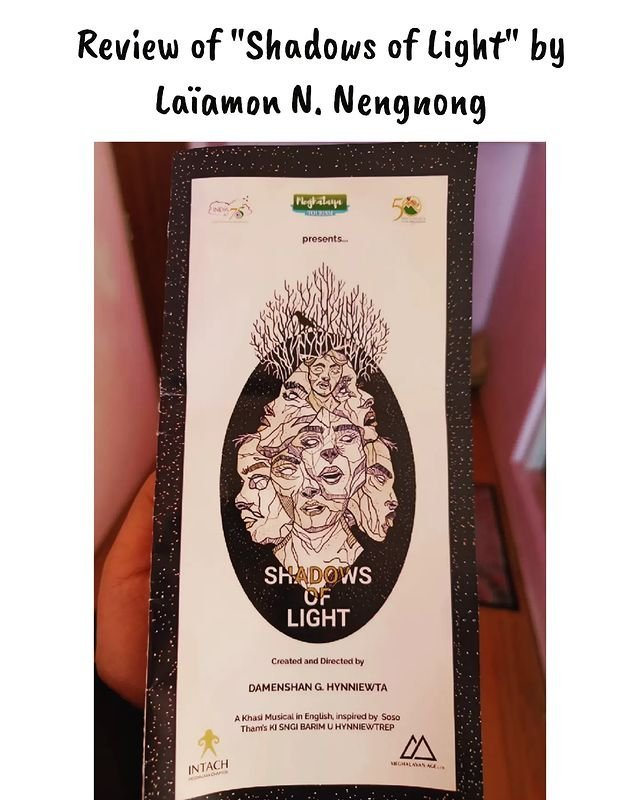
  • Review of “Shadows of light” by Laïamon N. Nengnong

    "Shadows of Light" directed and written by Damenshan Hynniewta is deftly and most intelligently created. The script, acting, music and arrangement of light and sound is unmatched. An interweaving of folklore into themes which emanate social and psychological realism, with every character standing out.

    Each theme is portrayed in nuanced and complex ways, staying true to the human condition that each legend and folktale is a mirror reflection of. The themes of love, motherhood, necromancy, in the stories of Ka Sohlyngngem, Ka Sngi bad U Bnai, U Sier Lapalang and others, showcase ingenuity of plot molding, so that the meaning is not one, but many.

    The theme of love is brought forth in the idea of forbidden love, the tenacity for beating all odds in spite of what is forbidden-the odds of family, rules of exogamous marriage in the Khasi society, and even to challenge death itself.

    Through the theme of parental love, the writer makes one re-examine the well accepted idea of unconditional love associated with it. At the same time, Hynniewta drives home the theme of purpose and fulfilment, the gendered biases and prejudice that society has on a "loose woman" from that of a man "who sows his seed everywhere" and is never made accountable for his misdeeds.

    All in all, "Shadows of Light" is a journey; one which makes the spectator reflect, contemplate, question, and even transform. It is the kind of musical that can capture the audience's attention and senses, in their entirety and I am excited for more works by Damenshan Hynniewta.

    Ka Peit Bniah ne ka Review jong ka sawangka "Shadows of Light" kaba la long ha ki tarik 13, 15 bad 17 u Kyllalyngkot 2022, ha ka Shillong International Centre for Performing Arts and Culture, SICPAC, Mawdiangdiang.

    Khublei Shibun @laia.naomi ba phi la phah ïa kane ka Peit Bniah kaba la pyrkhat sani bha! 😃🙏

    📸 @laia.naomi

  • Translation

    Khyndiat ki jingpuson shaphang ka jingpynkylla ktien:

    Ka dei kaei kaei kaba sngewtynnat bad kaba phylla ba ka riti ka dustur kaba la ai na kawei ka pateng sha kawei pat da ka ktien kan nym iehnoh ïa ngi da lei lei ruh. Kane kam long tang shaphang ki khanaparom ne ki khanatang jong ngi, hynrei ka jia ha ka jungim kaba man la ka sngi ruh. Kum haba ngi ong ba lah "thoh shun ki blei"' ne haba ngi ong "Kamai ïa ka hok". Ngi ngeit bad ngi bud ïa kata kaba la ïathuh pateng ha ngi. Kano kano kaba la kren ka don ka bor bad ka jingshisha. Kane ka dei ka bor jong ki riti dustur kiba la ai pateng ha ngi.

    Namar ba ki tynrai ba jylliew bad ka jingkordor kaba dang ïai bteng jong ki riti dustur ba la ai da ka ktien ha ka jymbriew Khasi, ka ktien kaba kren ka don ka jingialeh bad ka ktien kaba thoh. Tanga lyngba ka jingpynkylla ktien ka wan ka jingïamir ha ka jaka jong ka jingïaleh hapdeng ka ktien ba kren bad ka ktien ba thoh. Khamtam haba pynkylla na ka Khasi sha ka English ka don ka jingpyrshang ban kem ïa ki bun syrtap jong ka ktien kaba kren kiba tuid hin hin. Ngi kyrmen ba ngim pat duh noh ïa ki 'sai kordor jong ka ktien kaba kren. Ka jingpynkylla ktien ka lah ban pyrshang ban ïoh ksoh ïa kine tangba kan nym lah hi baroh. Ka mynsiem jong ka ktien kaba sawa kan man pher hi na ka sia jong ka ktien kaba thoh.

    Some thoughts about translation:

    It is something beautiful and remarkable that the oral tradition will never leave us. This is not only concerning our folktales but our day to day life. For instance, when we say "thoh shun ki blei", being marked for good fortune by the gods or "kamai ia ka hok", earn righteousness and integrity. We believe it and we adhere to what has been passed down to us. Anything that is said, anything that is spoken holds validity and power. This is the power of the oral tradition.

    Because of the deep roots and continuing relevance of orality in Khasi culture, the spoken word will have its conflict with the written word. Yet through translation, there is perhaps a reconciliation rather than a tussle between the spoken word and the written word. Especially when translating from Khasi to English, the attempt is to capture the multi-layered quality of the spoken word which is itself so fluid. We hope we have not lost the nuances and beauty of the spoken word. Translation should try to capture that, though this is not 100% guaranteed. The spirit of the spoken word will always be different from the ink of the written word.

    Namar ba kawei na ki thong jong ka page ka dei ban pynkylla sha ka ktien English ïa kiba lah sah dak ha ka page, khnang ba kito ki bym sngewthuh ïa ka ktien Khasi bad Pnar kin ïoh ka lad ban sngewthuh bad ïoh ka jingbatai kaba dei shaphang ka histori, ka ktien bad ka jymbriew Khasi-Pnar. Kane ka jingpynkylla ktien kan ïarap ïa kiwei ba kin ïohi ïa ngi ha ka rukom kaba dei bad kaba shai. 🆎🅰️🅱️

    The way in which a community and culture is represented to the world is of critical importance. In this regard, translation serves a relevant role. Has anyone thought of taking up translation as a profession? ✍️🆎🅰️🅱️

    #kajingpynkyllaktien #translation #representation #documentation #oraltradition #khasioraltradition #khasiorality #spokenword #writtenword #kaktien #kaktienbakren #kaktienbathoh #speakyourroots #speakyourrootschallenge
    #talklocal

  • Kynmaw

    How do I explain the word? "Ka ktien".

    Say it. Out loud. Ka ktien. The first, a short, sharp thrust of air from the back of your throat. The second, a lift of the tongue and a delicate tangle of tip and teeth.

    For I mean not what's bound by paper. Once printed, the word is feeble and carries little power. It wrestles with ink and typography and margins, struggling to be what it was originally. Spoken. Unwritten, unrecorded. Old, they say, as the first fire. Free to roam the mountains, circle the heath, and fall as rain.

    We, who had no letters with which to etch our history, have married our words to music, to mantras, that we repeat until lines grow old and wither and fade away. Until they are forgotten and there is silence.

    How do I explain something untraceable? The perfect weapon for a crime. Light as pine dust. Echoing with alibis. Conjuring out of thin air, the ugly, the beautiful, the terrifying.

    Eventually, like all things, it is unfathomable. So, how do I explain?

    Perhaps it's best, as they did in the old days, to tell a story.

    ……………………….

    I was asked recently, what's your favourite word in Khasi? Usually, I find "favourite" questions very difficult–favourite book, song, movie. So many, I reply helplessly, it's impossible to pick just one. But not this time. It came to me easily, immediately, and while there are many delicious words in Khasi (rympei, the hearth; 'lap praw praw, rain on a tin roof), this one is closest to my heart.

    Kynmaw.

    To remember.

    And not merely because of its rich and resonant meaning, but also because of its etymology. For the longest time, the people of these hills nourished an oral culture–one replete with song and story–and while there were attempts to "give" the languages here a script (using the Bengali alphabet), it was the British missionaries who succeeded. In particular a missionary named Thomas Jones, who travelled to Sohra in 1841, at a time when conversion to Christianity was at its slow beginning. What would help was to disseminate the word of God through the Bible–except how to publish an edition in a scriptless language?

    Today, in Meghalaya, is Thomas Jones Day. And so we remember him. For his diligence and good deeds, of which there were many–how complicated are our colonial histories!–but I choose to remember also how the languages here, at heart, are languages of the wind, the

    mountains, and waterfalls and forests. How they once sprung from land and tongue and remained untethered to page and pen and ink.

    How did we remember? Through song and story, of course, and stone. We computed our histories through stone–choosing to raise monoliths to mark lives and events and relationships. And so even our word for remember-kynmaw–means to "carry like stone". Here, remembering is not taken lightly. It is borne on our backs like stone–unwavering even in the face of (colonial) beliefs that the oral is light and frivolous and inauthentic. The spoken is as much true as the written. When we have no preservatory documents, remembering, to kynmaw, becomes all the more pressing, more important. The spoken does not forget."

    Khublei Shibun @janicepariat for your beautiful and profound thoughts! 🤗❤️🙏

    The era of the spoken word and of Khasi orality is vast, moving in the many sunrises and sunsets of history. This history which is our heritage pleads to be preserved as we move forward.

    As it is the course of things, we were given the Khasi alphabet by Welsh missionary, Rev. Thomas Jones. The Khasi alphabet has brought us to another chapter in Khasi orality, as our stories, teachings and values are transcribed onto paper. Yet as Janice Pariat has asserted, ban kynmaw ka long kaba kongsan, ban kynmaw ka long kaba kumba ngi dei ban long, namar ïa ka ktien la thaw, la shon nyngkong ha ki jylliew ka pyrkhat ka pyrdaiñ; la thaw la shon ïa ka ktien ha ki tyllun u thylliej bad ka shyntur. Kumba ki ong ki longshuwa, ka ktien kaba tam. Ka ktien ka long kaba maïan, ka ktien ka long kaba nylla!

    📸 All photos are from @janicepariat 🙏

  • Ka Ngot bad ka Ïew

    Mynkulong-kumah, mynba dang lung ka pyrthei-ka mariang, la don arngut shipara, kiba kyrteng ka Ngot bad ka Ïew, ki khun jong u ’Lei Shillong. Baroh arngut ki long kiba bhabriew, la nam ka pyrthei-ka mariang baroh. Ki ïaid-ki-ïeng, ki leit-kai-leit-iaid ryngkat ryngkat shipara bad ki ïakup ïasem ruh kumjuh kumjuh. Ka nam ka burom bad ka dur ka akor jong ki, ka la par kylleng ka ri Khasi ri Jaiñtia.

    Ka Ïew ka la long kaba kham san kham rangbah, kaba la ïohi shuwa ïa ka Sngi ïa u Bnai. Hynrei ka kham sngewmeng, ka khoi-khoi mynsiem sngewrem lada kam lah ban leh ïa kano-kano kaba ka la thmu ban leh. Ka la long kaba kham kab-kab bad kham shlei-ktien khlem pyrkhat. Kaba leh kjeh, hynrei ka phoi kynsha bad ka syam. Ka Ngot pat, ka long markhongpong ïa ka Ïew. Ka mynsiem jong ka, ka jem hun-hun bad ka bapasiang kum ka tlieng. Ka khmut-ka-khmat jong ka, ka i jemnud jai-jai, bad ka phuh samrkhie rymmuiñ kum u 'tiew-dyngngai ba dang shylluit hapoh kob. Ka smat, ka sting bad ka ïarap ïa la ka hynmen ban trei ïa kane-katai.

    Ha kawei ka sngi Synrai kaba rang bha kdiar kdiar, bad ba phngaiñ bha ka bneng, ba lah ban ïohi sawdong ïa ka trai-bri pyrthei: ka Ïew ka la ïawer ia ka Ngot ban leitkai shalor Lum Shillong. Ki la ïaïaid kai kylleng shane shatai, haduh ba kin da poi top halor lum. Haba ki dang khmih nangta sawdong ka ri Khasi, ki ïohi ïa ki lum-ki them, ki wahduid wahheh, ki lyngkha-ki risa, bajyrngam byrtem, ki baitynnat la biang; bad haba ki phai shaphang arsut jong ka ri, ki la ïohi ïa ka ri thor jong ka ri Dkhar, kathie ngai-lyngai. Kane ka jingïohi baitynnat ka la shoh-jingmut ïa ki arngut shipara haduh ba ki la kwah ban leit jngohkai ïa kito ki jaka-ki puta. Ki um ki baphyrnai khlek-khlek bad ki baphalang ha ka jingthaba jong ka sngi, kiba don ha ki baden bad ki bir, ki pynkyndeh-mynsiem ia ka Ïew bakhyllew; bad ka la ong ïa la ka para, ka Ngot, ban ïaleitkai shata.

    Ha ka banyngkong, ka Ngot kam shym treh, namar ka la sheptieng ba jngai than. Hynrei ka Ïew, ka beiñ-ka-sin ïa ka ba ka long ka bakhawpud bad ka barit-bor-rit-mynsiem. “To” la kren-kob ka Ïew “lah mapha ne manga ban ïa mareh pynpoi kloi shaduh shathie.” “Em phi kong,” la ong ka Ngot, “lada phi kwah te ngin ïaleit lang keiñ, namar ngim tip ïa ka lynti ka syngkien kaba kumno bad ba ka bajngai artat” — Ka Ïew ka la kem-ktien bad ka la ong: “To ngin shu ïa kylla-um bad ngin leit tuid katba poi kloi.” Ka Ngot pat haba ka la ïohi ba ka Ïew ka la sngew-sarong than, ka la klet-noh ïa la ka jingrit-mynsiem baroh bad ka ong: “Lada phi da kob eh katta katta te to.” Te baroh arngut ki la kylla artylli ki wah.

    Ka Ngot ka la wad lynti na basuk bad ka tuid hin-lyhin, na ki jaka ki bajem, haduh ba kan da poi sha Shilot. Hynrei la ka lynti jong ka ka kham suk, ka la long pynban kaba khongdong mongdong, ka bakyllaiñ bad ka bajngai. Ynda ka la poi ha Shilot, la ka peit ïa ka hynmen shano shano ruh kam ïohi, kumta ka la sngewlyngngoh bad ka la sheptieng ïoh la jia eiei ha lynti. Ka la khun ïalade sha Shatok bad ka la leit shaduh Dwara, nangta ka phaidien biang ban leit wad ïa ka Ïew. Kane ka jingkhun jong ka Ngot ka la long ka baitynnat haduh katta-katta ba ki kjat sngi ki sngewtynnat ban leitkai sha ka bad ki shad ki sngewbha ha ka. Ka Ngot pat da ka jingphalang ka sngi, ka thaba khlek-khlek kum ka rupa bad namar ka jingpynkhun jong ka, haduh mynta-mynne ki briew ki sin ïa ka, ka “Rupa tylli.” Bad ha kata ka jaka, ki khot ïa ka haduh kine ki sngi, ka “Wah Rupa tylli.”

    Ka Ïew pat, ha la ka sngewmeng sngewsarong, ha la ka sngewkhlaiñ bor khlaiñ tyrpeng, ka wad na bajan bajan. Ka thom bor ïa ki lum ki them, ka kylla khriang bad lat-lat; ka syllud ïa ki diengbah diengsan, ki mawbah mawheh, bad ka tih naphang kat ïa kiba wit ha lynti. Hakhmat jong ka, ym don bakhraw ym don barit, ka syllad naphang; wat ki mawramsong, hakhmat jong ka ki kylla-mat-lieh, bad ki tyllun kum ki mawpyllon. Hynrei haba ka la poi ha Shella, ka dum ka buit ka stad jong ka baroh; ka la lyngngoh ngaiñ bad ka la sngewingkhong khait, haba ka ïohi ba ka Ngot, ka lah da poi nyngkong. “Ïa kat kane ka raiñ ka rem, ka jahburom duhburom, hakhmat ka pyrthei, ban da jop eh da ka para, la ong ka Ïew, ngan nai im shuh hi, la suk ka ïap.” Kumta ka ïam ka ud ka lympat-ka-lynsher ïalade, haduh ba kan da pait san bynta bad ka kylla san tylli ki shnat-wah; ka Dwara, ka Umtang, ka Kumarjani, ka Pasbiria bad ka Umtarasa.

    Naduh kata, don kiba khot ïa ka, ka Umïew bad don ruh kiba khot ka Umïam. Bad na kata ka jingjop, ka Ngot ka la kylla long kaba kham halor. Baroh ki ñiew ïa ka kaba kham pawnam, kham don-burom-surom, kham itynnat bad kham iphuh-iphieng. Te u dkhar-u-lyngkien ruh, u kheiñ ïa ka kum ka blei bad u noh ka kñia-ka khriam, u nguh-u-dem bad u duwai-u-phirat ïa ka. Haduh kine ki sngi, u khun ka ri Laiphew syiem bad u khun ka ri Khatar Doloi, u kheiñ ba ym bit ban jam pynjah-burom sha shiliang jong ka, khlem nguh khlem khublei, kumba ju long ka akor Khasi naduh hyndai ka sngi, ba ym bit ban ryngkang ne ban jam ïano ïano ruh, ne ban ïaid na khmat jongno jongno, namar ba ka long ka nongjop basngewrit.

    Umiew and Umngot are two major rivers in the Khasi Hills, both springing from the Shyllong Peak and flowing towards the plains of Bangladesh. But legend has it that the two rivers were the twin daughters of U 'Lei Shyllong, the god of Shyllong. As goddesses, the two were much acclaimed throughout the length and breadth of Ri Hynñiew Trep for their matchless grace and beauty and their love for one another. For in the world of spirits they were never seen apart but went everywhere in each other’s company.

    But unknown to many outside their closest circle of friends, the love that existed between the two sisters was not without ups and downs, arising mostly out of the peculiar traits of the elder sister, Ka Ïew. Having as the elder daughter seen the sun and the moon first, Ïew was more presumptuous in knowledge, more conceited by nature and totally uncompromising in attitude. She was also bad-tempered and noisy. Ka Ngot was more subdued, milder and pleasant, though not without a passion of her own which surfaced every now and then when her sister’s impudence crossed the bounds of what was proper and decorous.

    One bright sunny day in autumn, while the two young princesses were out strolling on the slopes of Shyllong Peak, enjoying the cool breeze and the magnificent scene of evergreen hills tinged with gold by the autumn sun, the sisters’ eyes strayed far away into the distant fields of Bangladesh. As the princesses gazed on, the water that collected in the numerous lakes shimmered in the sun so that the whole land seemed to twinkle with diamond s. A bold and adventurous plan presented itself to Ïew and she said: "Say, sister, why don’t we embark on an expedition to those shimmering lakes and unending valleys! Just imagine what new charms we may encounter! Staying on in these hills is boring!"

    But Ngot shook her head. Though smitten as much as her sister by the exquisite beauty of the sight, she was far too sensible to give up the security and happiness of her home and follow a mere whim into a remote land. Ïew, on the other hand, scoffed at her sister: "Come on, you foolish girl let’s run a race and see who reaches those valleys first." Ngot replied, "Dear Kong, if we must go, let us go together, without competing. The valleys are far and the way may be dangerous. It will be better if we stick together." But Ïew flew into a rage and said "If you are so damned afraid of the dangers on the way, let us turn into water and travel in the guise of rivers. But if you still say no to this, you are a coward and have no right to live like a goddess." Now Ngot was truly provoked by her sister’s scorn and insolence. She decided to take up the challenge and so both of them turned into rivers.

    In keeping with her mild and temperate character, Ngot sought the soft and gentle ways in her journey, unmindful of the numerous twists and turns she had to take in doing this. Thus she glided gently till she reached a place in Bangladesh called Shilot. In Shilot, however, she saw no sign of Ïew anywhere. She was surprised. Having made detours round many an obstacle, Ngot had lengthened her route a great deal and delayed her progress by many weeks. She had naturally expected her sister, therefore, to be already waiting there for her, with her boisterous laughter and scorn. Not finding her there made Ngot extremely anxious. She changed course, veered towards Shatok and went on to Dwara in search of her sister. Not finding her there either, and now convinced that Ïew was nowhere ahead of her, Ngot swivelled round and returned to look for her along the way she had come.

    These serpentine curves form the most attractive part of the river in its entire course, and when seen from a distance with the sun’s rays playing on the water, the river looks like silver. And that is why, to this day people call it “Wah Rupa Tylli", or the "River of Solid Silver". All this time Ïew was preoccupied, fighting her own impediments on the course she had chosen. Proud and domineering as a tyrant, she aimed for her target like an arrow. In trying to reach Shilot by the shortest and quickest route possible, she ploughed her way through hills and valley; and swept everything in her path, uprooting large trees breaking stones, pushing boulders aside, cutting a path through jungles, jumping into deep ravines and digging tunnels into the ground. But in spite of her great strength, all this was slow labour, and without her knowing it, took a great deal of her time, for there was an obstacle almost every inch of her route.

    And so it was not surprising that when she eventually rolled into Shella, near Shilot, she found Ngot far ahead of her. Ïew was simply dumbfounded. To think that her weakling sister had put her in second place! It was intolerable! A trick of fate! Her pride deeply hurt, she raved, "To suffer such damnable shame before the whole world! To be defeated by a mere child! How can I live on? Tell me, why should I live? I’ll remain a river forever!" Saying these words and cursing her fate, she cried and groaned, threw herself on the ground, and struck herself with such force that she splintered into five branches, called the Dwara, the Umtang, the Kumarjani, the Pasbiria and the Umtarasa. On hearing about her sister, Ngot was grief-stricken. She blamed herself for everything that had happened and decided not to return home alone, but also remain a river by the side of her sister.

    By and by the story of the two goddesses filtered into the human world and people began to flock to these rivers as pilgrims. Ngot was especially esteemed as a superior stream, attracting non-Khasis from the plains to its banks to perform religious rites. The ancient Khasis themselves considered it an immoral act to ford this river or go across it on a bridge

    without first offering prayers to it, for the river was, after all, a modest victor and a goddess.

    "Ka Ngot bad ka Ïew" is an endearing story of the relationship between two sisters. 🏞️🏞️
    The Khasi version has been abridged from H. Elias S.D.B and the English version has been abridged from Kynpham Sing Nongkynrih by @speakyourroots

  • Review of “The Legend of Ka Noh ka Likai” by Lapdiang Syiem

    Lapdiang Syiem’s Dramatisation of The Legend of Ka Noh Ka Likai: A Review by Dr. Amanda C. Tongper and Dr. Daiarisa Rumnong

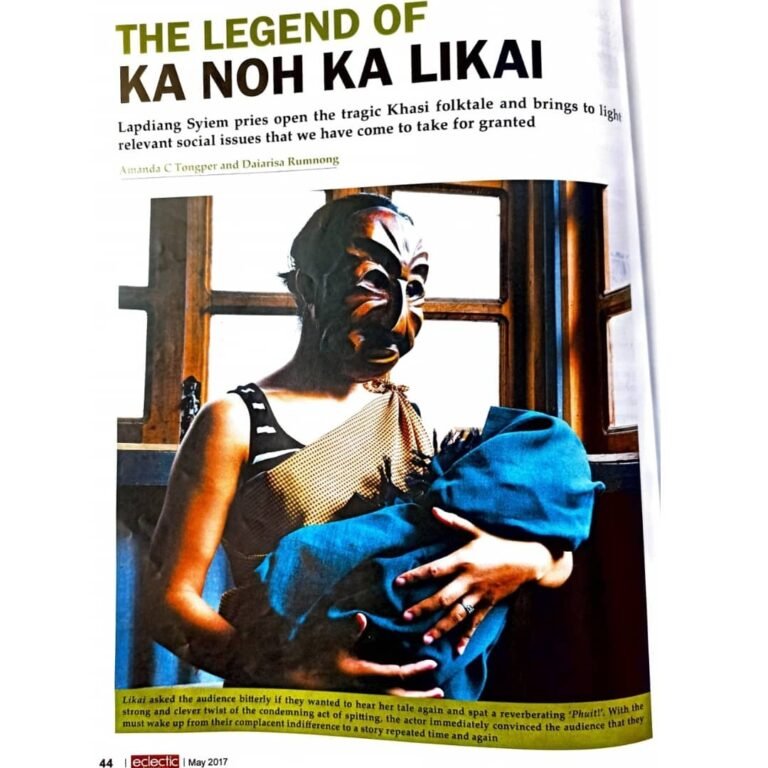
    Nothing prepared us for the phenomenon which is Lapdiang Syiem. As we were ushered in into the enclosed space at Dylan’s Café, we were greeted by a figure framed atop a mula, transfixed with a baby in her arms. We stopped for a second, looking for traces of life in that mannequin of a being even though we knew at the back of our minds, that it is the actor, Lapdiang Syiem.  The first achievement of the actor was accomplished in the very first seconds of the play, as we later realised that we did not just enter the room where the performance was to take place – we were pulled into the orbit of the actor with a grip that was to hold us for the rest of the performance. 

    Lapdiang, through the character of Likai, pried open the tragic story of Ka Noh Ka Likai that has been encapsulated in time and brought to light relevant social issues muted within a tale that we have come to take for granted. Likai asked the audience bitterly if they wanted to hear her tale told again and spat a reverberating “Phuit!” With the strong and clever twist of the condemning act of spitting, the actor immediately convinced the audience that they must wake up from their complacent indifference to a story repeated time and again. The spit cautioned the audience that in this re-telling, they cannot rely on their rote-memory of the story. The spit challenged the collective conscience of the audience who may have known the narrative of Ka Noh Ka Likai, but has never thought to understand the story of Ka Likai, the being with thoughts and emotions of her own.

    Lapdiang Syiem’s performance provokes a fresh look at the oft-told story of Likai. Entering the venue, the image of Lapdiang whose face was covered by a mask, holding a baby seemed to be suspended in purgatory, adrift in limbo. The image is at once a detonating symbol. It evokes the pre-conceived notion that a woman is pitiable, weak, unsettled on her own and a man is her only anchor. This notion that rises from a deep-seated, almost genetic conditioning remains such an inescapable factor even in this 21st  century stage of our lives. The orbit we were drawn into had a familiar ring to it. But were we looking hard enough to notice the reflection we should see of ourselves; of how much the motif of a woman jumping to her death actually echoes all those stories of violence, dispossession and death?  Why is it that a woman is expected to be tied to a man? Why does a part of a so-called “binary” cannot exist alone? In the performance of Ka Noh Ka Likai, Likai after living as a widow was told by other women in her community that she should marry another man. A man it appears embodies security. However, this “security” that society perceives as normal or good may actually lead to irrevocable despair.  

    The only device that aided Lapdiang’s performance was the music played by Apkyrmen Tangsong. Apkyrmen played original compositions on the maringud, ksing and besli. All three instruments moulded themselves into the performance, even eerily voicing out the muffled cries

    of Likai’s baby. The poignant and haunting pieces feel like the past knocking on our foreheads saying: “Don’t get too comfortable, too familiar with showing me off. Try to understand my relevance for the present and even the future!” The music, words and gestures of the performance swayed the audience, dug out tears, drawing us breathless with questions that perhaps are desperate to break free. It made us feel uncomfortable…in all the right places.

    In Lapdiang’s performance, there is a curious blend of acting and telling, so that one is compelled to say, the oral is still with us. One usually speaks of the oral tradition with a sense of

    nostalgia, as a thing of the papyral past. However, with Lapdiang’s performance, one witnesses that this form of communication has never really left us. We only have to engage with it once again. The gusts and ripples of ka Ka Noh Ka Likai echo everyday, do we listen?

    As the play came to its end, there was silence among the audience. It was a sacred moment to watch Lapdiang give Likai life with such heart, strength and intelligence.


    Lapdiang Syiem is a force to be reckoned with.  

    Lapdiang A. Syiem was born and brought up in Shillong. She is a graduate from National School of Drama, Delhi with a specialisation in Physical Theatre from the Commedia School, Copenhagen. In 2016, Lapdiang, along with Keshav Pariat and Juban Lamar founded an artistic commune called, The Unhinged Commune. They blog regularly at kinongbamsohlah.wordpress.com

    This is a review of a fantastic and heart-wrenching performance by @lapdiangsyiem of "The Legend of Ka Noh ka Likai" in 2017. Folktales transformed into theatre is something else! 💫💫💫

    The review was published in @eclectic_northeast magazine and has been written by Dr. Daiarisa Rumnong (Assistant Professor, St. Mary's College) and Dr. Amanda C. Tongper (Assistant Professor, St. Anthony's College).

    Thank you @lamar.juban for the beautiful pictures used in this review!

    Please send an email to speak.your.roots@gmail.com if you would like to read the review!

  • Nga Kynmaw/ I Remember

    That is why the Khasi stories always begin with "When man and beasts and stones and trees spoke as one…." This shows the Khasi world view, that sees the universe as a cosmic whole that receives its animation and force from the one living truth, their God, U Blei.

    Around the Hearth, Kynpham Sing Nongkynrih

    They say that long before the written word arrived in the mystical hill state of Meghalaya in Northeast India, an ancestor lost the manuscript that contained the religious and philosophical scripts of the Khasis as dictated by God. Descending from the great summit after meeting God, the ancestor came across a raging and turbulent river. He clenched the manuscript between his teeth as he tried to swim, but being from the hills, he was not adroit at swimming such torrid waters. He bobbled midstream and the manuscript was reduced to mush, which he swallowed. He managed somehow to return home empty-handed, and recounted his plight to his clansmen, assuring them that he could still recite God's word to them. The clans convened a council of members where the ancestor instructed them on the laws and teachings of God. It was from here, they say again, that the Khasi traditions of storytelling originated. Bah Kynpham Sing Nongkynrih's Around the Hearth: Khasi Legends brings alive the history and traditions of Khasi storytelling. The Khasis developed a script only as recently as 1842, thanks to Welsh missionary Thomas Jones. Their language and tradition of oral storytelling, though, has survived for centuries among a people of soft yet strong disposition who believe supremely in the symbiotic relationship between nature and man. Who live in the shelter of clouds above pine trees, lush green mountains, and share songs and poetry warmly around the fires of their hearth.

    "Nga Kynmaw/ I Remember" sent by Randeep Baruah @rondeview_ 💭🗯️💬Thank you Sir for this valuable reminder on the oral tradition of the Khasis! 🙏🙏

    Taking his inspiration from Around the Hearth: Khasi Legends (Folktales of India)(2007) written by Kynpham Sing Nongkynrih, Randeep talks about the story of the lost of script of the Khasis that he recounts from Nongkynrih's book. It is a story that cements the power of story-telling and the art and truth contained in the oral tradition. May the words we speak echo the spirit of our forefathers, who with a wisdom of the ages laid down the roots of our intrinsic bond with nature.

    Randeep Baruah is a writer and communications designer.

    Picture credit: @rondeview_