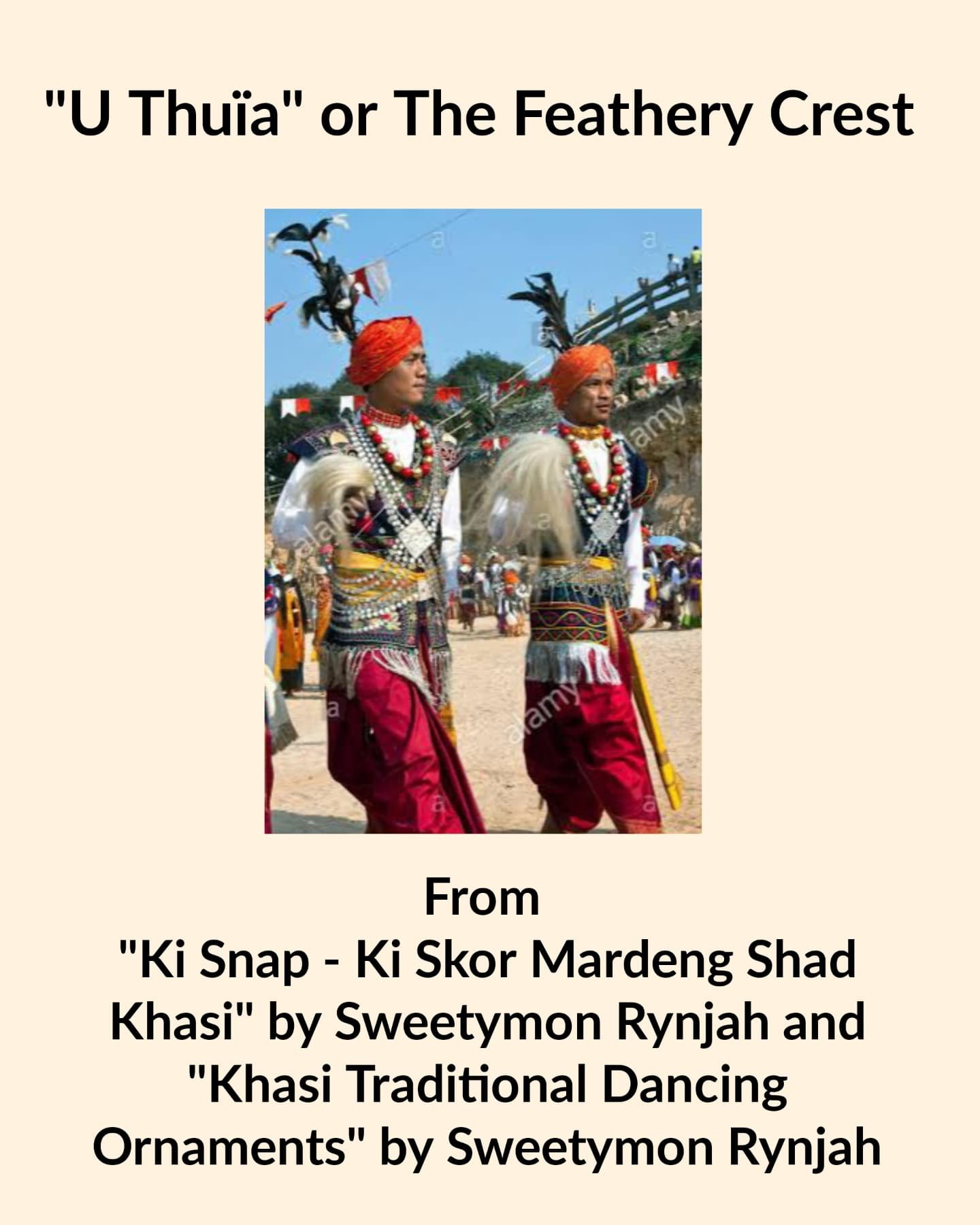
"U Thuia" or The Feathery Crest
From Ki Snap – Ki Skor Mardeng Shad Khasi by Sweetymon Rynjah and
Khasi Traditional Dancing Ornaments by Sweetymon Rynjah
U Thuïa
Ka jaiñspong ha ka riam Khasi ka ïoh ïa ka bynta ba kongsan eh ha ka riam u rangbah Khasi. Ka pynphuh ïa ka maiñ rangbah bad ka ïoh la ka longsan ha ka jingpynkup burom ha kino kino ki kam bad jingleh burom kat kum ka rukom Khasi…Tangba ha ka shad ka kmen khamtam ka shad ainguh, la sieh bad pyndait pat sa ïa u Thuïa. Kumta u Thuïa u shim ïa ka bynta kaba kongsan bad ba khlieh tam ha ka riam shad shynrang jong ngi ki Khasi.
Ïa u Thuïa la sieh tyngkhap ha ka jaiñspong na shadien khlieh jong u nongshad bad la teh pynskhem da ki arliang ksai jong u bad pynskhem ha ka jainspong. Une u Thuïa, ym tang ba u pynphuh pynphieng ïa ka maiñ ki long shynrang, hynrei la bsap ruh ïa ki jingmut barieh, kiba ki longshuwa manshuwa ki la pynkup ha u, kum ki dak ki shin ban pynpyrkhat bad ngam jylliew ban khyllie pat ïa kita ki syrtap ba la pynkap bad pynshat ha u dur jong u. Hynrei kam long kumta ha ka pyrkhat bad pynshong kaba ka sain pyrkhat pynneh dustur bad pynsah riti jong ki longshuwa jong ngi.
La shna pynbit pynbiang ïa u thuïa na ki sner jong ki sim ki doh. Ki sner kiba kham heh ki long kiba ïong, ïa kine la teh pyndait ha i dieng ba la khrud pyllon bad teh pynskhem bha, ban da pynwandur kyrphum ba kham ïar na sha trai bad nang kham rit khyrphum katba nang kiew sha khar jong u. Ha kine ki sner kiba ïong pat, la teh pyndait ïa ki sner lung balieh, kiba la teh synrop kumba saw ne san tylli bad pynkhreh kyrpang shuwa ban teh ha ki sner ba ïong, ba la pynskhem ha i dieng pyllon ba la pai pynjlih pynrit ban rung ha ka tyngkhap syrtap jaiñspong u nongshad.
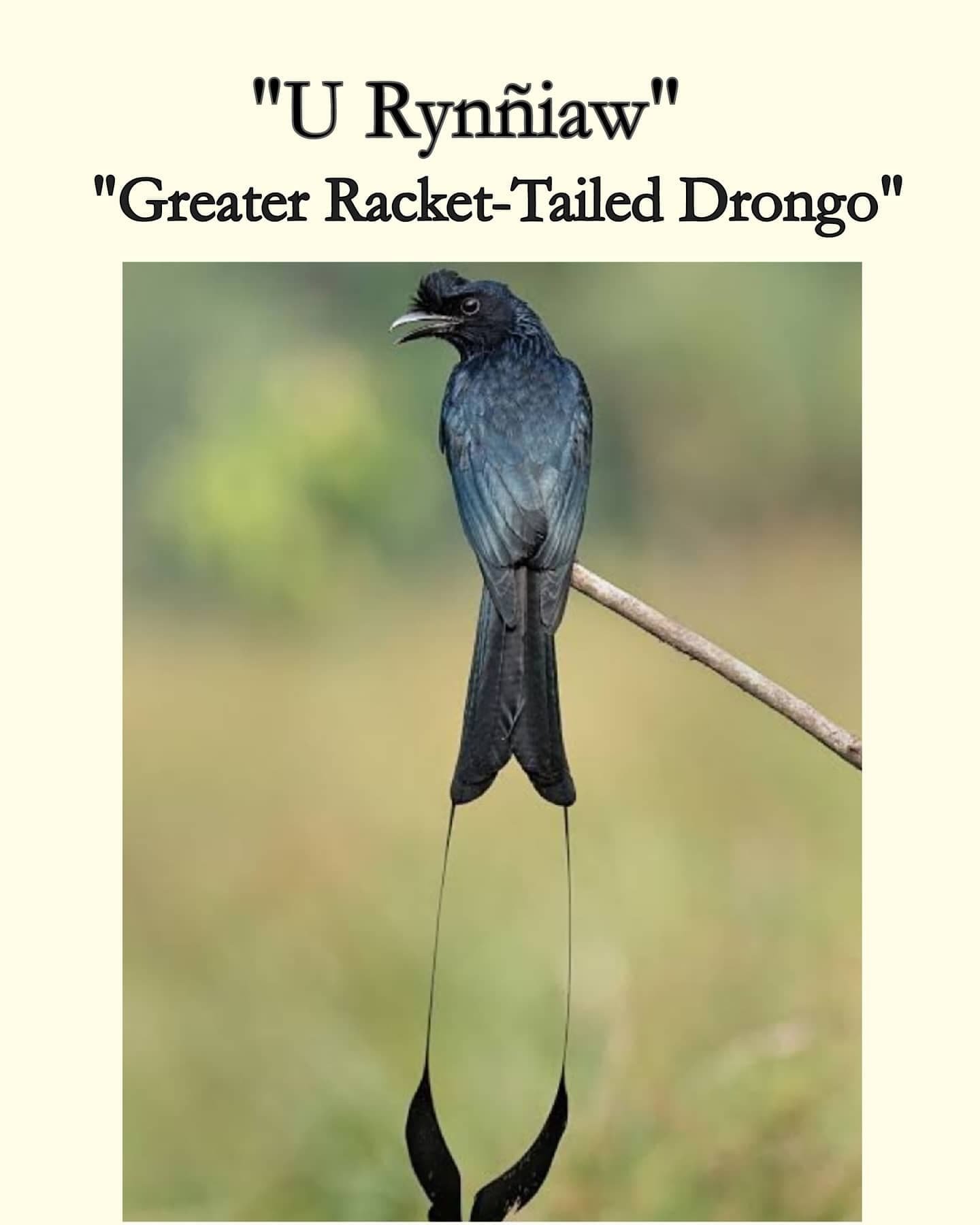
Ki kpa tymmen jong ngi ki ju kham pyndonkam da ki sner u sim Rynñiaw. Une u sim u phong u kup da ki sner kiba ïong ha met katba na shadem haduh tyngkhap kjat, ki sner ki long lam bthuh-lieh. Ha u tyndai dong jong u, u don artylli ki sner kiba kham jrong na baroh kiba shat ïa ka rong thwei ïong, rong lir syriem ïa ki sner jong u klew. Ha ki puriskam purinam Khasi ïa u sim Rynñiaw la pynkap kum u khun binong bishon, uba don ka akor bad kup da ker la ka burom, uba wan na ka longïing longsem kaba bha ba miat. Ha une u sim la pynïasoh ïa ka jingshlur bad shynrang mynsiem bad la pynkup ruh ha u, ïa ki nuksa jong ka jinglong shynrang jingmut ha la ka jingthmu…La pynïasoh ruh bad une u sim kum u shynrang ka wait ka stieh kaba mut ba thew ïa u briew uba kloi ban len ïalade na ka bynta kiwei pat lane na ka bynta la ka hok.
The Feathery Crest/ U Thuïa
Thuïa is the feathery crest or plume attached to the "spong khor" of a Khasi male dancer. "Spong khor" is a head-dress or turban, called "jaiñspong" in Khasi. This "jaiñspong" does not only give a manly appearance to a Khasi male but also enhances his stature and look. This Khasi head-dress has become a way of honouring and glorifying any important personage, by presenting and entwining the same on his head on any occasion of festivity. It has also become an integral part in the consecrating ceremony of the chosen Khasi Syiem. The "Spong khor" is entwined on the head of the chosen Syiem as a mark and symbol of instrumental authority after completion of all the religious ceremonies.
We also witness in the Khasi Thanksgiving Dance of "Ka Shad Suk Mynsiem", all male dancers dressed with turbans of dhara, muga or ka "Spong khor". This "Spong khor" is a hard strong mixture of silk, known in assamese as "Gumchen", specially made with geometrical designs or animals motifs in red with a background of yellow. On the back of this turban, a feathery crest or plume called "U Thuïa" is attached. It is fastened to the turban, its two threads, which passed through the layers of the turban before fastening and knotting.
"U Thuïa" is prepared from the feathers of birds. The bigger feathers are of black colour, which are fastened and tightened to a small stick, prepared for this purpose. The lower portion of the stick has been thinned out to enable to pass through the layers of the turban. On the tips of these black feathers, a small bunch of white soft feathers in a cluster of four to five, prepared separately are fastened and tied to the black feathers. "U Thuïa" gives a conical shape broader at the base and narrower while ascending to the top.
It has been orally told by Khasi elders that our forefathers used the feathers from the bird, called "Rynñiaw" while preparing "U Thuïa". It is a bird with black feathers on its body, while on its chest, the feathers are soft and cloudy white. This bird has two feathers on its tail with shades of blue, tinted with indigo like that of a peacock. In the Khasi fable of "U Rynñiaw", the bird is personified as a nobleman, well brought up in good etiquette and behaviour, with good qualities and moral values. Courage and chivalry are also embodied in this bird, being an example of a man with strong will and determination, who girdled his will power, in whatever, he aimed at, without scarificing his manly honour and prestige. "U Rynñiaw" was also assimilated as a champion for a noble cause of peace and harmony, at the cost of his own mental agony and lamentation. Hence, he can mortify himself for others for a righteous cause.
The traditional Khasi attire of men in "Ka Shad Suk Mynsiem" contains a deep significance. Thanks to Kong Sweetymon Rynjah we understand the beauty and symbolism behind "U Thuïa" or the Feathery Crest of "Ka Spong Khor".
"U Rynñiaw" is the bird from the fable "U Rynñiaw bad ka Sohlyngngem".
🟡 Abridged and translated by @speakyourroots