Tag: khasivalues

  • “Ka Jingsneng Tymmen Shaphang ka Akor Khasi ha ka Rukom Rwai Phawar”, Part I (1902) & Part II (1903)

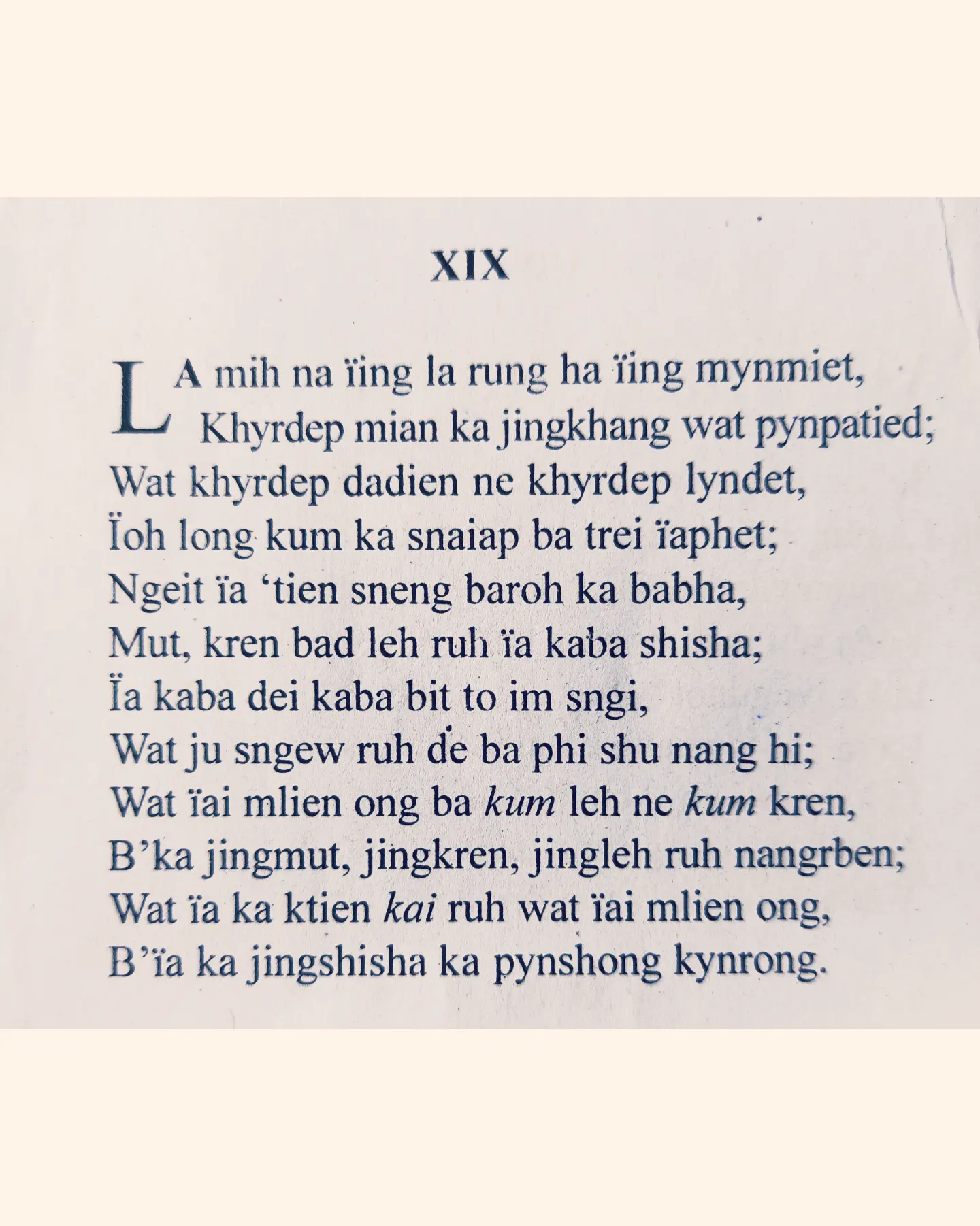
    La mih na ïing la rung ha ïing mynmiet,

    Khyrdep mian ka jingkhang wat pynpatied;

    Wat khyrdep dadien ne khyrdep lyndet,

    Ïoh long kum ka snaiap ba trei ïaphet;

    Ngeit ïa 'tien sneng baroh ka babha,

    Mut, kren bad leh ruh ïa kaba shisha;

    Ïa kaba dei kaba bit to im sngi,

    Wat ju sngew ruh de ba phi shu nang hi;

    Wat ïai mlien ong ba kum leh ne kum kren,

    B'ka jingmut, jingkren, jingleh ruh nangrben;

    Wat ïa ka ktien kai ruh wat ïai mlien ong,

    B'ïa ka jingshisha ka pynshong kynrong.

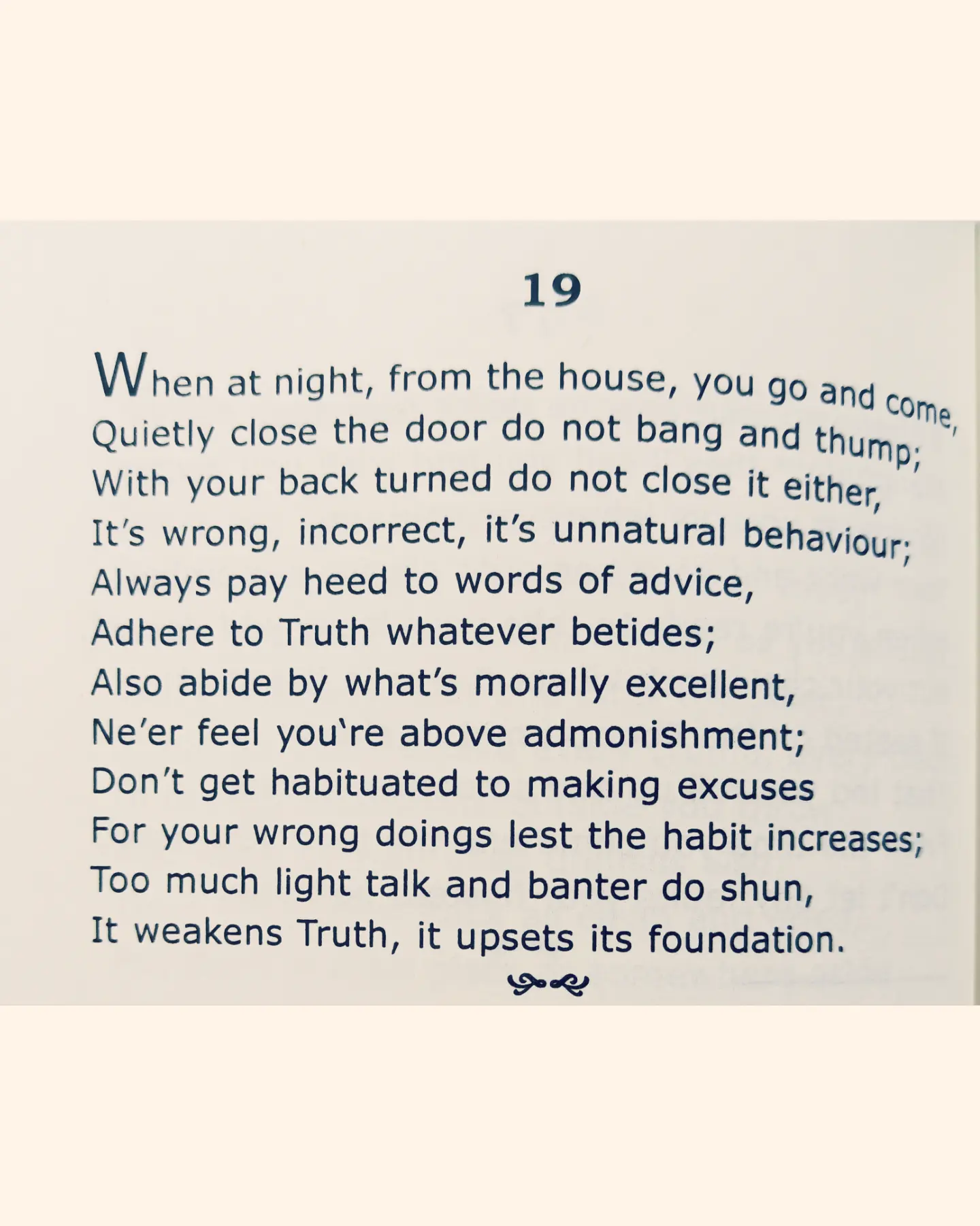
    When at night, from the house, you go and come,

    Quietly close the door do not bang and thump;

    With your back turned do not close it either,

    It's wrong, incorrect, it's unnatural behaviour;

    Always pay heed to words of advice,

    Adhere to Truth whatever betides;

    Also abide by what's morally excellent,

    Ne'er feel you're above admonishment;

    Don't get habituated to making excuses

    For your wrong doings lest the habit increases;

    Too much light talk and banter do shun,

    It weakens Truth, it upsets its foundation.

    Ïa katei ka dkhot kaba 19 la shim na "Ka Jingsneng Tymmen" Part I.

    "Ka Jingsneng Tymmen Shaphang ka Akor Khasi ha ka Rukom Rwai Phawar" Part I (1902) & Part II (1903) by Radhon Sing Berry Kharwanlang is a unique collection of valuable lessons and teaching on how to live a good and moral life. The teachings are given in the form of "phawar” where two lines follow the same rhyme scheme, that is, aa bb.

    Both Part I and Part Il have been translated into English by Bijoya Sawian @sawianbijoya in her book "The Teachings of Elders: Ka Jingsneng Tymmen, Parts I and II" (1997).

    🟡 Slide 1: Number 19 "Ka Jingsneng Tymmen Shaphang ka Akor Khasi ha ka Rukom Rwai Phawar" Part I (1902)

    🟡 Slide 2: Number 19 "The Teachings of Elders: Ka Jingsneng Tymmen, Parts I and II" (1997).

    #kajingsnengtymmen #radhonsingberrykharwanlang #theteachingsofelders #bijoyasawian #moralteaching #morallesson #phawar #speakyourroots #speakyourrootschallenge #talklocal
  • Ka Jingsneng Tymmen Shaphang ka Akor Khasi ha ka Rukom Rwai Phawar”, Part I (1902) & Part Il (1903)

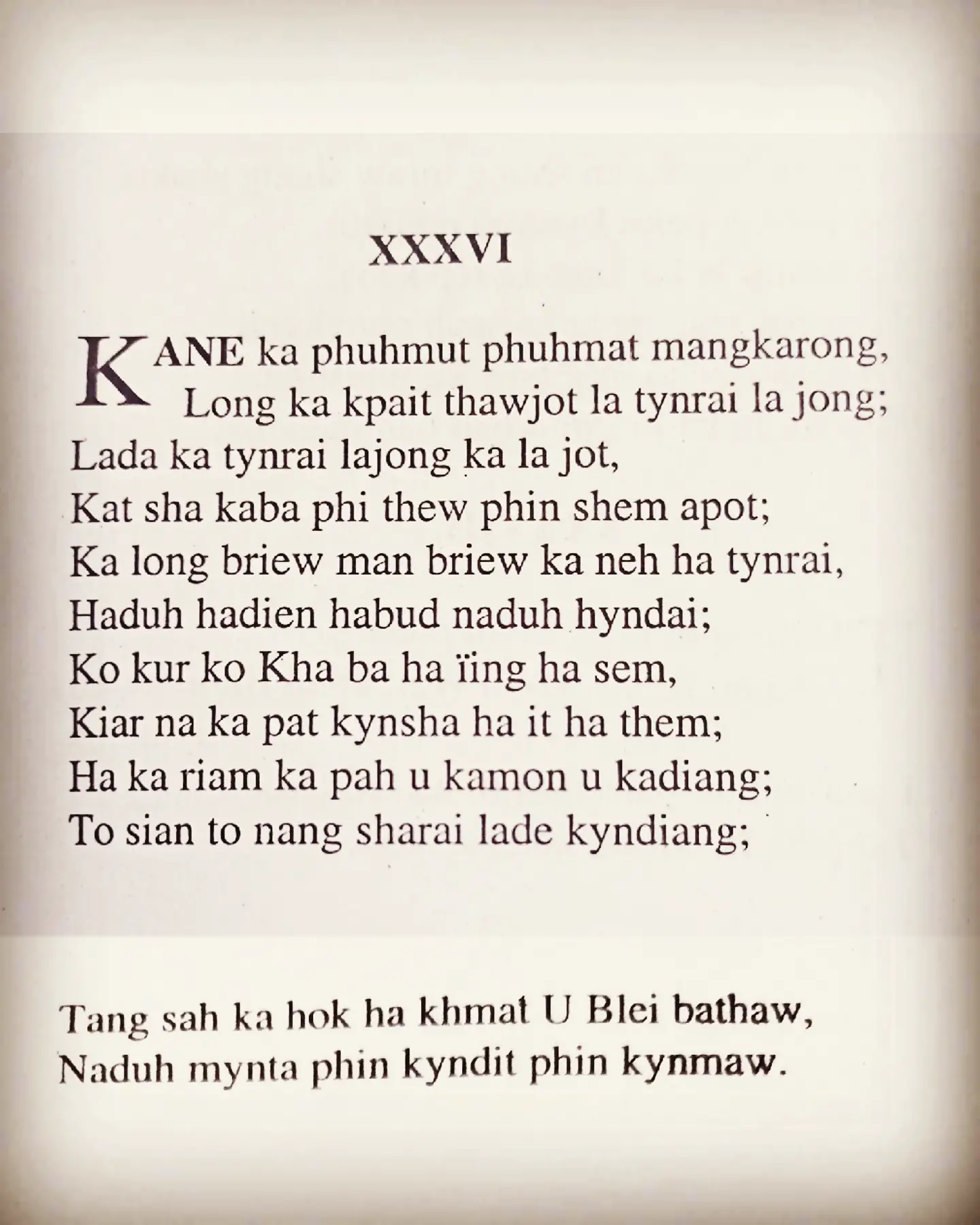
    Kane ka phuhmut phuhmat mangkarong,

    Long ka kpait thawjot la tynrai la jong;

    Lada ka tynrai lajong ka la jot,

    Kat sha kaba phi thew phin shem apot;

    Ka long briew man briew ka neh ha tynrai

    Haduh hadien habud naduh hyndai;

    Ko kur ko Kha ba ha ïing ha sem,

    Kiar na ka pat kynsha ha it ha them;

    Ha ka riam ka pah u kamon u kadiang;

    To sian to nang sharai lade kyndiang;

    Tang sah ka hok ha khmat U Blei bathaw,

    Naduh mynta phin kyndit phin kynmaw.

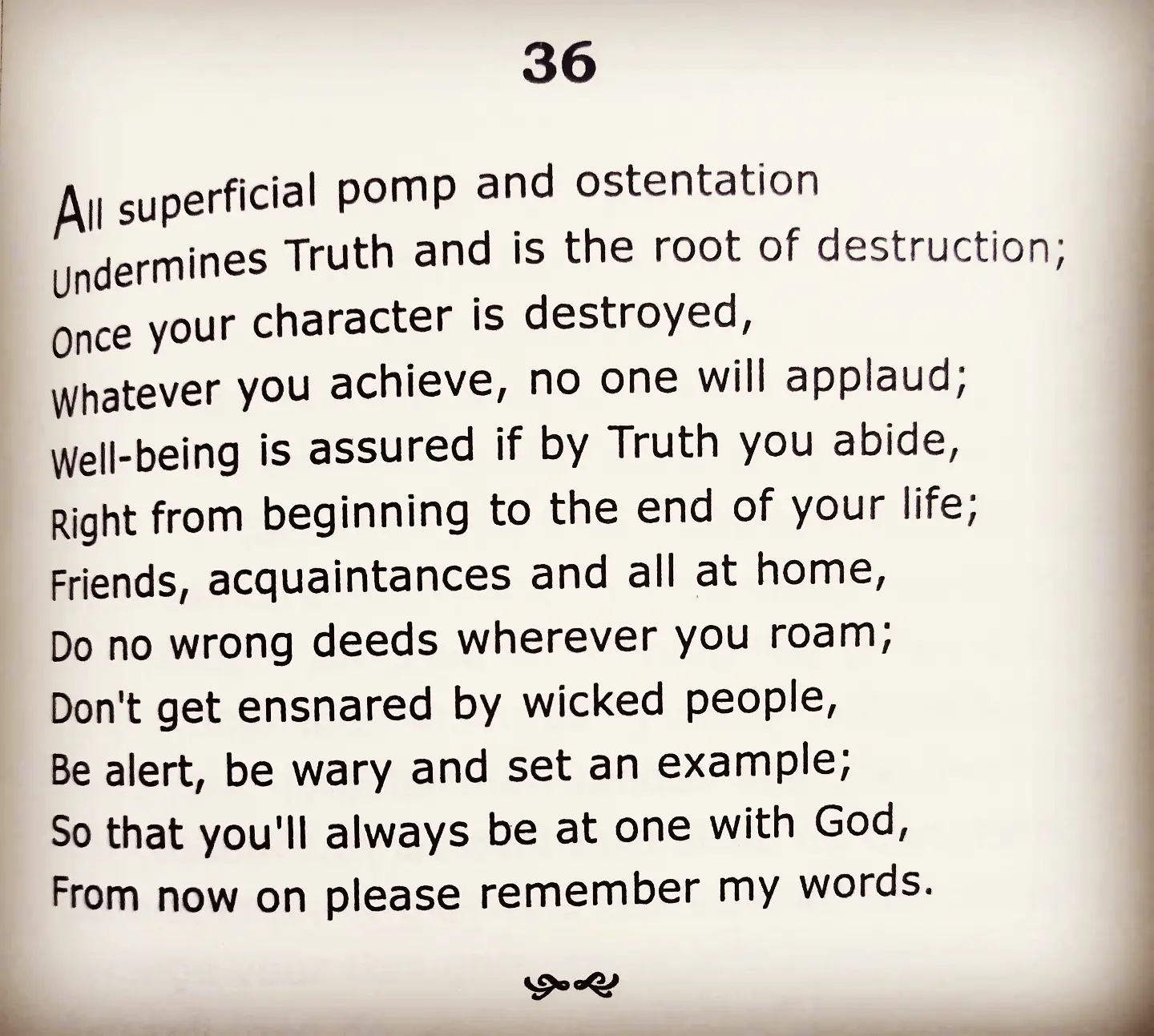
    All superficial pomp and ostentation

    undermines Truth and is the root of destruction;

    Once your character is destroyed,

    Whatever you achieve, no one will applaud;

    Well-being is assured if by Truth you abide,

    Right from beginning to the end of your life;

    Friends, acquaintances and all at home,

    Do no wrong deeds wherever you roam;

    Don't get ensnared by wicked people,

    Be alert, be wary and set an example;

    So that you'll always be at one with God,

    From now on please remember my words.

    Ka Jingsneng Tymmen Shaphang ka Akor Khasi ha ka Rukom Rwai Phawar, Part I (1902) & Part Il (1903) by Radhon Sing Berry Kharwanlang is a unique collection of valuable lessons and teaching on how to live a good and moral life. 📝✒️

    The teachings are given in the form of "phawar” where two lines follow the same rhyme scheme, that is, aa bb.

    Both Part | and Part II have been translated into English by Bijoya Sawian @sawianbijoya in her book The Teachings of Elders: Ka Jingsneng Tymmen, Parts I and II (1997).

    Slide 1: Ka Jingsneng Tymmen Shaphang ka Akor Khasi ha ka Rukom Rwai Phawar, Part I (1902)

    Slide 2: The Teachings of Elders: Ka Jingsneng Tymmen, Parts | and II (1997).

  • Tip Briew, Tip Blei

    The Khasi precept "Tip Briew, Tip Blei" literally translates to "Know man, know God". It is one of the three tenets of Khasi socio-religious cultural worldview, which can be understood as knowing man (in all the sense of knowing) is knowing God. One simply cannot approach to an understanding or a relationship with God if he/she cannot do so with his/ her fellow human beings. It does resonate with one of the laws that Jesus gave which is "to love thy neighbour" or even to the English proverb "service to man is service to God". For a Khasi, this phrase also gives one an ontological understanding of oneself.

    "Tip Briew Tip Blei" sent by @bada_boombam 😀💖💖💖 Thank you for another fantastic contribution Bada!

    "Tip Briew Tip Blei" is translated as Know Man, Know God. This Khasi precept is one of the three tenets of the Khasi socio-religuious cultural worldview. The other two being "Kamai Ïa Ka Hok" and "Tip Kur Tip Kha". These tenets should govern life in all aspects for the growth of a healthy and mindful collective consciousness.