Tag: legends

  • “Pahsyntiew” by Indari S. Warjri

    I heard of your beauty

    Blushing daughter of the deities

    Sheltered in your cave of chastity

    No man dare explore.

    A dark cascade rises from

    your shoulders

    But a tender lily

    Should not be bruised by

    hostile rocks.

    Your slender hand will stretch

    Towards the flower in the man's hand

    For in his hand man hold

    Unnamable delight.

    And you became mine,

    sweet maiden.

    O be the mother of my sons!

    But also the warm nest for

    my love.

    O children, may you be noble

    May you possess the

    strength of rocks

    May you protect the weak

    May you be suckled on knowledge

    For the celestials beckon

    And I must return.

    The sons became men, royal in stature

    Having wisdom gifted by the gods

    They came to rule the misty hills;

    To dwell in pinewood mansions

    Where carpets of clouds

    And cloaks of rain

    Conserve the forests of the Khasi hills.

    O mother, giver of life,

    See your sons-the syiems.

    "Pahsyntiew" by @indariwarjri based on the legend of Ka Pahsyntiew 🌹

    Indari S. Warjri (Associate Professor) is Head of the Department of English, St. Mary's College, Shillong.

    The Legend of Ka Pahsyntiew has been published in English, in the book Around the Hearth: Khasi Legends (Folktales of India) by Kynpham Sing Nongkynrih. The book is published by Penguin Books.
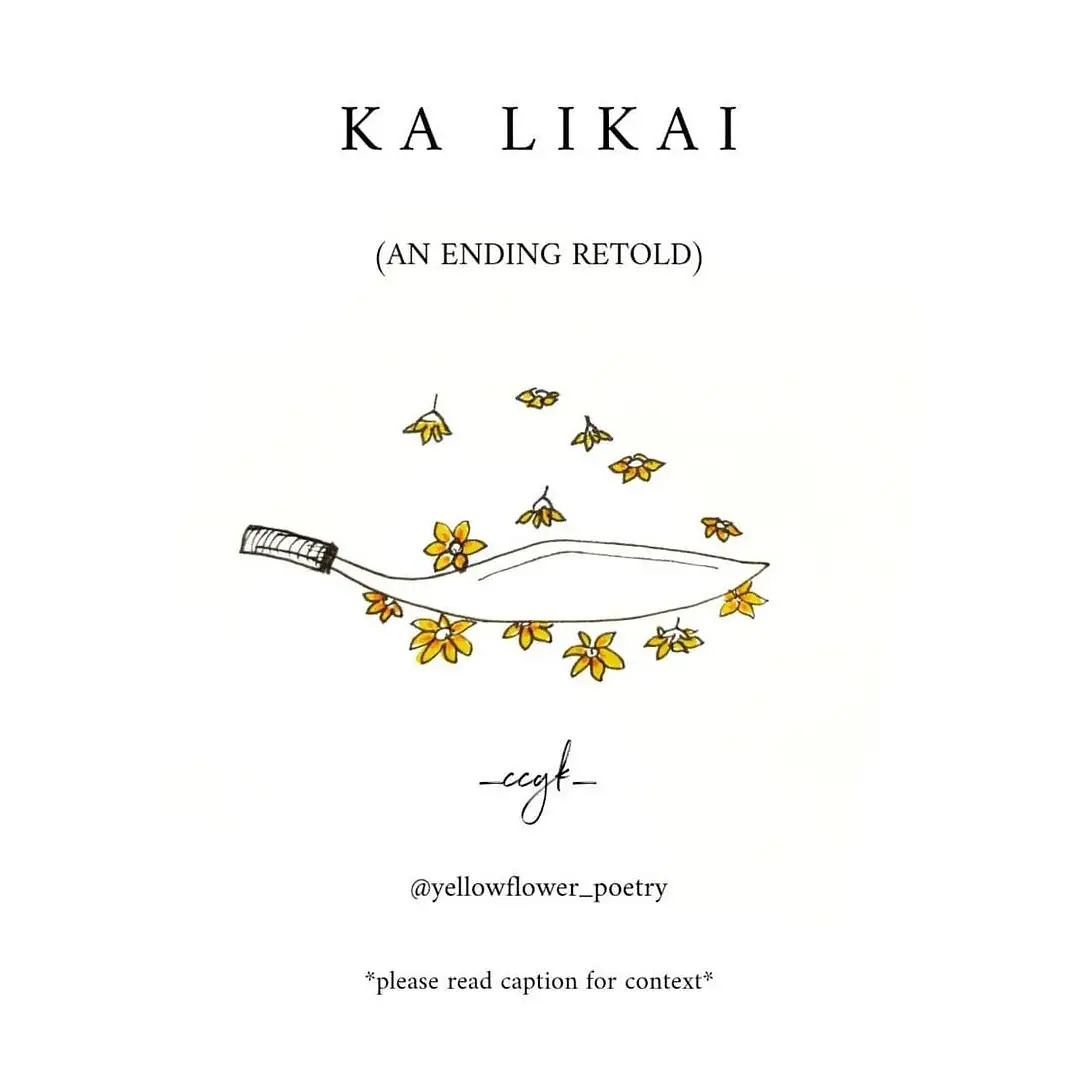
  • “Ka Likai (An Ending Retold)” by Clarissa Giri

    Calmly by the fire,

    She sits staring at the flames before her.

    Ember sparks burn freckles on weathered

    floorboards,

    Restless charcoal crackle uneasily in the dpei,

    While vapour fumes from her drenched

    kyrshah.

    Smoke and ash cling to her damp hair,

    A hot tear makes its way down her cheek,

    The wait glistens bloody at her heel,

    And she watches the shadows form on the

    wall before her

    As her ancestors dance for war.

    The rueful dish cooked to perfection,

    She feeds him a mouthful of this concoction-

    A stew of his own fingers; there will be no

    leftovers.

    How he tossed her daughter's tiny fingers like

    refuse in the shang-kwai,

    No. This butcher will devour his.

    There is a Khasi folktale about a widow named Likai who had a daughter whom she loved more than life itself. She was remarried after some time, to a man who later turned out to be abusive and dangerous and who eventually murdered her only daughter, while Likai was toiling in the fields. He butchered her and cooked a stew with the remains which Likai ate unknowingly. She found out after her meal when she was about to consume "kwai", a combination of betel leaf, lime and areca nut (a traditional edible) where she saw the remains of her daughter's fingers in the "shang-kwai" (areca nut basket).

    This caused a cacophony of chaos in her, driven by immense heartbreak and in a rage she ran after the man with a "wait" (a Dao or large bladed knife). Being unable to find him, in her madness-driven rage and being unable to endure life because of such a tragedy, Likai threw herself off of a waterfall. The waterfall is named after her fall "Noh Ka Likai" falls (Literally, Where Likai Jumped).

    This poem is a twist on that ending, as folktales go, there is always an ending of "What if?" and in this one there is no mention about what happened to the murderer and if ever he was given what he deserved. In this poem, I ask what if Likai found her daughter's murderer cowering in the forests of "Sohra" (Cherrapunji), and she was able to avenge her daughter before deciding upon her own fate?

    "Dpei" – hearth, "Kyrshah" – traditional khasi apron

    Caption and original artwork by @yellowflower_poetry