Lapdiang Syiem’s Dramatisation of The Legend of Ka Noh Ka Likai: A Review by Dr. Amanda C. Tongper and Dr. Daiarisa Rumnong
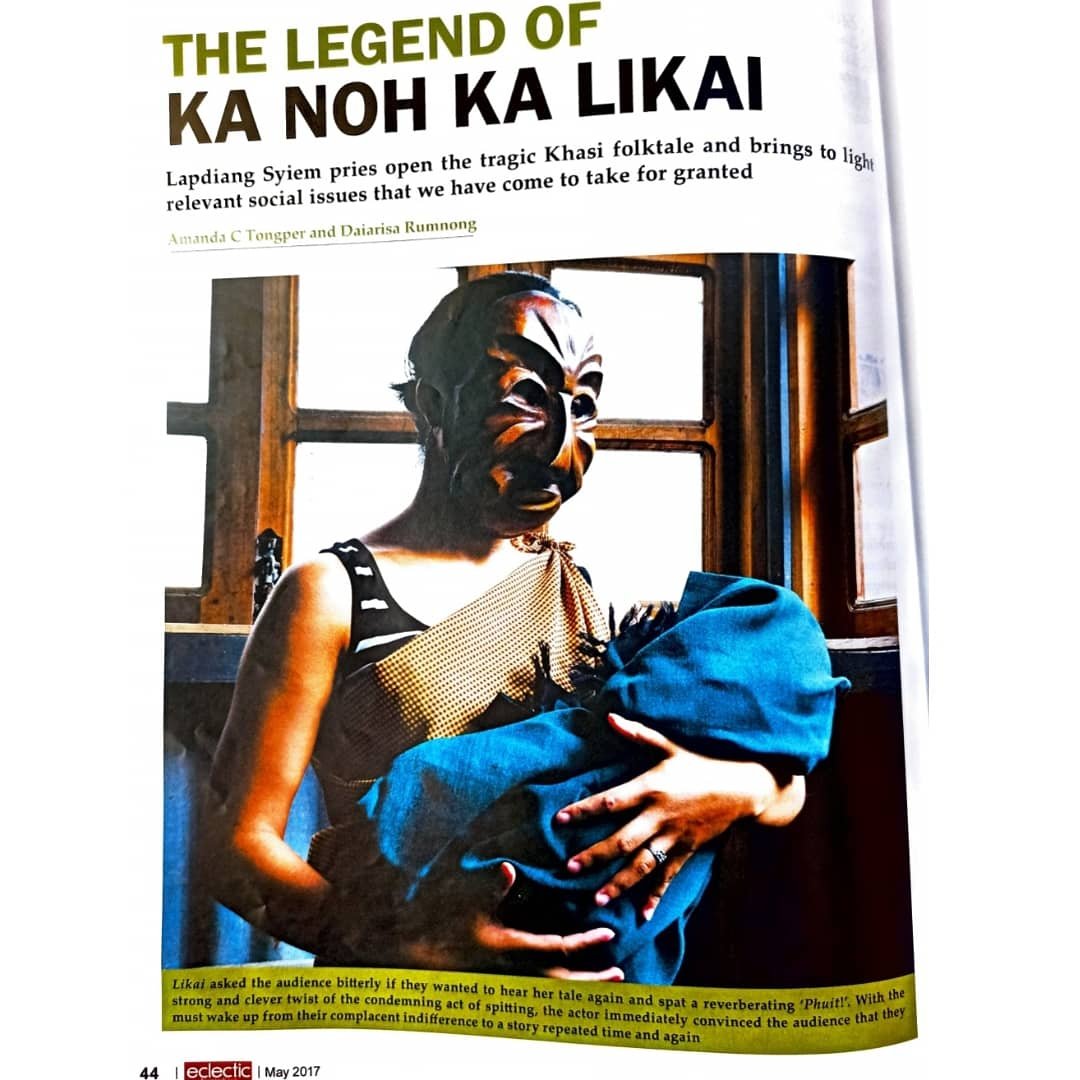
Nothing prepared us for the phenomenon which is Lapdiang Syiem. As we were ushered in into the enclosed space at Dylan’s Café, we were greeted by a figure framed atop a mula, transfixed with a baby in her arms. We stopped for a second, looking for traces of life in that mannequin of a being even though we knew at the back of our minds, that it is the actor, Lapdiang Syiem. The first achievement of the actor was accomplished in the very first seconds of the play, as we later realised that we did not just enter the room where the performance was to take place – we were pulled into the orbit of the actor with a grip that was to hold us for the rest of the performance.
Lapdiang, through the character of Likai, pried open the tragic story of Ka Noh Ka Likai that has been encapsulated in time and brought to light relevant social issues muted within a tale that we have come to take for granted. Likai asked the audience bitterly if they wanted to hear her tale told again and spat a reverberating “Phuit!” With the strong and clever twist of the condemning act of spitting, the actor immediately convinced the audience that they must wake up from their complacent indifference to a story repeated time and again. The spit cautioned the audience that in this re-telling, they cannot rely on their rote-memory of the story. The spit challenged the collective conscience of the audience who may have known the narrative of Ka Noh Ka Likai, but has never thought to understand the story of Ka Likai, the being with thoughts and emotions of her own.
Lapdiang Syiem’s performance provokes a fresh look at the oft-told story of Likai. Entering the venue, the image of Lapdiang whose face was covered by a mask, holding a baby seemed to be suspended in purgatory, adrift in limbo. The image is at once a detonating symbol. It evokes the pre-conceived notion that a woman is pitiable, weak, unsettled on her own and a man is her only anchor. This notion that rises from a deep-seated, almost genetic conditioning remains such an inescapable factor even in this 21st century stage of our lives. The orbit we were drawn into had a familiar ring to it. But were we looking hard enough to notice the reflection we should see of ourselves; of how much the motif of a woman jumping to her death actually echoes all those stories of violence, dispossession and death? Why is it that a woman is expected to be tied to a man? Why does a part of a so-called “binary” cannot exist alone? In the performance of Ka Noh Ka Likai, Likai after living as a widow was told by other women in her community that she should marry another man. A man it appears embodies security. However, this “security” that society perceives as normal or good may actually lead to irrevocable despair.
The only device that aided Lapdiang’s performance was the music played by Apkyrmen Tangsong. Apkyrmen played original compositions on the maringud, ksing and besli. All three instruments moulded themselves into the performance, even eerily voicing out the muffled cries
of Likai’s baby. The poignant and haunting pieces feel like the past knocking on our foreheads saying: “Don’t get too comfortable, too familiar with showing me off. Try to understand my relevance for the present and even the future!” The music, words and gestures of the performance swayed the audience, dug out tears, drawing us breathless with questions that perhaps are desperate to break free. It made us feel uncomfortable…in all the right places.
In Lapdiang’s performance, there is a curious blend of acting and telling, so that one is compelled to say, the oral is still with us. One usually speaks of the oral tradition with a sense of
nostalgia, as a thing of the papyral past. However, with Lapdiang’s performance, one witnesses that this form of communication has never really left us. We only have to engage with it once again. The gusts and ripples of ka Ka Noh Ka Likai echo everyday, do we listen?
As the play came to its end, there was silence among the audience. It was a sacred moment to watch Lapdiang give Likai life with such heart, strength and intelligence.
Lapdiang Syiem is a force to be reckoned with.
Lapdiang A. Syiem was born and brought up in Shillong. She is a graduate from National School of Drama, Delhi with a specialisation in Physical Theatre from the Commedia School, Copenhagen. In 2016, Lapdiang, along with Keshav Pariat and Juban Lamar founded an artistic commune called, The Unhinged Commune. They blog regularly at kinongbamsohlah.wordpress.com
This is a review of a fantastic and heart-wrenching performance by @lapdiangsyiem of "The Legend of Ka Noh ka Likai" in 2017. Folktales transformed into theatre is something else! 💫💫💫
The review was published in @eclectic_northeast magazine and has been written by Dr. Daiarisa Rumnong (Assistant Professor, St. Mary's College) and Dr. Amanda C. Tongper (Assistant Professor, St. Anthony's College).
Thank you @lamar.juban for the beautiful pictures used in this review!
Please send an email to speak.your.roots@gmail.com if you would like to read the review!