Chapter – 6 The Ethno-archaeology of Sohpet Bneng Hill
While pursuing historical research with an archaeological approach, the contemporary traditional mode of life can contribute greatly in providing analogy about the ones in the past, since archaeological interpretation basically depends and ultimately rests on analogy. The significance of ethnology in archaeology can be understood from the remarks made by some archaeologists that archaeological reconstruction is an analogy with or without ethnological recourse In order to understand the material culture preserved in traditional practices, ethnoarchaeology? tries to study the possible correlation between the material culture of the people on one side and the unobservable social relations or spiritual life on the other. Thus the material data can be used to integrate knowledge to other non-material or intangible facets of the society which are reflected and embedded in tradition through an approach called folk archaeology! Archaeology can therefore contribute directly towards historical reconstruction when conventional historical sources are lacking or when other forms of preserved traditions require substantial support. By doing so, the mythical notion about the ancient ways of life, particularly the lifestyle of the pre-historic people is significantly reduced.
Applying "Direct Historical Analogy" when there is temporal continuity between the archaeological culture and the ethnographic culture, the folk narrative of U Sohpet Bneng can become part and parcel of ethno archacological research, not as a partial and fragmentary record of the past, but as true elements that can be rescued from the clouding fantasy and helped to blend the two interacting modes of representing the past by using different accounts of the same events and objects.
Inspired by the folk narrative, a systematic archaeological survey and exploration of the entire hill range around the areas close to Sohpet Bneng peak is conducted to gain empirical data from the area. During the course of exploration, which started in year 2003, the archaeological site of Lawnongthroh* which lies at the foot of the peak and along the ridge of Sohpet Bneng hill is discovered. Archaeological evidences of different cultural periods are observed at the site which stretched to more than a kilometer along the ridge.
The site of Lawnongthroh is named after a village which is located in the northern slopes of Sohpet Bneng hill in the Ri-Bhoi district of Khasi hills, Meghalaya. On the ridge of the hill's northern slope that extends approximately 1.5 Kms in length and spread between 50-60 Meters in width, archaeological evidences like the Megalithic monuments, secondary burial Cist, cremation mound, Iron smelting area and wheel-made potsherds are found. Subsequent exploration of the ridge led to the discovery of 11 numbers of stone implements of Neolithic origin from the surface of a site which falls in one of the village's locality called Lum Mawbuh on the northern part of the village.
According to informant the archaeological evidences recorded on the western slope of the ridge are associated with an ancient deserted settlement called, Mawbuh which lies a kilometer north of the present Lawnongthroh village. The source also added that it was the inhabitants of the Mawbuh village who were the first people to initiate religious ceremonies at the Lum Sohpet Breng peak. The ridge top of Lawnongthroh on the other hand, was an uninhabited area then and known to the inhabitants of ancient Mawbuh village by the name
Synner, known for being an ancient route where the procession rested for a night before the ceremony at the apex of U Lum Sohpet Bneng.
After the abandonment of the ancient Mawbuh settlement, there was a lull phase of human occupation on the hill till the appearance of the present village of Lawnongthroh which came into existence on the ridge only 30 years ago. These new occupants who formed the present village came in at different times from other nearby villages and also from distant places of Khasi hills to farm and cultivate on the ridge and its hill slopes. The reoccupation of the site after a long interval of abandonment is an important feature to help understand The settlement system on this hill and can also offer strong analogy on the pattern of human occupation of the area in archaeological past and an important pointer to the antiquity of settlement, giving the hill a unique character of being an area attraction. Archaeological findings from this area which are associated with different cultural periods of the past are clear evidence of human occupation pattern on the ridge and its surrounding slopes.
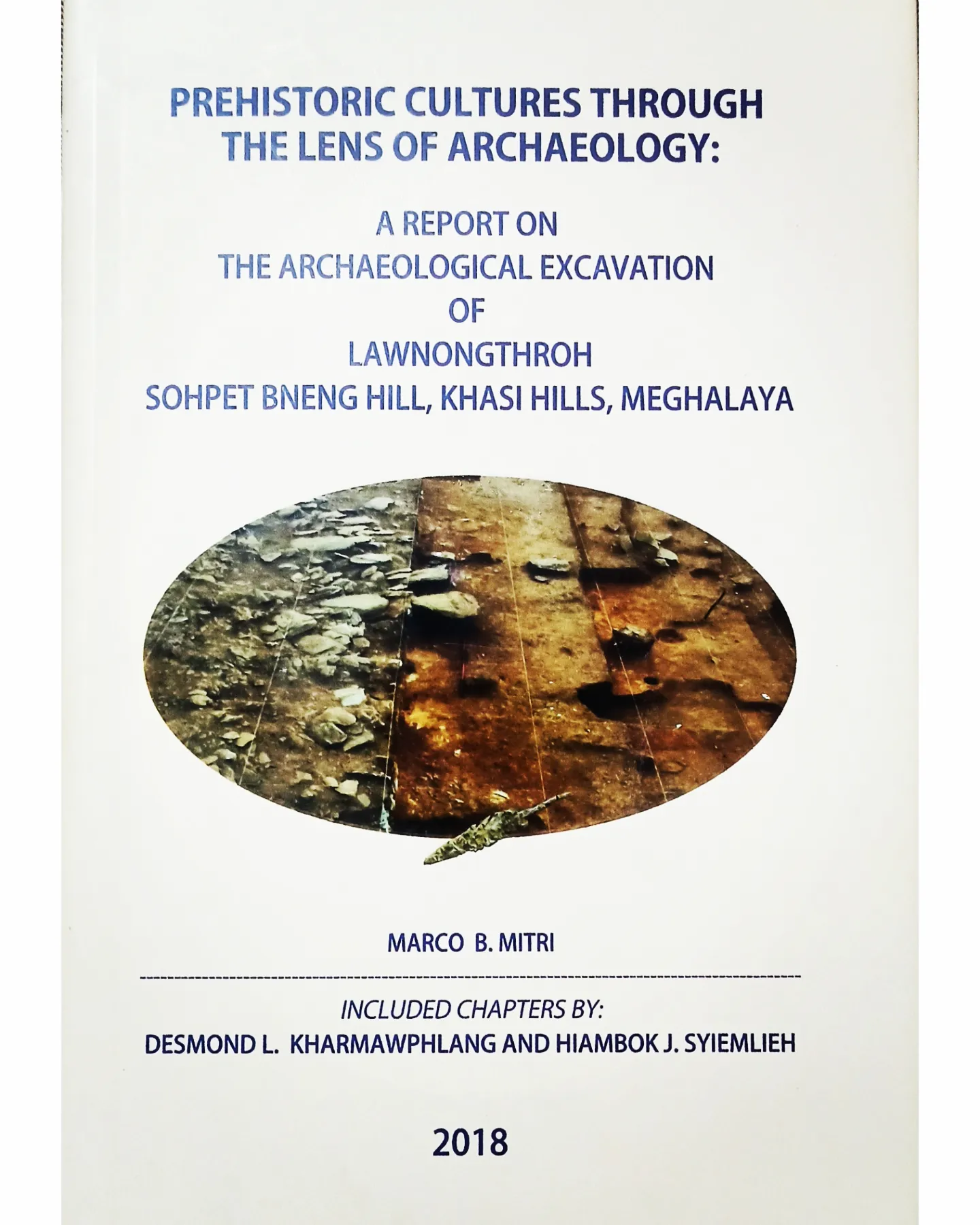
Prehistoric Cultures Through The Lens Of Archaeology: A Report On The Archaeological Excavation Of Lawnongthroh, Sohpet Bneng, Khasi Hills, Meghalaya (2018) by Dr. Marco Babit Mitri is a wonderful treasure which documents the archaeological efforts in Lawnongthroh, Sohpet Bneng Hill.
The book merges archaeology, geography, history and cultural studies to build a vivid understanding of life in the area. 📝⛏️⚒️📏📐📚
The post shows excerpts from Chapter 6 which focusses on "The Ethnoarchaeology of Sohpet Bneng Hill" 🏞️🌄
Dr. Mitri has lead an intensive research of the site and reading the book piques the imagination as one reads of Neolithic sites and stone artifacts in the Khasi and Jaiñtia Hills.
Dr. Mitri is an Associate Professor at Union Christian College, Meghalaya. Dr. Mitri specialises in the fields of Archaeology and Prehistory.