Tag: phawar

  • “Ka Jingsneng Tymmen Shaphang ka Akor Khasi ha ka Rukom Rwai Phawar”, Part I (1902) & Part II (1903)

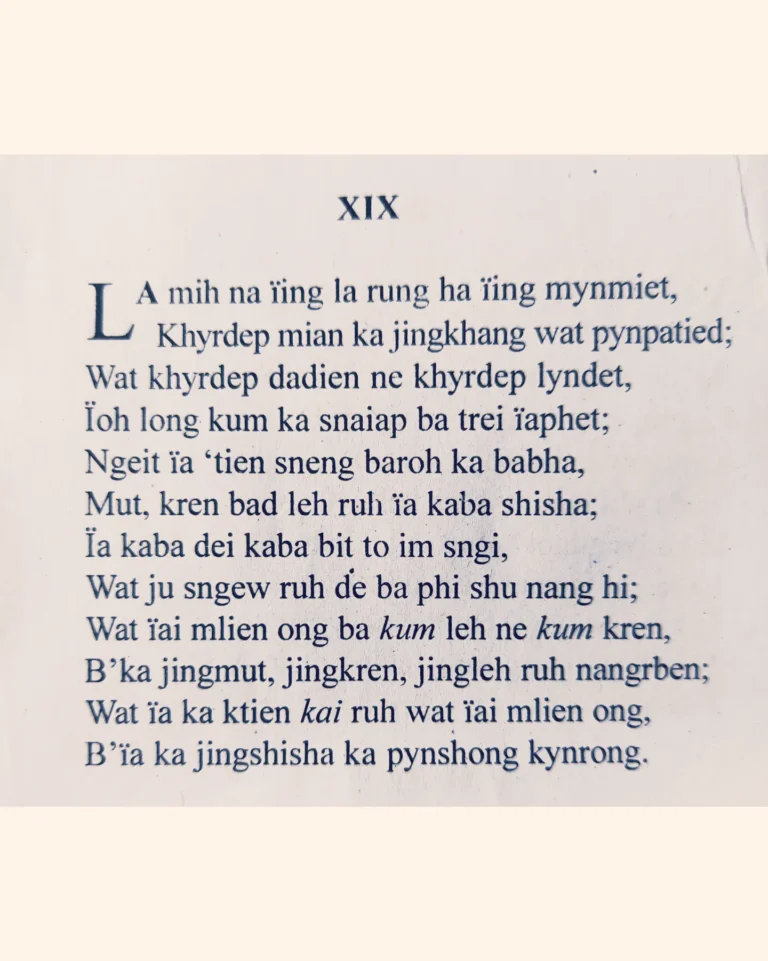
    La mih na ïing la rung ha ïing mynmiet,

    Khyrdep mian ka jingkhang wat pynpatied;

    Wat khyrdep dadien ne khyrdep lyndet,

    Ïoh long kum ka snaiap ba trei ïaphet;

    Ngeit ïa 'tien sneng baroh ka babha,

    Mut, kren bad leh ruh ïa kaba shisha;

    Ïa kaba dei kaba bit to im sngi,

    Wat ju sngew ruh de ba phi shu nang hi;

    Wat ïai mlien ong ba kum leh ne kum kren,

    B'ka jingmut, jingkren, jingleh ruh nangrben;

    Wat ïa ka ktien kai ruh wat ïai mlien ong,

    B'ïa ka jingshisha ka pynshong kynrong.

    When at night, from the house, you go and come,

    Quietly close the door do not bang and thump;

    With your back turned do not close it either,

    It's wrong, incorrect, it's unnatural behaviour;

    Always pay heed to words of advice,

    Adhere to Truth whatever betides;

    Also abide by what's morally excellent,

    Ne'er feel you're above admonishment;

    Don't get habituated to making excuses

    For your wrong doings lest the habit increases;

    Too much light talk and banter do shun,

    It weakens Truth, it upsets its foundation.

    Ïa katei ka dkhot kaba 19 la shim na "Ka Jingsneng Tymmen" Part I.

    "Ka Jingsneng Tymmen Shaphang ka Akor Khasi ha ka Rukom Rwai Phawar" Part I (1902) & Part II (1903) by Radhon Sing Berry Kharwanlang is a unique collection of valuable lessons and teaching on how to live a good and moral life. The teachings are given in the form of "phawar” where two lines follow the same rhyme scheme, that is, aa bb.

    Both Part I and Part Il have been translated into English by Bijoya Sawian @sawianbijoya in her book "The Teachings of Elders: Ka Jingsneng Tymmen, Parts I and II" (1997).

    🟡 Slide 1: Number 19 "Ka Jingsneng Tymmen Shaphang ka Akor Khasi ha ka Rukom Rwai Phawar" Part I (1902)

    🟡 Slide 2: Number 19 "The Teachings of Elders: Ka Jingsneng Tymmen, Parts I and II" (1997).

    #kajingsnengtymmen #radhonsingberrykharwanlang #theteachingsofelders #bijoyasawian #moralteaching #morallesson #phawar #speakyourroots #speakyourrootschallenge #talklocal

  • “Ka Jingsneng Tymmen Shaphang ka Akor Khasi ha ka Rukom Rwai Phawar”, Part I (1902) & Part II (1903)

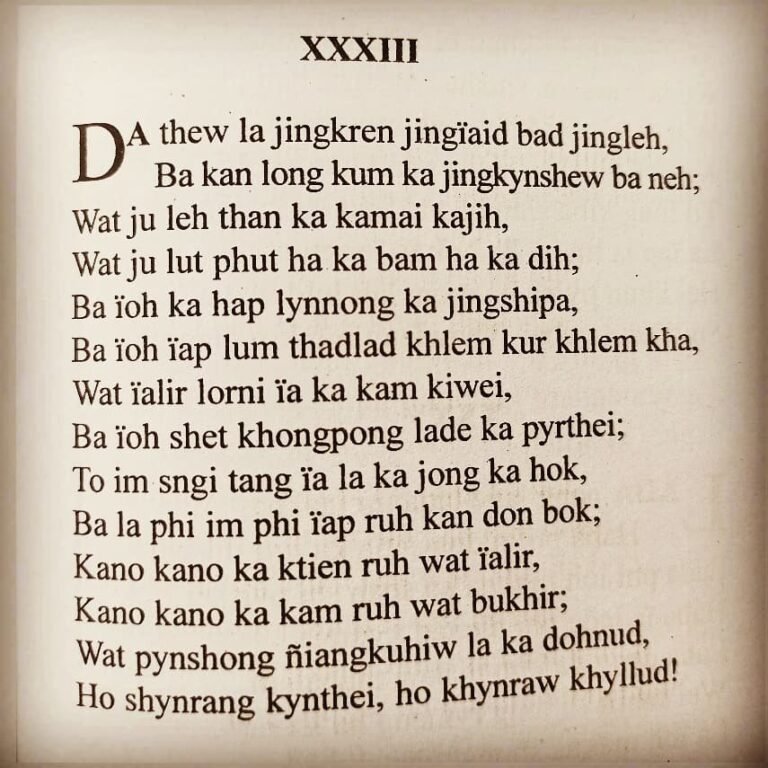
    Da thew la jingkren jingïaid bad jingleh,

    Ba kan long kum ka jingkynshew ba neh;

    Wat ju leh than ka kamai kajih,

    Wat ju lut phut ha ka bam ha ka dih;

    Ba ïoh ka hap lynnong ka jingshipa,

    Ba ïoh ïap lum thadlad khlem kur khlem kha,

    Wat ïalir lorni ïa ka kam kiwei,

    Ba ïoh shet khongpong lade ka pyrthei;

    To im sngi tang ïa la ka jong ka hok,

    Ba la phi im phi ïap ruh kan don bok;

    Kano kano ka ktien ruh wat ïalir,

    Kano kano ka kam ruh wat bukhir;

    Wat pynshong ñiangkuhiw la ka dohnud,

    Ho shynrang kynthei, ho khynraw khyllud!

    Always with discretion talk and act,

    It's an investment that remains intact;

    Do not overspend and your earnings deplete,

    In drink and food, too, be discreet;

    An extravagant life leads to penury,

    You'll die alone without people and money;

    Do not interfere in others' lives,

    It does no good, trouble multiplies;

    Concentrate on a life that's good and true,

    Good fortune will always be there with you;

    Never be too inquisitive and too prying,

    Never meddle and be too interfering;

    Always keep your innocent hearts pure as a pearl

    All ye budding youth, ye boys and girls.

    Ka Jingsneng Tymmen Shaphang ka Akor Khasi ha ka Rukom Rwai Phawar, Part I (1902) & Part II (1903) by Radhon Sing Berry Kharwanlang is a unique collection of valuable lessons and teaching on how to live a good and moral life. 📝📄📙

    The teachings are given in the form of "phawar" where two lines follow the same rhyme scheme, that is, aa bb.

    Both Part I and Part II have been translated into English by Bijoya Sawian @sawianbijoya in her book The Teachings of Elders: Ka Jingsneng Tymmen, Parts I and II (1997).

    Picture 1: Ka Jingsneng Tymmen Shaphang ka Akor Khasi ha ka Rukom Rwai Phawar, Part I (1902)

    Picture 2: The Teachings of Elders: Ka Jingsneng Tymmen, Parts I and II (1997).

  • “Ka Jingsneng Tymmen Shaphang ka Akor Khasi ha ka Rukom Rwai Phawar”, Part I (1902) & Part II (1903)

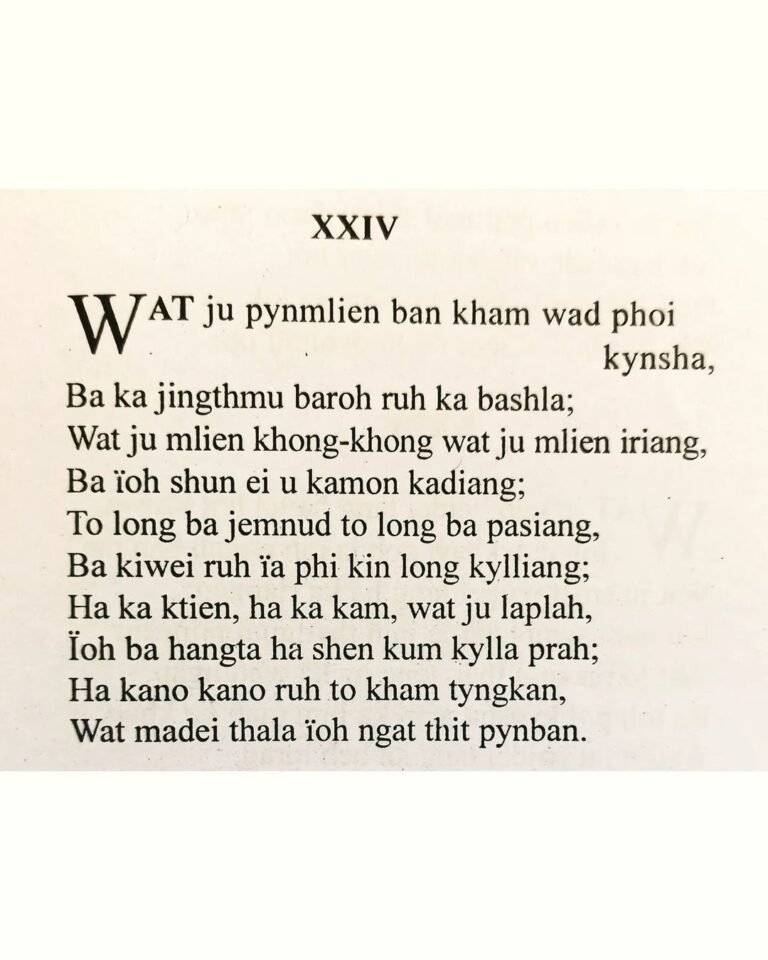
    Wat ju pynmlien ban kham wad phoi kynsha,

    Ba ka jingthmu baroh ruh ka bashla;

    Wat ju mlien khong-khong wat ju mlien iriang,

    Ba ïoh shun ei u kamon kadiang,

    To long ba jemnud to long ba pasiang,

    Ba kiwei ruh ïa phi kin long kylliang;

    Ha ka ktien, ha ka kam, wat ju laplah,

    Ïoh ba hangta ha shen kum kylla prah;

    Ha kano kano ruh to kham tyngkan,

    Wat madei thala ïoh ngat thit pynban.

    Don't sulk and be moody without any cause,

    All good intentions and aims will surely be lost;

    Don't be irritable and easily ired,

    You'll make enemies wherever you are;

    Be gentle and helpful, good-natured and kind,

    Others will pay you back some time;

    In word and deed don't be in a hurry,

    Everything goes wrong and topsy turvy;

    In whatever you do, whatever you think,

    Be not in a rush for you'll suffer and sink.

    Ïa katei ka dkhot kaba 24 la shim na ka Ka Jingsneng Tymmen Part I.

    Ka Jingsneng Tymmen Shaphang ka Akor Khasi ha ka Rukom Rwai Phawar, Part I (1902) & Part II (1903) by Radhon Sing Berry Kharwanlang is a unique collection of valuable lessons and teaching on how to live a good and moral life. 😄🌲😌

    The teachings are given in the form of "phawar” where two lines follow the same rhyme scheme, that is, aa bb.

    Both Part I and Part Il have been translated into English by Bijoya Sawian @sawianbijoya in her book "The Teachings of Elders: Ka Jingsneng Tymmen, Parts I and II" (1997).

    Slide 1: Ka Jingsneng Tymmen Shaphang ka Akor Khasi ha ka Rukom Rwai Phawar, Part I (1902)

    Slide 2: The Teachings of Elders: Ka Jingsneng Tymmen, Parts I and II (1997).

  • Ka Liengmakaw da Jespil Syiem

    There was once an orphaned youth U Manik by name who had no living relative in the world. He was nicknamed U Manik Raitong, meaning the lonely one, absolutely bereft of all family support. So overcome was he with the loss that had struck him early in his young life, that he roamed the village like one mad. At night, however, he would put away his sackcloth and ashes, eat, bathe and dress himself up in ceremonial garb. Then he would take up his flute, and play the most compelling dirges on it. Unknown to him, U Syiem's wife who had often heard him, became completely magnetised by the tunes that he played on his flute. In the event of U Syiem having to leave her to attend to matters of state in nearby regions, she was left all alone and was therefore lonely. Besides she had only just been married to U Syiem. One night she felt compelled to come to Manik's hut, but was denied entry. She broke open the door in order to be able to hear him better. However much he tried to send her away she refused.

    It was thus that she came to him every night and as a result she became pregnant. However, never once did she disclose her identity to him. When U Syiem returned after long months of being away he found that Ka Lieng Makaw, his wife, had given birth to a son who was now a few months old. He was naturally angry when he found that his wife refused to disclose the identity of the father. He summoned his people and commanded all the men folk to assemble before him. Each was ordered to bring a bunch of bananas with him. On the assigned day he ordered each one of them to offer a banana to the baby boy in order to prove the boy's paternity. However, the baby boy refused each man's offer.

    Then, when U Syiem inquired if any man had been left out, general mention was made of U Manik Raitong. It was a known fact that U Manik Raitong lived a life that was no better than a dog's. U Syiem took no chances, however, and had him come to court with a bunch of bananas. When the baby boy was offered the fruit he reached for it as if familiar with U Manik Raitong. The father having been identified, it was now the turn of the people to be shocked. U Syiem's anger knew no bounds and he ordered that U Manik Raitong be beaten to death as a criminal. U Manik Raitong, however, pleaded before the king to be allowed to choose death by burning.

    On the assigned day U Manik Raitong dressed in all his finery, made his way backwards to the funeral pyre, all the while playing on his flute. The people had already set the pyre alight. When he reached it he walked round three times but before jumping into the burning pyre, he stuck his flute upside down into the ground. The queen too who was indeed agitated beyond control and who had also dressed up as U Manik Raitong had done, watched every development from her room. But when she saw U Manik Raitong jump into the funeral pyre she rushed after him in order to join him in death. The funeral pyre was transformed into a gushing spring of water which exists even to this day, and if one were to visit Raitong one would discover that in the place where the flute had been planted upside down there grows a cluster of bamboos, whose leaves point downwards.

    Khublei Shibun Daohi Manar @xdtnoahjupejackllthmanar ba phi phah ïa kine ki dur jong kane ka kot 😄🙏

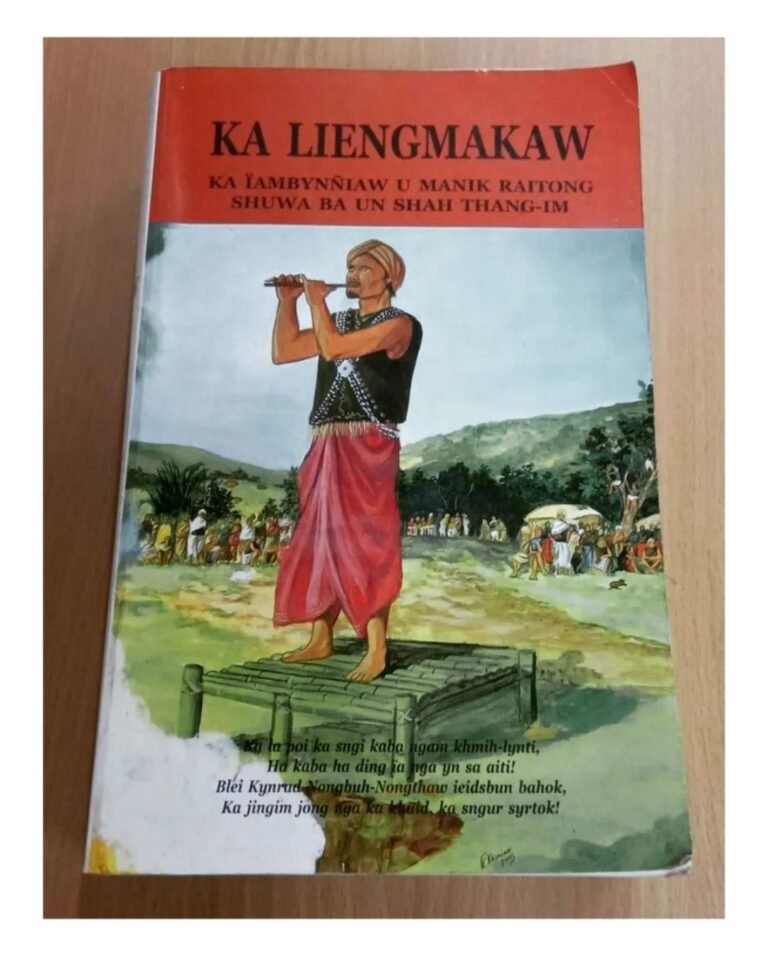
    U Daohi u ong: Ka kot Ka Lieng Makaw: Ka Ïam bynñiaw u Manik Raitong Shuwa Ba Un Shah Thang-Im ka dei ka jinglum lang jong ki jingrwai phawar kiba la rwai da i Bah Jespil Syiem. Kaba donkam ban tip ka long ba i Bah Syiem i khlem thoh ïa kine ki phawar, hynrei la lum lang hangne bad pynmih da ka Seng Kyrsei, jong ka Hima Raid UMden-Nongtluh, Ri Bhoi. Ïa kane ka kot la lah ban pynmih da ka jingimsngi bad jingduriap jong ka Vendrame Missiological Institute, Sacred Heart Theological College ka ba don ha Mawlai, Meghalaya.

    Kane ka kot ka batai bniah bha shaphang ka jingïam bynñiaw jong u Manik Raitong shuwa ba un shah thang-im bad ïa kane ngi lah ban sngewthuh lyngba ka jingpynwandur jong ki phawar. La thoh ïa kane ka kot ha ka rukom jong ki phawar. Ïa kine ki phawar la pynwandur da i Bah Syiem bad haba ngi pule ïa ki, nga sngew ki don ka bor ban pynmutdur ne pynpyrkhat ïa ka jinglong-jingman jong kata ka jingïam bynñiaw u bapli u Manik Raitong. Kaba myllung shuh shuh ka dei ka jingdon jong ki dur, kiba la pynwan katkum ki lynnong phawar.

    Daohi says: The book Ka Lieng Makaw — Ka Ïambynñiaw u Manik Raitong Shuwa Ba Un Shah Thang-im is a compilation of "phawar" sung by Jespil Syiem published by Seng Kyrsei, jong ka Hima Raid Umden-Nongtluh, Ri Bhoi. It is important to note that the phawar in the book have not been written by Mr. Syiem, as he has only sung and performed them. The book has also been released through the efforts of Vendrame Missiological Institute, Sacred Heart Theological College ka ba don ha Mawlai, Meghalaya.

    The book contains elaborate details of the sorrow and pain of "U Manik Raitong" before his burning and this is brought to us through the compositions of the "phawar". The story of "U Manik Raitong" and "Ka Lieng Makaw" is delivered through the singing of the "phawar". They have been composed in such a way as to express the despairing cries of "U Manik Raitong". What makes it even more evocative are the pictures that have been drawn according to the chapters of the "phawar".

    The English translation of the story is taken from "U Manik Raitong, Icon of Love and Creativity: An Appraisal" in the book The Oral Discourse in Khasi Folk Narrative by Dr. Esther Syiem.

  • Ka Jingsneng Tymmen Shaphang ka Akor Khasi ha ka Rukom Rwai Phawar”, Part I (1902) & Part Il (1903)

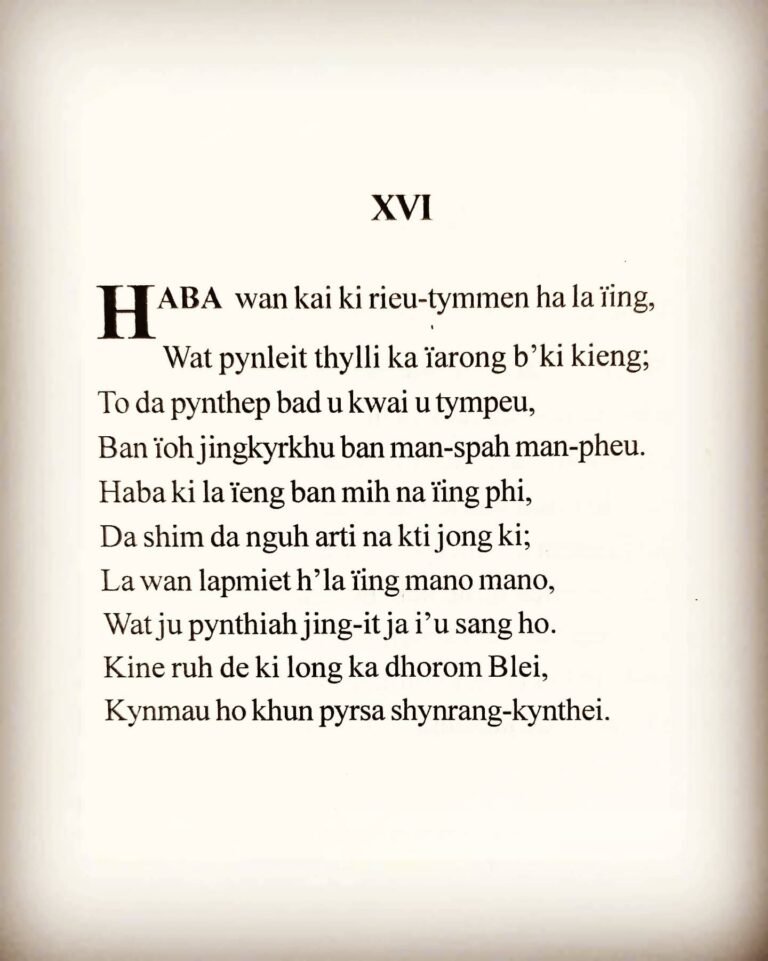
    Haba wan kai ki rieu-tymmen ha la ïing

    Wat pynleit thylli ka ïarong b'ki kieng;

    To da pynthep bad u kwai u tympeu,

    Ban ïoh jingkyrkhu ban man-spah man-pheu.

    Haba ki la ïeng ban mih na ïing phi,

    Da shim da nguh arti na kti jong ki;

    La wan lapmiet h'la ïing mano mano,

    Wat ju pynthiah jing-it ja i' u sang ho.

    Kine ruh de ki long ka dhorom Blei,

    Kynmau ho khun pyrsa shynrang-kynthei.

    Whenever elders come visiting,

    Their bags shouldn't be empty while returning;

    Fill them with 'paan' leaves and betel nuts,

    You'll be blessed and praised and rewarded;

    When they are ready to get up and go,

    Bow with folded hands touching theirs too;*

    If they are delayed and their departure defer,

    Food and lodging you must always offer,

    These rules too come from God Almighty,

    Ye boys and girls take these seriously.

    * The traditional way of greeting and leave taking among the Khasis.

    "Ka Jingsneng Tymmen Shaphang ka Akor Khasi ha ka Rukom Rwai Phawar", Part I (1902) & Part Il (1903) by Radhon Sing Berry Kharwanlang is a unique collection of valuable lessons and teaching on how to live a good and moral life. 🌻🌼🏵️

    The teachings are given in the form of "phawar” where two lines follow the same rhyme scheme, that is, aa bb.

    Both Part I and Part II have been translated into English by Bijoya Sawian @sawianbijoya in her book "The Teachings of Elders: Ka Jingsneng Tymmen, Parts I and II" (1997).

    Slide 1: "Ka Jingsneng Tymmen Shaphang ka Akor Khasi ha ka Rukom Rwai Phawar", Part II (1902)

    Slide 2: "The Teachings of Elders: Ka Jingsneng Tymmen, Parts I and II" (1997).

  • Ka Jingsneng Tymmen Shaphang ka Akor Khasi ha ka Rukom Rwai Phawar”, Part I (1902) & Part Il (1903)

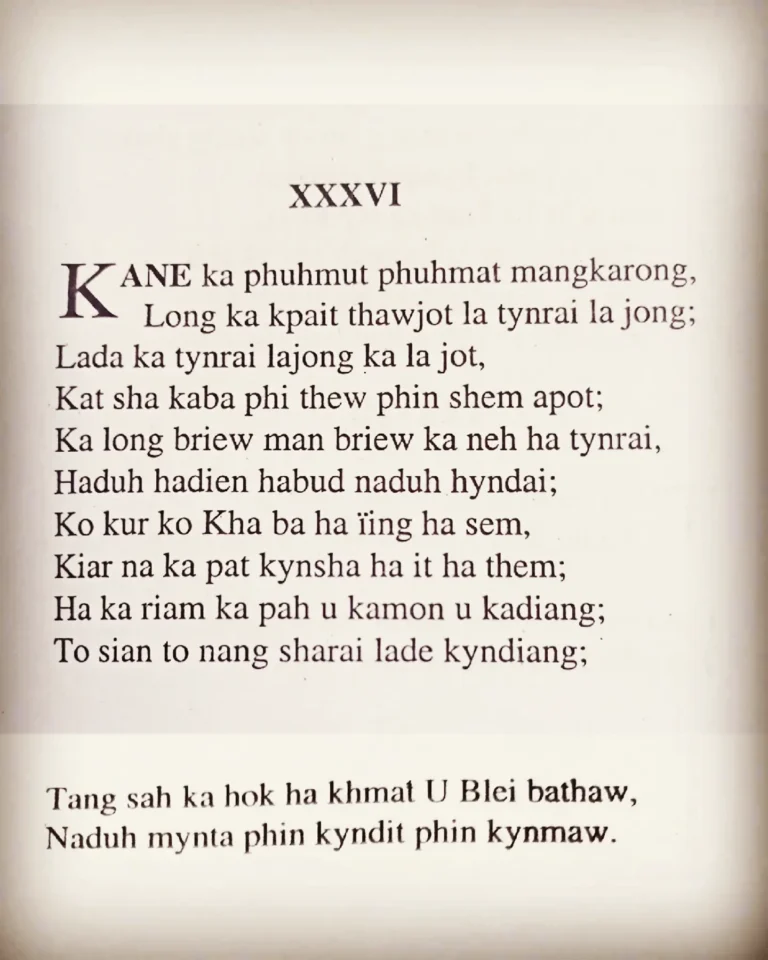
    Kane ka phuhmut phuhmat mangkarong,

    Long ka kpait thawjot la tynrai la jong;

    Lada ka tynrai lajong ka la jot,

    Kat sha kaba phi thew phin shem apot;

    Ka long briew man briew ka neh ha tynrai

    Haduh hadien habud naduh hyndai;

    Ko kur ko Kha ba ha ïing ha sem,

    Kiar na ka pat kynsha ha it ha them;

    Ha ka riam ka pah u kamon u kadiang;

    To sian to nang sharai lade kyndiang;

    Tang sah ka hok ha khmat U Blei bathaw,

    Naduh mynta phin kyndit phin kynmaw.

    All superficial pomp and ostentation

    undermines Truth and is the root of destruction;

    Once your character is destroyed,

    Whatever you achieve, no one will applaud;

    Well-being is assured if by Truth you abide,

    Right from beginning to the end of your life;

    Friends, acquaintances and all at home,

    Do no wrong deeds wherever you roam;

    Don't get ensnared by wicked people,

    Be alert, be wary and set an example;

    So that you'll always be at one with God,

    From now on please remember my words.

    Ka Jingsneng Tymmen Shaphang ka Akor Khasi ha ka Rukom Rwai Phawar, Part I (1902) & Part Il (1903) by Radhon Sing Berry Kharwanlang is a unique collection of valuable lessons and teaching on how to live a good and moral life. 📝✒️

    The teachings are given in the form of "phawar” where two lines follow the same rhyme scheme, that is, aa bb.

    Both Part | and Part II have been translated into English by Bijoya Sawian @sawianbijoya in her book The Teachings of Elders: Ka Jingsneng Tymmen, Parts I and II (1997).

    Slide 1: Ka Jingsneng Tymmen Shaphang ka Akor Khasi ha ka Rukom Rwai Phawar, Part I (1902)

    Slide 2: The Teachings of Elders: Ka Jingsneng Tymmen, Parts | and II (1997).

  • “Ka Jingsneng Tymmen Shaphang ka Akor Khasi ha ka Rukom Rwai Phawar”, Part I (1902) & Part Il (1903)

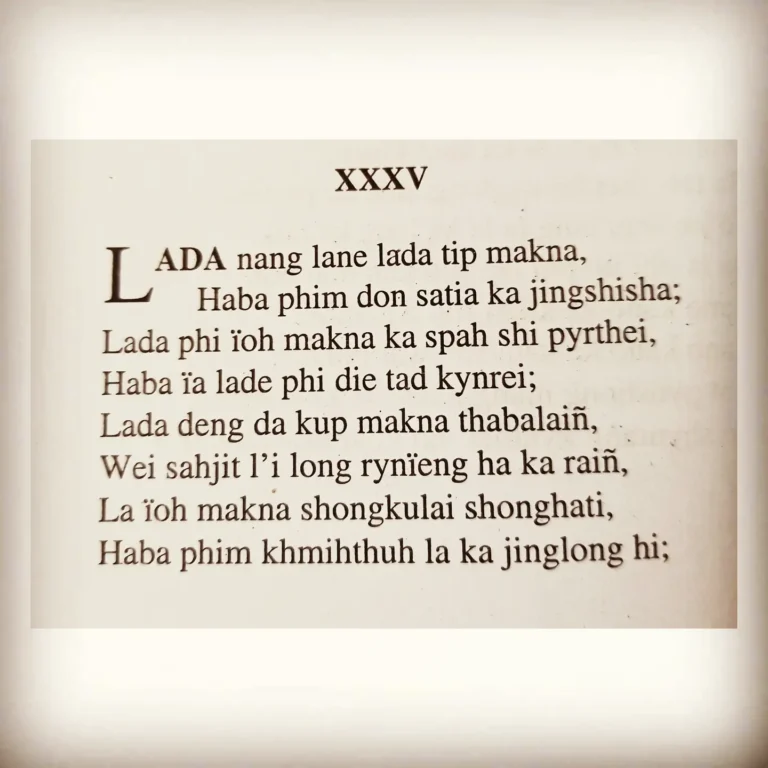
    Lada nang lane lada tip makna,

    Haba phim don satia ka jingshisha;

    Lada phi їoh makna ka spah shi pyrthei,

    Haba їa lade phi die tad kynrei;

    Lada deng da kup makna thabalaiñ,

    Wei sahjit l'i long rynїeng ha ka raiñ,

    La їoh makna shongkulai shonghati,

    Haba phim khmihthuh la ka jinglong hi;

    Lada phi bat niam nguh arti makna,

    Haba phim long bahok ne ba shisha;

    Lada phi tip phi kyrpad Blei makna,

    Haba phim bat їa ka tynrai babha;

    Lada phi paw nam makna ha pyrthei,

    Haba phim mut, phim kren, phim leh shong Blei;

    Kumno phin lait na ka jingmai U Blei,

    Lada naduh nangne ne haduh lawei?

    Kumno phin lait na ka rkhie beiñ rahrong,

    Jong u bamih basep baroh sawdong?

    Whatever you know whatever you gain,

    It's useless if not by Truth sustained;

    Even if very rich you become,

    If no one respects you, what use is the pomp?

    Even if you are very grandly attired,

    it's useless for it's only your shame camouflaged:

    You may reach the top, sit on horse, elephant,

    If your reputation is sullied what use is it then?

    Even if you worship with folded hands,

    What use is it if you're not honest and kind?

    Even if you worship God and Him entreat,

    If, within you, goodness is not rooted deep,

    Even if you're famous and well known worldwide,

    If God you don't worship and revere inside,

    How long will your escape His wrath, His judgement

    Today or tomorrow you'll come to a sad end;

    How long can you escape the scoffing of the world

    Hounding you from all around?

    Ka Jingsneng Tymmen Shaphang ka Akor Khasi ha ka Rukom Rwai Phawar, Part I (1902) & Part Il (1903) by Radhon Sing Berry Kharwanlang is a unique collection of valuable lessons and teaching on how to live a good and moral life. 🌻🌻

    The teachings are given in the form of "phawar” where two lines follow the same rhyme scheme, that is, aa bb.

    Both Part I and Part II have been translated into English by Bijoya Sawian @sawianbijoya in her book The Teachings of Elders: Ka Jingsneng Tymmen, Parts I and II (1997).

    Picture 1&2: Ka Jingsneng Tymmen Shaphang ka Akor Khasi ha ka Rukom Rwai Phawar, Part I (1902)

    Picture 3: The Teachings of Elders: Ka Jingsneng Tymmen, Parts I and II (1997).

  • Ka Jingsneng Tymmen Shaphang ka Akor Khasi ha ka Rukom Rwai Phawar, Part I (1902) & Part Il (1903)

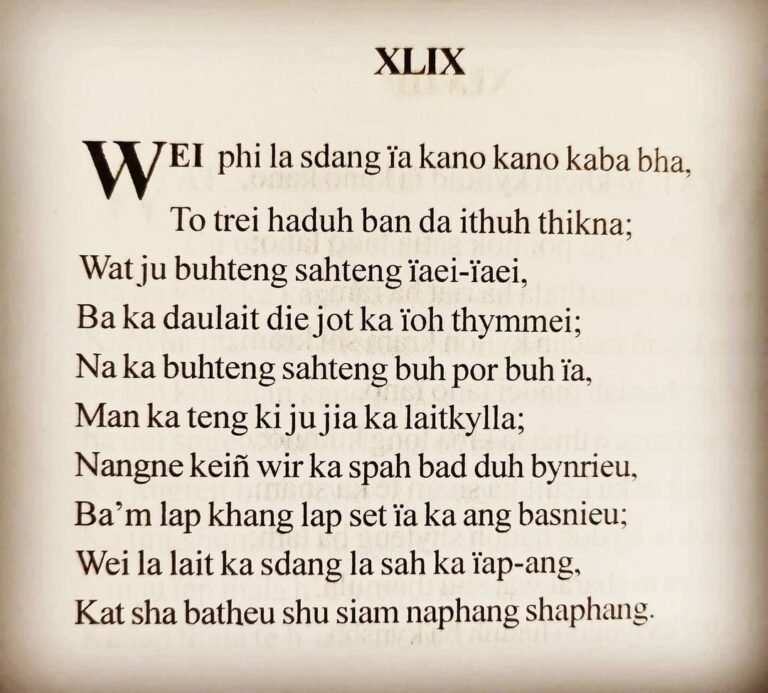
    Wei phi la sdang ïa kano kano kaba bha,

    To trei haduh ban da ithuh thikna;

    Wat ju buhteng sahteng ïaei-ïaei,

    Ba ka daulait die jot ka oh thymmei;

    Na ka buhteng sahteng buh por buh ïa,

    Man ka teng ki ju jia ka laitkylla;

    Nangne keiñ wir ka spah bad duh bynrieu,

    Ba'm lap khang lap set la ka ang basnieu;

    Wei la lait ka sang la sah ka ïap-ang,

    Kat sha batheu shu siam naphang shaphang.

    Once you've started some good endeavour,

    Until its fruition you must work and labour;

    Don't avoid responsibilities that go with it,

    Or you'll lose your investment, you won't profit;

    If you keep delaying and your duty defer,

    You'll miss opportunities and will not go far;

    This is the way one loses one's wealth,

    For one has not nipped, what's wrong, in the bud;

    Once you miss the chance you'll end up gaping,

    Whatever you aim at you'll keep on missing.

    Ka Jingsneng Tymmen Shaphang ka Akor Khasi ha ka Rukom Rwai Phawar, Part I (1902) & Part II (1903) by Radhon Sing Berry Kharwanlang is a unique collection of valuable lessons and teaching on how to live a good and moral life. ⏳📝🏃

    The teachings are given in the form of "phawar” where two lines follow the same rhyme scheme, that is, aa bb.

    Both Part I and Part II have been translated into English by Bijoya Sawian @sawianbijoya in her book The Teachings of Elders: Ka Jingsneng Tymmen Parts I and II (1997).

    Picture 1: Ka Jingsneng Tymmen Shaphang ka Akor Khasi ha ka Rukom Rwai Phawar, Part II (1902)

    Picture 2: The Teachings of Elders: Ka Jingsneng Tymmen, Parts I and II (1997).

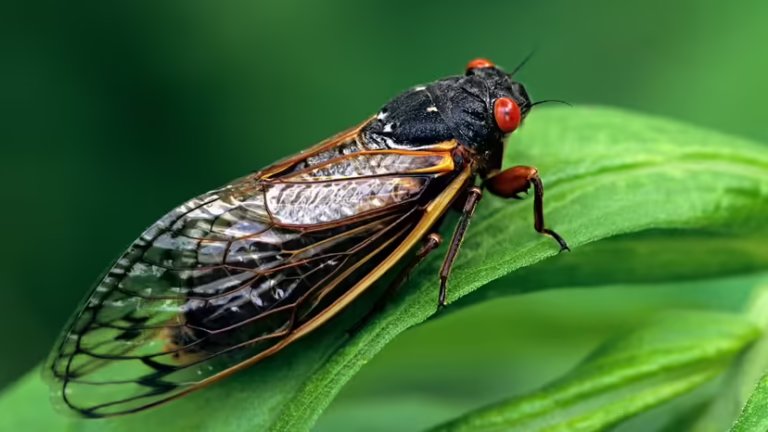
  • “Choh Jamalung” (The call of the Cicada)

    As dusk fell, there are days in the valley of Ri Bhoi when children would gather outside their houses; and hold two little bamboo sticks in their hands. In front of a small tree or a branch and just beside the light bulb, they make beating sounds with those sticks to call the "jamalung" (an insect under cicada family).

    The children from Raid Nongtluh would also phawar (chanting song):

    “Et-et pule, charadom pule;

    Saiñ syrmah siñ-jop, siñ-jop

    Chi bang-op, bang-op.

    Dap te ka dap-te ka dap dohkha,

    Chang te ka chang-te ka chang kyrla;

    O! Siñ lum, O! Siñ wah:

    Ka kmei pha te ka tah, tung-dung;

    U pa pha te u wieh, cha-rung”

    The "jamalung" is captivated by the radiance of tungsten lights, and wings its way to the tree. The children are enlivened as they contend with each other for the catch. And the fate of "jamalung" is uncertain, it may be consumed, released back or played with till it is no more.

    "Ka Choh Jamalung" (The Call of the Cicada) is a chanting song sent by @esra_syiem ! 😀😀 Thank you for this unique entry!

    It is reminiscent of those childhood chants and games which sound like gibberish but no one cares because they're so much fun to say 😂😂😂 Those were the days when children were shooed away outside the house to play and shout 💞💞

    "tungsten light" is the light from a filament bulb.