Tag: radhonsingberrykharwanlang

  • “Ka Jingsneng Tymmen Shaphang ka Akor Khasi ha ka Rukom Rwai Phawar”, Part I (1902) & Part II (1903)

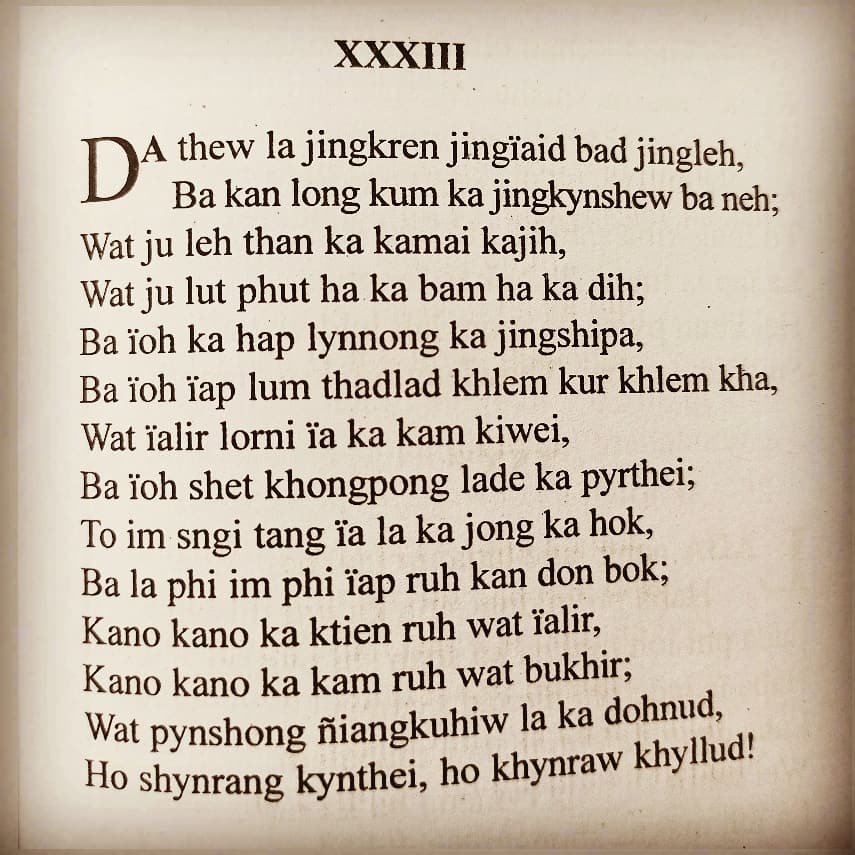
    Da thew la jingkren jingïaid bad jingleh,

    Ba kan long kum ka jingkynshew ba neh;

    Wat ju leh than ka kamai kajih,

    Wat ju lut phut ha ka bam ha ka dih;

    Ba ïoh ka hap lynnong ka jingshipa,

    Ba ïoh ïap lum thadlad khlem kur khlem kha,

    Wat ïalir lorni ïa ka kam kiwei,

    Ba ïoh shet khongpong lade ka pyrthei;

    To im sngi tang ïa la ka jong ka hok,

    Ba la phi im phi ïap ruh kan don bok;

    Kano kano ka ktien ruh wat ïalir,

    Kano kano ka kam ruh wat bukhir;

    Wat pynshong ñiangkuhiw la ka dohnud,

    Ho shynrang kynthei, ho khynraw khyllud!

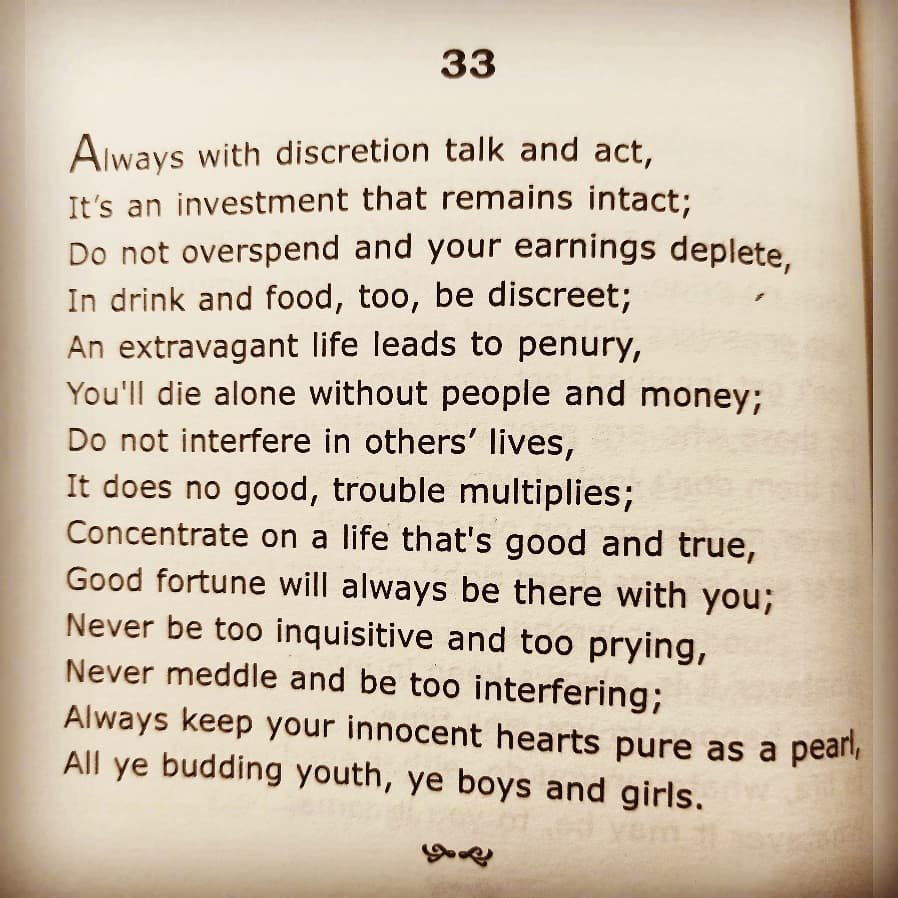
    Always with discretion talk and act,

    It's an investment that remains intact;

    Do not overspend and your earnings deplete,

    In drink and food, too, be discreet;

    An extravagant life leads to penury,

    You'll die alone without people and money;

    Do not interfere in others' lives,

    It does no good, trouble multiplies;

    Concentrate on a life that's good and true,

    Good fortune will always be there with you;

    Never be too inquisitive and too prying,

    Never meddle and be too interfering;

    Always keep your innocent hearts pure as a pearl

    All ye budding youth, ye boys and girls.

    Ka Jingsneng Tymmen Shaphang ka Akor Khasi ha ka Rukom Rwai Phawar, Part I (1902) & Part II (1903) by Radhon Sing Berry Kharwanlang is a unique collection of valuable lessons and teaching on how to live a good and moral life. 📝📄📙

    The teachings are given in the form of "phawar" where two lines follow the same rhyme scheme, that is, aa bb.

    Both Part I and Part II have been translated into English by Bijoya Sawian @sawianbijoya in her book The Teachings of Elders: Ka Jingsneng Tymmen, Parts I and II (1997).

    Picture 1: Ka Jingsneng Tymmen Shaphang ka Akor Khasi ha ka Rukom Rwai Phawar, Part I (1902)

    Picture 2: The Teachings of Elders: Ka Jingsneng Tymmen, Parts I and II (1997).
  • “Ka Jingsneng Tymmen Shaphang ka Akor Khasi ha ka Rukom Rwai Phawar”, Part I (1902) & Part II (1903)

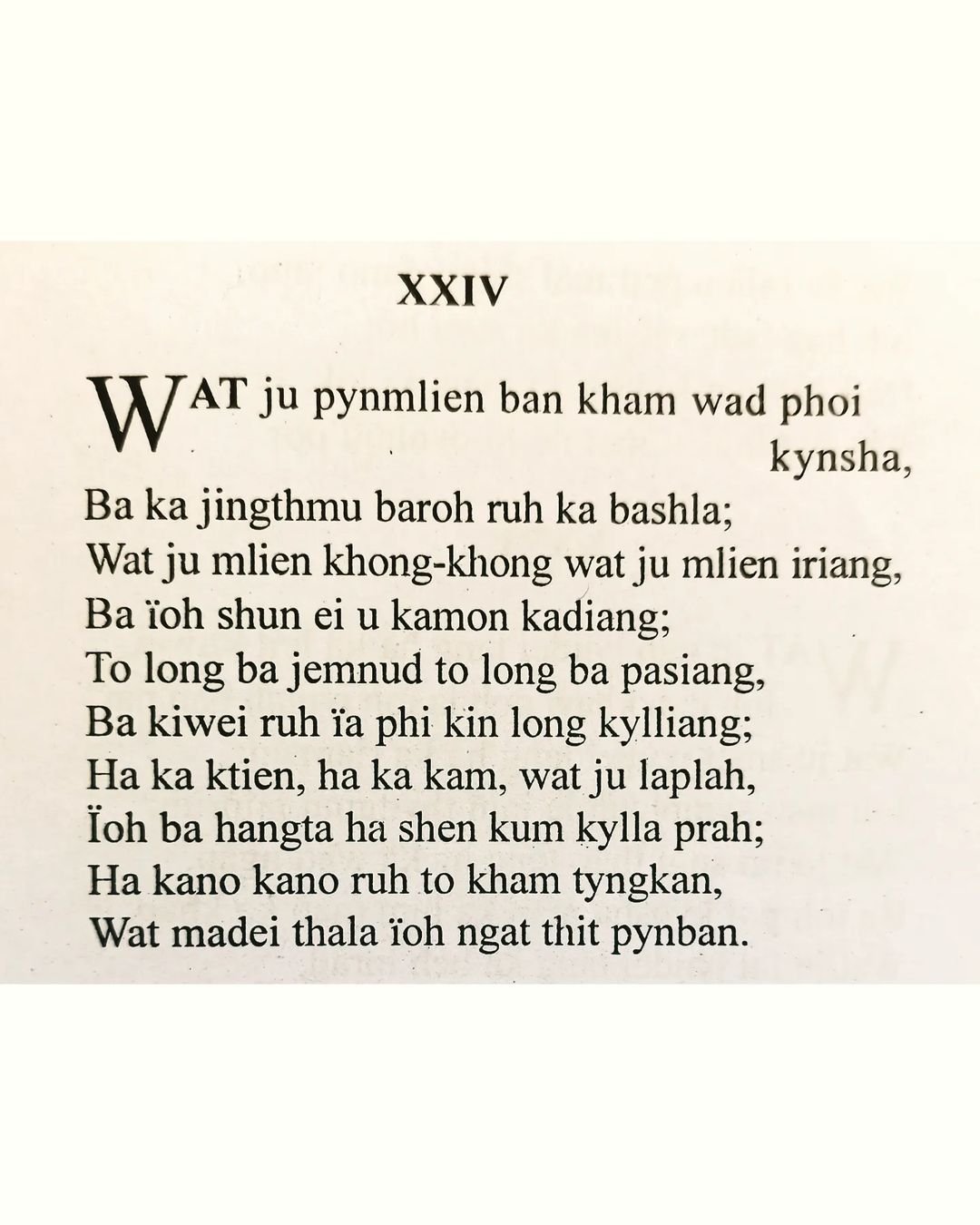
    Wat ju pynmlien ban kham wad phoi kynsha,

    Ba ka jingthmu baroh ruh ka bashla;

    Wat ju mlien khong-khong wat ju mlien iriang,

    Ba ïoh shun ei u kamon kadiang,

    To long ba jemnud to long ba pasiang,

    Ba kiwei ruh ïa phi kin long kylliang;

    Ha ka ktien, ha ka kam, wat ju laplah,

    Ïoh ba hangta ha shen kum kylla prah;

    Ha kano kano ruh to kham tyngkan,

    Wat madei thala ïoh ngat thit pynban.

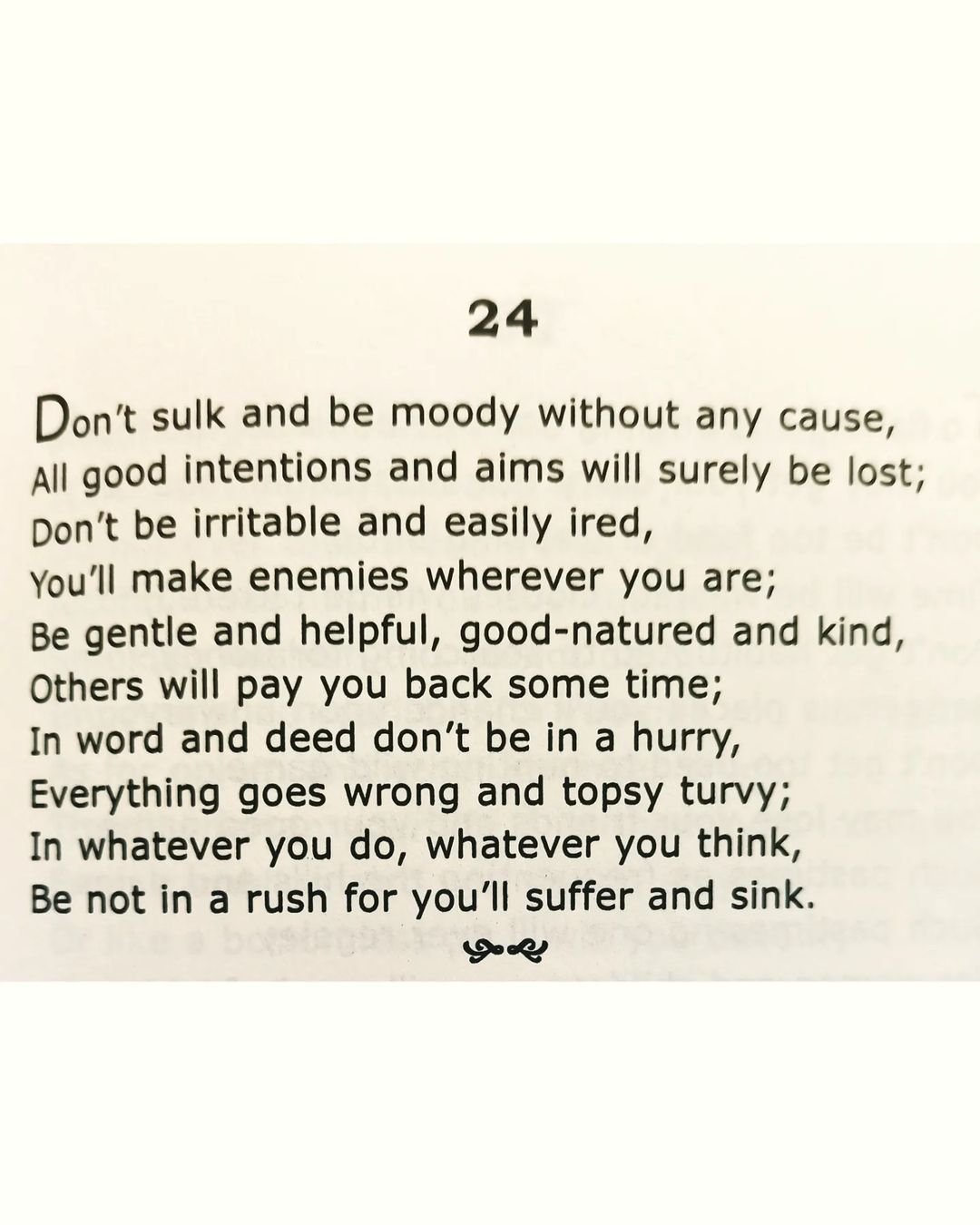
    Don't sulk and be moody without any cause,

    All good intentions and aims will surely be lost;

    Don't be irritable and easily ired,

    You'll make enemies wherever you are;

    Be gentle and helpful, good-natured and kind,

    Others will pay you back some time;

    In word and deed don't be in a hurry,

    Everything goes wrong and topsy turvy;

    In whatever you do, whatever you think,

    Be not in a rush for you'll suffer and sink.

    Ïa katei ka dkhot kaba 24 la shim na ka Ka Jingsneng Tymmen Part I.

    Ka Jingsneng Tymmen Shaphang ka Akor Khasi ha ka Rukom Rwai Phawar, Part I (1902) & Part II (1903) by Radhon Sing Berry Kharwanlang is a unique collection of valuable lessons and teaching on how to live a good and moral life. 😄🌲😌

    The teachings are given in the form of "phawar” where two lines follow the same rhyme scheme, that is, aa bb.

    Both Part I and Part Il have been translated into English by Bijoya Sawian @sawianbijoya in her book "The Teachings of Elders: Ka Jingsneng Tymmen, Parts I and II" (1997).

    Slide 1: Ka Jingsneng Tymmen Shaphang ka Akor Khasi ha ka Rukom Rwai Phawar, Part I (1902)

    Slide 2: The Teachings of Elders: Ka Jingsneng Tymmen, Parts I and II (1997).
  • Ka Jingsneng Tymmen Shaphang ka Akor Khasi ha ka Rukom Rwai Phawar”, Part I (1902) & Part Il (1903)

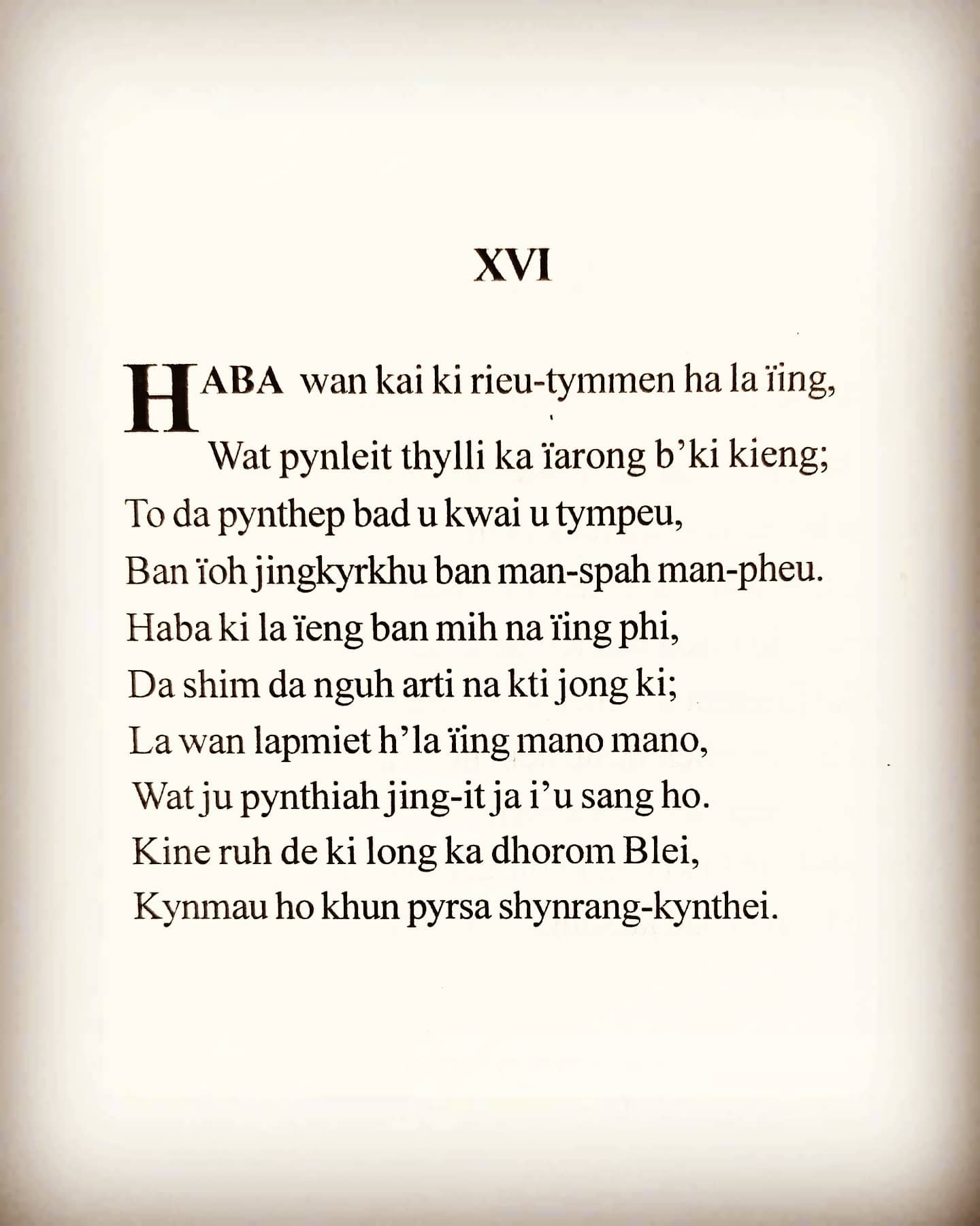
    Haba wan kai ki rieu-tymmen ha la ïing

    Wat pynleit thylli ka ïarong b'ki kieng;

    To da pynthep bad u kwai u tympeu,

    Ban ïoh jingkyrkhu ban man-spah man-pheu.

    Haba ki la ïeng ban mih na ïing phi,

    Da shim da nguh arti na kti jong ki;

    La wan lapmiet h'la ïing mano mano,

    Wat ju pynthiah jing-it ja i' u sang ho.

    Kine ruh de ki long ka dhorom Blei,

    Kynmau ho khun pyrsa shynrang-kynthei.

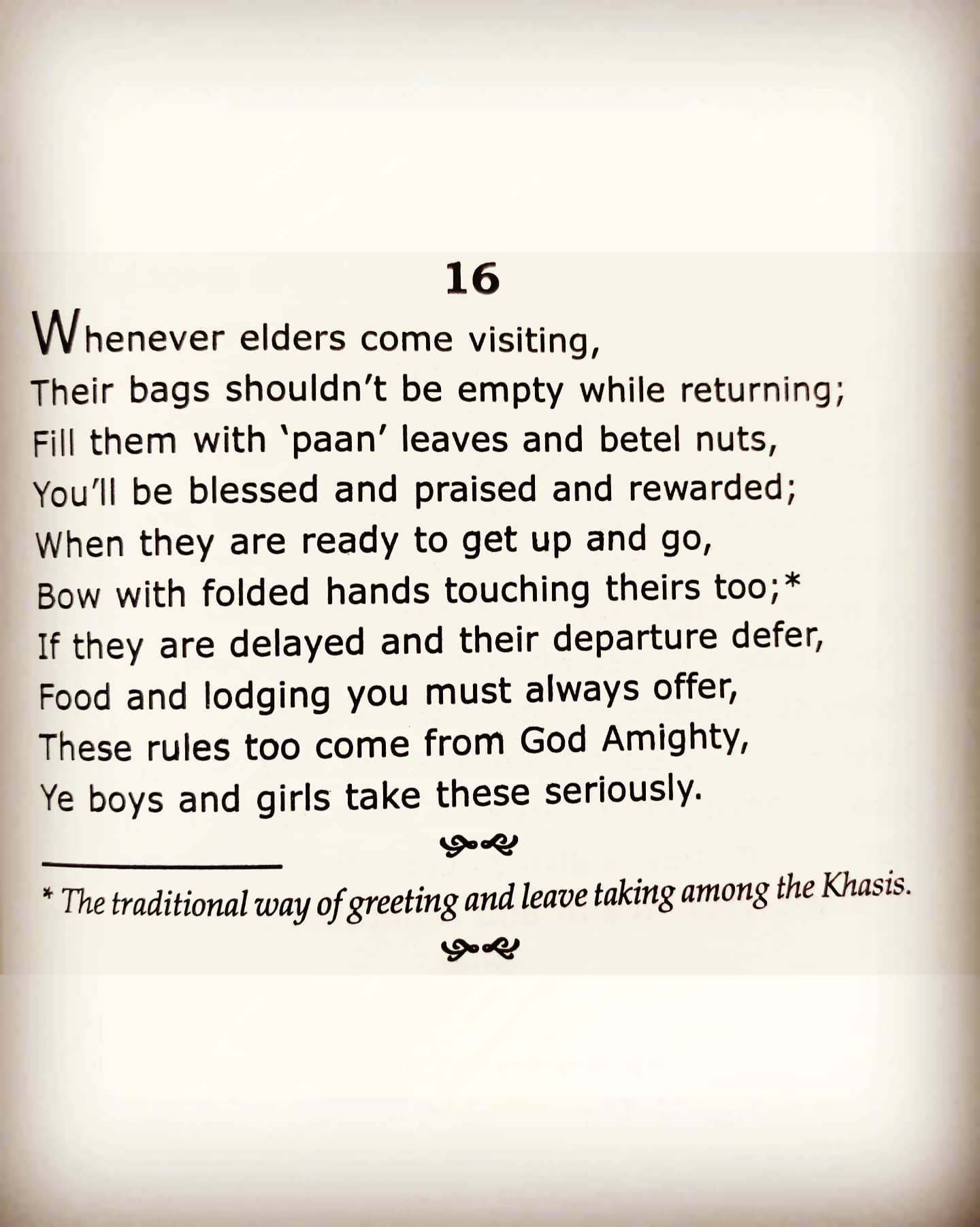
    Whenever elders come visiting,

    Their bags shouldn't be empty while returning;

    Fill them with 'paan' leaves and betel nuts,

    You'll be blessed and praised and rewarded;

    When they are ready to get up and go,

    Bow with folded hands touching theirs too;*

    If they are delayed and their departure defer,

    Food and lodging you must always offer,

    These rules too come from God Almighty,

    Ye boys and girls take these seriously.

    * The traditional way of greeting and leave taking among the Khasis.

    "Ka Jingsneng Tymmen Shaphang ka Akor Khasi ha ka Rukom Rwai Phawar", Part I (1902) & Part Il (1903) by Radhon Sing Berry Kharwanlang is a unique collection of valuable lessons and teaching on how to live a good and moral life. 🌻🌼🏵️

    The teachings are given in the form of "phawar” where two lines follow the same rhyme scheme, that is, aa bb.

    Both Part I and Part II have been translated into English by Bijoya Sawian @sawianbijoya in her book "The Teachings of Elders: Ka Jingsneng Tymmen, Parts I and II" (1997).

    Slide 1: "Ka Jingsneng Tymmen Shaphang ka Akor Khasi ha ka Rukom Rwai Phawar", Part II (1902)

    Slide 2: "The Teachings of Elders: Ka Jingsneng Tymmen, Parts I and II" (1997).

  • “Ka Jingsneng Tymmen Shaphang ka Akor Khasi ha ka Rukom Rwai Phawar”, Part I (1902) & Part Il (1903)

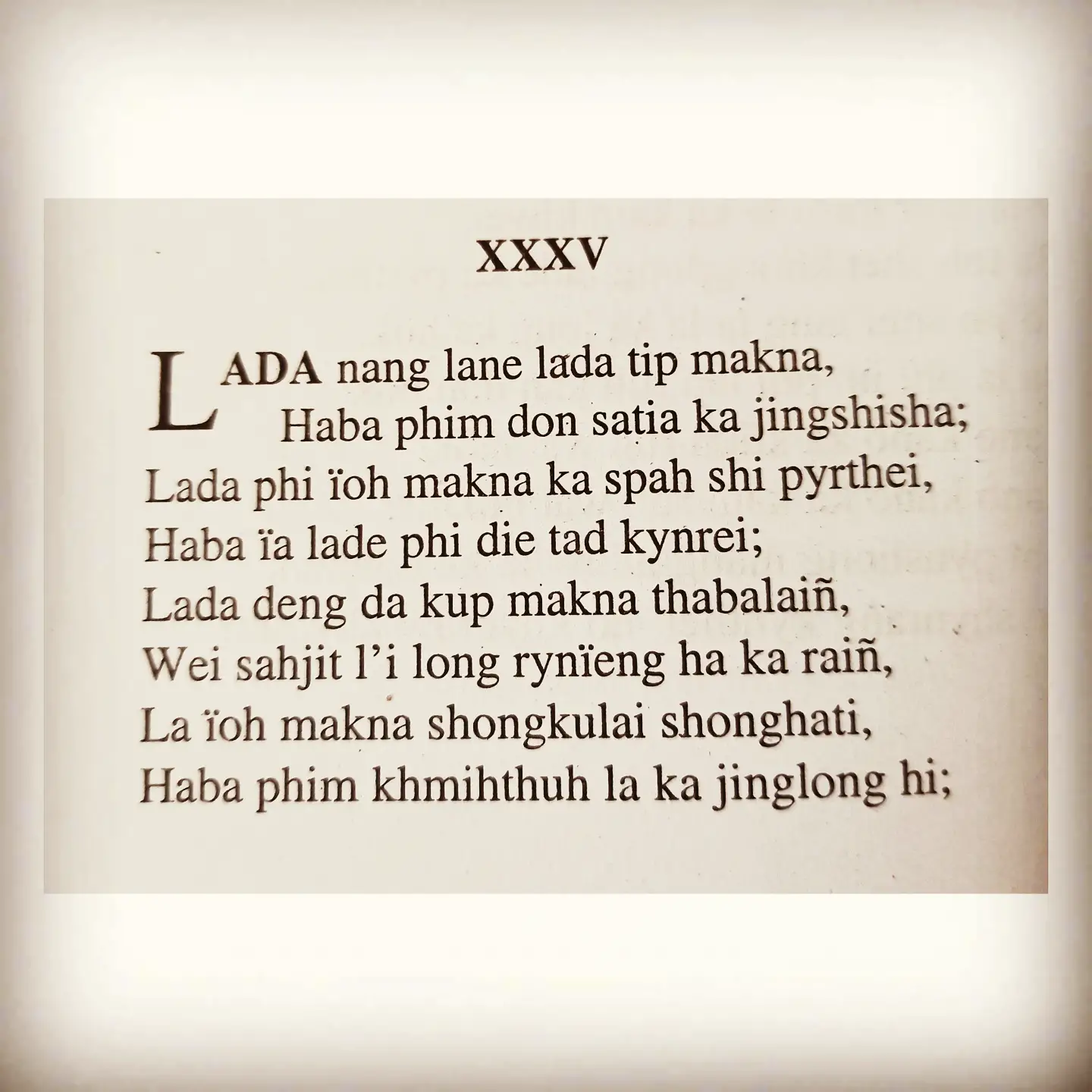
    Lada nang lane lada tip makna,

    Haba phim don satia ka jingshisha;

    Lada phi їoh makna ka spah shi pyrthei,

    Haba їa lade phi die tad kynrei;

    Lada deng da kup makna thabalaiñ,

    Wei sahjit l'i long rynїeng ha ka raiñ,

    La їoh makna shongkulai shonghati,

    Haba phim khmihthuh la ka jinglong hi;

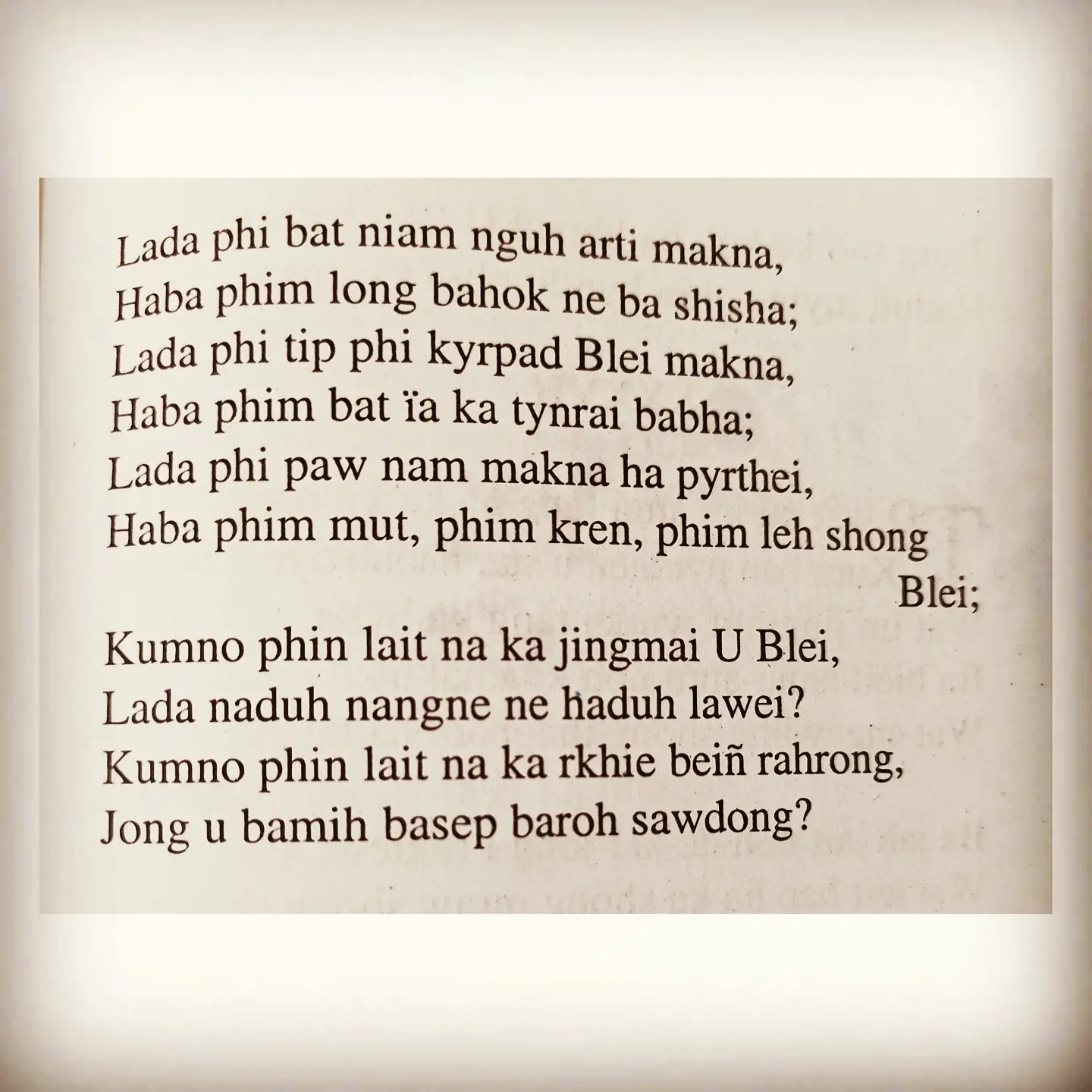
    Lada phi bat niam nguh arti makna,

    Haba phim long bahok ne ba shisha;

    Lada phi tip phi kyrpad Blei makna,

    Haba phim bat їa ka tynrai babha;

    Lada phi paw nam makna ha pyrthei,

    Haba phim mut, phim kren, phim leh shong Blei;

    Kumno phin lait na ka jingmai U Blei,

    Lada naduh nangne ne haduh lawei?

    Kumno phin lait na ka rkhie beiñ rahrong,

    Jong u bamih basep baroh sawdong?

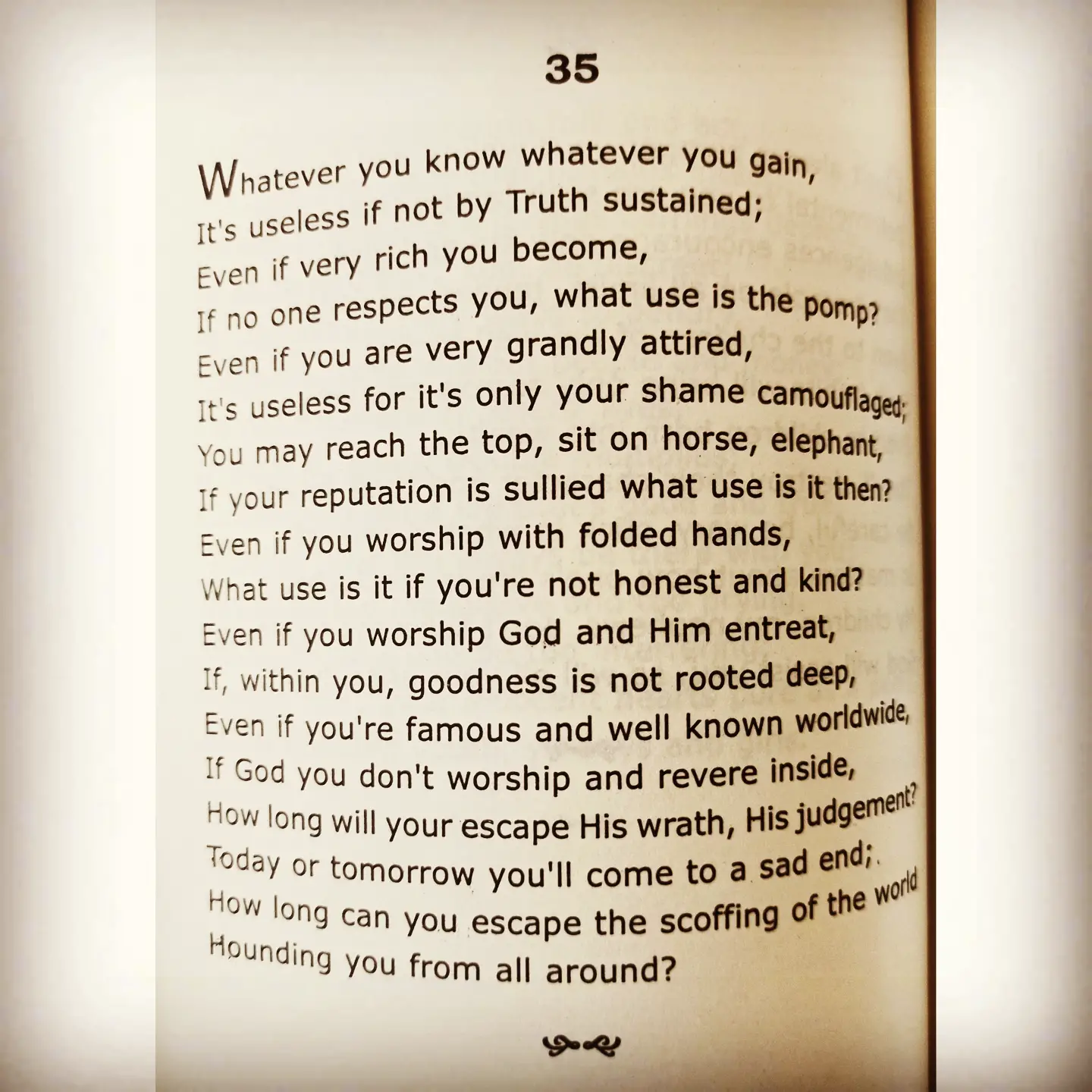
    Whatever you know whatever you gain,

    It's useless if not by Truth sustained;

    Even if very rich you become,

    If no one respects you, what use is the pomp?

    Even if you are very grandly attired,

    it's useless for it's only your shame camouflaged:

    You may reach the top, sit on horse, elephant,

    If your reputation is sullied what use is it then?

    Even if you worship with folded hands,

    What use is it if you're not honest and kind?

    Even if you worship God and Him entreat,

    If, within you, goodness is not rooted deep,

    Even if you're famous and well known worldwide,

    If God you don't worship and revere inside,

    How long will your escape His wrath, His judgement

    Today or tomorrow you'll come to a sad end;

    How long can you escape the scoffing of the world

    Hounding you from all around?

    Ka Jingsneng Tymmen Shaphang ka Akor Khasi ha ka Rukom Rwai Phawar, Part I (1902) & Part Il (1903) by Radhon Sing Berry Kharwanlang is a unique collection of valuable lessons and teaching on how to live a good and moral life. 🌻🌻

    The teachings are given in the form of "phawar” where two lines follow the same rhyme scheme, that is, aa bb.

    Both Part I and Part II have been translated into English by Bijoya Sawian @sawianbijoya in her book The Teachings of Elders: Ka Jingsneng Tymmen, Parts I and II (1997).
    Picture 1&2: Ka Jingsneng Tymmen Shaphang ka Akor Khasi ha ka Rukom Rwai Phawar, Part I (1902)

    Picture 3: The Teachings of Elders: Ka Jingsneng Tymmen, Parts I and II (1997).
  • Ka Jingsneng Tymmen Shaphang ka Akor Khasi ha ka Rukom Rwai Phawar, Part I (1902) & Part Il (1903)

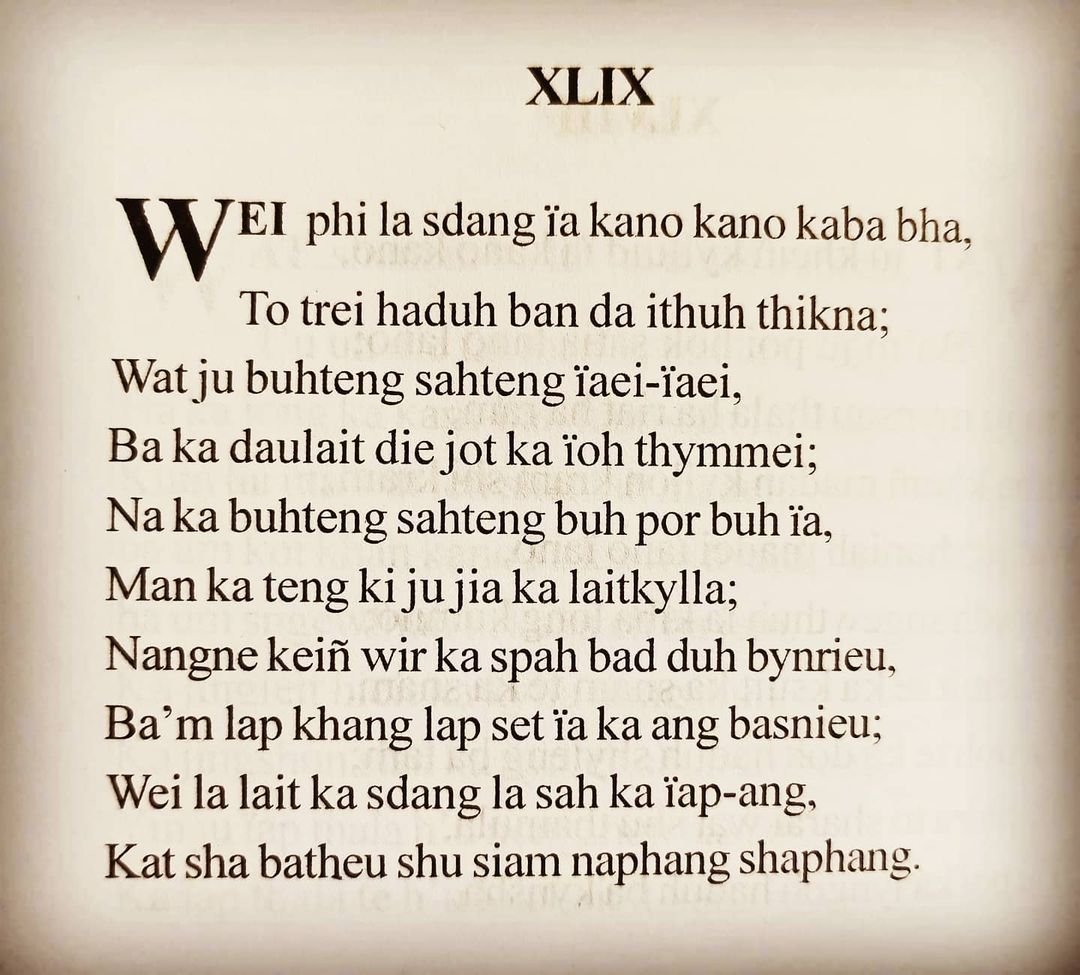
    Wei phi la sdang ïa kano kano kaba bha,

    To trei haduh ban da ithuh thikna;

    Wat ju buhteng sahteng ïaei-ïaei,

    Ba ka daulait die jot ka oh thymmei;

    Na ka buhteng sahteng buh por buh ïa,

    Man ka teng ki ju jia ka laitkylla;

    Nangne keiñ wir ka spah bad duh bynrieu,

    Ba'm lap khang lap set la ka ang basnieu;

    Wei la lait ka sang la sah ka ïap-ang,

    Kat sha batheu shu siam naphang shaphang.

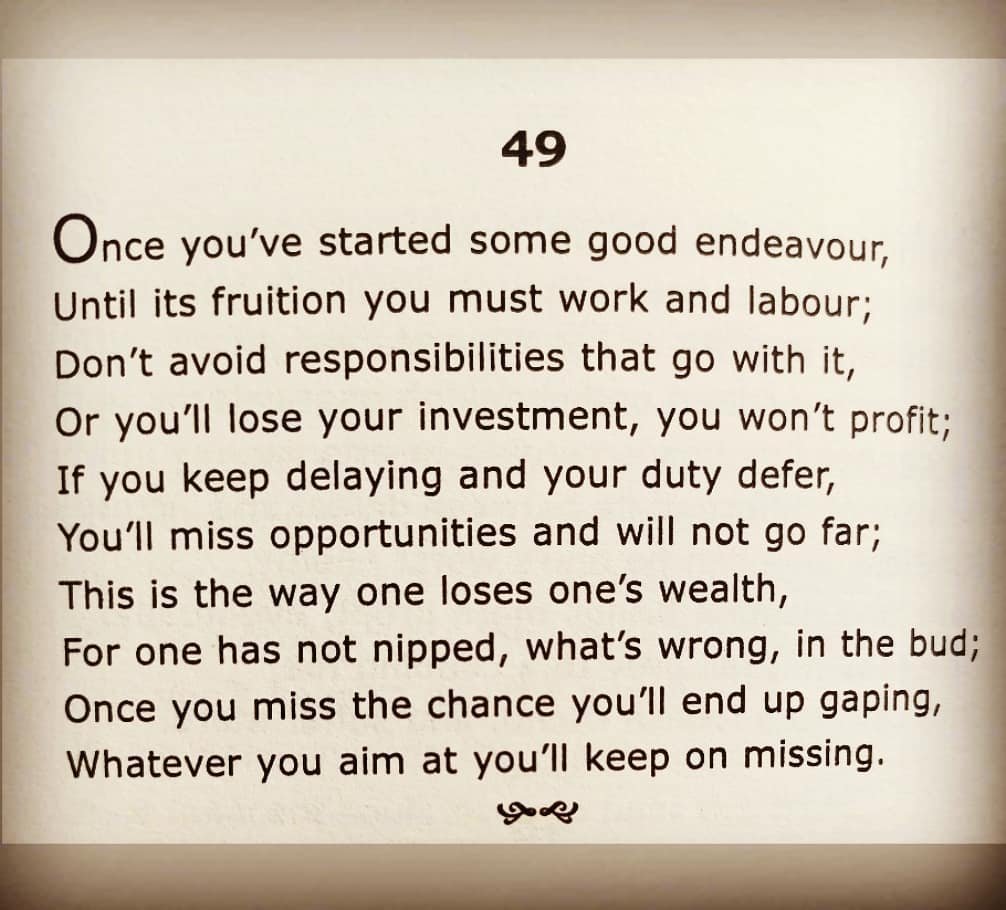
    Once you've started some good endeavour,

    Until its fruition you must work and labour;

    Don't avoid responsibilities that go with it,

    Or you'll lose your investment, you won't profit;

    If you keep delaying and your duty defer,

    You'll miss opportunities and will not go far;

    This is the way one loses one's wealth,

    For one has not nipped, what's wrong, in the bud;

    Once you miss the chance you'll end up gaping,

    Whatever you aim at you'll keep on missing.

    Ka Jingsneng Tymmen Shaphang ka Akor Khasi ha ka Rukom Rwai Phawar, Part I (1902) & Part II (1903) by Radhon Sing Berry Kharwanlang is a unique collection of valuable lessons and teaching on how to live a good and moral life. ⏳📝🏃

    The teachings are given in the form of "phawar” where two lines follow the same rhyme scheme, that is, aa bb.

    Both Part I and Part II have been translated into English by Bijoya Sawian @sawianbijoya in her book The Teachings of Elders: Ka Jingsneng Tymmen Parts I and II (1997).

    Picture 1: Ka Jingsneng Tymmen Shaphang ka Akor Khasi ha ka Rukom Rwai Phawar, Part II (1902)

    Picture 2: The Teachings of Elders: Ka Jingsneng Tymmen, Parts I and II (1997).