Tag: sohra

  • Ki Mawsiang Kulong Kumah Ka Sohra da i Kynpham Sing Nongkynrih

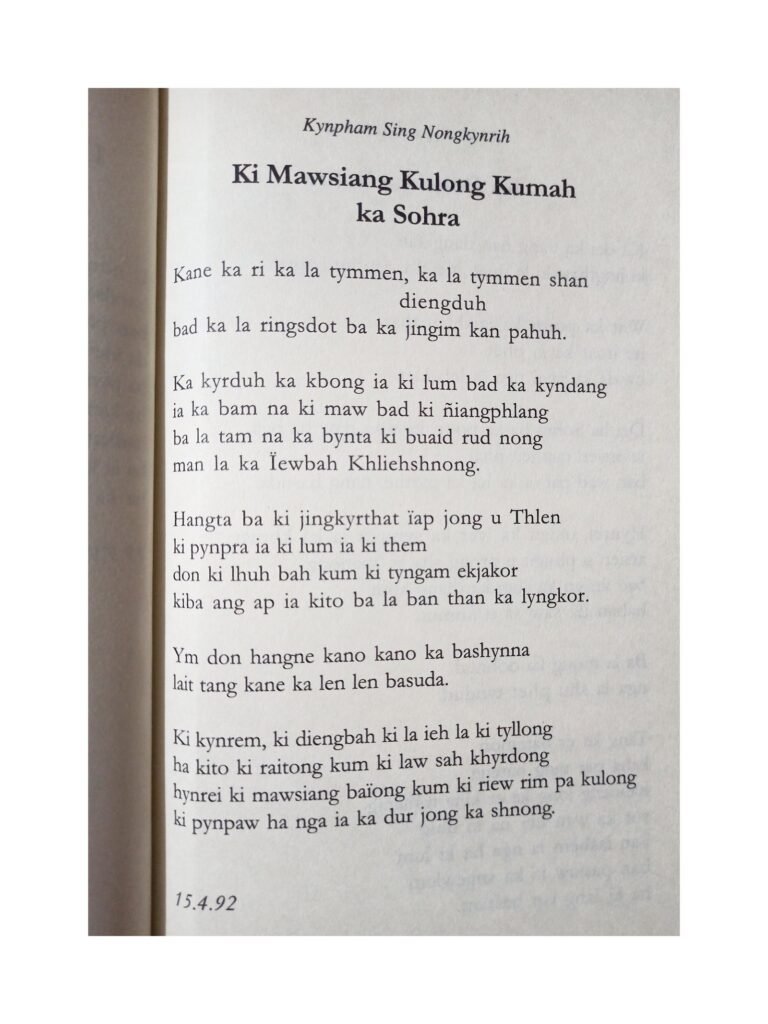
    Ka poitri "Ki Mawsiang Kulong Kumah Ka Sohra" na ka thup "Ki Mawsiang Ka Sohra" (2007) ba la thoh da i Babu Kynpham Sing Nongkynrih ka kren shaphang ka jingkylla kaba la wan ha ka shnong Sohra ha ki sngi mynta. Ki dei sa tang ki mawsiang ka Sohra kiba ïeng kynjreng kum ki dak ka jingkynmaw ïa ka ïing bad ïa ki por ki ïa kiba la leit.

    Ngi dap da ka jingsngewkmen ba ngin ïoh lad ban kren bad phylliew jingmut bad i Babu ha ka 2 tarik u Nailar ha @eveningclubshillong, ryngkat bad i @samuel.sawian bad i @daia.risa ban tip ïa ka jingïaid lynti jong i kum u nongthoh Khasi uba la pawnam ha ri India bad shabar ka ri India ruh.

    Khublei Shibun @pyrta.collective ba phi la pynkhreh kum ïa kane ka jingïakynduh! 😄🙏

    The poem "The Ancient Rocks of Cherra" from "The Yearning of Seeds" (2011) written by Kynpham Sing Nongkynrih speaks of the changes that Sohra/ Cherra has undergone in these present times. It is only the rocks and boulders of Sohra who stand constant as symbols of the memory of home and the days that have gone by.

    We are happy to be getting the opportunity to talk to Bah Kynpham Sing Nongkynrih on the 2nd of August in @eveningclubshillong together with @samuel.sawian and @daia.risa to know more about his journey as a Khasi writer who is well known in India and abroad too.

    Thank you @pyrta.collective for organising such an occasion! 😄🙏

  • U Slap

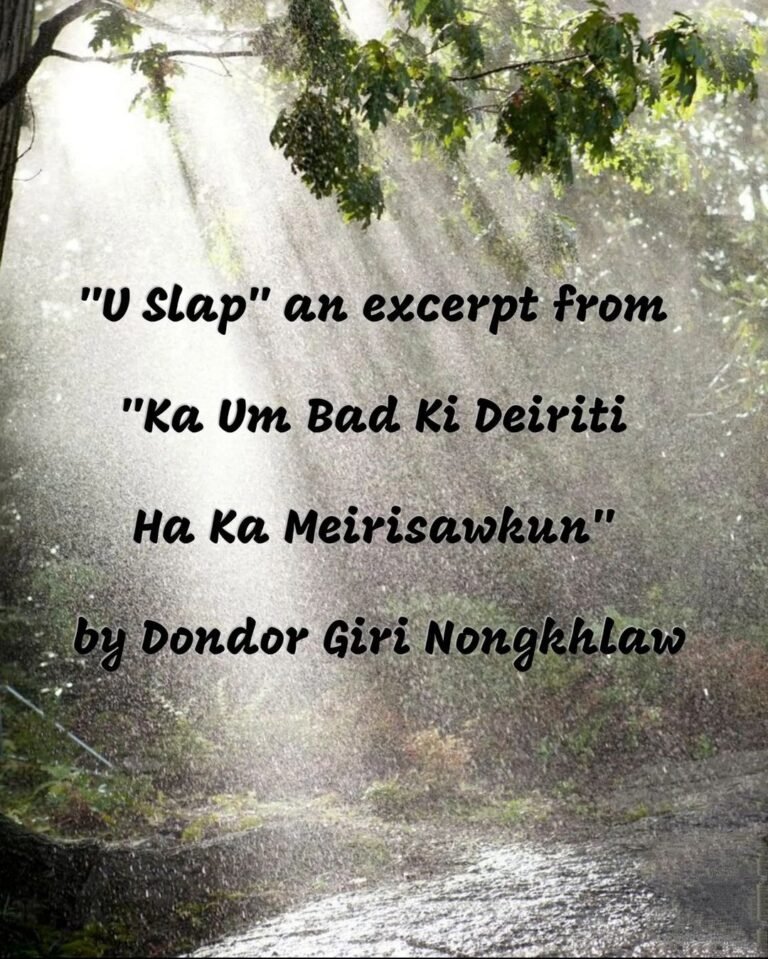
    U slap haba u hap ha sla khyndew u hap syngngeit bad hap lynsher. Ha ki jaka bym don phlang ne kino kino ki jynthung, u slap u don ka bor kaba khlaiñ ban ksam bad pynmong ïa ka khyndew. Mar ïa slap ki symboh khyndew ne shyiap ki shah kynting kumba Iai haduh san inshi na sla khyndew shalor bad shah bret sharud na ka jaka ba kine ki symboh ki don mynshuwa. La ïoh jingkheiñ da ki riewstad ba u lapbah u lah ban pynkynriah jaka ïa ki symboh khyndew symboh shyiap haduh shispah ton ha ka shi akar ha ka shikynta.

    When rain falls on the earth it falls in a forceful beating or grinding motion. In a place with no grass or plants, rain has the strong power to punch through and pound the soil. The instant it rains, soil or sand are thrown up about three to five inches from the ground and then they fall on a different place from where they were. Scientists have discovered that heavy rain can move 100 tons of soil from one acre in one hour.

    Haba u slap u hap halor ka khyndew bym don jynthung ki symboh khyndew symboh shyiap bani bin bin ki set noh ïa ki thliew ki syar (pores) jong ka syrtap khyndew syrtap maw. Ka umslap ba bun ka tuid noh wut tang nalor sla khyndew bad tang khyndiat eh ka ngam shapoh ñiamra. Ïa kane ka jingtuid umslap nalor ki jaka bym don ne duna jynthung la khot "ka tuid wut" (run off) katba ïa ka jingtuid umslap ha sla khyndew ha baroh ki jaka ba don khlaw ne bym don khlaw la khot "ka tuid lor" (overland flow).

    Kane ka tuid wut bad tuid lor jong ka umslap ki long ki bor bashyrkhei ban khrud bad pynkhoi ïa ka sla khyndew.

    When rain falls on a place that is empty of plants, the fine soil or sand that is moved by the rain covers and blocks the pores of the earth and of rocks. Most of the rain water flows quickly over the ground and only a little seeps through into the earth. This flow of rain water in a place where there is less or no vegetation is called run off, while the rain water that flows in a forested area or a non-forested area is called overland flow.

    Run off and overland flow of rain water are dangerous forces which scrub and erode the top soil.

    U slap bad ka rukom hap jong u…Sngewtynnat ban pule ïa kane ka jingthoh ha ka kot i Dr. Dondor Giri Nongkhlaw. 🌦️🌧️

    Rain and the way it falls…It is always a good idea to read books written by Dr. Dondor Giri Nongkhlaw. 🌦️🌧️

    Dr. Dondor Giri Nongkhlaw is a Geomorphologist who has written several Khasi books focussing on the elements of the environment and their bond with Khasi life and culture.

    🟡 English translation by @speakyourroots

  • Ka Sohra

    The following excerpt is from U Khasi Hyndai (1959) written by Rash Moon Roy Nongrum

    43. La don bun jait ki ktien ha kane ka Ri Khasi Ri Pnar jong ngi ba ngi ia kren hapdeng jong ngi bad ngim lah ban ia sngewthuh lut baroh ia ki ktien ba ki ia kren na kawei ka jaka ha kawei ka jaka.

    44. Na ka bynta ka jingbha ko jingbit jong ngi, U Pa Blei Trai Kynrad, U Nongthaw, U Nongbuh, U la pynmih ia kawei ka kynthei briew kaba la iathuh kyrteng ialade Ka Sohra. Kata Ka Sohra ka la wan poi ha lew Mawshohdoh. Kane ka shnong Mawshohdoh kaba don shi mail artet na Sohrarim.

    45. Kata Ka Sohra ka la kren tiak tiak, shliak shliak, ha ka sur ktien kaba jem jai jai. Ym don ba tip nangno ka wan poi hangta ha Shnong Mawshohdoh. Ka hikai ia ki briew baroh ban nang kren ia ka ktien Sohra. Ka riam ka beit ka kup ka sem ruh thabdiab kum ka nongsohra paka kaba mynta.

    46. Baroh ki para ba ia shong hangta ha Mawshohdoh ki la ia sngewbha bad sngewtynnad ban ia bud bad ban ia kren ka ktien kum kata Ka Sohra.

    Kata ka kynthei briew Ka Sohra ka la thaw la ka ïng ka sem bad ke la ker kper shaduh ki them ki phud wah ba leit hap haduh ka wah bah. Ka Nongrim
    Sohra ruh ka sah kyrteng haduh mynta.

    Naduh kata ka por ia ka Wah bah baroh shilynter ruh ki la khot Wah Sohra. Kata ka kyrteng Wah Sohra ruh ka la neh la sah kyrteng haduh mynta.

    47. Ki Sohra kiba la mih na Mawshohdoh mian pa mian ki la wan poi arsut pa arsut haduh ba kin da wan poi ha kane ka shnong Sohra kaba mynta, kaba dei Ka Sohra Thymmai. Ka Sohrarim te dei kaba la don la barim barim.

    48. Ki Sohra kiba la mih na Mawshohdoh ki la nang pynroi pynroi ia ka ktien Sohra. Haduh mynta ia ka ktien Sobra ki khot ka ktien Khasi paka.

    49. Ka ktien Sohra kaba hikai ban kren tang da ki ktien kiba don akor suda, lada ha ka iaid ka ieng ka ktien ka thyllieid dei ban kren tang da ka Akor kaba bha.

    50. Ka ktien Sohra ka hikai ban long kiba jemnud ha ka mynsiem ban nym long kiba bitar kiba khong khong.

    Ka ktien Sohra ka hikai ban nym kren ka ktien kaba iwtung lano lano lane iano iano.

    Ka ktien Sohra ka bikai ban tip ba ka Hok ka long kaba halor tam eh. Ka Hok ka jop ha kaba kut haba da iaineh ha ka Hok.

    Ka ktien Sohra ka hikai ban mane ban nguh ngon ban dem khrup tang ha la U Blei U Trai Kynrad U Nongthaw U Nongbuh ia lade.

    Ka ktien Sohra ka hikai ban mane ban burom la ki Kmie ki Kpa ki nongpun ki nongkha, ki nongpynsan pynrangbah.

    Ki Kmie ki Kpa ki long ki Mei Ïawbei Pa Thawlang.

    51. Baroh kiba mynta ki iathoh ki ia pule ruh tang ha ka ktien Sohra. Ka ktien Sohra kan sa phriang kylleng baroh ka Ri Khasi Ri Pnar. Hangta ngin sa long tylli baroh kawei ka Ri Khasi Ri Pnar.

    52. Ka Sohra ka shu jah noh haba ki briew ki la nang ban kren ia ka ktien Sohra. Ym don ba tip ba ka poi shano.

    53. U Khasi Hyndai um ju don ka ngeit bieit, namar ba u tip ba tang U Pa Blei Trai Kynrad hi, U long U Nongthaw U Nongbuh. Marwei hi U la thaw ia ki symbai bynriew. Nalor nangta ki thang ia ka met iap, kim ju tep hapoh thliew

    ia kiba iap, kiba tip ban thang ia ka met iap ruh dei tang ki briew. Namarkata ki ksuid ki tieng ki khaweit ia u Khasi Hyndai namar ba ka jingngeit bieit kam don ha uba hyndai u Khasi. U Khasi Hyndai u ong ba ka Hok ka long kaba kor tam bad kaba halor tam, namar ba uba hok um tieng iano iano ruh. U Khasi Hyndai u ong ba ka Hok ka jop ha kaba kut. Namarkata u Khasi Hyndai u ieng skhem tang ha ka Hok. U Khasi Hyndai uba ieit la ka Riti Khasi kaba neh ha ka Hok. U Khasi Hyndai uba kynshi uba isih eh ia ke Raibi kaba sniew eh.

    The following excerpt is from Funeral Nights (2021) by Kynpham Sing Nongkynrih

    At around this time, there was a fierce dispute between the people of Mawphu from the Khathynriew Shnong province and the people of Laitïam, in the south-east. The people of Laitïam were backed by two other villages, Ryngud and Sohbar. Both claimed ownership of a large tract of land bordering the heavily wooded River Umïong that extended up to another river called Risaw, north of Umïong. Soon, a protracted war broke out. The Mawphus killed the warrior leader of the Laitïams, called U Dei, near a place known as Nongsawlia; however, the LaitÏams retaliated and killed the Mawphus' warrior leader, called U Sohmen, not too far from where Dei had fallen. These places came to be known as Pomudei and Pomsohmen, that is, the hacking-of-Dei and the hacking-of-Sohmen. At this juncture, the founding clans of the new settlement of Sohra intervened. They talked to both parties about how futile and destructive the war had already been, and offered the idea of merging all their villages into a single hima, or state, comprising the provinces of Khatar Shnong, Khathynriew Shnong and Ki Lai Shnong–the three villages of Laitïam, Ryngud and Sohbar. The warring parties readily agreed, and a new state was born out of the war.

    The founding clans now began to look for a syiem, a king, who would be wholly responsible for the day-to-day administration. But nobody wanted a king from one of the other clans. They did not want to grant that kind of power and prominence to one who was not their own. It was when they were sitting in an open dorbar (council), trying to find a ruler, that a gentlewoman of divine grace mysteriously appeared out of nowhere and declared in front of the founding clans that her children would be the kings of the new state. When asked for her name, she said, 'Sohra, and when asked for her purpose, she said, 'My purpose is to teach grace and good manners to the people'.

    From that time, the new settlement was known as Sohra (for the settlement itself), Hima Sohra (for the state of Sohra) and Ri Sohra (for the country of Sohra). The names were given in honour of the mysterious woman, who, true to her word, tutored the people in the ways of civilised living and refined manners. It is for this reason that the community regards Sohra as the birthplace of Khasi etiquette and good conduct–'ka akor Sohra', a kind of savoir-vivre.

    But though the woman was accepted as divine, or at least as an agent of divine intervention, nobody thought of asking her what her name meant. It was only much later that people realised that she had chosen a name to reflect the most typical feature of the Sohra landscape. Since it is the wettest place on earth (I am sticking to this assertion because, although Mawsynram, the other East Khasi Hills village, has recorded higher precipitation now and then, the matter is far from settled–rain being a notoriously whimsical thing) and has a gently sloping tableland overlooking the plains of Bangladesh, Sohra has no topsoil. All of its topsoil has been washed away, either to the fertile and heavily forested gorges at the foot of the tableland, known as Ri War (where the War people live in their bountiful jungle farms), or to the plains of Sylhet, which are transformed every summer by the pelting rain of Sohra into a gigantic inland ocean. It follows then that Sohra is a place where nothing grows. And that is the meaning of Sohra: fruitless. In a way, the name completely justifies the description of the place as the wettest desert on earth.

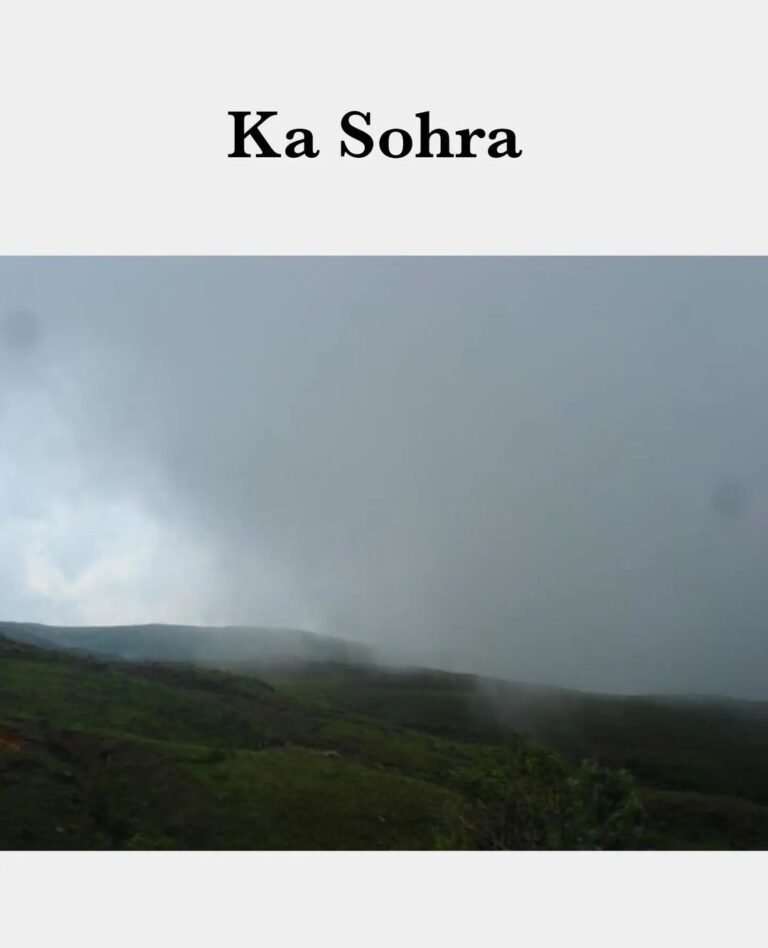
    These two excerpts are about "Sohra": the origin of the name "Sohra" and the origin of the Sohra Khasi which is now spoken as the standard Khasi. Besides that the two exceerpts talk about the teaching of Khasi grace and manners which are valuable lessons for our children today! Very interesting! 👍👍

    Picture credit: https://www.tripadvisor.com/LocationPhotoDirectLink-g668046-i84372639-Sohra_East_Khasi_Hills_District_Meghalaya.html

  • U Mot Sahnam ia u myllung ka ri, U Soso Tham ha Saitsohpen

    @kronosynchronicity says:

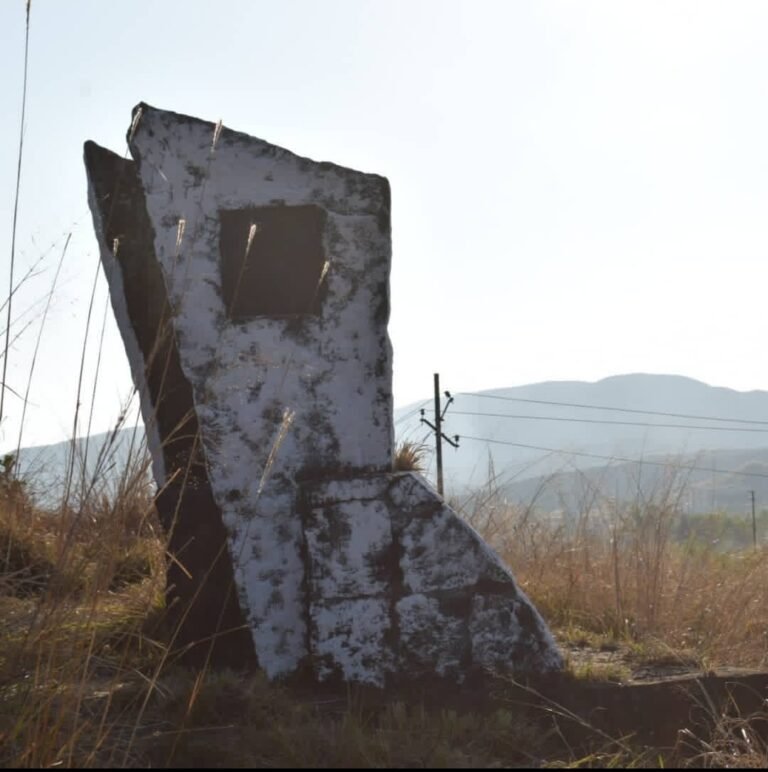
    U Mot Sahnam ia u myllung ka ri ha Saitsohpen la jied ia kane ka jaka ha Saitsohpen da ki trai shnong, haka jingialam i (L). W. Knight bad i Bah Palwan Deingdoh, ban buh ia une u Mot Sahnam na ka bynta u myllung Soso Tham. La sngewthuh ba ha ki por ba u dang khynnah, u myllung u juh bha ban leit shong kai barobor halor une u lum, na kaba iohi kyndiang ia ka jingitynnat jong ka shnong sawdong. La pynwan dur ia une u maw da u wei na ki pyrsaksiew, U Albert. C. Tham, bad i batai kumne: "Ka Sur u Myllung ka iai pyrta, hato ko hynñiewtrep ha shkor kin sawa? Ki kyntien kordor ba ngin niewkor, ha ki sngi jong ngi u hynñiewtrep ki ba mynta" ha ki jingthew jong une u mot la pyndonkam da u sien hynñiew bad la thaw ia u na u maw Sohra. Lah ruh ban pule ia ki jingthoh baroh laidong ia ki kyntien ki ba sot na ki poitri jong u myllung.

    La plie paidbah ia une u mot sah nam da i (L) Prof. I. M. Simon ha ka jingialang bala pynbeit daka shnong lem bad ka jingdon ryngkat ki bahaing u myllung haka 29/12/2007.

    The monument for Khasi Poet Laureate U Soso Tham in Saitsohpen was chosen under the leadership of (L) W. Knight and Bah Palwan Diengdoh to commemorate the achievements of u Soso Tham. It is understood that when he was a boy, the poet would love to sit on this hill, where he could see the all-round beauty of the hamlet. The monument was designed by the poet's grand nephew Albert C. Tham and he says: "The voice of the poet continues to echo, can the hynñiewtrep hear them? valuable words we should hold dear, in the present day of the hynñiewtrep". The measurement and design of this monument has been based on the number seven and it has been made with Sohra stone. Three sides of the monument have also been engraved with verse of U Soso Tham.

    The monument was opened to the public by (L) Prof. I. M. Simon in a gathering arranged by the village administration and the relatives of the poet on 29th December 2007.

    Thank you @kronosynchronicity for this! 😄🙏

    Photo credit @kronosynchronicity

    English translation by @speakyourroots

  • Ka shnong Rangjyrteh

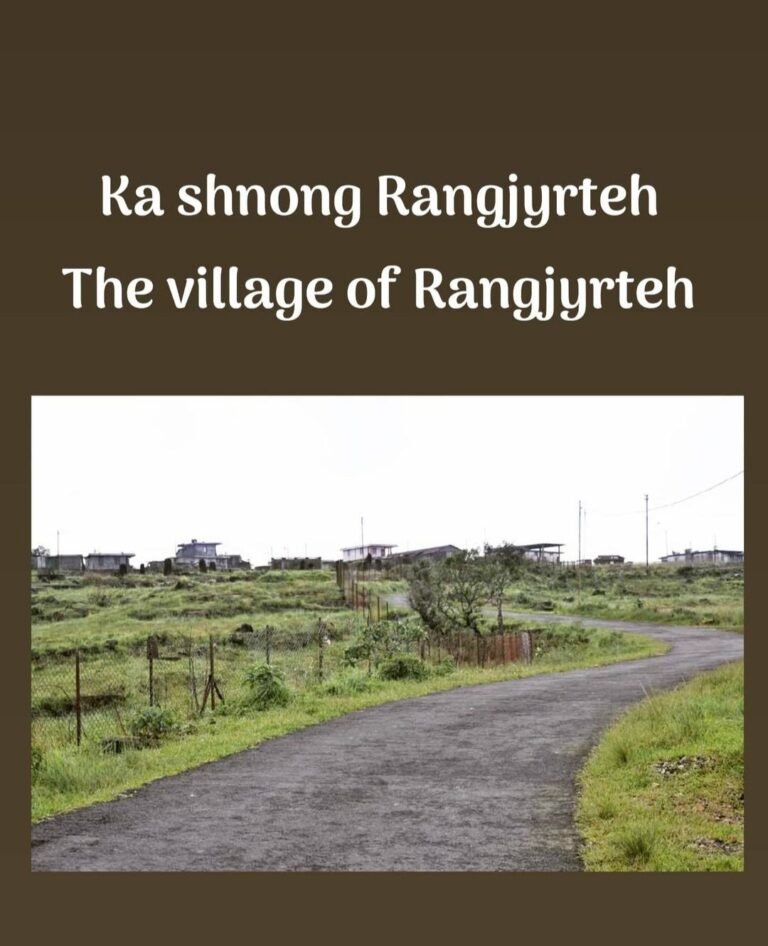
    Ka shnong Rangjyrteh

    The village of Rangjyrteh

    In the bygone days, Rangiyrteh was a thriving village known for its mastery of iron smelting across the region, but now it is left abandoned in ruins and mostly only ever referred to in old Khasi folklores. Rangiyrteh is said to be the village where the woman named 'Ka Likai' hailed from. According to folklore, after a gruesome and devastating tragedy befell her, Ka Likai ran to the edge of a cliff and threw herself towards a waterfall to her death. The waterfall was then named 'The Fall of Ka Likai' or more popularly, the 'Nohkalikai Falls' According to oral tradition, Rangjyrteh was a prosperous place during that time and people lived mainly by the trade of iron smelting. The transaction of the iron products was between the local villagers and the people of Sylhet (now in Bangladesh). It is regarded as one of the oldest villages in the Khasi and Jaintia Hills and no one really knows when this village came into being but it has achieved its prominent place in Khasi imagination.

    (Taken from: https://www.google.com/amp/s/www.tripoto.com /trip/trip-to-rangiyrteh-lost-civilization -mawsawa-falls-dainthlen-falls-cherrapunjee -sohra-meghalaya-5f575ca82f851.amp)

    …just seven kilometers away from proper Sohra on the western side, lies an extinct ancient settlement, a place rarely appearing in Khasi literature but which has many historical and mythological events associated with significance and direct references to various aspects of Khasi culture and society. Believed to be the ancient industrial centre for iron smelting, people also adopted orange cultivation as a major activity. Located exactly opposite to Dainthlen Falls, this ancient settlement is known as 'Rangiyrteh' an indigenous name which currently falls within the jurisdiction of Laitduh village under Sohra Syiemship. But before the formation of Hima Sohra, Rangjyrteh was very much part and parcel of the then Hima Khathynriew Shnong (a conglomerate of several villages on the slope where the Umiam Mawphlang river flows). But as far as the historical aspects of 'Rangiyrteh' are concerned, it can be construed as the centre for forging iron which lasted till the 17th century. From the remains it shows that there was a generation of industrialized communities a long time ago in these hills. But the reason for the collapse of this indigenous ancient industry as was narrated by older people was primarily the incapability to compete with the products coming from then East Bengal under the British. Iron smelting was the main trade and activity of this place. Besides, the famous Nohkalikai Falls too has derived its name from the person of this hamlet (Rangiyrteh). Considering the plurality of history associated with 'Rangjyrteh', I wonder if it could ever be included in the list of heritage sites presented to UNESCO for possible funding. The factuality and merit of the place defines it and it deserves to be treated as a priority as far as preservation of evidence associated with our ancient socioeconomic system is concerned. The present and future generations should become aware of all these things. Therefore, when we have something as clear evidence connected with our past generation, we should attempt to explore and unearth the mysteries associated with our own origin..As far as Rangjyrteh is concerned, including the culture and activities that existed there long time ago, we should be proud of it as a community and this particular spot on this region belongs not only to a particular Hima or Raid or Village but to the entire Khasi community.

    (Taken from: https://theshillongtimes.com/2017/08/07 /rangiyrteh-a-forgotten-heritage-site-of-sohra/ (Written by Aristotle Lyngdoh) )

    It is a place with historical treasures and ethnic beauty that can still be witnessed today. Monoliths of different forms, tall and short and each having its own meaning, talk of a civilization's past. Under these monoliths are bronze or earthen pots with ashes of our ancestors; there are a few silver shells too. The place is characterized by some form of marking around each area surrounded by well-constructed rocks. The stone foundation used to cremate the dead and the place where they used to hold meetings or the 'dorbar' are visible too. There is also a belief that this village was once fortified with well-constructed walls made from iron and rocks. The people used a gateway called 'Ka Khyrdop' to go in and out of the village for trade or other purposes. There is also a belief that a battle between Rangiyrteh and a nearby village had taken place. The battle claimed the life of the Doloi or headman, and the place where he died is known as Ka Pom-Doloi. The monoliths on the spot are in remembrance of those who fought in that battle. It was in this village that the finest iron was made. We can still see rocks shaped like a basin where water was kept to cool the iron after melting. These irons were exported to Bangladesh, earlier known as Shilot. The people used to trek down to sell these irons, the pathways still noticeable from Rangiyrteh through Dainthlen, Mawpun and on to Nohkalikai Falls connecting Mawmluh village and finally to the plains of Bangladesh.

    (Taken from: https://thenortheasttoday.com/oped/the-lost -civilization/cid2550931.htm (Written by Shynna Lyngdoh Mawphlang) )

    Rangjyrteh is a village that many of us might not have heard of. There are many historical and folkloristic associations that the village holds. 🏞️🪨🌲
    If you know more please tell us!

    All photos are from https://www.google.com/amp/s/www.tripoto.com/trip/trip-to-rangjyrteh-lost-civilization-mawsawa-falls-dainthlen-falls-cherrapunjee-sohra-meghalaya-5f575ca82f851.amp

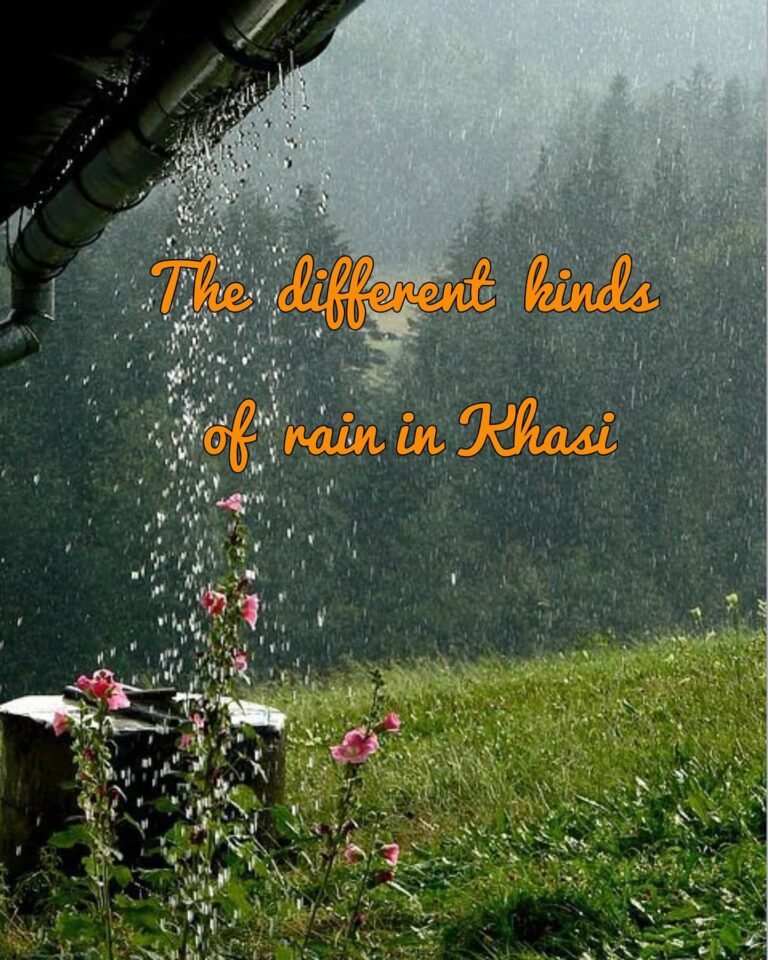
  • The different kinds of rain in Khasi

    " 'lapbah" is heavy rain

    " 'lap bñiup bñiup" is a drizzle

    " 'lapkyrtiah" is a rain storm with strong wind

    " 'lap praw" is a sudden shower

    " 'lap mynsaw" is sudden rain in the midst of a bright and sunny day. This rain causes the rapid flooding of rivers.

    " 'lapbehmrad" is rain that comes at the beginning of Spring. It is said that this rain helps hunters to identify the tracks of animals.

    " 'lapshiliang" is rain that falls only in certain areas.

    " 'lap Sohra" is the heaviest rain in the world that falls in Sohra (Cherrapunji).

    Belonging to the place with the heaviest rainfall in the world, the Khasis have different names for different kinds of rain 🌦️🌧️⛈️🌨️🌩️

  • Thomas Jones Day

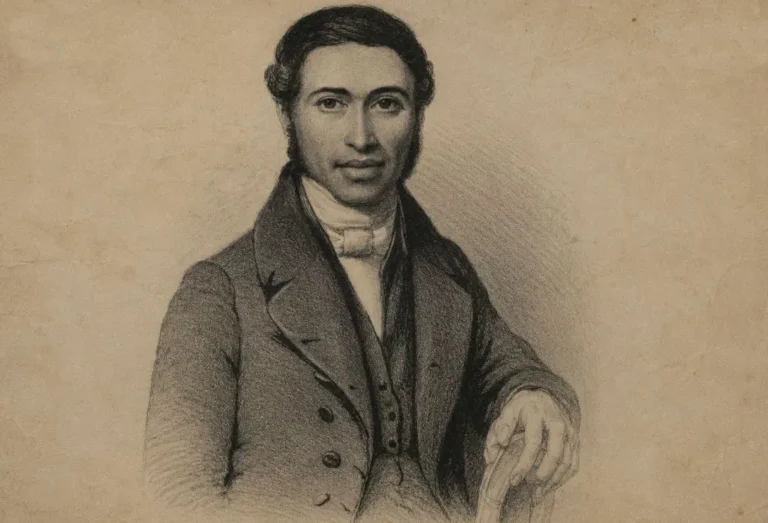
    Reverend Thomas Jones kum kpa ki dak thoh khasi,

    Dak a, b, k, d ba ngi nang dei ba

    phi hikai ïa ngi.

    -Daohi Manar

    The 22nd of June, the day that marks the arrival of Thomas Jones in Sohra is commemorated as Thomas Jones Day in Meghalaya. Thank you @xdtnoahjupejackllthmanar for sending this!

    Thomas Jones was a Welsh Christian missionary, who worked among the Khasi people of Meghalaya and Assam in India and of Bangladesh. He recorded the Khasi language in Roman script and the inscription on his gravestone calls him "The founding father of the Khasi Alphabet and literature".

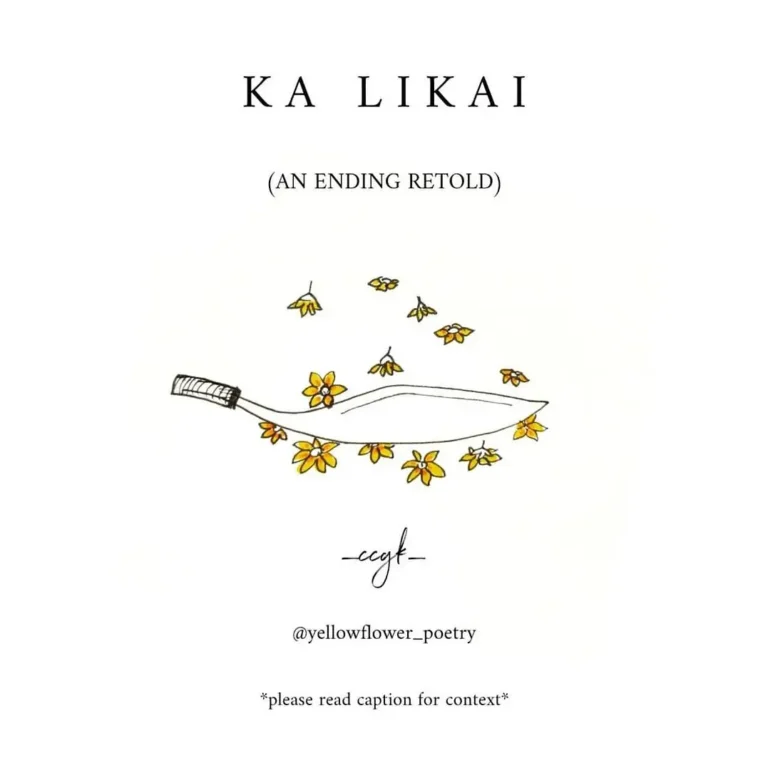
  • “Ka Likai (An Ending Retold)” by Clarissa Giri

    Calmly by the fire,

    She sits staring at the flames before her.

    Ember sparks burn freckles on weathered

    floorboards,

    Restless charcoal crackle uneasily in the dpei,

    While vapour fumes from her drenched

    kyrshah.

    Smoke and ash cling to her damp hair,

    A hot tear makes its way down her cheek,

    The wait glistens bloody at her heel,

    And she watches the shadows form on the

    wall before her

    As her ancestors dance for war.

    The rueful dish cooked to perfection,

    She feeds him a mouthful of this concoction-

    A stew of his own fingers; there will be no

    leftovers.

    How he tossed her daughter's tiny fingers like

    refuse in the shang-kwai,

    No. This butcher will devour his.

    There is a Khasi folktale about a widow named Likai who had a daughter whom she loved more than life itself. She was remarried after some time, to a man who later turned out to be abusive and dangerous and who eventually murdered her only daughter, while Likai was toiling in the fields. He butchered her and cooked a stew with the remains which Likai ate unknowingly. She found out after her meal when she was about to consume "kwai", a combination of betel leaf, lime and areca nut (a traditional edible) where she saw the remains of her daughter's fingers in the "shang-kwai" (areca nut basket).

    This caused a cacophony of chaos in her, driven by immense heartbreak and in a rage she ran after the man with a "wait" (a Dao or large bladed knife). Being unable to find him, in her madness-driven rage and being unable to endure life because of such a tragedy, Likai threw herself off of a waterfall. The waterfall is named after her fall "Noh Ka Likai" falls (Literally, Where Likai Jumped).

    This poem is a twist on that ending, as folktales go, there is always an ending of "What if?" and in this one there is no mention about what happened to the murderer and if ever he was given what he deserved. In this poem, I ask what if Likai found her daughter's murderer cowering in the forests of "Sohra" (Cherrapunji), and she was able to avenge her daughter before deciding upon her own fate?

    "Dpei" – hearth, "Kyrshah" – traditional khasi apron

    Caption and original artwork by @yellowflower_poetry