Tag: speakyourroots

  • Bia

    Bia [adverb] The formal union of a man and a woman, typically recognized by law, by which they become husband and wife, a marriage

    This meaning of the word "bia" has been taken from the Pnar-English Dictionary by Sajeki Passah (2013).

    Bia [noun] marriage; wedding. -verb. bia ka•a to marry; to wed;

    This meaning of the word "bia" has been taken from the Garo-English Dictionary by P. R. Marak (2010).

    Khublei Chiboon @micromotives for quite an interesting observation! 😄👍

    Who would have thought that a word in the Pnar and Garo languages would be the same and have the same meaning too.

    Sngew kmen ba lah nang bun na ngi kiba pule ïa ki dictionary ne ki dienshonhi, ki ban ai bun ki jingtip ïa ngi. 👏👏

  • ‘Ñiangbamkot

    Phi lah ju pyrkhat ne em ïa ka kyntien " 'ñiangbamkot"?

    Ka dei ka kyntien kaba la pynkylla beit shisur shidur na ka kyntien phareng "bookworm" kaba thew ïa ki briew kiba khlaiñ bad sngewtynnat ban pule kot. Shuh shuh, kane ka jingpynkylla ka dei ruh ka jingbatai ïa ka kam ne ka jingbam jong ki "silverfish".

    Have you ever thought of the Khasi word "'ñiangbamkot"?

    The word is a literal translation of the English word "bookworm" which refers to a person who has a passion for reading. What's more is the translation emphasises the function of silverfish which is to eat paper. In Khasi" 'ñiang" is a shortened form of "khñiang" which means insect, "bam" means to eat and "kot" means paper.

    It may be said that " 'ñiangbamkot" is a recent translation because Khasis arise from an oral tradition which would not have given importance to being a "ñiangbamkot" 😅📖🐛

    Dedicated to all you worthy ñiangbamkotsss! 😁😂

  • Phlanduman and Thlandaman

    "Phlanduman" ka dei ka kyntien Khasi kaba mut kaba kren ban ïalam bakla ïa ka jingmut da kaba kren kumne kumtai. Ka thew ruh ïa kaba shukor ne thok da ka rukom kaba leh mynleh hok.

    "Thlandaman" toh i kyntien Pnar i wa mut ha wa klam tyngkleiñ yow pynsñiawthooh bakla ya i yïumut wa sakhiat. Jooh ong i pyn thlandaman hawa thok næ chukor da iwa pynyoo kam iwa sakhiat.

    Both "Phlanduman" (Khasi) and "Thlandaman" (Pnar) mean to talk in a roundabout way so as to deliberately make a person misunderstand something or to deliberately divert the person's train of thought. The words refer to the act of lying or deceiving so as to make something appear true.

    "Phlanduman" ( Khasi) and "Thlandaman" (Pnar) are such interesting words 🤓🤓
    They both testify to the dichotomy between appearance and reality, a dichotomy that marks human life, but which is not easily perceived.

    English, Khasi and Pnar expilcation by @speakyourroots

  • Kshaid, Ticha, Dare

    Waterfall

    Indigenous words for the English word "waterfall"

    In Khasi a waterfall is called "Kshaid"

    In Pnar a waterfall is called "Ticha"

    In Garo a waterfall is called "Dare" (pronounced as "Daare")

    The word that most of us will not have heard of is the Pnar word "Ticha" for waterfall 😄 Khublei Chiboon Anvil R. Laloo for telling us about this word! 😄🙏

    Khublei Shibun @kari.on.travels for your pictures! 🙏🙏 Congratulations on your page!

    1st picture: Prut falls is located in Laitlyndop, Sohra. This waterfall emerges from Urwan river formed by the inflowing stream from Khliehshnong Laitlyndop, Umkrem and Madan Umkrem. The Urwan river flows to Mawsiang and reaches upto Shyngoid under Sohra Syiemship. (Source: https://theshillongtimes.com/2021/09/27/sohra-adds-new-waterfall-to-its-list-of-tourist-spots/)

    2nd picture: Weinia Falls is one of the falls located on the Namlang River which, along with the Kynshi river encircles the Nongkhnum River Island – the second largest river island in Asia after the magnificent Majuli. The falls lies on the northern periphery of the river island, about 13km from Nongstoiñ town, the district headquarters of West Khasi Hills. (Source: https://youtu.be/EPIl4nOFz8w by @kari.on.travels )

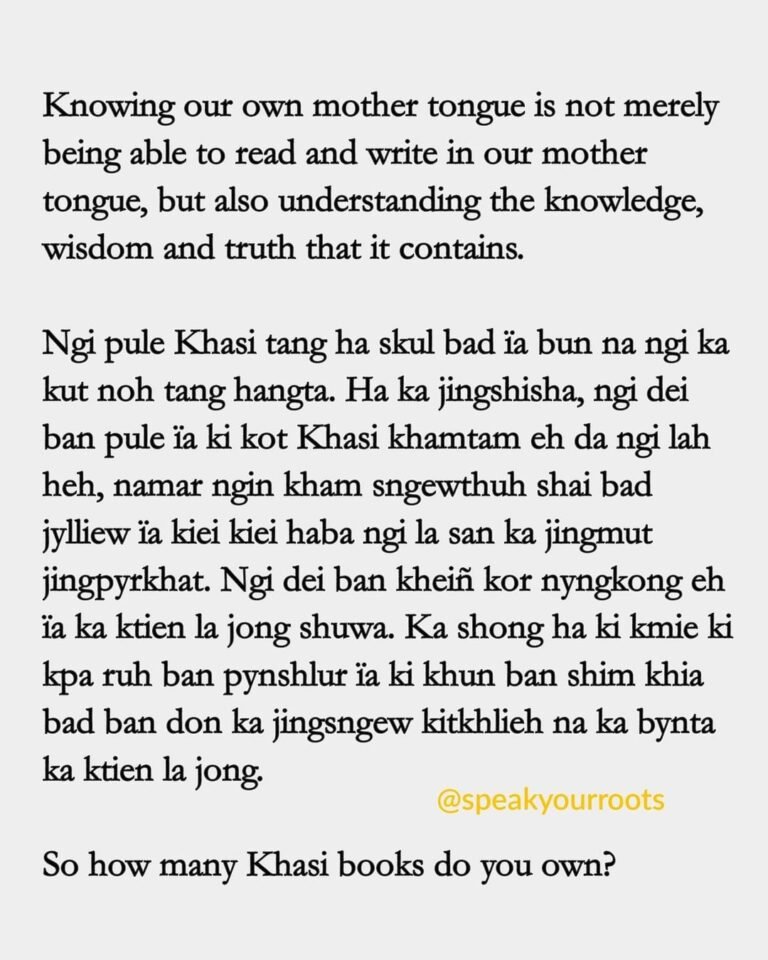
  • Excerpt from the Introduction of “Ki Khanatang bad U Sier Lapalang” by Primrose Gatphoh (1937)

    U Primrose Gatphoh u ong:

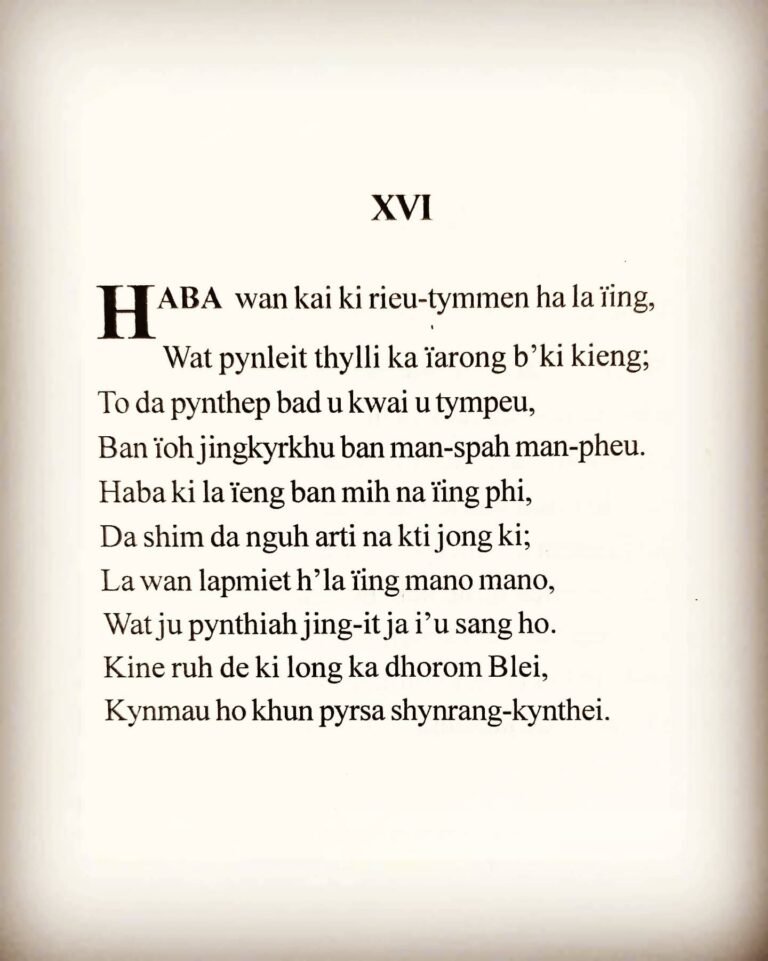
    "Ki Puriskam, ki Purinam, ki Parom bad ki Khanatang ki don sawdong kane ka ri jong ngi, ha ki trep bad ki skum, sawdong ka lyngwiar dpei ba syaid bad ba rhem jong u khun Khasi Pnar baroh. Hynrei ka long kaba eh shibun ban lum ban lang, bad ban tai ban peh bha ïa ki shuwa ban pynsah ïa ki ha ka thoh ka tar kum ki mar kynti ka ri.

    Kam long ka kam kaba suk ban lum na kaba shu ïohsngew ka shkor, bad kaba shu kem na ka hamsaïan shaphang kiei kiei kiba ngi ju ïohsngew bad ïa kren barabor hapdeng jong ngi, kum ïa ki khlawait, ki thma, ki kut, ki kharai bad ka jingngeit ki briew ïa ki ryngkew ki basa kiba don sawdong ki lum bad ki wah jong ngi…

    Ngim lah ban ieit ïa la ka ri khlem da tip ïa ki Khanatang ki longshuwa jong ngi. Ban bud dien bad ban wad ïa ka kpait ka rukom pyrkhat hyndai, ka long ka jingsdang kaba shi kyrdan sha ka jingieit ri kaba shisha. La ki nongthoh bad ki nongïathuh ki ïapher, hynrei ki thymmei bad ki jingthmu na kiba ki la mih ki long kijuh."

    "Fairytales, fables, folktales and myths are all around our hills, in huts and homes, around the warm and fiery hearth of Khasi and Pnar families. But it is arduous to collect, to select, to sift and sieve through these stories before they are preserved in the written form as valuable heritage. It is not an easy job to gather from what is heard by the ears, and to grasp from unclear accounts that are heard from here and there, about what we usually hear and talk about among ourselves, about brave warriors, warfare and the belief in forest guardians who are present in our hills and rivers…

    We cannot love our community without knowing the myths and folktales of our ancestors. To follow and to search for the tracks of the old ways of thinking, is to begin at the first step towards a true and real love for community. Even though writers and story tellers are different, but the source and the aspirations from which they arise are the same."

    Bunsien ngim ju kham pule ïa ki "Shi Kyntien" jong ki nongthoh kaba ki ai ha kaba sdang jong ki kot jong ki. Kane ka dei na ka kot jong u Primrose Gatphoh. ✒️📖 Ki dei ki ktien kiba ai jingtip, jinghikai bad ki pynsngew ruh ïa ka jingsngew kitkhlieh na ka bynta ka ri la jong. 🏞️🌧️

    Often we do not read the introductions or the forewords given by writers at the beginning of their books. This introduction is from the book of Primrose Gatphoh. ✒️📖 These are words which give knowledge and teaching. They also reflect a sense of responsibility for the community 🌧️🏞️

    🟡 English translation by @speakyourroots

  • To “G” or not to “🥚”

    😁😂🤡 To "G" or not to "🥚"

  • Jakhom

    Ka ktien "Jakhom" ka mut haba mad ïa ka sohsat, ka shitom ne ka mynsaw ha ka jingim u briew. Kum haba ong "Jakhom haba la wan ka 'er kyllang bad u slap."

    The Khasi word "Jakhom" means to experience difficulty and suffering, to be in trouble or to be wounded. When used in a sentence "It is jakhom when a cyclone hits accompanied with rain."

    Katba ngi nang kren, nang pule bad nang thoh ha ka ktien la jong, ngi nang lap bun ki kyntien kiba ngi lah ban pyndonkam ha ka jaka jong kiwei. Ka kyntien "Jakhom" ka long kawei na kum kita ki kyntien. 🗣️✒️📖

    The more we speak, read and write in our own indigenous languages, we will find more and more words that we can use instead of others. The Khasi word "Jakhom" is one such word. 🗣️✒️📖

    Hap kiar mo lok na ka jakhom! Tangba lada ka wan ruh, ngin nang khlaiñ bad met bad mynsiem! 💪💪

    🟡 English translation by @speakyourroots

  • Shape shifters by Mario Pathaw

    Mario says: "Shape shifters are popular figures in myths and folktales around the world. In Japan and China, foxes assume human form to bedevil the unwary. In Brazil, the river dolphin Boto can turn into a boy and many Native American cultures have stories of "skin-walkers”. In Ireland, there is a myth which talks about the man wolves of Ossory."

    "This concept is also very popular in the Khasi tribe and there are tales and myths about the shape shifters of my clan, The Pathaw clan. According to the tales passed down from my great grandmother, the men of the Pathaw clan leave their bodies in a seemingly lifeless state while their spirits travel and roam around as the "Khla" (Tigers/ Leopards). The Khasi tribe describes a brave warrior as "U Khla Wait" (attributing to the fighting spirit of the Khla) and my mother describes our Pathaw men as warriors and protectors of the family."

    🐯…….🐯…….🐯

  • Tungtap (Fermented fish)

    “Tungtap" or fermented dry fish is an ingredient in many indigenous recipes or chutneys of Northeast India 🐟🐟

    It is preferably ground on stone with onion, chilli, turmeric and "jaїur", a native kind of szechuan pepper. Some also prefer making the chutney with "jyllang" or garlic chives.

    "Tungtap" can be added to any other dish that includes tomato, bamboo shoot or even bitter gourd. 😄😋

  • “Ka Hukum” da i Dawa Dkhar

    Ka Hukum

    Hukum na chwa da ong,

    Pynduh ia ki tam adong;

    Sajier syndong yei man i long,

    Iow leit ka pyrthai u klam sarong;

    Hei ktien thylliej man i wa jem,

    Burom iow phooh ka iung ka sem;

    Kam u knii to ieiñ rangbah,

    Ham em mynsien dei sah khynnah;

    U kynrad wa stad na jrong,

    Wow bichar lut yeini nadong chadong.

    Ka Hukum

    Hukum na shuwa ka la ong,

    Pynduh ïa ki tam adong;

    Sumar syndong ïa la ka long ka man,

    Ban lait ka pyrthei ban kren sarong;

    Ha ka ktien ka thylliej long kiba jem,

    Ban phuh ka burom ha ïing ha sem;

    Kum u kñi to ïeng rangbah,

    Wat don ka mynsiem kaba dang sah khynnah;

    U Kynrad ba stad na jrong,

    Un bishar lut ïa kane nadong shadong.

    An original Pnar poem entitled "Ka Hukum" by @dawadkhar ✒️📖 Khublei Chiboon wa phah phi ya ka jingthoh yong phi kawa sñiaw toh wa ki por katni 😄🙏

    Kane ka poitri ka don ha ka, ka jingïasyriem bad "Ki Jingsneng Tymmen" ha ka rukom thoh bad ka rukom hikai jong ka.

    🟡 Khasi translation by @speakyourroots