Tag: translation

  • Ka kyntien Khasi “Kai”/ The Khasi word “Kai” by Janice Pariat

    In Khasi, the adverb "kai" suggests a mood that has no English equivalent and yet is very much a part of the lexicon of Khasi identity. "Kai" possesses a sense of pleasurable purposelessness, suffixed to a whole host of activities – "Ïaid kai" (to ramble, to stroll in the manner of a flaneur); "shong kai" (to sit around), "peit kai" (to just look), "leit kai" (to go on a leisurely outing) and so on.

    Perhaps "hanging out" or "chilling" best approaches the feeling contained in the word -although both these terms indicate an attitude that involves some premeditation or conscious choice and somehow do not quite capture the relaxed, joyful spontaneity of the easy-going "kai" with its wonderful connotations of having the freedom to roam, to look, to relax – "for free" – in a world that is not bound by the demands of time.

    Come, ïaid kai with me.

    Inspired by Janet Hujon; Tales of Darkness & Light

    Ka kyntien Khasi "kai" ka dei ka kyntien kaba ngi ju pyndonkam man la ka por tangba ngim ju poi pyrkhat ban batai bha ïa ka 😀

    Khublei Shibun @janicepariat ïa ka jingpuson jong phi kaba sngewtynnat bad kaba sngew kordor! ❤️❤️ Ki don ki kyntien ki bym lah ban pynkylla shisha ïa ka jingmut jong ki sha kawei pat ka ktien.

    📸 @janicepariat

  • Khasi words and their English equivalents

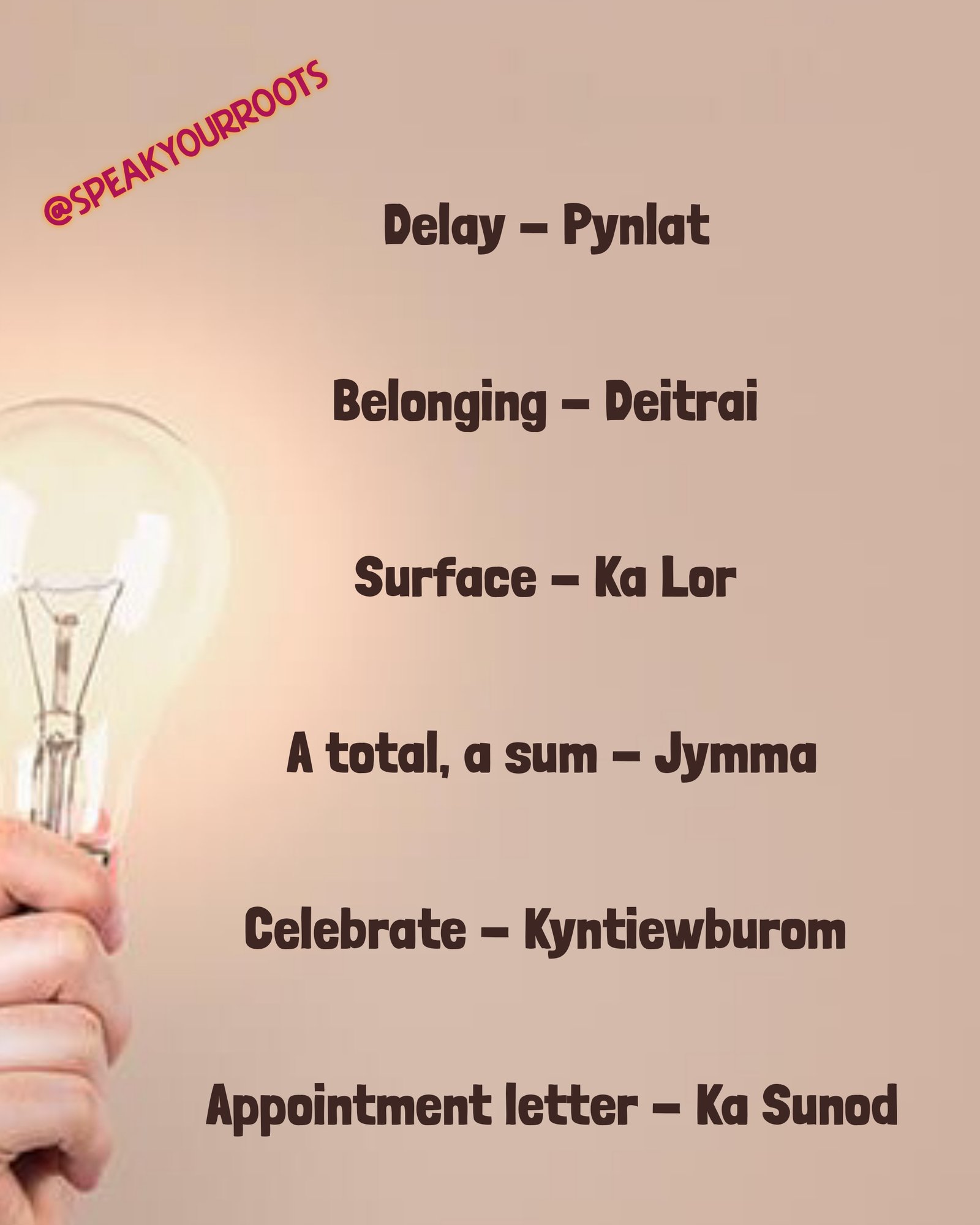
    Delay- Pynlat

    Belonging- Deitrai

    Surface- Ka Lor

    A total, a sum- Jymma

    Celebrate- Kyntiewburom

    Appointment letter- Ka Sunod

    We haven't had a list of Khasi words for some time 😄 Kine ki long khyndiat ki kyntien kiba ngi lah ban nang tip bad nang kynmaw, khnang ba ngin pyndonkam ïa ki ha ka kren bad ka thoh 🗣️✍️

  • Translation

    Khyndiat ki jingpuson shaphang ka jingpynkylla ktien:

    Ka dei kaei kaei kaba sngewtynnat bad kaba phylla ba ka riti ka dustur kaba la ai na kawei ka pateng sha kawei pat da ka ktien kan nym iehnoh ïa ngi da lei lei ruh. Kane kam long tang shaphang ki khanaparom ne ki khanatang jong ngi, hynrei ka jia ha ka jungim kaba man la ka sngi ruh. Kum haba ngi ong ba lah "thoh shun ki blei"' ne haba ngi ong "Kamai ïa ka hok". Ngi ngeit bad ngi bud ïa kata kaba la ïathuh pateng ha ngi. Kano kano kaba la kren ka don ka bor bad ka jingshisha. Kane ka dei ka bor jong ki riti dustur kiba la ai pateng ha ngi.

    Namar ba ki tynrai ba jylliew bad ka jingkordor kaba dang ïai bteng jong ki riti dustur ba la ai da ka ktien ha ka jymbriew Khasi, ka ktien kaba kren ka don ka jingialeh bad ka ktien kaba thoh. Tanga lyngba ka jingpynkylla ktien ka wan ka jingïamir ha ka jaka jong ka jingïaleh hapdeng ka ktien ba kren bad ka ktien ba thoh. Khamtam haba pynkylla na ka Khasi sha ka English ka don ka jingpyrshang ban kem ïa ki bun syrtap jong ka ktien kaba kren kiba tuid hin hin. Ngi kyrmen ba ngim pat duh noh ïa ki 'sai kordor jong ka ktien kaba kren. Ka jingpynkylla ktien ka lah ban pyrshang ban ïoh ksoh ïa kine tangba kan nym lah hi baroh. Ka mynsiem jong ka ktien kaba sawa kan man pher hi na ka sia jong ka ktien kaba thoh.

    Some thoughts about translation:

    It is something beautiful and remarkable that the oral tradition will never leave us. This is not only concerning our folktales but our day to day life. For instance, when we say "thoh shun ki blei", being marked for good fortune by the gods or "kamai ia ka hok", earn righteousness and integrity. We believe it and we adhere to what has been passed down to us. Anything that is said, anything that is spoken holds validity and power. This is the power of the oral tradition.

    Because of the deep roots and continuing relevance of orality in Khasi culture, the spoken word will have its conflict with the written word. Yet through translation, there is perhaps a reconciliation rather than a tussle between the spoken word and the written word. Especially when translating from Khasi to English, the attempt is to capture the multi-layered quality of the spoken word which is itself so fluid. We hope we have not lost the nuances and beauty of the spoken word. Translation should try to capture that, though this is not 100% guaranteed. The spirit of the spoken word will always be different from the ink of the written word.

    Namar ba kawei na ki thong jong ka page ka dei ban pynkylla sha ka ktien English ïa kiba lah sah dak ha ka page, khnang ba kito ki bym sngewthuh ïa ka ktien Khasi bad Pnar kin ïoh ka lad ban sngewthuh bad ïoh ka jingbatai kaba dei shaphang ka histori, ka ktien bad ka jymbriew Khasi-Pnar. Kane ka jingpynkylla ktien kan ïarap ïa kiwei ba kin ïohi ïa ngi ha ka rukom kaba dei bad kaba shai. 🆎🅰️🅱️

    The way in which a community and culture is represented to the world is of critical importance. In this regard, translation serves a relevant role. Has anyone thought of taking up translation as a profession? ✍️🆎🅰️🅱️

    #kajingpynkyllaktien #translation #representation #documentation #oraltradition #khasioraltradition #khasiorality #spokenword #writtenword #kaktien #kaktienbakren #kaktienbathoh #speakyourroots #speakyourrootschallenge
    #talklocal
  • English to Khasi translation

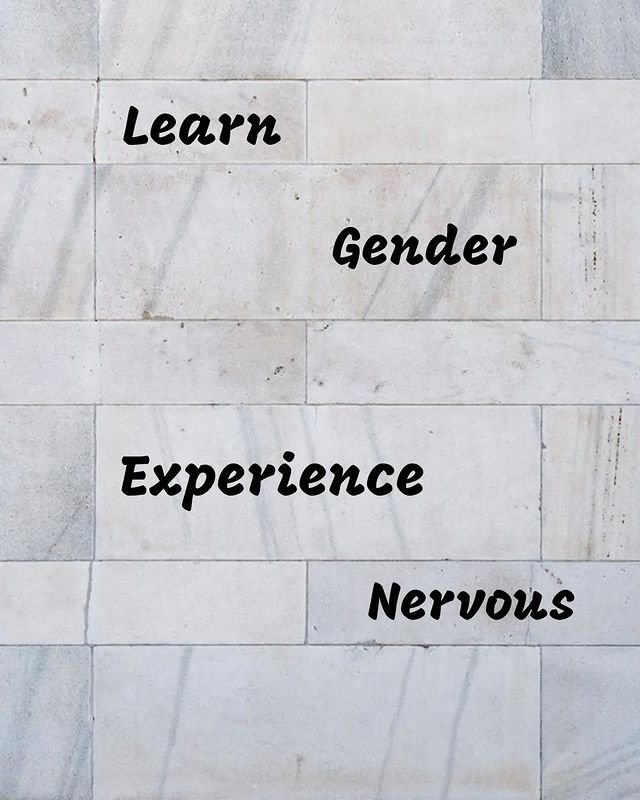
    Gender – Ka jingsngew ba dei kynthei ne ka jingsngew ba dei shynrang, kat kum ka rukom im, ka rukom pyrkhat bad kat kum ki jingngeit bad jinghikai ka iymbriew.

    Experience – Ki jingjia bad jingshem ha ka jingim kiba ai ka jingsngewthuh shaphang ka longbriew manbriew.

    Learn – Ban ksoh ia ka jingtip, ka jingsngewthuh bad ka jingstad.

    Nervous – Ka jingtieng kaba wan bad ka sngew syier bad ka pisa jingmut.

    Lah bun na ki nongbud jong ka page kiba la kylli kumno ban buh ha ka ktien Khasi ïa kine ki kyntien English. 🔡💭 La pyrshang ban pynkylla sha ka ktien Khasi ha ka rukom ban pynwan ïa ka jingmut jong kitei ki kyntien. 😄🙏

    Many followers of the page have asked how to translate these English words. 🔡💭 This is an attempt to place the right Khasi words so as to get the meaning of the words correctly. 😄🙏

    🟡 Khasi translation by @speakyourroots

  • Early to bed, early to rise, makes a man healthy, wealthy and wise

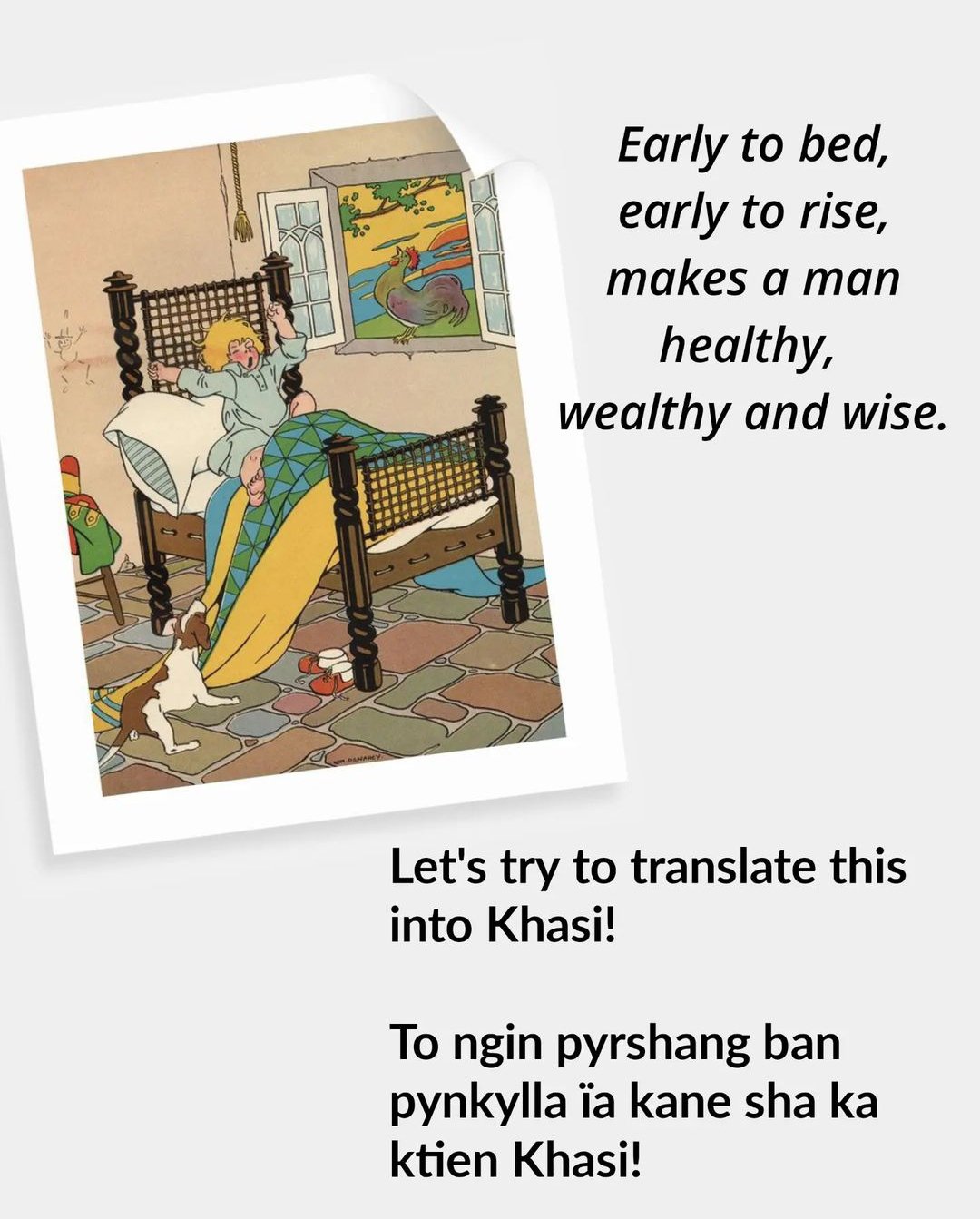
    "Early to bed, early to rise, makes a man healthy, wealthy and wise."

    Let's try to translate this into Khasi!

    To ngin pyrshang ban pynkylla ïa kane sha ka ktien Khasi!

    TRANSLATION 1

    Thiah dang kloi

    bad khie dangstep,

    ba phin khiah krat.

    ban kamai hok.

    bad ban stad.

    TRANSLATION 2

    Thiah dang kloi

    bad khie dangstep,

    ba phin khiah krat,

    ban roi ka kamai,

    bad ban stad.

    Kane ka dei ka jingpyrshang ban pynkylla sha ka Khasi ïa ki nursery rhymes ba dei da ka phareng. Kan bha shikatdei lada ngi lah ban pynwan ïa ki sha ka rukom pyrkhat, rukom im jong ngi ki Khasi. 😄😄

  • How do we translate the word “ethical” into Khasi?

    The word "ethics" (noun) deals with what is good or bad; a set of moral principles or a system of moral values. So "ethical" (adjective) would mean something that is based on a knowledge and understanding of moral values and principles.

    Thus, translated into Khasi the word "ethical" would perhaps be "Kaei kaei kaba ïeng ha ka nongrim jong ka jingtip bad jingshemphang jong ka akor longbriew manbriew bad ka hok ka sot."

    Here is an attempt to translate the word "ethical" into Khasi. This may be superficial so we welcome others to contribute your thoughts on this. 😊😊

    Khublei Shibun @sohphohkhasi for asking the question and Khublei Shibun @meiithei @bawanshwa_syiemlieh @wallam__ @carey_lynz @a_pocketful_of_plums @occyliana_ for your responses! 🙏🙏