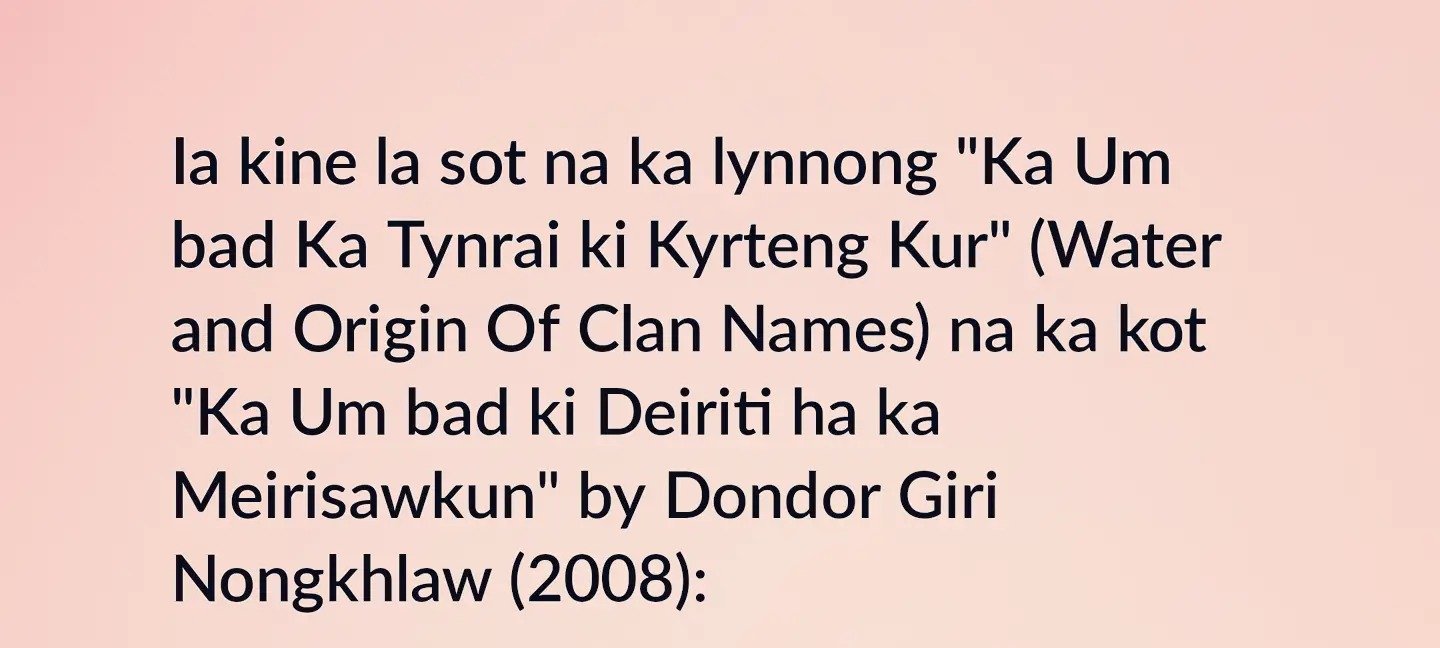
Ïa kine la sot na ka lynnong "Ka Um bad Ka Tynrai ki Kyrteng Kur" (Water and Origin Of Clan Names) na ka kot Ka Um bad ki Deiriti ha ka Meirisawkun by Dondor Giri Nongkhlaw (2008):
Katkum u Spiton Kharakor (1981) ha ka kot jong u "Ki Khun ki Ksiew a Hynñiewtrep" la shem ba don ki kur ba la ïoh kyrteng na ka um, ka wah, ka myn bad ka am.
Ki kur ba la sdang da ka 'um' na khmat ki don khadlai kur bad kine ki long ka kur Umbah, Umblah, Umdong, Umdoh, Umdor, Umdung, Umyiap, Umladkur, Umlong, Umsong, Umsohbar, Umthlu bad Umwai.
Ki kur ba la sdang da ka ktien 'wah' ki don khaddar kur bad kine ki long ka kur Wahksi, Wahksing, Wahlang, Wahlang mawleiñ, Wahlang pahsyntiew, Wahlang ryntathiang, Wahrait, Wahrih, Wahrit, Wahshah, Wahshrieh bad Wahspeh.
Ki kur ba la sang da ka 'am' na khmat ki don shiphew kur bad kine ki long ka kur Amkhlaw, Amkhlow, Amksang, Amkoi, Amded, Amdep, Amora, Amse bad Amwai.
Nangta sa ki kur ba sang da ka 'myn' ki don jin haduh arphew hynñiew kur bad kine ki long ka kur Mynbah, Mynbon, Mynkseh, Mynieng, Mynjar, Mynnar, Myniar, Mynrap, Mynriang, Mynrieng, Mynriem, Mynring, Mynsang, Mynskut, Mynsni, Mynso, Mynso-shangpung, Mynsong, Myntdu, Mynteng, Mynthang, Mynthliang, Mynthlong, Mynthlu, Mynthong, Mynthui bad Myntlang.
Ban sngewthuh ïa kane ka jingïasnoh ka kyrteng kur bad ki jnit ka mariang bad ruh bad ki deiriti ngin ïa shim tang kawei ar tylli ki kur kum ka nuksa.Tharai, lada ngi shim da ka kur Amkhlaw, Umyiap, Wahksing bad Mynthlong ka biang ban ïa batai bad pyni nia.
Kat kum ka tyllong kyntien ka kur Amkhlaw ka long ka kyntien ba la oh na ka 'am' bad 'khlaw'. Kane ka pyni ba ka kur ka don jingïadei bad ka um bad ka khlaw. Baroh ar, ka um ne am bad khlaw, ki dei ki jnit ka meirisawkun, kaba mut, lehse, ba ka kur Amkhlaw ka long ka kur kaba la buhai nyngkong ha ka jaka ba jan ka um bad ka khlaw.
Ka kur Umyiap, katkum ka tyllong kyntien, ka thew ka um bad u shyiap kiba baroh ar ki long ki jnit ka meirisawkun, ha kaba lah ban long ba kine ki kur ki la buhai nyngkong ha ki jaka ba don ka um bad u shyiap.
Nangta, ka kur Wahksing, katkum ka tyllong kyntien, ka long ka kur ba la ïoh kyrteng na ka wah bad ka ksing. Hangne, ka wah ka long ka jnit jong ka meirisawkun, katba ksing pat ka dei ka bynta jong ka deiriti. Kumta kane ka kur ka la oh kyrteng kur na ka wah bad ka ksing. Hangne ksing ka thew ïa ka deiriti put deiriti tem.
Nangta ka kur Mynthlong, ka pyni ba ka kur ka long kaba pyndonkam um, kaba pyndonkam thlong ruh. Hangne thlong ka thew ïa ka deiriti dung kum ka dung kba, dungnei, dungsoh bad ter ter. Namarkata ngi donkam ban nang ïaleh ban wad ban thud ïa ki kyrteng, ïa ki jingmut bad thymmei ki kyrteng kur.
The following is taken from the chapter entitled "Ka Um bad ka Tynrai Ki Kyrteng Kur" (Water and Origin of Clan Names) from the book Ka Um bad ki Deiriti ha ka Meirisawkun by Donor Giri Nongkhlaw (2008).
Nongkhlaw cites Spiton Kharakor (1981) from his book Ki Khun Ki Ksiew u Hynñiewtrep where he discusses how some clans received their names from the words "um", "wah", "myn" bad "am".
The clan names that start with the word "um" are 13 in number and some of them are Umbah, Umsong, Umyiap and Umthlu.
The clan names that start with the word "wah" are 12 in number and some of them are Wahlang, Wahrait, Wahshrieh and Wahksing.
The clan names that start with the word "am" are 10 in number and some of them are Amkhlaw, Amkoi, Amdep and Amksang.
Finally, the clan names that start with the word "myn" are 27 in number and some of them are Mynring, Mynsong, Mynrieng and Mynthlong.
To understand the connection between the clan name and the elements of nature, Nongkhlaw looks at four clans to discuss this.
The clan name Amkhlaw comes from the words "am" and "khlaw". This shows that this clan must have settled near "um" or "am" which is water and "khlaw" which is forest.
The clan name Umyiap refers to "um" that is water and "shyiap" which is sand. This shows that the clan must have settled in a place which has water and sand.
The clan name Wahksing comes from the words "wah" which means river and "ksing" which means drum. "Wah" is connected to the environment and "ksing" is related to the tradition of music.
Finally, the clan name Mynthlong comes from the words "myn" which is connected to the use of water and "thlong" which is the traditional mortar for pounding and grinding used by the Khasis. The mortar is a symbol for the traditions of pounding rice, sesame seeds, fruits and others.
Ka Um Bad Ki Deiriti Ha Ka Meirisawkun (Water and Culture On the Environment)(Volume II, 2008) by Dondor Giri Nongkhlaw is such an interesting book with great information on the intrinsic value of water and the environment to Khasis! 🌅🌅
🟡 English translation by @speakyourroots