Category: Art

  • Shape shifters by Mario Pathaw

    Mario says: "Shape shifters are popular figures in myths and folktales around the world. In Japan and China, foxes assume human form to bedevil the unwary. In Brazil, the river dolphin Boto can turn into a boy and many Native American cultures have stories of "skin-walkers”. In Ireland, there is a myth which talks about the man wolves of Ossory."

    "This concept is also very popular in the Khasi tribe and there are tales and myths about the shape shifters of my clan, The Pathaw clan. According to the tales passed down from my great grandmother, the men of the Pathaw clan leave their bodies in a seemingly lifeless state while their spirits travel and roam around as the "Khla" (Tigers/ Leopards). The Khasi tribe describes a brave warrior as "U Khla Wait" (attributing to the fighting spirit of the Khla) and my mother describes our Pathaw men as warriors and protectors of the family."

    🐯…….🐯…….🐯

  • U Bnai Lber by Careen J. Langstieh

    "U Bnai Lber'" (The month of March) by artist Careen Joplin Langstieh presents the visages of three Khasi women, who are at different points in their lives as daughters, wives and mothers. Poised above "mawbynna" as if forming a bedrock of support for them as bearers of precious heritage, their thoughts, emotions and experiences join and entwine as veins of smoke, leaves and blood which return back to "mawbynna and meiramew".

    @careenjoplinlangstieh says:

    " 'U Bnai Lber' was executed in early March 2022 at Dimapur. Three women portraits in a dreamy state, reminiscing of home, huddled together, sharing one's own position and endless conversations about how life affects their work. Identity, responsibility and the resolve to establish their own mark no matter where life's journey takes them."

    Khublei Shibun @careenjoplinlangstieh for generously allowing the page to post another one of your paintings! 🙏🙏😄😄

  • Ka Phan Nonglait by Tony Slong

    Ka Phan Nonglait is one of the Khasi women freedom fighters and is considered one of the bravest women of that time. Most women were either raped, molested or ill-treated by the British soldiers. This made Ka Phan Nonglait and some women from Hima Khatsawphra to take matters into their own hands with the help of Mon Bhut. With his help Ka Phan Nonglait was able to trap the British soldiers by offering them alcohol. When they were inebriated, she took all the weapons of the soldiers and threw them into one of the rock holes in the Nongrmai falls (now known as Phan Nonglait Falls). Due to this act, she is remembered in the stories that have been retold for generations. Then U Mon Bhut along with other soldiers killed 32 British soldiers. This was in the year 1829.

    In Ka Jait Nonglait: Ka Thymmei bad ki Dienjat written by T. Daniel Stone Lyngdoh Nonglait, the historical contexts of the Nonglait Clan has been given. Since ours is a society that relies on oral narratives, I have heard of the valour and bravery of ka Phan Nonglait. It has intrigued me to do further research upon this narrative. Yet, there is more to be unearthed. From the British perspective, the only record made was on U Mon Bhut who fought gallantly against the British. He was U Tirot Sing's most trusted general. The records about the Nongkhlaw incident were said to be the first spark that led to the war of the Khasis against the British. Among those killed, two British officers named Lieutenant Bedingfeld and Lieutenant Burlton were killed. In a letter to Lamb by David Scott, dated 10th April 1829, he mentioned that this fateful incident happened either on the 4th or 5th of April, 1829. This incident shook the Britishers and was recorded in the memoir of the Late David Scott, esq.

    On this Independence Day we remember Ka Phan Nonglait as the first Khasi woman freedom fighter. The achievements of Khasi women who fought against the British are often not recorded by history. Ka Phan Nonglait is remembered as one of those freedom fighters who have made a mark on Khasi history.

    This entry has been contributed by @carey_lynz Thank you so much! 🙏🙏 Our gratitude also goes to @tonyslong 😃🙏

    🟡 Picture 1: Painting of Ka Phan Nonglait by @tonyslong

    🟡 Picture 2: http://wikimapia.org/21065891/Phan-Nonglait-Falls-Nongrmai

    🟡 Picture 3: Ka Jait Lyngdoh Nonglait: Ka Thymmei bad ki Dienjat written by T. Daniel Stone Lyndoh Nonglait.

    🟡 Picture 4: A Memoir of the Late David Scott, Esq. written by Major Adam White (1831, 1st edition)

  • Ka Tari Dab by Careen J. Langstieh

    This painting by @careenjoplinlangstieh shows "Ka Tari Dab" which is a typical kitchen knife, present in each and every Khasi household. It comes in different sizes and is also carried by women in their "bek" (bag).

    In the artist's mind, the most common objects are given new life, meaning and power. 🔥 🎨🖌️

  • Ka Nam bad U Khla (Ka Nam and the Tiger) by Wallam Kupar War

    Continuing with the theme, images and characters of the Khasi folktale "Ka Nam bad U Khla" ("Ka Nam and the Tiger") here is a striking painting by @wallamkuparwar which portrays the mother of Ka Nam.

    The art piece takes as its centre the experience of the mother of Ka Nam. We see her pregnant and meeting the tiger who would change the fate of her daughter forever. Once again art has taken the responsibility of envisioning a story providing us with a different kind of retelling of a folktale. Thank you @wallamkuparwar for sending this! 😀🙏

  • Ap jon, ap jon by Careen J. Langstieh

    "Ap jon, ap jon,

    thung soh 'riew,

    ka miaw, ka ksew.

    Ka mat ia thung,

    ka mat ia thung.

    Yn bret lut sha khyndew.

    Phurrrrrr…..”

    "Ap-jon" or "Ap-jan" is a favourite children's pastime played with as many participants present. It involves pinching each other's hands one on top of each other to make a ladder-like formation. The rhyme is then sung while rocking the chain of hands up and down. The song ends with 'phurrrr' which signals letting go of the hands and immediately is followed by children tickling each other. When I was little, I always knew who was going to give me the sharpest pinch so I'd try to put my other hand on top of that kid's hand to counter myself. But we carry no grudges because in the end we would end up laughing hysterically by tickling each other.

    "Ap jon, ap jon" sent by @careenjoplinlangstieh 😄😄😄 This is a beautiful art piece on the childhood game! 🤩🤩🤩❤️❤️👏👏

    "Ap jon, ap jon" is a childhood game that most Khasi children will know. Like the post says it is a popular pastime during play. Remember those painful pinches with voices anticipating the tickles at the end? 😅😂 Khublei shibun Kong @careenjoplinlangstieh for this entry! ❤️🤍💜💙

  • Ka Jaiñ-it by Careen J. Langstieh

    "Ka jaiñ-it" ka dei ka jaiñ bah ïa ki khyllung ne ki khun rit; ka dei ruh ka jaiñ kaba pynskhem haba bah ne kit.

    Ka jaiñ-it ka dei ka jaiñ ba pyndonkam da ki Khasi ha ka por ba ki bah ïa ki khunrit. Lah ban ong ba ka dei ka jaiñ ba jrong lynter ba la thaiñ na ki sai kynphad balieh bad don ruh ki jingthaiñ da ki ksai ba saw sha tduh jong ka jaiñ. Ha kylleng sawdong ka Ri Khasi bad Jaiñtia, ki longkmie ki ju pyndonkam da kane ka jaiñ ban kit ne bah ïa ki khyllung ne khunrit hadien met khnang ba kin lah ban trei ban ktah ruh ha kajuh ka por-lada dei hapoh ïing ne shabar, khlem da pynsepei ïa ka por.

    Ki kynthei Khasi ki dei kiba smat bad bunsien ngi ju ïohi ïa ki longkmie kiba bah khun da kaba pyndonkam ia ka "jaiñ-it" ha ka por ba ki trei ïa kano kano ka kam: lada dei ka kam shet, kam sait, kam khlieng ne haba ki leit sha la ki bri ban trei kam rep kam riang. Ka jaiñ-it ka dei ruh kaba ju ai sngewbha da ka Meikha ïa ki ksiew. Kane ka dustur ka dang im sah haduh ki por mynta ruh, tangba lehse ka jingpyndonkam ïa ka jaiñ-it ka lah kham duna ha ki thaiñ sor.

    Ïa ka jaiñ-it lah ban pyndonkam baroh shi snem lynter bad ka kham ïarap khamtam eh ha ki por tlang ha kaba i khyllung i ïohthiah ha syndah ka met jong ka kmie bad i ïoh ruh ka jingsyaid na ka met jong ka. Ki pyndonkam ruh sa da ka jaiñ-kup ha kaba ka kmie ka kup ïalade da katei ka jaiñ ban sop syaid ia i khyllung iba ka bah.

    "Ka jaiñ-it" is a traditional baby sling-wrap used by Khasis and Pnars which may be described as a long strip of cotton cloth made from big strands of white thread with red stripes at the ends. In the Khasi and Jaiñtia hills, mothers use this cloth to carry a baby on their backs, so as to be able to perform work in the house or outside.

    Khasi women are never idle sitters. We see mothers carrying babies securely and safely fastening them with the jaiñ-it while they go about their daily work, be it cooking, washing and sometimes tilling the field.

    The jaiñ it is traditionally gifted by the paternal grandmother to her grandchildren. This practise is still alive and well. However, the use of the jain-it is lessening in the urban areas. The jain-it can be used all year round and is particularly handy in the winter months when the baby is snugly fastened and then a "jaiñ-kup" (flannel shawl) is wrapped around the baby to keep it warm.

    Most of us have a picture of ourselves tied by a "jaiñ-it" on our mother's back when we were babies ☺️☺️

    Kudos to our mothers for being the symbolic "jaiñ-it" who bind our families together with their unconditional love 🧡🧡🧡

    Thank you Kong @careenjoplinlangstieh for allowing us to use your artwork! 🙏🙏

  • Maw-San by Careen Joplin Langstieh

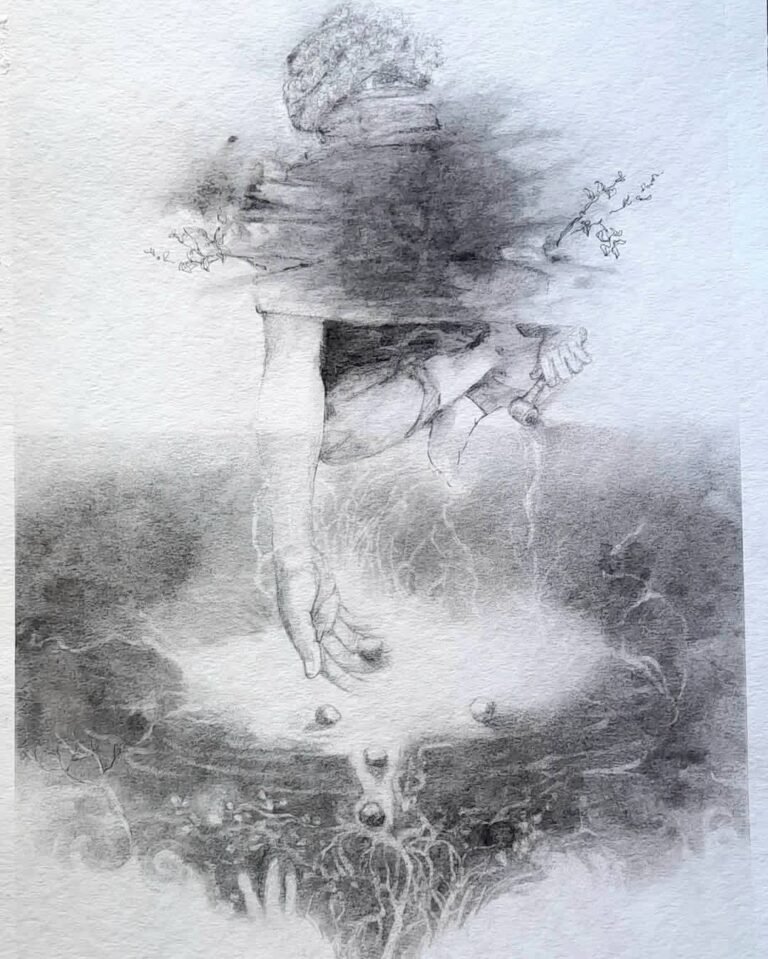
    "A game of five stones"

    This charcoal art piece by @careenjoplinlangstieh is named after an indigenous game called "Maw-san".

    Do you remember playing this game?

    Khublei Shibun Kong @careenjoplinlangstieh for sending this beautiful piece!