Category: Humour

  • Ki mawsiang bymman

    Kane ka dei ka jingjia kaba shisha kaba jia la kham mynshuwa ïa i Mei jong ngi haba i dang leit skul. Ka dang dei ruh ka por haba ki nonghikai ki hikai beit da ka ktien Khasi ha skul. Ka pher ka rukom kren bad ka rukom shah mai de ha kito ki sngi.

    La don ki khynnah kiba shong shadien ha ka klas bad ki bunktien bunnia bha haduh ba ita i nonghikai i lah sngew wit. Ha ka jingdom i la ong kumne: "Kitei kiba shong shadien! Ki mawsiang bymman, phi leh aïu!?"

    Tharai ngi sngew khor haba ïohsngew nyngkong tangba ka dei kaba sngew biria ruh ka rukom mai. Ka ktien "mawsiang" ruh ka ïa hap bha namar ka thew ïa ka jinglong tlew tlew bym suidñiew jong kita ki khynnah.

    Ka rukom mai ka dei kawei hi ka sap ha kaba da ngi nang ban pynshong bha ki kyntien, kata ka jingsneng jingkraw jong ngi kan ktah bad neh ha ka jingmut jingpyrkhat jong ki khynnah, bad wanrah ïa ka jingbha.

    This is a real event which happened to my mother when she was in school. It was a time when teachers still taught in the Khasi language. They way Khasi was spoken and expressed was different back then, which is apparent in the way they scolded their students.

    There were a group of talkative students who sat at the back of the class. One day when the teacher became angry with them, she said: "Those sitting at the back! Those sullen wicked boulders, what are you doing?!"

    It might sound harsh when we hear it for the first time but it is also a funny and sarcastic way of scolding someone. The word "mawsiang" or boulder suits the situation well and is a humorous metaphor because of the indifference and uncaring attitude of the students.

    These are stories we hear from our parents or grandparents that we will never get to experience in our schools 😅😂😂

    🟡 English translation by @speakyourroots

  • Leh Piat

    The Khasi colloquialism/ phrase "leh piat" or sometimes "ba piat bha" is used to describe a person who may be seen as a jack of all trades. He or she seems to be seen everywhere, meeting and conversing with people. Thus, the phrase is a way of describing the popularity of a person.

    An onion is one of the most important ingredients in Khasi recipes. Therefore the metaphor of an onion implies that a "piat" person is usually popular and is invited to (or attends) functions and events.

    The persons who are described as being "piat" or "leh piat" may also be extroverts, they are talkative, outspoken or opinionated, having a large circle of acquaintances.

    According to Ka Dienshonhi: The Khasi Encyclopaedic Dictionary the word "piat" can also be used as an adverb which means: Da kaba mut skhem ne ka jingkut jingmut shaphang kaei kaei, kum "nga shong piat ban pule, ban bam, ban trei bad kiwei-kiwei".

    This means that the word "piat" can be used to descibe the firm determination (or decision) of a person to do anything.

    The phrases "Leh Piat" or "Ba Piat Bha" are amusing, sarcastic and definitely interesting 😄😂 Whoever coined this phrase is a master of wit! 🌰🌰

    Khublei Shibun @_.natalie_kharkongor._ ba phi phah ïa kane! 🙏🙏😀

    🟡 Expanded by @speakyourroots

  • Kut ka speed

    "Kut ka speed" is a humorous phrase which is a combination of Khasi and English. "Kut" in Khasi means an end or a stop to something.

    So "kut ka speed" means the end of something that was looked forward to, like the cancellation of a picnic or the abrupt end to something which had promise like a failure in business. The use of the English word "speed" in the phrase emphasises the end or the stop to an action or event which was deemed to have momentum (in the literal and symbolic sense) but which met with an untimely end. The phrase also has the power of a warning, so as to caution someone, in case what they are doing will end up incomplete or as a failure.

    An example of the phrase in a sentence: "Ka bha ba phi mih kloi. Da mih kham sngi tang ka dheng kali ruh lah kut ka speed."

    This sentence can be translated as "You should leave early, otherwise the traffic will be kut ka speed". The phrase sounds unsuitable when the sentence is translated into English. It does not possess the same punch because it is meant to be a sentence in Khalish and not English. Further, the exact sense of the sentence is lost when we try to translate it.

    "Kut ka speed" is an interesting example of "Khalish", that is the combination of English and Khasi. The merging of indigenous languages with English is happening around the world and shows the development and evolution of language. This is present mainly in urban areas where people use English daily in their communication with others.

    Khalish in particular leads to funny phrases and jokes which have a distinct ring and flavour to them which is both indigenous as well as global. Though there will be many critiques, this phenomenon is here to stay and seems inevitable in the evolution of language.

    When you were planning to have that jadoh but when you reach the Kong says there's no more jadoh! Huuu…kut ka speed! 😂😂😂

    "Kut ka speed" is the Khalish equivalent of a buzz kill 😖 Don't deny it, especially the Shillongites 😅 Khalish has become a way of how we speak 😜

    Please comment with sentences having "kut ka speed" 😂😂

  • Sboh masi

    Here's a funny incident from a Khasi language class in school:

    During a Khasi language class a boy was told to make a sentence with the word "sboh". This is what he wrote: "Nga bang bha ka sboh masi."

    The boy is referring to beef curry but "sboh masi" actually means manure.

    So it's high time we start posting jokes 😂🤡💩Here's a really "sboh" one to exercise those belly rounds 🤭🤭

  • Ki Kyrteng Sin Part II/ Khasi Nicknames Part II

    Sympiw (rit khmat/ small eyes)

    Tun tun (sngaid/ chubby)

    Samah (sngaid bad lyngkot/ short and stout)

    Shrieh (khih ksaiñ, balaiñ/ hyperactive, mischievous, oversmart)

    Shyrjei (ima ka dur/ scary looking face)

    Sadman

    Sadmew

    Thamer

    Thohliap

    Tah (from mattah meaning snail; a reference to being slow)

    Krew krew (big eyes)

    Piduiñ (sngaid/ fat)

    Ldoiñ (heh briew bad biej/ big-built and dumb or foolish)

    Kriw kriw (rit briew bad shalak/ small, smart or sly)

    Bah Rai (raikhoh/ thin)

    Bah Kyn jait Roi (ba kynroi than/ prone to having fights)

    Priñ (Pnar) (ba ïong/ a dark complexion)

    Chru (Pnar) (Ka shriew/ Yam)

    Sti (wrinkled looking or used for someone thin)

    Mum (pronounced as Moom)

    Another round of "Ki Kyrteng Sin"/ Khasi Nicknames 😆😂😆😂

    These nicknames have been collected from the comments section of the earlier post on Khasi nicknames. Thank you to everyone who contributed! 🤡🤠🎃

  • Ki Kyrteng Sin Part I/ Khasi Nicknames Part I

    The Khasis have a practice of giving nicknames and besides the usual Bahduh, Theiheh, Kongdeng, Bahrit, which denote a specific position among siblings based on age, there are other kinds of nicknames that are given because of a context related to the person concerned. Here are some:

    Ka Smaw (ba ïong, ba jaing/ being dark and dirty)

    U Satlew (ba heh bad khlaiñ/ big built and strong)

    U Ren (ba bun ka shang/ always going out)

    U Dum (as in lyndum/ bald)

    Ka Taiñtabul (for timetable)

    U Koted (like the air horn of Bedford buses)

    U Buit (rit, buittuh, shu shyit briew beit/ small, wiry, likes to pinch others)

    U Tamuiñ (saw ki khmat bad ka ïambait/ red eyes and a cry baby)

    U Lo (pronounced like the word Law)

    Ka Bon

    U Been Loons

    U Sahep Laitkor

    Ka Samap (raikhoh/ stang shñiuh/ skinny, limp hair)

    U Bring

    Ka Rai (namar ba bang Krai/ because she likes millet)

    Bah Ling Saphu (a girl's nickname because she was scared of a beggar with this name)

    U Ro

    Ka Thre (named after a woman obsessed with cleanliness)

    U Lui

    U Jon Snai (named after a man who stole roosters to make them fight)

    Shnuit

    Ïong (dark complexion)

    'Ngaid (sngaid/ fat)

    Bung

    Lew Lew (from Pyllew/ big eyes)

    Pit Pit (namar ba sympit/ small eyes)

    Mem Syndem (ba syndem/ flat nose)

    Dem (ba syndem/ flat nose)

    "Ki Kyrteng Sin" or Khasi nicknames

    Don't we love our nicknames?! 😄😄😄😂😂😂 Here are some Khasi nicknames contributed by @indariwarjri @carey_lynz @bibianaryntathiang. Thank you for sending them! 😄

    Some have a context and some don't, but please do enjoy them and come up with your own interpretation!

    Please tell us about your funny nicknames! 🤡🤡😎🤓😎🤠🤠

  • U Swet Titiaw

    Have you ever met a person who says no but they actually mean yes? If you offer them something they refuse and act as if they don't want it but in reality they do. In the Pnar language, they have a name for people like this. They call them "Swet Titiaw".

    The story goes that "U Swet Titiaw" is a farmer from Jowai. He has a peculiar quality and that is when people ask him something he acts as if he doesn't want to answer or when they offer him something he refuses but in his heart he wants to answer and he wants to accept the offer.

    In Pnar they say: "Leh u kam u wym bien tangwa napoh napoh kwah u naduh mynsien. Neite i daw haduh katni leh ia ki bru wa man kam o juh sin ki ki dei pyrtuid u 'Swet Titiaw'."

    "U ong tae ym bien ym bien

    tangwa ki kti ner ner nei dien.”

    "He will say no, no but his hands

    are already open from behind.”

    The Pnar nickname "U Swet Titiaw" sent by @laloorisa 😅😅😂😂 Thank you for your entry!

    "U Swet Titiaw" is quite the satiric nickname for someone who says no but actually means yes…🤡🤡

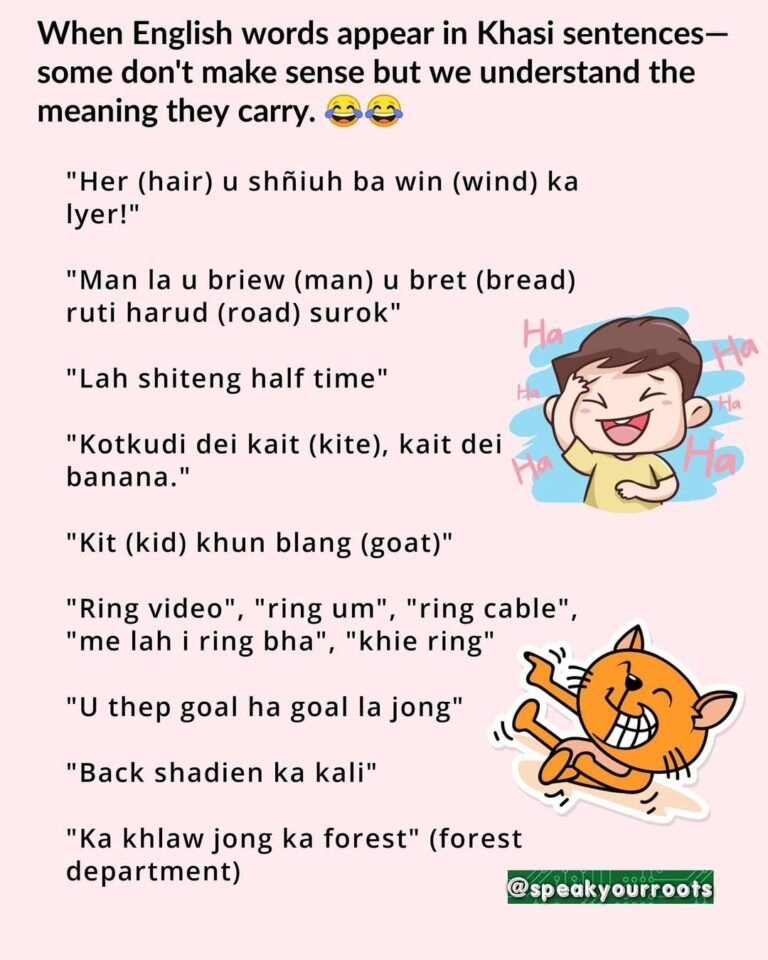
  • When English words appear in Khasi sentences

    When English words appear in Khasi sentences, some don't make sense but we understand the

    meaning they carry. Here are a few examples:

    "Her (hair) u shniuh ba win (wind) ka lyer!"

    "Man la u briew (man) u bret (bread) ruti harud (road) surok."

    "Lah shiteng half time."

    "Kotkudi dei kait (kite), kait dei banana."

    "Kit (kid) khun blang (goat)"

    "Ring video", "ring um", "ring cable", "me lah i ring bha", "khie ring."

    "U thep goal ha goal la jong."

    "Back shadien ka kali."

    "Ka khlaw jong ka forest." (forest department)

    The merging of languages is bound to happen and creates funny and interesting expression! 😂😂😂

    Thank you @_catherinemelam @esra_syiem @shillongftw @jeanrichardmawa @a_pocketful_of_plums @courageaity @longnamkharpuri @wthongnj for your contributions! 😆😆😆

  • Janor

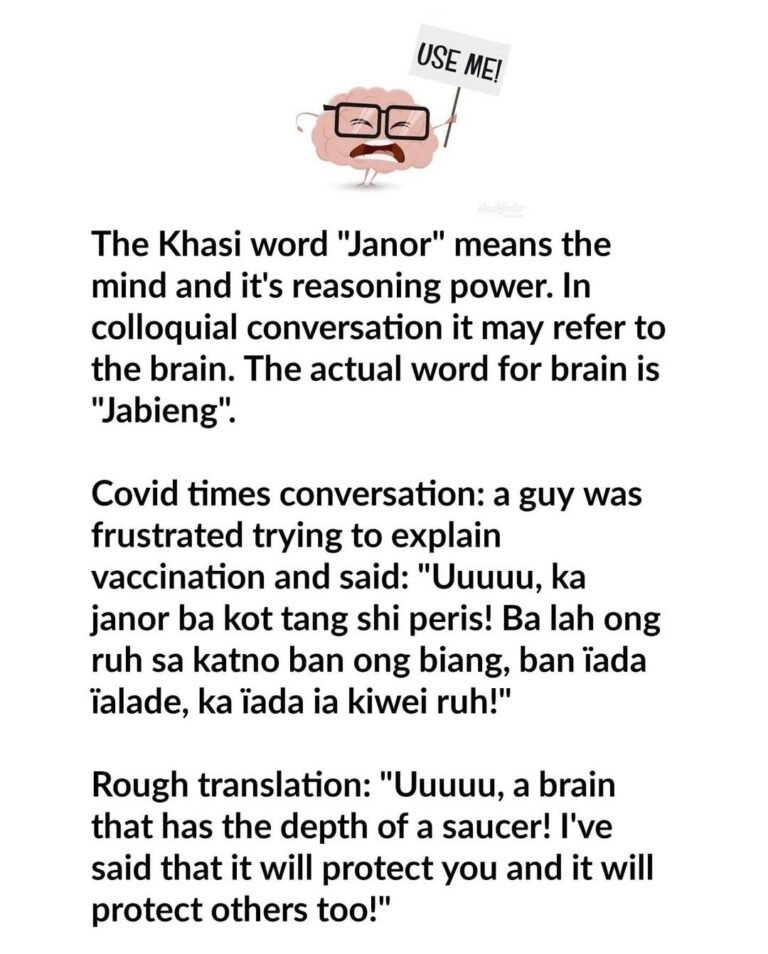
    The Khasi word "Janor" means the mind and its reasoning power. In colloquial conversation it may refer to the brain. The actual word for brain is "Jabieng".

    Covid times conversation: a guy was frustrated trying to explain vaccination and said: "Uuuuu, ka janor ba kot tang shi peris! Ba lah ong ruh sa katno ban ong biang, ban iada ialade, ka iada ia kiwei ruh!”

    Rough translation: "Uuuuu, a brain that has the depth of a saucer! I've said that it will protect you and it will protect others too!”

    "Janor" sent by @longnamkharpuri 😂😂😂 The "Janor" is inside the "Maloi" and so is the "Jabieng". Thank you for bringing this up in the "Maloi" comments! 💀💀💀

    Loving the analogy between the mind and the saucer! 🤣🤣

  • Shyrkhei

    @laurette_dkhar says:

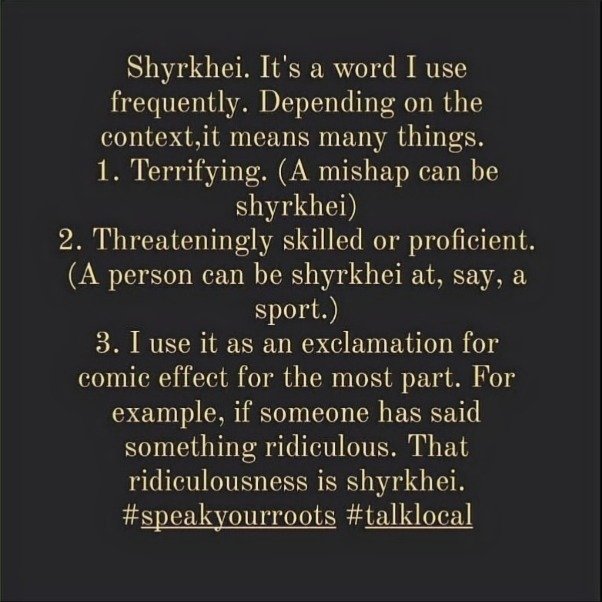
    It's a word I use frequently. Depending on the context, it means many things.

    1. Terrifying. (A mishap can be shyrkhei)

    2. Threateningly skilled or proficient. (A person can be shyrkhei at, say, a sport.)

    3. I use it as an exclamation for comic effect for the most part. For example, if someone has said something ridiculous. That ridiculousness is shyrkhei.