Category: Khasi Dialects

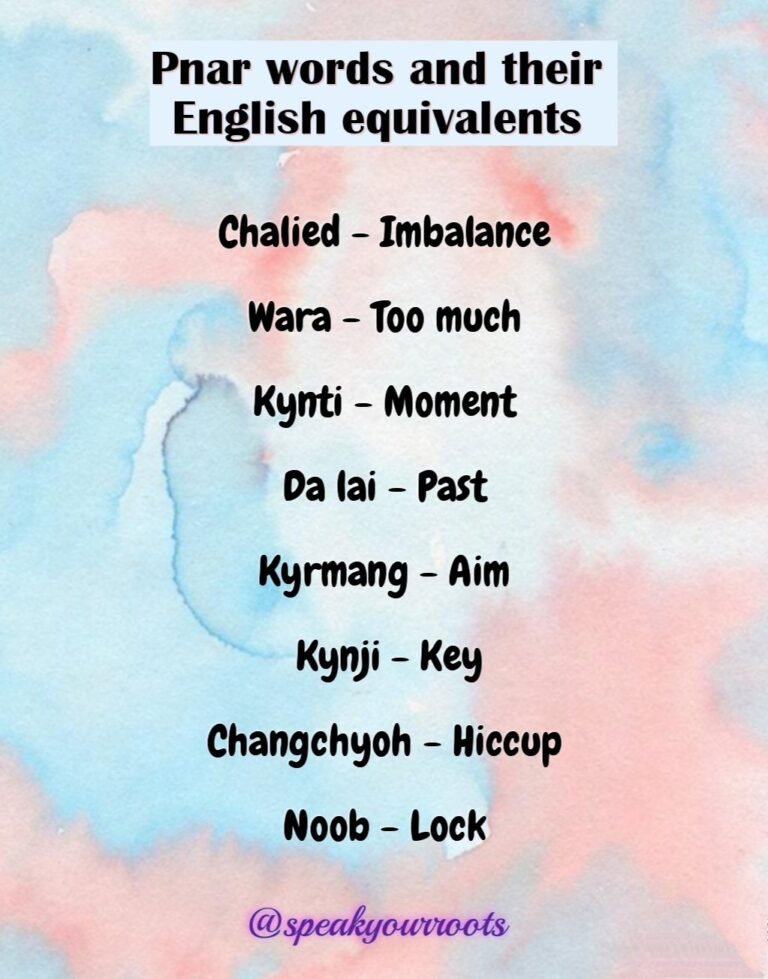
  • Pnar words and their English equivalents

    Kine ki dei ki kyntien Pnar kiba la phah da i @xdtnoahjupejackllthmanar 😄

    Khublei Chibōn wa phah phi ya kini ki kyntien Pnar, yow tip i wei yow nang i u pynemkam ha ka klam ktien Pnar. 🙏🙏

    Here are a few Pnar words and their English equivalents sent by @xdtnoahjupejackllthmanar

    🟡 Source: Pnar-English Dictionary by Sajeki Passah (2013)

    #pnarlanguage #pnarwords #pnarlanguageconservation #jaiñtiahills #jowai #indigenouslanguages #indigenouslanguageconservation #speakyourroots #speakyourrootschallenge #talklocal

  • Nga khmah a phai/ I miss you

    I miss you – Nga khmah ïa phai, ka daw ka iong pynkylla ktian ha ka kyntian chnong cji. "Nga khmah ïa phai" a "Nga lah khmah bha ïa phai" – "I have dearly missed you." La kanai ka senten ka chi kit iongmut lot archah ban ted ïa ka iongong "| miss you." Kanai ka senten "nga khmah ïa phai" ka thow bha ia ka iong snow angnod, ka iong snow angnod ban cjoh ia kynduh lot bad arcju arcju iong cji blah, ban cjoh a en lot nen ki por man riim, a ted ban cjoh ji lot be iah ki iong cji sngow blah, ban cjoh lot ia ka iong snow chngaiñ cjin dah ji lot ia kita.

    La ka kyntian "khmah" ka en lot sa kawei ka iongmut ha ka kyntian chnong cji, kata ka daw "to look up" a ban syndang hah kynjang.

    Ha ka por iong cji dang nahrit (wat mynnai cji da lah san be) cji sngow chalai bha ban pynpaw ïa kanai ka kyntian ha ki braw iong cji soid, cji khmah. Ki kow be, ki sngowchalai ban krenkai krensoid be kanai ka kyntian.

    Te man ka por, cji dah ong cji lah khmah bha ia phai, kin kyllai kylla iah cji, "how have you missed me?" (phi khmah lehnow ia nga?), nen ki nahrit man dang luilui ka iongmut, cji be cji khmah ki khleh ha kynjang ban pynpaw ba cji khmah ia kikow lehtow. Ka sngow chalai bha da cji pyrkhat ja kata.

    Dialect – War Mawpud

    Shnong – Lower Mawpud

    I miss you – "Nga khmah ia phai", a direct translation to our dialect. "Nga khmah ia phai" or "Nga lah khmah bha ia phai – I have dearly missed you. " But the sentence carry a deeper meaning than just a mere "I miss you", it's more of a longing. A longing to be with someone and recreate past memories again, or even just to see them and feel their presence once again. However, the word "khmah" holds a different meaning again in our dialect, which is "to look up".

    As young kids (even now as adults) we, that is, our people back in the village, including I, love to expresse this word to our loved ones when we miss them. They, in turn, love to be playful with the word.

    So whenever we told them we have missed them, they would playfully ask us "how have you missed me?" and we would innocently lift up our heads in the sky (the other meaning of "khmah" is to look up) to show them that's how we've missed them. And it's so adorable when think about it.

    In Khasi we say "Nga tmang ïa phi" or "Nga kynjah ïa phi" which is translated as "I miss you". 💌💌💌

    Khublei Shibun @aiti.wniang for sending this! 🙏😄 She has written this post in her dialect which is from War Mawpud. It is interesting to read it in your dialect! 🤓

    🟡 English translation by @aiti.wniang

  • Where is the dialect from? #4

    Khublei ïa phi baroh! Kane ka dei ka jingïakob halor ki ktien shnong (dialect contest) na ki bynta ba pher jong ka ri Khasi kum shi bynta fa ka jingrakhe ïa ka International Mother Language Day, kaba la wanrah sha phi da ka @speakyourroots bad ka Big FM 98.3 Shillong lyngba ka jingkyrshan jong ka @neindiaarchive !

    🟡 Kane ka dei ka jingkylli kaba khatduh!

    🟡 Lada phi tip ïa kane ka ktien la kren ha ka shnong ne ka thaiñ aïu, phah ïa ka jubab da ka text sha une u number 8798997511. Phin ïoh ïa ka khusnam kaba la pynkhreh kynsai!

    🟡 SNGEWBHA AI ÏA KA KYRTENG JONG KA SHNONG/ THAIÑ BAD KA KYRTENG KABA PURA KA JONG PHI RUH.

  • The Maram Dialect

    The Maram Dialect

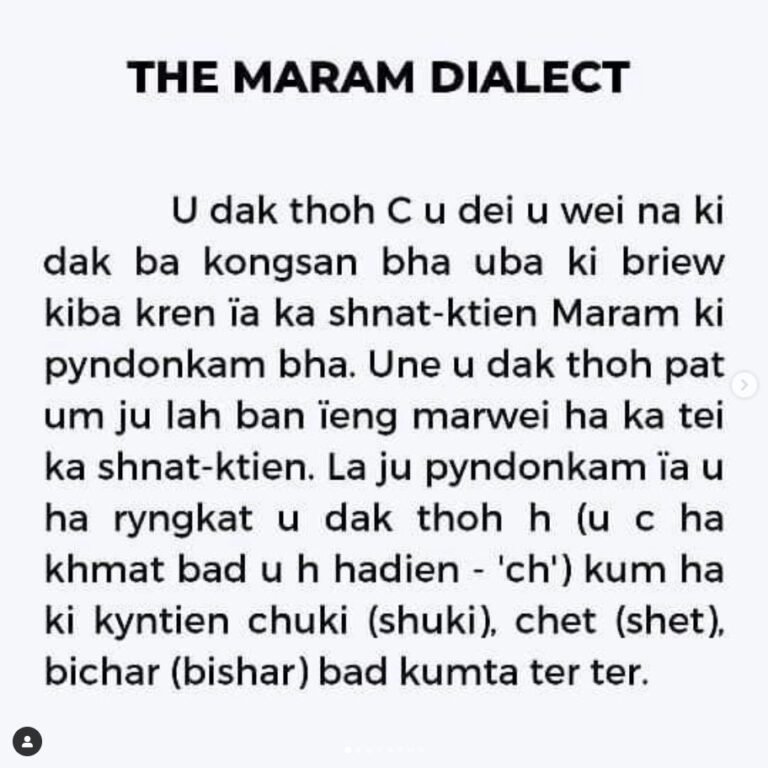
    U dak thoh "C" u dei u wei na ki dak ba kongsan bha uba ki briew kiba kren ïa ka shnat-ktien Maram ki pyndonkam bha. Une u dak thoh pat um ju lah ban ïeng marwei ha katei ka shnat-ktien. La ju pyndonkam ïa u ha ryngkat u dak thoh "H" (u "c" ha khmat bad u "h" hadien – "ch") kum ha ki kyntien chuki (shuki), chet (shet), bichar (bishar) bad kumta ter ter.

    The letter "C" is an important letter for those who speak the Maram dialect, which they use from time to time. However, "C" cannot be used by itself in this dialect. It is usually placed together with "H" ("c" in front and "h" following – "ch") in words like "chuki" (shuki/ chair), "chet" (shet/ cook), "bichar" (bishar/ judge) and so on and so forth. ✍️🆎

    The compound letter "ch" is a significant letter in the Pnar and Bhoi dialects too.
    Khublei Shibun @the_maram_dialect for sending this informative contribution! 😄🙏
    All photos are from @the_maram_dialect

  • Long rat

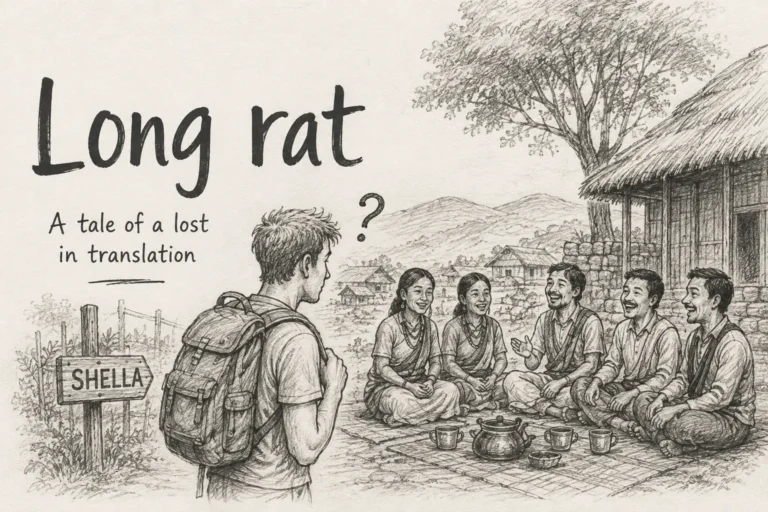
    Ha kawei ka sngi, lah don uwei u phareng uba wan jngohkai ïa kane ka ri Khasi ngi. U leit kylleng ki shnong bad kawei na ki ka dei ka Shella kaba bna nam bha shaphang kata ka "shoh dohkha". Te u lah poi hangta ha ka shnong bad ki don ki briew katto katne kiba khot sngewbha ïa u sha ïing jong ki. Ki bun ki briew kiba nang ban kren phareng tang ban ïapei bad u bad para ma ki pat ki kren da ka ktien shnong lajong. Te u sngap shkor bha haba ki ïa kren para ma ki bad katba ki dang kren u da peit artat sha madan, shapoh khrum shuki ba u shong, shadien bad shakhmat ruh. Kita ki briew ki lah iohi ïa kane ka rukom leh jong u te ki kylli balei ba u i khuslai bad ba u peit lut ïa ka madan ka khrum kumba wad aïu re aïu. Uta u phareng u jubab: "Where the hell is the goddamn long rat that you guys have been talking about??" Phewse "long rat" ki dei ki dei ki kyntien shnong jong ki bad uta u sahep u mut ïa ki ba ki kren phareng de tiak tiak namar u mut ki kren shaphang ka khnai baheh!

    "Long rat" ka mut "ym lei lei" ne "kam pher" ha ka ktien Shella 😄😂 Namar kata ym long rat, kam don ka khnai 😂😂😂🐀🐀

    "Long rat" means "it's okay" or "it's all right" in the Shella dialect. So "long rat" is not a long rat 😂😂🐀🤡

    Khublei Shibun @shillongftw for this joke 😂😅 U Phareng got lost in translation!

  • Bia

    Bia [adverb] The formal union of a man and a woman, typically recognized by law, by which they become husband and wife, a marriage

    This meaning of the word "bia" has been taken from the Pnar-English Dictionary by Sajeki Passah (2013).

    Bia [noun] marriage; wedding. -verb. bia ka•a to marry; to wed;

    This meaning of the word "bia" has been taken from the Garo-English Dictionary by P. R. Marak (2010).

    Khublei Chiboon @micromotives for quite an interesting observation! 😄👍

    Who would have thought that a word in the Pnar and Garo languages would be the same and have the same meaning too.

    Sngew kmen ba lah nang bun na ngi kiba pule ïa ki dictionary ne ki dienshonhi, ki ban ai bun ki jingtip ïa ngi. 👏👏

  • Phlanduman and Thlandaman

    "Phlanduman" ka dei ka kyntien Khasi kaba mut kaba kren ban ïalam bakla ïa ka jingmut da kaba kren kumne kumtai. Ka thew ruh ïa kaba shukor ne thok da ka rukom kaba leh mynleh hok.

    "Thlandaman" toh i kyntien Pnar i wa mut ha wa klam tyngkleiñ yow pynsñiawthooh bakla ya i yïumut wa sakhiat. Jooh ong i pyn thlandaman hawa thok næ chukor da iwa pynyoo kam iwa sakhiat.

    Both "Phlanduman" (Khasi) and "Thlandaman" (Pnar) mean to talk in a roundabout way so as to deliberately make a person misunderstand something or to deliberately divert the person's train of thought. The words refer to the act of lying or deceiving so as to make something appear true.

    "Phlanduman" ( Khasi) and "Thlandaman" (Pnar) are such interesting words 🤓🤓
    They both testify to the dichotomy between appearance and reality, a dichotomy that marks human life, but which is not easily perceived.

    English, Khasi and Pnar expilcation by @speakyourroots

  • Kshaid, Ticha, Dare

    Waterfall

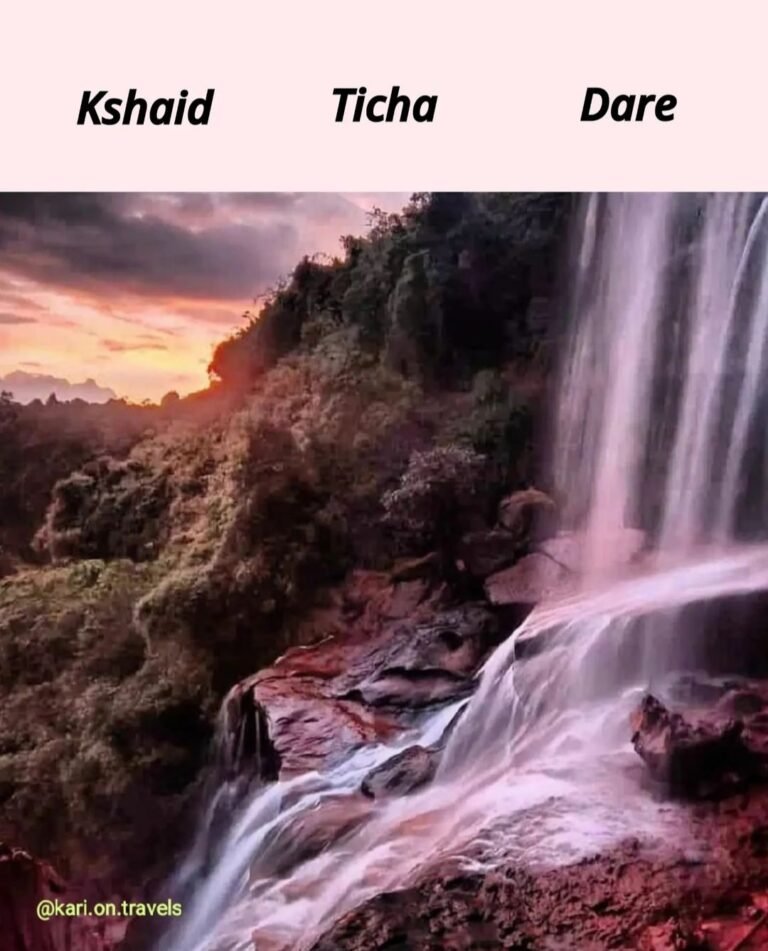
    Indigenous words for the English word "waterfall"

    In Khasi a waterfall is called "Kshaid"

    In Pnar a waterfall is called "Ticha"

    In Garo a waterfall is called "Dare" (pronounced as "Daare")

    The word that most of us will not have heard of is the Pnar word "Ticha" for waterfall 😄 Khublei Chiboon Anvil R. Laloo for telling us about this word! 😄🙏

    Khublei Shibun @kari.on.travels for your pictures! 🙏🙏 Congratulations on your page!

    1st picture: Prut falls is located in Laitlyndop, Sohra. This waterfall emerges from Urwan river formed by the inflowing stream from Khliehshnong Laitlyndop, Umkrem and Madan Umkrem. The Urwan river flows to Mawsiang and reaches upto Shyngoid under Sohra Syiemship. (Source: https://theshillongtimes.com/2021/09/27/sohra-adds-new-waterfall-to-its-list-of-tourist-spots/)

    2nd picture: Weinia Falls is one of the falls located on the Namlang River which, along with the Kynshi river encircles the Nongkhnum River Island – the second largest river island in Asia after the magnificent Majuli. The falls lies on the northern periphery of the river island, about 13km from Nongstoiñ town, the district headquarters of West Khasi Hills. (Source: https://youtu.be/EPIl4nOFz8w by @kari.on.travels )

  • Kurwan!

    Ka ktien "kur" toh hawa khut næ pah ïa yi ïa yi, khamtaam hawa khut syiar, kam wa jooh ong i "kur kur". Ka ktien "wan" mut wada lai tæ wan biang. Ka ktien "kurwan" man kam wa khut biang ïa iwon iwon i iwa da laai yo'u man biang i jooh i rakom man kamwa dang dæp. Da'i wa ong kurwan man kam wa pynstiñ ya i man i long wa khia ha i tu por wa dang dap jia won iwon hawa khyrngiat næ phylla.

    Ka ktien "kur" ka dei kaba khot ne wer, kum haba khot syiar ngi ong "kur kur". Hangne ka ktien "wan" ka thew ïa kaei kaei kaba leit tangba kaba la wan biang. Ka ktien "Kurwan" ka long kum ban khot biang ïa ka jinglong jingman kaba la dep, ban oh ïa ka jinglong jai jai. Da kaba ong kurwan ka pynsting ïa ka jingkhia jong kano kano ka jingjia kaba dang jia shen shen haba kyndit ne phylla.

    The word "kur" is used when we call out to something, like when we call out to chicken we say "kur kur". In the context of "kurwan" the word "wan" refers to something that has gone but has come back again. The Pnar word "Kurwan" is used in order to recall or retrieve a moment which has gone, so that one feels calm and tranquil again. When the word "kurwan" is used, it is meant to lighten the effect of something that has happened, which caused shock or wonder.

    Ka ktien "kurwan" ka dei ka ktien kaba don ha ka ïa ka jingmut kaba pher bad la pyndonkam ïa ka ban thew ïa ka jingsngew kaba kyrpang. Ka pher na ka jingmut jong "kyndit" (Khasi) bad "khyrngiat" (Pnar). 😯😨😲😮

    The word "kurwan" has a specific meaning and usage. Its meaning is different from the Khasi word "kyndit" and the Pnar word "khyrngiat". 😦😧😱😯

    Khublei Shibun Anvil R. Laloo for sending this!

  • War Jaiñtia Dialect

    Ma – Mei – Mother

    Pa – Pa – Father

    Bua ji – Bam ja – To eat rice

    Deh cha -Dih sha – To drink tea

    Rhen – Lynti – Road

    Am -Um – Water

    Ïu-nga/ Shnga – Sngi – Sun

    Pnu – Bnai – Moon

    Jeprow – Briew – Person

    Derow – Samla – Youth

    U Pra – U Blei – God

    Hun – Khun – Son/ Daughter

    Jeme/ Dia – Jaiñ – Cloth/ Clothes

    Pdeng – Lum – Hill

    Phliang – Suiñbneng – Sky

    Lia -Leit – Go

    Hynbo – Khynnah – Child

    Sere – Lyer – Wind/ Air

    These are some words from the War Jaiñtia dialect sent by Sunrise Pohtam 🏞️🌲
    Khublei Shibun for sending this list of words! 🙏😄