Category: Khasi Dialects

  • The Dialect of Raid Narleiñ, Ri Bhoi District

    Kine ki dei khyndiat ki kyntien kiba na ka Raid Narleiñ, Ri Bhoi District (Ki shnong ba hap kum ka Mawrong, Syngku, Umkei, Mawkangi, Raitong)

    Here are some words from the dialect of Raid Narleiñ, Ri Bhoi District (including some villages like Mawrong, Syngku, Umkei, Mawkangi, Raitong)

    Khñiem – Shitom ne pang (ill, sick)

    Jam – Pang (in pain)

    Khyññiet – Kyndit (in shock)

    Pyrtij – Kyrteng (name)

    Kyrkaw – Pyrta (call out a name/ shout out)

    Siah – U synsar/ ba sar (broom stick/ to sweep)

    Synrum – Ki jaboh/ ñuit (waste material)

    Mynchem/ Phyndwar – Phyllaw (lawn)

    Chynraiñ – Sngiew phieng ne tieng burom (awe/ respect)

    Mynraiñ – Lehraiñ (ashamed)

    Ba leh ba leh ba – Da kumno kumno ruh (whatever the situation)

    Jyrnep, Jyrnait – Jaboh (dirty)

    Luia – Jaituh (lazy)

    Syriaw, Jaknar – Jaituh and Lehsih (lazy and dirty)

    Sker – Tiar (solid things)

    Tadap – Ba lah jot/ bym ler/ bym long shuh (old, useless, torn, low quality thing)

    Pukai – Na ka bynta (in favour of)

    Tngam – Khriat (feeling cold)

    Tyrlan – Pjah (cold)

    Khyrngu – Rnga (Charcoal)

    Pharap – Kyrkieh (in a hurry/rush)

    Myrlin – Klet (forget)

    Here are some words from the dialect of Raid Narleiñ, Ri Bhoi District sent by @phiba_makdoh 😃👍 Khublei Shibun for sending these words @phiba_makdoh 🙏🏞️😄

  • “Lai rukloo-rukloo” from the Tuber dialect

    "Lai rukloo rukloo" from the Tuber dialect sent by Ribait Phawa

    Kawei ka kyntien nga kwah ban bynrap ha kaba ki ju kren ha ki por mynshwa bad ïa mynta tang ki riewtymmen ki kham pyndonkam ïa kane ka kyntien ha ka dialect Tuber.

    "Lai rukloo-rukloo" ka mut ban leit kloi-kloi sha ka kam ba lah phah, la haka leit shim ki tum ki tam ne ban leit thied jingthied. Ne kino kino ki jingphah kiba kham san ki phah da ka jingkyrkieh.

    "Lai rukloo-rukloo" is a phrase in the Tuber dialect that was used before and which is now used mostly by the elderly.

    The phrase means to do a task with a sense of hurry and urgency, whether if it is to take something or to buy something. It is also used when the elderly send us on an urgent errand.

    "Lai rukloo-rukloo" is a phrase from the Tuber dialect which means to do something quickly. Khublei Shibun @b.a.i.t_phawa_ for sending this! 😃🙏

  • Laitlyngkot dialect

    Some words in the Laitlyngkot dialect contributed by @mebatei I khongsti given in the order of Lailyngkot – Standard Khasi – English.

    Ma ï – Mangi – Us

    Bileh – Balei – Why

    Ynñioh – Ynnai – No need

    Jyrwoi/Khynning – Kynjing – Disgusting

    Mieh – Wad – Search

    Lyntun – Tyllun – Roll

    Diei – Dei – Correct/ Right

    Bliei – Blei – God

    Kynthiei – Kynthei – Girl/ Woman

    Syir – Syiar – Hen

    Sning – Sniang – Pig

    Pding – Pdiang – Accept

    Sohlah – Phan – Potato

    Bitlun/ Pitlun – Patlun – Pants

    Bam jia – Bamja – To eat rice

    Dih shia – Dih sha – To drink tea

    Here are some words according to the Laitlyngkot dialect contributed by @mebatei_l_khongsti Khublei Shibun! 😀🙏

  • The Pnar Alphabet

    Aa Ari! (Ani in Khasi)

    Bb Bol (Bol in Khasi)

    Cc Chalani (Pdung in Khasi)

    Dd Dieñ (Dieng in Khasi)

    Ee E ngooh (Ai nguh in Khasi)

    Ӕӕ Ӕrplieñ (Liengsuiñ in Khasi)

    Hh Hati (Hati in Khasi)

    li Istri (Istri in Khasi)

    Yy Yuta Juti in Khasi)

    Ji Jhōr (hur in Khasi)

    Kk Khai kyoh (Jyrhoh in Khasi)

    Li Lieñ (Lieng in Khasi)

    Mm Muja (Muja in Khasi)

    Nn Neini (Nangne in Khasi)

    Ññ Ñaam (Niad in Khasi)

    Ŋŋ Ŋap (Ngap in Khasi)

    Oo Oꞑthai (Phone in Khasi)

    Ōō Ōr khûndau (Twa khyndew in Khasi)

    Pp Phok (Kot kudi in Khasi)

    Rr Raᶇ Khatjhep (Tin khatñuit in Khasi)

    Ss Surō (Synsar in Khasi)

    Tt Tana (Rumal in Khasi)

    Uu Um (Um in Khasi)

    Ȗȗ Ȗem (Ym don in Khasi)

    Ww Wieh (Wieh in Khasi)

    The need for a Pnar alphabet has been felt for a long time. The Jaiñtia Hills Autonomous District Council (JHADC) released the Jaiñtia Phonetic Alphabet on the 25th of March 2021. (https://wyrta.com/pdiang-ka-dorbar-ka-jhadc-ya-ki-dak-thoh-pnar/)

    The two books are:

    🟡 Ki Dak Thoh næ Puræ Hei Ktien Pnar by Riquoma Rq. Laloo.

    🟡 Ka Kot Sikai Yoh U Pliah u Kûnnoh Wei Wau Pûn Emkaam Ya Ki Dak A-B Jaiñtia by Riquoma Rq. Laloo.

    🟡 Picture of alphabets with illustrations is from Ka Kot Sikai Yoh U Pliah u Kûnnoh Wei Wau Pûn Emkaam Ya Ki Dak A-B Jaiñtia by Riquoma Rq. Laloo.

    You can watch a video on YouTube for the correct pronunciation of the letters at this link: https://youtu.be/q49RFIfCZH0

    We would like to congratulate Riquoma Rq. Laloo for publishing these valuable books. If anyone is interested in purchasing the books please DM us. Thank you Riquoma Rq. Laloo for sending the pictures of the books! 🙏🙏

  • “Koh” “Chchaw” Maram

    In the Maram dialect, the affixes "Koh" instead of "Bah" and "Chchaw" instead of Kong are used. "Koh Ja"- my mother tells me that this particular nickname is given to someone notorious. The name is in close reference to a "Koh Ja", an infamous man who lived much before her time of whom villagers apparently suspected of being a "menshohnoh". So when boys misbehave, they say "en nan koh Ja" or "he resembles Koh Ja".

    "Chchaw Bih"/ "Kong Bih"/ "Bih Bih"/ "Ka Bih"- I've always found this nickname intriguing as "Bih" in Khasi also means poison. Additionally we even have "Bihrit", "Bihheh", "Bihdeng" if there are many female siblings. "Chchaw Mem" is also another intriguing nickname. My mother says that this is particularly used for the fair skinned girl child (considering that they call a white woman a Mem/ Ma'am).

    The Maram dialect is spoken in the West Khasi Hills District of Meghalaya. The variety of dialects spoken enriches a language giving it depth and scope. 🗣️🗣️

    Thank you @laia.naomi for this contribution! 🤗🤗

  • Tura nga!

    In Khasi, the word for being in a hurry is "kyrkieh".

    "In Ri Bhoi District Umroi area, where I am from, if we are in a hurry we say 'Tura nga'.

    People misunderstand this and think we are going to Tura."

    "Ha Ri Bhoi District Umroi area, da ngi 'kyrkieh' ngi ong 'Tura nga'. Ki briew ki bakla beit, ki mut ba ngi mut leit Tura.

    "Tura nga" sent by @adele__miss_dreamy 🏃🏃🏃 for when you are in a big hurry!!

    There are so many dialects present among the Khasi people. This is one from Ri Bhoi District. 😀 In this instance, people think it means "Tura" in the Garo hills. Thank you @adele__miss_dreamy for sending this!

  • Ka Choh Jamalung (The Call of the Cicada)

    This is the tune and the lyrics to the chanting song "Choh Jamalung" (The Call of the Cicada) performed by @esra_syiem . The tune is endearing and draws in a nostalgia for those crisp village evenings. 🌤️🌲

    This chanting song is sung by children at dusk as described in the post. It is popular in Raid Nongtluh of Ri Bhoi District, Meghalaya. Thank you @esra_syiem for sending this unique entry! 😃😃

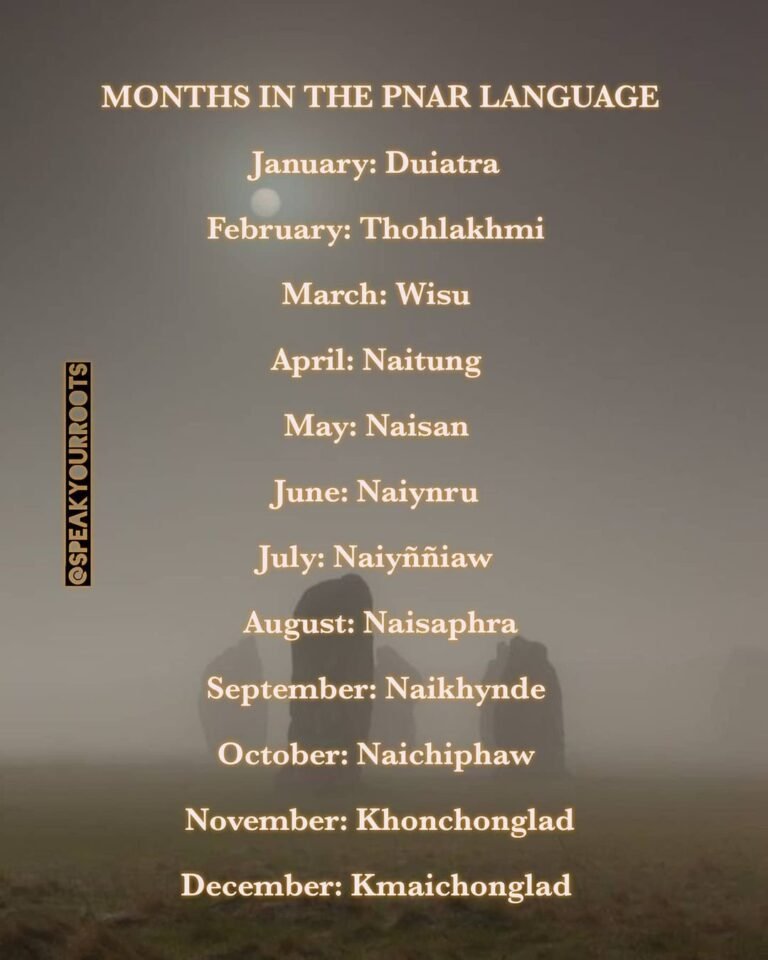
  • Months of the year in the Pnar language

    January: Duiatra

    February: Thohlakhmi

    March: Wisu

    April: Naitung

    May: Naisan

    June: Naiynru

    July: Naiyññiaw

    August: Naisaphra

    September: Naikhynde

    October: Naichiphaw

    November: Khonchonglad

    December: Kmaichonglad

    These are the months of the year in the Pnar language. 📆📆 The Pnar/ Jaiñtia language is mostly spoken in the Jaiñtia Hills District of Meghalaya.

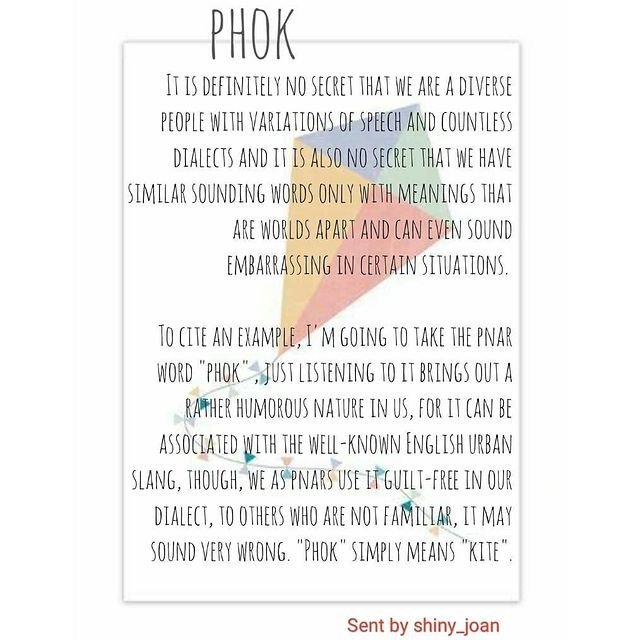
  • Phok

    It is definitely no secret that we are a diverse people with variations of speech and countless dialects and it is also no secret that we have similar sounding words only with meanings that are worlds apart and can even sound embarrassing in certain situations. To cite an example, I’m going to take the pnar word "Phok". Just listening to it brings out a rather humorous nature in us, for it can be associated with the well-known English urban slang, though, we as Pnars use it guilt-free in our dialect, to others who are not familiar, it may sound very wrong. '"Phok" simply means "kite”.

    The word "Phok" in the Pnar language means "Kite". Thank you @shiny_joan for sending this! 😄😄

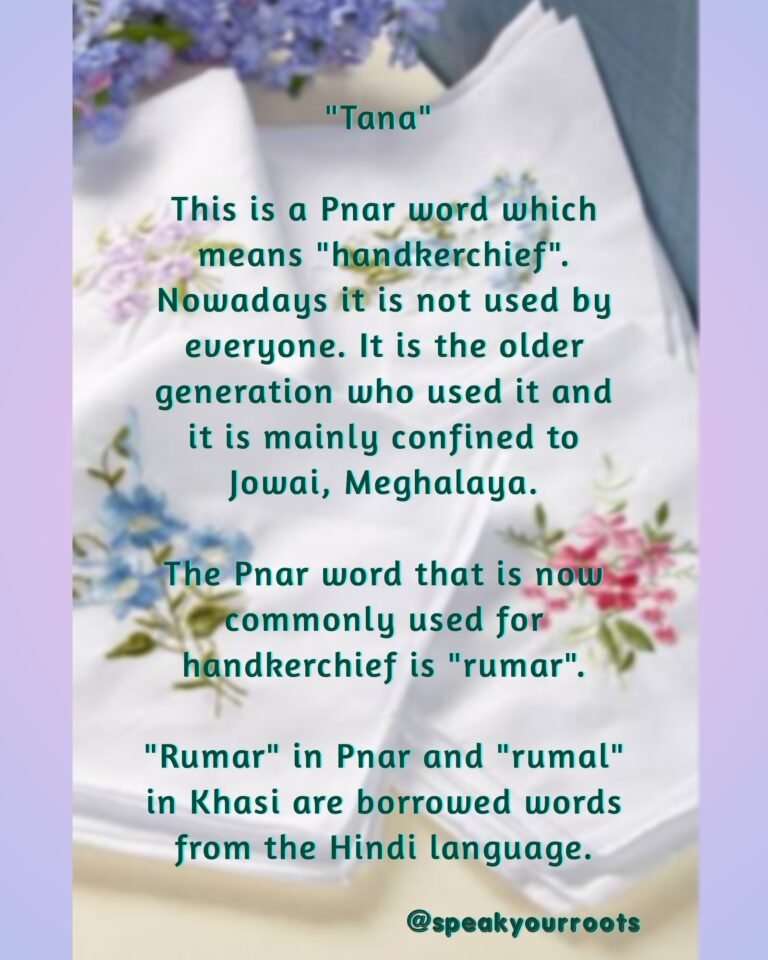
  • Tana

    "Tana" is a Pnar word which means "handkerchief". Nowadays it is not used by everyone. It is the older generation who used it and it is mainly confined to jowai, Meghalaya. The Pnar word that is now commonly used for handkerchief is "rumar". "Rumar" in Pnar and "rumal" in Khasi are borrowed words from the Hindi language.

    Thank you @shiny_joan !