Category: Unique Khasi Words

  • Ehrang

    Ka ktien "ehrang" ka don ar jingmut. Ha kawei ka liang ka mut u ne ka briew kiba ïeng pyneh satar ha ki khep wat lada kane ka wanrah ïa ka jingma bad ka jingshitom. Ha kawei pat ka liang la ju pyndonkam ruh da ka ktien "ehrang" ïa kito kiba don ka mon kaba jwat bad ki bym jem khnap, wat haba ki mad ïa ki jingeh bad jingkordit.

    The word "ehrang" has two meanings. On one hand, it describes a person who stands firm even if this brings destructive consequences. On the other hand, the word "ehrang" is also used to describe someone who has a firm resolve and a determined will, even when facing difficult and harrowing experiences.

    Ehrang" is another Khasi word that needs a proper definition in order to understand its whole meaning.

    Khublei Shibun @meiithei for helping to define this word! 😄🙏

    Khasi explication and English translation by @speakyourroots

  • Syrtok

    "Syrtok" ka mut ba ha ka jingim jong ngi ne ha ki kam jong ngi la pynshisha da ki dak jong ka. Kum ha ka senten "ka jingim kaba la i syrtok" ne "ka kam kaba la i syrtok".

    Ïa ka dkhot harum la shim na Ka Jingsneng Tymmen Shaphang Ka Akor Khasi Ha Ka Rukom Rwai Phawar, Part I ba la thoh da U Radhon Sing Berry Kharwanlang.

    "To mut bha, to kren beit bad to leh hok,
    Lada phi im phi ïap noh ruh syrtok;
    To ieit ïalade burom ïa kiwei,
    Ba phin suk ha pyrthei, phin suk h'U Blei…"

    Sngewbha ai jingmut shuh ïa ka jingmut jong ka ktien "syrtok". 😀🙏

    Shuh shuh kum ka nuksa ha ka senten "Ka jingtreishitom kaba la i syrtok". @geraldsamuelpinocchioduia @cuthbert7981_run__to_jesus

    Kumba la ïoh ban wad jingtip, ka ktien "syrtok" ka dei ka adjective kaba thew ïa ka jingkhraw ne ka jingjur (intensity/ extremity) jong kano kano ka kam ne ka jingshem ha ka jingim u briew. Kumba ong ka jingbatai ha ka Dienshonhi (Rev. Dr. Ïarington Kharkongngor), ka dei ka dak (indicator/ indicative) kaba pynpaw shabar ïa ka jingshem ne ka kam. Kumba ngi ju ong "Ka jingjynjar kaba la i syrtok". Kata ka mut ba ka jingjynjar ka dei ka dak jong ka jingshem jong u briew bad ngi pyndonkam ïa ka ktien "syrtok" ban syrtap shuh shuh ïa kata ka jingshitom bad jinglanot.
    @geraldsamuelpinocchioduia @cuthbert7981_run__to_jesus

  • Ka Sotti Juk

    Ka Sotti Juk ka dei ka juk kaba dang khuid dang sngur naduh ka saiñpyrkhat, ka rukom im la ka long naduh na la ïing la sem, ha shnong ha thaw, ki kam shnong ne saiñhima sima, haduh ka die ka thied, ka khaïi ka pateng. Ha kaba ka ktien ka ïeng rasong bad ka hooid ka neh ka hooid, ka em ka neh ka em. Wat ha uno ma uno u pud ka jingïakajia ne bym sngewthuh jingmut ka dang beit ban ïa kren tang da ka ktien ka thylliej khlem da kiew ïinglieh ïingsaw. Ka juk ha kaba U Kpa, U Kñi ki don la ka bor ka iktiar bad ki khun ki tieng burom la ki kmie ki kpa. Ka Juk kaba ka kmie ka long ka dohnud ka ïing bad U Kpa ka tyrpeng ka ïing, la kum ka tnum kaba kdup bad u rishot uba kyrshan.

    "Ka Sotti Juk" is an age where honesty, truth and integrity prevails whether in ways of thinking, ways of life at home, in village or town, administrative or political activities and in trade and commerce. The power of the spoken word stands strong, where yes remains yes and no remains no. In a quarrel or misunderstanding, the spoken word is enough to resolve any contention or problem, without going to the extent of having to seek legal remedy. An age when the wisdom of the father and the maternal uncle have their strength and foresight and children love and respect their parents. An age where the mother symbolises the heart of the home and the father is the shoulder who holds responsibilities, like a roof who embraces all and a pillar who supports all.

    Ka Sotti juk ka dei ka juk mynshwa hyndai ha ka por ba ki briew ki dang long shida bha; shu kren da ka ktien lah skhem lut ki kam ki jam bad wat ka kam thied jaka ruh ki shu ong da ka ktien lah biang ym donkam sakhi haduh katta ka jingiashaniah bad jinglong shisur.

    Ka Sotti Juk ka dei ka juk jong ki khathynriew trep khathynriew skum. Ka juk ha kaba u Blei u dang ia iaid bad kren markhmat bad u briew.

    Ka Sotti Juk ka mut ka juk jong ka jingsngur, jingshida mynsiem. Ka juk kaba hun ïa kaei kaba u Blei u la buh la thaw. Ka juk ka bym don jinglushia eiei ia ki jingdon jingem jong ka mariang.

    Ka Sotti Juk ka dei ka por ba dang hok ka pyrthei…ka por ba u briew bad ka mariang ki dang kren kajuh ka ktien…ym tip ka bishni ne ka pihuiñ…ka lorni ka lorhap..ki im sngi thop ha la i kam lajong bad janmiet sawdong ka lyngwiar dpei ha ryngkat ka saw ksai ban sneng ban kraw.

    Ka Sotti Juk ka dei ka juk ba dang hok dang shida ha baroh ki liang la ha ka ktien ka thylliej, ka akor ka burom, ka riam ka beit, ka ïaid ka ïeng, ka trei ka ktah. Baroh da ki jinglehhok suda khlem ka jingthok jinglamler, ka bamsap bamklop.

    Nga shu iohsngew ha bun ki jingïathuhkhana ïa kane ka kyntien bad bunsien nga ïohsngew kumne , "ka sotti juk haba u briew bad u mrad ki dang kren kawei ka kyntien" nuksa ka Ïew Luri-Lura. Ha ka jingsngewthuh jong nga ka mut ka juk ha kaba ngi dang don ka jingsngewthuh iwei ïa iwei khlem da donkam ban pynsngewthuh lane kum ban ong noh ngi dang don kata ka jingïatiplem iwei ïa iwei bad ym pat don kata ka jingbishni ne jingpihuiñ kum ba ngi ïohi byllai ha kane ka juk kaba ngi im mynta . Namar ka jingbishni ka dei kawei ka daw ba tynrai kaba wanrah ïa ka jingïashun iwei ïa iwei. Kum ban pynkut kamut ka dei ka juk kaba lait naka jingbishni pihuiñ iwei ïa iwei.

    Ka Sotti Juk ka mut ka por mynshwa ha kaba ki briew ki dang im shi sur shi dur bad ba ym ju don kano kano ka jingïakajia. Ki brew ki im suk im saiñ. Wat la ki duk ne riew spah kim kwah rhah ïa kano kano ka bym dei jong ki. Ki shong ki sah bad ki trei ki ktah tang hala u pud u sam. Kim don kata kw mynsiem bishni pihuiñ iwei ïa iwei.

    "Ka Sotti Juk" is a Khasi phrase we have heard from our parents and grandparents. Here are some explanations of the phrase from our followers! 😃😃

    Khublei Shibun @redfm_rjzack@amy_grace_7@kevin_nelson_17@ms_sngewbhalang@the_lost_soul_dreamer@zephyra_lavenza@evarylda022@gen_amane@_bala_kshr_06 for sending in your understanding of the phrase 🙏🙏 💜💜 They have made this post all the more richer!

    🟡 English translation by @speakyourroots

  • Ka Rngiew: A perspective from Dr. Margaret Lyngdoh, University of Tartu, Estonia

    In the Christian worldview, a person is made of the body, mind, and soul. In the traditional Khasi perspective, a person is made up of met, mynsiem, and rngiew. While met is the body, mynsiem is breath. Rngiew is what invests a body with personhood and it stays with a person through life. It is the quality that allows a person to remain impervious to the evil eye or ka sabuit. Thus the term longbriew means the nature of being "human" or the nature of an entity who is endowed with rngiew.

    There is no English word to approximate this Khasi concept. In its simplest explanation, rngiew is what makes a person human. Further, the Khasi word for breath, mynsiem has been adapted to fit the Western idea of the "soul" or even, "spirit". I cite, Lyngdoh, Margaret (2021). "Landscapes of Enchantment and their Usage: A Critical Case-Study from the Khasi Ethnic Community, Northeast India'' in Graham Harvey and Opinderjit Kaur Takhar (Ed.). "Religion and Senses of Place'' UK: Equinox Publications. (Religion and The Senses) [forthcoming]:

    A being is made up of Ka met (lit. body). ka mynsiem (lit. breath) and ka rngiew. To ‘be' a human being (longbriew), the Supreme Being must clothe the being with a rngiew. I will quote my interlocutor, Sweetymon Rynjah on this, "Ka Rgiew ka dei ka bor maia ba kynja Blei, ba u Blei u la pynkup, pynphong ia u briew ha ka jingwan longbriew jong u' (20 November 2015)".

    I paraphrase: The Rngiew is an ability that is god-like, that the Supreme Being clothes or invests a being with when he/she comes out of the womb initially divine, and then whatever he/she acquires or achieves in a lifetime is dependent on him-/her-self. The rngiew stays with a person through life and is reflected in the person's being and stature. If their (jinglong mynsiem) personality, spirit, essence, strength of character, nature, principles, moral fortitude etc. are in line with, 'Ka tip briew ka tip blei and ka tip hok tip sot' (lit. living a good life in accordance with the Covenant decreed by the Supreme Being), then their rngiew is strong and protects them from those who desire ill or harm to befall upon them.

    All humans and non-humans have rngiew. Ryngkew or guardian deities, have rngiew. This gives a sense of agency to a human or non-human entity. But clans also have rngiew, and in different contexts this can mean different things. But a strong rngiew of a clan can protect a clan from extinction. When we refer to the clan in this context, we use the words “longkur longkha". But rngiew is always a strong, positive quality that remains with humans, places, non-humans (like ancestors and guardian deities) all their lifetime. The first ancestress, Iawbei also has rngiew, especially because they have to look after the well being of a clan and further it's progress and prosperity. Even though we live in a state of rapid transitions, we cannot forget these core Khasi indigenous concepts because this is an essential part of our longbriew manbriew!

    In the photo is Kre Makri, who is a Khruk, a female weretiger, from Raid Nonglyngdoh, Ri Bhoi. Her rngiew transforms into a tiger and roams around in the alternate reality, Ramïa, where notable ancestors also live. She said that while the male weretiger or sansaram (lit. five clawed) has the function of holding on the laws of the ryngkew, the female weretiger, ka khruk, has the sacred function of holding of the rngiew of the clan. The photo was taken by me and this was in the winter of 2012.

    Dr. Margaret Lyngdoh @lieng_makaw gives us what she has found in her research from the approach of Folkloristics about "Ka Rngiew", showing us that it is a far reaching concept which sheds light on the well-being of the individual, the clan and our worldview as Khasi-Jaiñtia society. Thank you @lieng_makaw ! 😀🙏

    The post on "Ka Rngiew" posted on the 5th of August 2021, garnered a lot of attention and also counter-reaction that has proved fruitful in our understanding of this unique Khasi concept. The expression and discussion of different points of view is something that is important for indigenous culture to thrive.

    No part of this material may be reproduced in any form without the consent of the author. All material for this content has been collected through primary fieldwork.

  • “U Kohtympan” (Khasi) and “U Mylumtympan” (Pnar)

    The meaning of "U Kohtympan" (Khasi) and "U Mylumtympan" (Pnar) is not easy to find as the word is not listed in the popular dictionaries that are available. What has been understood is that the word in the literal sense refers to someone who hides in the "tympan ïing" or the rafters of a house. This meaning is usually used from time to time to scare disobedient children by saying that Kohtympan or Mylumtympan will carry them away to a distant place if they continue to be disobedient and stubborn.

    Deriving from this, the Khasi phrase "pyntieng kohtympan" means making someone afraid or fearful based on something unfounded with no factual truth, thereby creating panic. Further, "kohtympan" (which has been used in songs too) in particular, is elaborated to mean something hidden, unseen and unknown, thus leading to the fear of the unknown. The word perhaps is also used in the sense of challenges, difficulties or problems faced by someone.

    "U Kohtympan" (Khasi) and "U Mylumtympan" (Pnar) is taken to mean something hidden and unseen leading to unfounded fear. Thank you @indariwarjri @laloorisa @a_pocketful_of_plums and @vancouvershullai for helping us understand the meaning of these words! 😃🤓

  • U Ryngkew and Khlaphuli

    The following has been quoted and summarised from Essays in Khasi Folkloristics by Dr. Desmond L. Kharmawphlang (2016).

    In Khasi belief, the sacred forests are protected by a "spiritual tutelary deity called U Ryngkew U Basa" who makes himself visible in the form of a tiger. Thus, 'U Ryngkew' is the tiger spirit who safeguards the sacred forest. After the chaos that ensued in the felling of the 'Diengiei' the gods sent 'U Ryngkew' to "stay forever in forests, mountain tops and places of wilderness revealing himself, whenever he does, as a tiger."

    Related to the significance of the tiger in Khasi myth and folklore, is the belief in "Khlaphuli" or the Weretiger. The Khlaphuli is a man or a woman who has the ability to change into a tiger with "this power being an attribute of their 'rngiew'…The Khasi belief in the 'ka rngiew' is so strong that it is regarded as an essence, a power which shapes and determines most of man's actions, thoughts and motivation, it gives shapes to his dreams and visions and charts the course of his life. It is imperishable and immutable. In the Weretiger tradition, it is the 'rngiew' that is directly responsible for men and women to possess the power to become weretigers or 'khlaphuli' as it is known in local parlance. This transformation from human to tiger is closely associated with aspects of religious and social practices."

    The belief in "U Ryngkew" and "Khlaphuli" form intrinsic aspects of Khasi spirituality and religion. They are also necessary to understand the effort to conserve our sacred groves and forests. 🏞️🏞️🌄🌄

  • Ka Rngiew

    The concept of "Ka Rngiew" in Khasi philosophy is difficult to translate. "Ka Rngiew" has to be understood and studied with depth and insight. Here are a few excerpts in Khasi and English

    from Professor Dr. Fabian Lyngdoh:

    Їa kine ki bynta la jied lyngkot na ka kot Ka Thymmei Pyrkhat U Khasi (2018) ba la thoh da i Dr. Fabian Lyngdoh.

    "Man la u briew u don la ka rngiew. Katkum u H. O. Mawrie, u Blei u la ai ïa ka rngiew tang ïa u briew ym ïa kiwei pat ki jingthaw, bad dei ka rngiew kaba pynïapher ïa u briew na u mrad. Ka rngiew ka dei ka jaka ne ka position u briew kum uba don mynsiem hapdeng kiwei pat ki para briew ba don mynsiem bad hapdeng kiwei pat ki kynja mynsiem, kum ki ksuid, ki snaïap bad ki blei ki dken."

    "Ka dei ka dur mynsiem (spiritual personality) jong u briew. U Blei u la thaw ïa kiei kiei baroh bad u la buh bynta bad sam bynta ha la ki jaka jaka. Man la u briew u dei ban pynneh (maintain) ïa kane ka jaka hapdeng ki bor mynsiem babun. Ki bor mynsiem khamtam eh ki ksuid, ki kwah ban pynpra ïa kane ka jingpynryntih (equilibrium) bad ki shim kabu man ki daw ban khynñiat noh їa u briew na ka jaka (position) ba u don, lane ban pynsniewdur їa ka rngiew jong u. U briew u ba la jem rngiew na kano kano ka daw u don ha ka position bym thikna (unstable equilibrium)".

    "Ban pynksan rngiew їa u la dei ban pynshong ne buh biang їa u ha ka jaka ba u ju don, kum u briew ba don mynsiem, uba la thaw da u Blei hi, uba don kata kata ka kyrteng, uba dei na kata kata ka kur, ba la kha na kata kata ka kmie, u ba dei u kñi kita kita, u para ne pyrsa jong kita kita; u lyngdoh, u basan ne u syiem ba la suid la shor bad kumta ter ter, kat kum ka position jong u ha ka mariang. U briew u ba biang ka rngiew u don ka daw (reason), ka tynrai (origin) bad ka jingiadei (relationship) ha kane ka mariang."

    "Ka mynsiem u briew ka dei ka maïan jinglong (being) jong u ka ban neh junom wat la ka met ka їap noh, bad ka rngiew pat ka dei ka dur ne ka jingpynpaw (manifestation) jong kata ka mynsiem. Ka mynsiem kam paw ha kano kano ka dur ne ka sur. Ki dak ki shin jong u briew ha ka mariang kum ka dur, ka kyrteng, ka sur bad ka jingiadei para briew ki pynlong ïa ka rngiew u briew. Haba ka mynsiem u briew uba la ïap ka wan paw ha ka dur ne ha ka sur hapdeng ki briew kiba im, ki Khasi ki ngeit ba ka dei ka rngiew briew bad kim ju ong ka dei ka mynsiem briew namar ba ïa ka mynsiem ym lah ban ïohi ne ban iohsngew.….Te hangne ngï ïohi ba ka rngiew u briew ka dei ka jinglong ne ka shap mynsiem u briew (spiritual personality) kaba don la ka jaka, ka dur, ka sur, ka kyrteng bad ka jingïadei parabriew ne ka jingïadei bad ka mariang."

    "U briew ha ka mariang u thaw dur ïalade ne ïa la ka rngiew (spiritual personality or spiritual identity) man la ka sngi lyngba ki jingїadei jong u bad kiei kiei baroh kiba shabar na u. Ka rngiew, kaba dei ka dur-maïan (ethereal image) jong u naduh met haduh mynsiem, kan shim dur ne shongdor katkum ki jingleh ne jingïakynduh jong u ha ka jingim bad kita kiba shabar na u."

    The following excerpts have been taken from an article by Dr. Fabian Lyngdoh in The Shillong Times, dated 23rd November 2017.

    "According to Khasi belief, man is a physical as well as a spiritual being who has a unique position and status among other beings. Every human being has 'ka rngiew' which may be conceived of as the spiritual personality or identity of the body and the spirit combined. 'Ka rngiew' means the place or position or status of each human being, man or woman, among other human beings and among other spiritual beings like 'ki ksuid' (demons), 'ki puri' (nymphs), 'ki blei ki dken' (gods and goddesses), ki sna-iap' (ghosts) and other beings, physical and spiritual within the cosmos. It is not man's personality in the social frame of reference, but it is his personality that is balanced in the spiritual frame of reference. When a person is in this balance, the Khasis say that he/she is 'dang eh-rngiew' (spiritual personality intact).."

    "The Khasis speak of a person who is 'u ba la jem-rngiew', meaning that he is out of position or in unstable equilibrium. In that unstable position a man's spiritual status is degraded or disfigured and evil may befall on him. To bring him back to his original status it requires first of all his own personal resolution, and second, the help of others especially through religious rites. These religious rites reflect the love and concern that his clan members have for him/her. The process of recovery according to the Khasis is to re-establish a person's status as a human being with body and soul, created by God Himself, who has such and such a recognized name given and confirmed in the ceremony of "ka jer ka thoh', belonging to such and such a clan, born from such and such a mother, who holds such and such a position in society, etc., the more we can recall of his/her various aspects of identity and human relationships, the better it would be. A man 'ba dang eh rngiew' (whose spiritual personality still intact), ha 'ka tynrai' (origin), 'ka dew' (reason to exist), and ka jingïadei' (relationships) is part of the human community and the entire cosmos."

    "Not only the physical environment and the human society, but the entire cosmos is understood by the Khasis as the medium where human beings live with their respective 'Ka rngiew', like water is to the fishes. Man cannot be a human being without 'ka rngiew' which is his overall personality, physical, mental and spiritual as recognized by his fellow human beings, by all creatures animate and inanimate and also recognized by spiritual beings. It is on this reason that the Khasis believe that man should not stand against nature, but adjust himself with it according to the requirements of his human existence."

    "Ka Rngiew" forms an important aspect of Khasi philosophy. The concept touches on the metaphysical nature of human existence. Thus, it will be gratifying to understand the many layers of meaning within this enriching concept. ✨✨✨

    Sources:

    🟡 https://theshillongtimes.com 2017/11/23/182286/

    🟡 Ka Thymmei Pyrkhat U Khasi (2018) by Fabian Lyngdoh.

  • Ñiuma

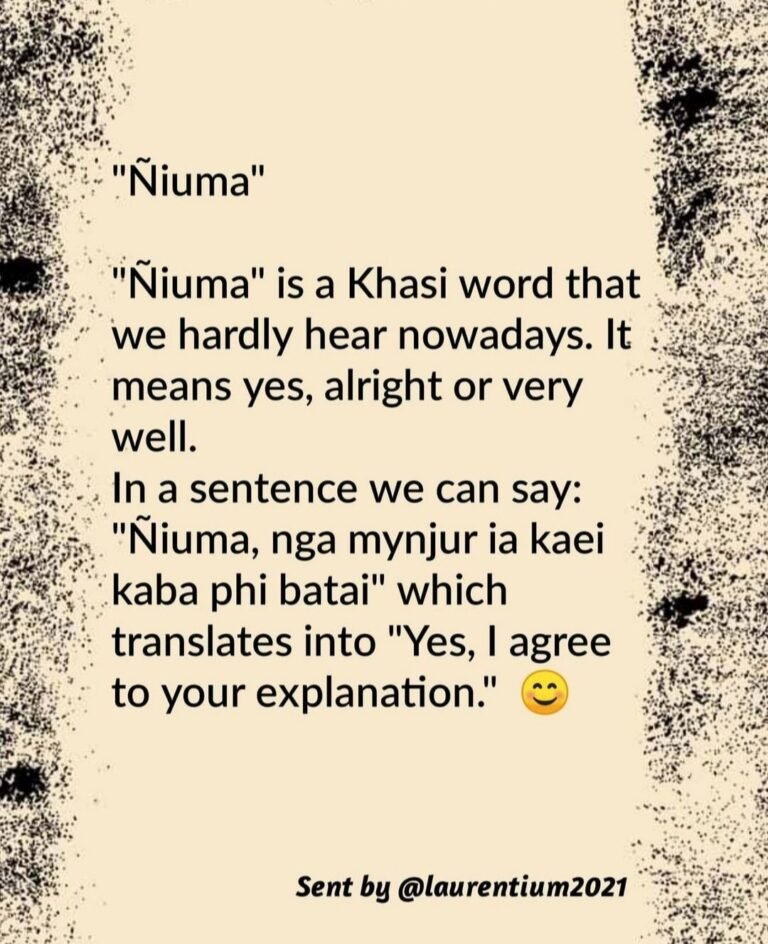
    Ka ktien "Ñiuma" ka dei ka ktien kaba pyndonkam haba mut ban ong ym lei lei ne koit. Kum haba ong “Ñiuma, nga mynjur ïa kaei kaba phi batai".

    Ñiuma is a Khasi word that we hardly hear nowadays. It means yes, alright or very well. In a sentence we can say: “Ñiuma, nga mynjur ïa kaei kaba phi batai" which translates into "Yes, I agree to your explanation."

    Ñiuma" sent by @laurentium2021 😄 Thank you!