Blog

  • Beiñ kiwa beiñ

    "Beiñ kiwa beiñ.

    Roh kiwa roh.

    Ïei їong kiwi,

    ym їe i u pyntoh."

    "Let those who criticise, criticise.

    Let those who praise, praise.

    Other people's opinions,

    cannot be catered to."

    Here's what may be described as a Pnar quote or chant sent by @laloorisa 😎😎😎 (translated by @speakyourroots)

    The lines urge us not to let people's words, either praise or criticism, affect us. Lest we fall prey to pride or feelings of inadequacy. We should just march to the beat of our own drum and do what makes us happy! 🌬️🌬️🌻🌼🌾

    Ham pynsñiaw ai ki! Wat pynsngew eh ia ki!

  • U Ryngkew and Khlaphuli

    The following has been quoted and summarised from Essays in Khasi Folkloristics by Dr. Desmond L. Kharmawphlang (2016).

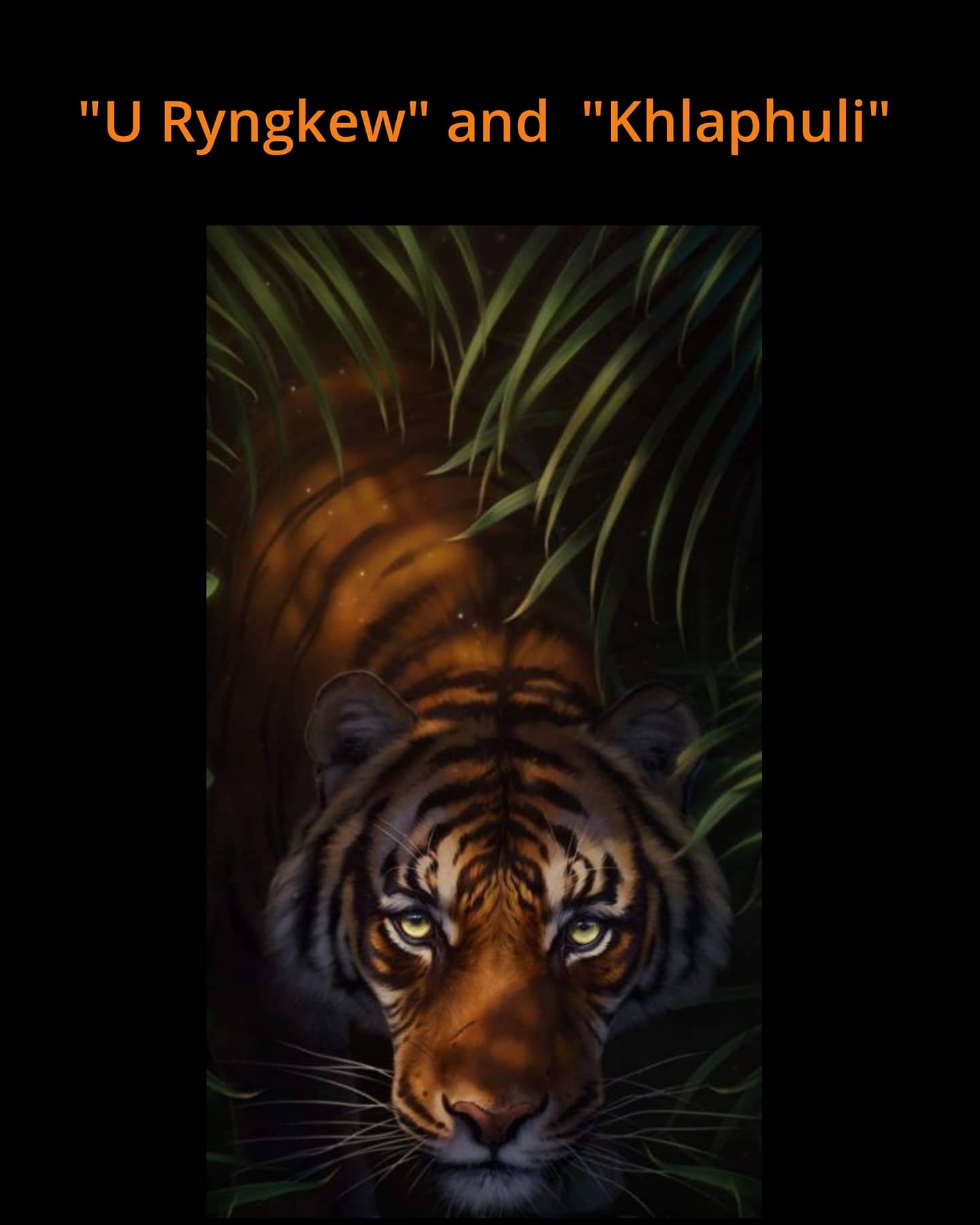
    In Khasi belief, the sacred forests are protected by a "spiritual tutelary deity called U Ryngkew U Basa" who makes himself visible in the form of a tiger. Thus, 'U Ryngkew' is the tiger spirit who safeguards the sacred forest. After the chaos that ensued in the felling of the 'Diengiei' the gods sent 'U Ryngkew' to "stay forever in forests, mountain tops and places of wilderness revealing himself, whenever he does, as a tiger."

    Related to the significance of the tiger in Khasi myth and folklore, is the belief in "Khlaphuli" or the Weretiger. The Khlaphuli is a man or a woman who has the ability to change into a tiger with "this power being an attribute of their 'rngiew'…The Khasi belief in the 'ka rngiew' is so strong that it is regarded as an essence, a power which shapes and determines most of man's actions, thoughts and motivation, it gives shapes to his dreams and visions and charts the course of his life. It is imperishable and immutable. In the Weretiger tradition, it is the 'rngiew' that is directly responsible for men and women to possess the power to become weretigers or 'khlaphuli' as it is known in local parlance. This transformation from human to tiger is closely associated with aspects of religious and social practices."

    The belief in "U Ryngkew" and "Khlaphuli" form intrinsic aspects of Khasi spirituality and religion. They are also necessary to understand the effort to conserve our sacred groves and forests. 🏞️🏞️🌄🌄

  • Sboh masi

    Here's a funny incident from a Khasi language class in school:

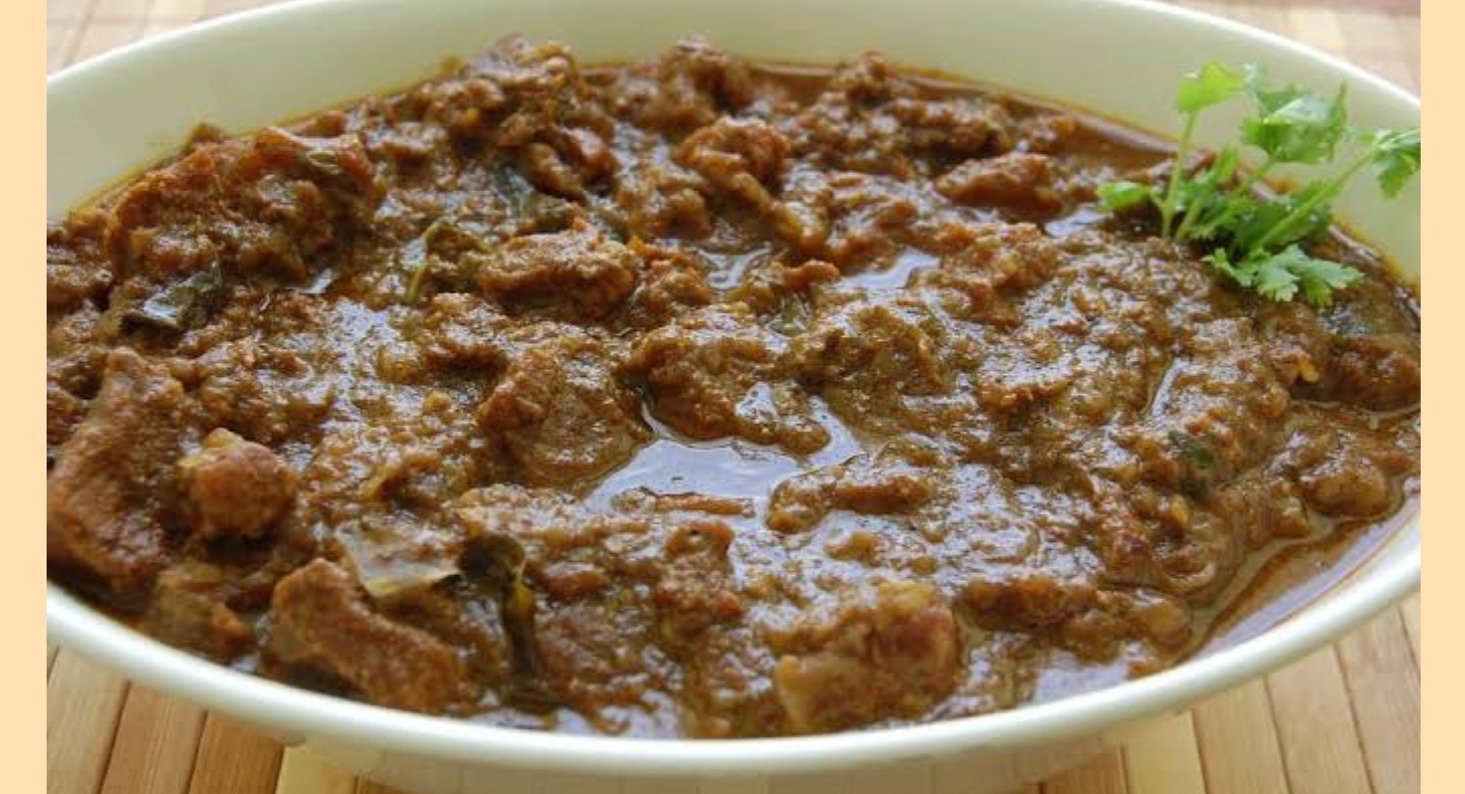
    During a Khasi language class a boy was told to make a sentence with the word "sboh". This is what he wrote: "Nga bang bha ka sboh masi."

    The boy is referring to beef curry but "sboh masi" actually means manure.

    So it's high time we start posting jokes 😂🤡💩Here's a really "sboh" one to exercise those belly rounds 🤭🤭

  • Ki Phawar

    "The Khasis have evolved and developed their own indigenous poetic creations called "Ki Phawar" which are often employed in story-telling. The Phawar are used in festivals, community work, and gatherings, hunting and fishing expeditions, games and archery. The presence of an audience in a Phawar recitation is imperative. It is a performance per se. The Phawar master is a performer, and hence, an actor, acutely conscious of the effect he has on the audience. He responds with enthusiasm to the reactions and applause of the audience, especially in contests. The performance is heavily dependent on the performer/ audience reaction, which provides scope for the development of the call-and-response or leader-choral antiphony. This is the most salient feature of the Phawar tradition. Needless to say, it is a dimension difficult to recreate in print."

    – From Essays in Khasi Folkloristics (2016) by Dr. Desmond L. Kharmawphlang

    Here are two popular Phawar:

    "Ohhhhh

    Dohkha ha Nan Palok,

    Dohkha ha Nan Palok.

    Ki їa beij ia u shana

    Kynmaw ho paralok

    Wat їa biej ia ka tyngka.

    Hoi kiw!

    Hoi kiw!"

    "Ohhhhh

    'Lang tylli lang teh

    'Lang tylli lang teh

    Ba la teh h'u mawbynna!

    Nga phah kylli pham treh

    Pha la duh ka deng khaila.

    Hoi kiw

    Hoi kiw!"

    Ka jingshongshit haba sngap їa ki Phawar ka dei kaba sngewbang shisha!

    The creation and the singing of "Ki Phawar" is a sure way to excite any crowd. We may take the liberty of describing them loosely as poetic chants, who sometimes contain humour and satire to name a few. 😄😄

    If you know some Phawar, please do type them down in the comments section! Hoi kiw!

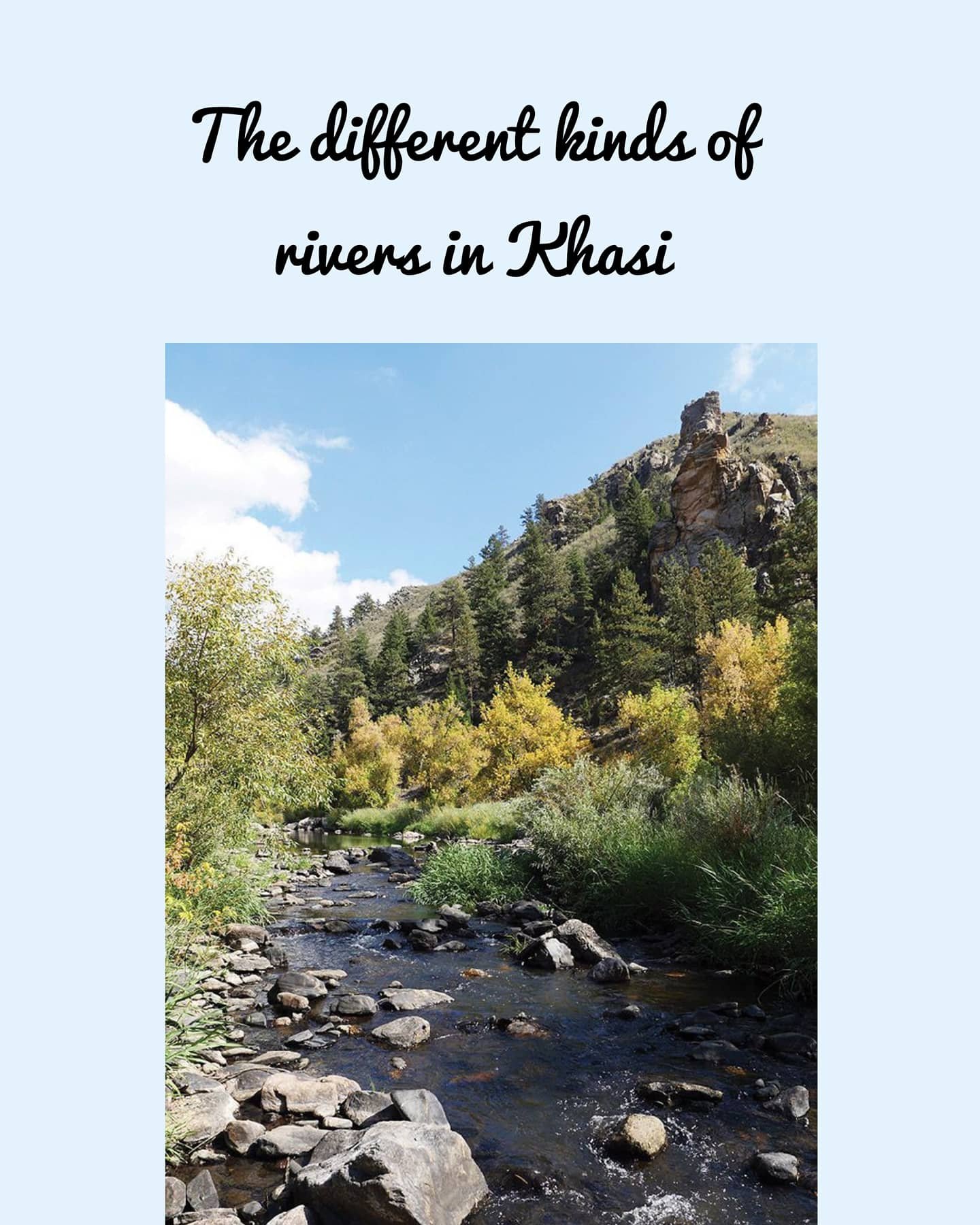
  • The different kinds of rivers in Khasi

    "Wah" is the usual name for a river or a stream.

    "Wahbah" is a large river.

    "Wahkaba" is a roaring and raging river which flows rapidly during the summer in Sohra.

    "Wahduid" is a streamlet or a rivulet.

    "Wahrupa" is a river whose water shines and shimmers like silver in the sunlight.

    In fact, a part of the Umngot river in Meghalaya is called "rupa tylli" as it is likened to a broad, flat silver necklace work by Khasi women.

    Our rivers are so many, so beautiful and so precious. Yet in Shillong, the most well known "Ka Wah Umkhrah" is perhaps a dying river. We made a hue and cry about the trees being cut but what will we do about our rivers in and around Shillong city? 🏞️🏞️

  • Ka Nam bad U Khla (Ka Nam and the Tiger) by Wallam Kupar War

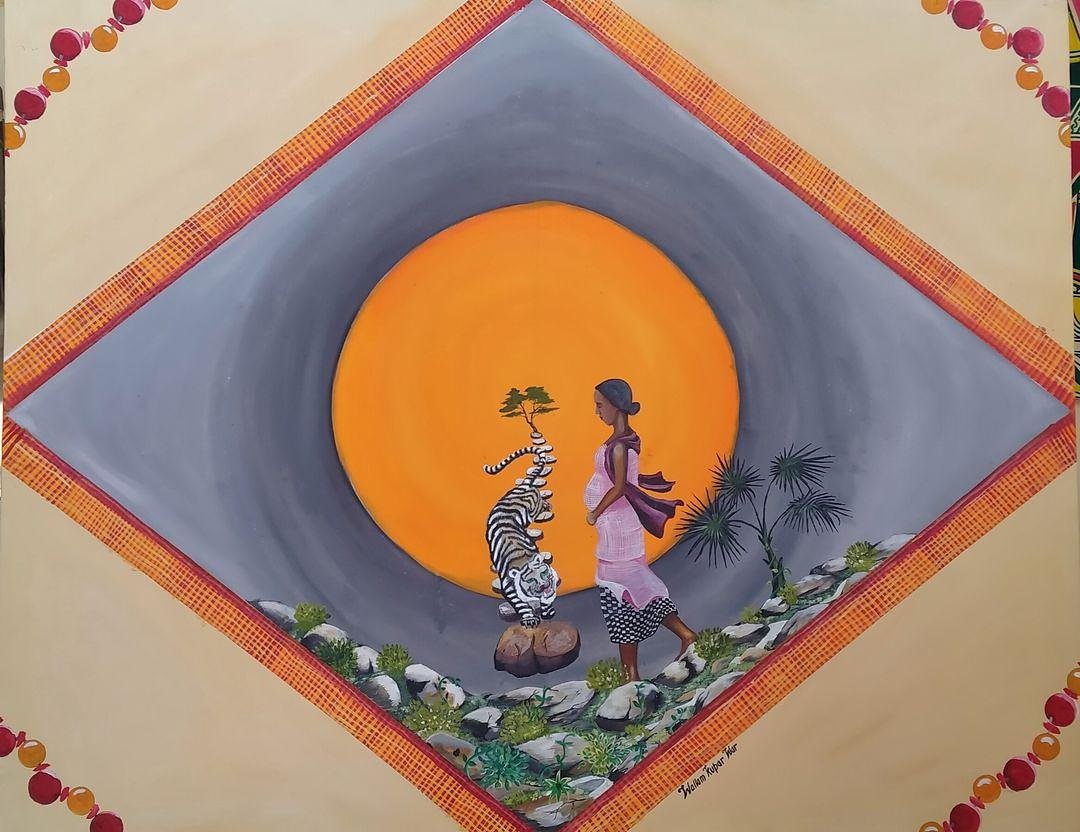
    Continuing with the theme, images and characters of the Khasi folktale "Ka Nam bad U Khla" ("Ka Nam and the Tiger") here is a striking painting by @wallamkuparwar which portrays the mother of Ka Nam.

    The art piece takes as its centre the experience of the mother of Ka Nam. We see her pregnant and meeting the tiger who would change the fate of her daughter forever. Once again art has taken the responsibility of envisioning a story providing us with a different kind of retelling of a folktale. Thank you @wallamkuparwar for sending this! 😀🙏

  • U Wah Sdai/ Sdie

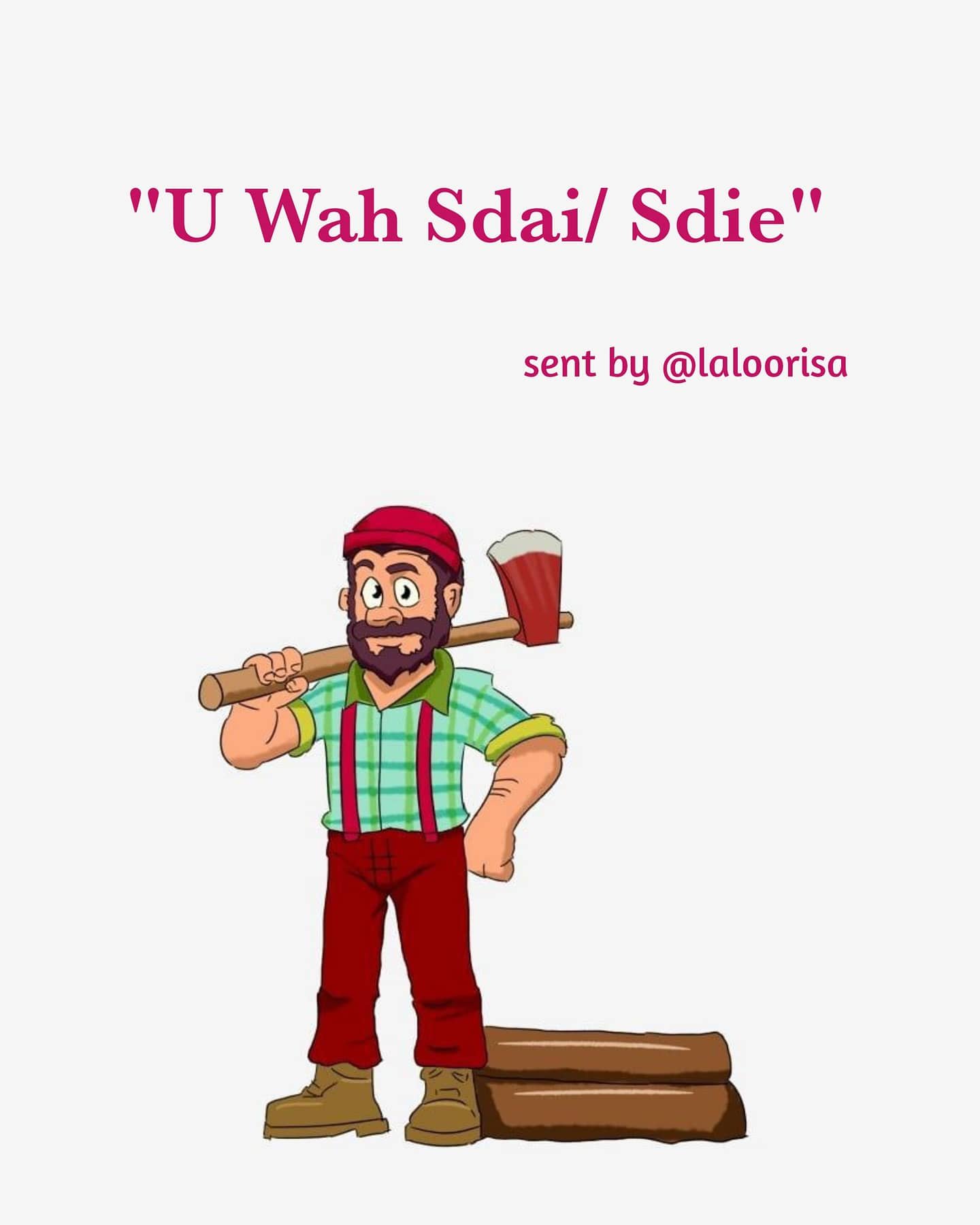
    "U Wah sdai/sdie" u dei nongrep na shnong Jowai, uba trei shitom hynrei uba klet biej. Ha kawei ka sngi, u thlieh dieng baroh shisngi. Hadien katto katne por, u shong thait bad u bam kwai. Ynda u la mut ban bteng biang їa la ka kam, um lap shuh ïa u sdie jong u. U la pyrshang ban kynmaw hangno ba u la buh їa u ruh, um lah kynmaw satia. Khatduh ki paralok kiba їa trei lang bad u haba ki їohi ba u їai wad kumne kim banse ban kylli, "Phi wad aїu kumto naduh mynne khlem lap shuh?" "Nga wad їa u sdie" u la jubab. "Phi khlem їohi hangno nga la buh?" Kita ki paralok ki la їa rkhie їa u bapli namar u sdie jong u, une lydui ha ka tyrpeng jong u hi. Namar ba kane ka wan jia barabor ha une u paralok, na kata ka daw u sa ioh їa ka kyrteng sin kum "U Wah sdai/ sdie". Na kane, їa kum kine ki briew kiba klet biej khamtam haba ki klet jaka buh їa kano kano ka tiar, ka sa kylla long ka rukom ban khot їa ki da ka kyrteng sin "U Wah sdai/sdie".

    There once was a farmer from Jowai who was hard working but quite forgetful. One day he had been cutting wood for a long time. So he sat down to rest and have some kwai. When he stood up to continue with his work, he couldn't find his axe. He couldn't remember where he kept it, even though he tried hard to remember where he left it. Finally, when his friends saw him searching, they asked him what he was looking for. He replied that he was searching for his axe. "Did you see where I left it?" he asked. His friends burst out laughing because the poor man did not realise that his axe was hanging from his shoulder. So because of his forgetfulness being a regular occurrence, his friends gave him the name of "Wah sdai/ sdie". For this reason those who easily forget where they keep things, are given the name "Wah sdai/ sdie".

    "Wah" means to hang something.

    "Sdai" (Pnar) and "Sdie" (Khasi) means axe.

    The Pnar nickname "U Wah Sdai/ Sdie" 🪓🪓 Another story about a nickname sent by @laloorisa 😄😄

    Khublei Chibun wa phah phi kini ki pyrtuit siñ! You've become our regular supplier of them! 😂😂

  • Gender in the Khasi language

    The English language does not have a grammatical gender as many other languages do. This means that it does not have a masculine gender or a feminine gender for nouns. The Khasi language however, gives gender to nature and objects. The two genders are distinguished only by means of the articles "U" for masculine and "Ka" for feminine in the case of singular nouns. For example, Cooked rice is "Ka ja" (feminine), A tree is "U dieng" (masculine), A road is "Ka surok" (feminine), A bed is "Ka jingthiah" (feminine), Chilli is "U sohmynken" (masculine), Cough is "U jyrhoh" (masculine) and Fever is "Ka shitmet/ jingshit" (feminine).

    Many other languages also give gender to animate and inanimate objects. Some of these include German, Hebrew, French and Kashmiri.

    Here are some words to compare:

    Spoon: In Khasi "ka shamoit" is feminine, while in German "der Löffel" is masculine.

    Salt: In Khasi "ka mluh" is feminine, while in French "le sel" is masculine.

    Crow: In Khasi "ka tyngngab" is feminine, while in Kashmiri "کاو" [ka.w] is masculine.

    Book: In Khasi "ka kot" is feminine, while in Hebrew "סֵפֶר" I/'sefer/I is masculine.

    In the Khasi language, nature and objects are given a gender. This is present in the French language too and is mentioned by Rev. H. Roberts in his book A Grammar of the Khasi Language (1891). Thank you @naphisabet1303 for initiating this in our conversations! ♂️♀️♂️♀️

    If anyone has studied Linguistics, we welcome your thoughts and observations in the comments section! 😀
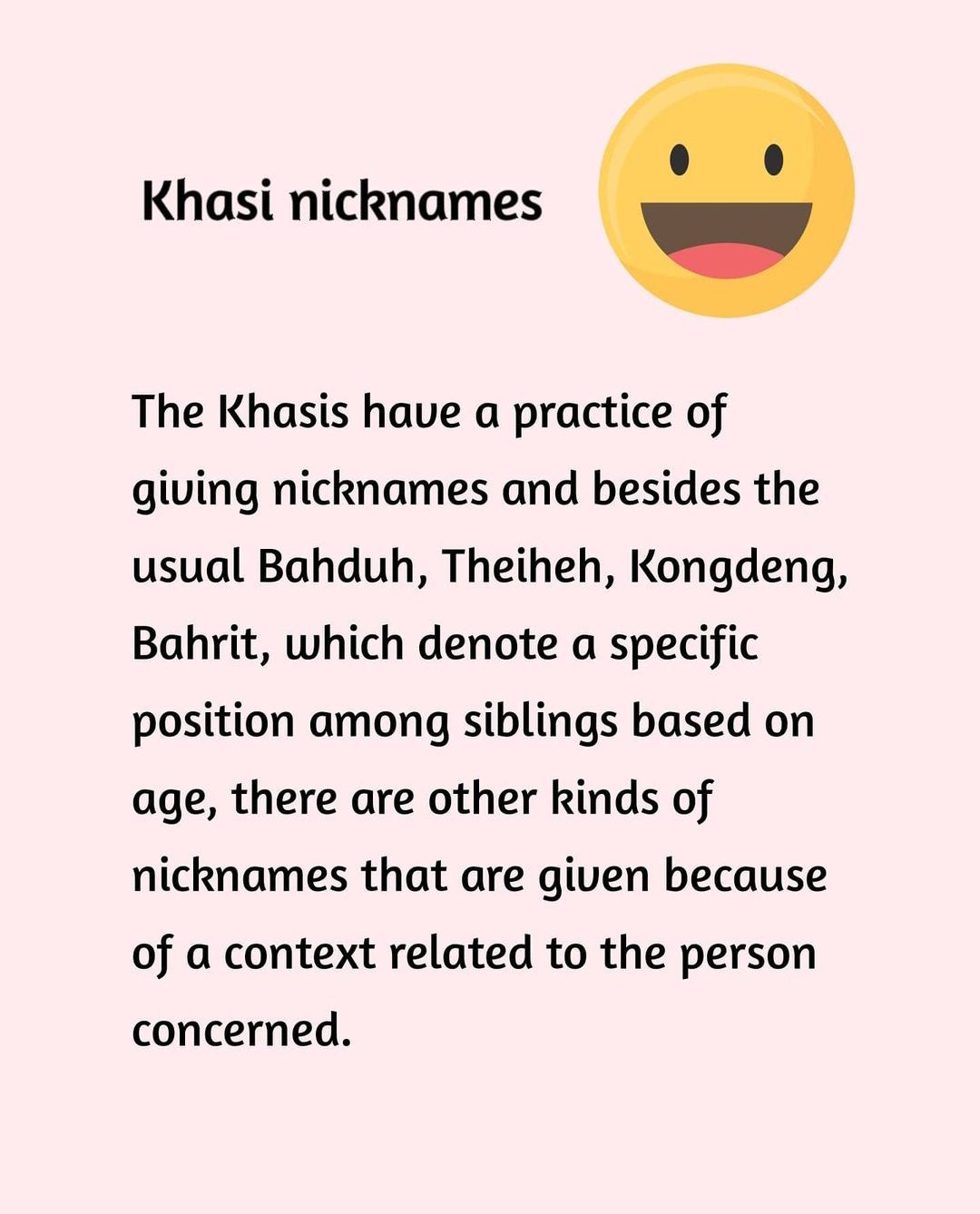
  • Ki Kyrteng Sin Part II/ Khasi Nicknames Part II

    Sympiw (rit khmat/ small eyes)

    Tun tun (sngaid/ chubby)

    Samah (sngaid bad lyngkot/ short and stout)

    Shrieh (khih ksaiñ, balaiñ/ hyperactive, mischievous, oversmart)

    Shyrjei (ima ka dur/ scary looking face)

    Sadman

    Sadmew

    Thamer

    Thohliap

    Tah (from mattah meaning snail; a reference to being slow)

    Krew krew (big eyes)

    Piduiñ (sngaid/ fat)

    Ldoiñ (heh briew bad biej/ big-built and dumb or foolish)

    Kriw kriw (rit briew bad shalak/ small, smart or sly)

    Bah Rai (raikhoh/ thin)

    Bah Kyn jait Roi (ba kynroi than/ prone to having fights)

    Priñ (Pnar) (ba ïong/ a dark complexion)

    Chru (Pnar) (Ka shriew/ Yam)

    Sti (wrinkled looking or used for someone thin)

    Mum (pronounced as Moom)

    Another round of "Ki Kyrteng Sin"/ Khasi Nicknames 😆😂😆😂

    These nicknames have been collected from the comments section of the earlier post on Khasi nicknames. Thank you to everyone who contributed! 🤡🤠🎃

  • “Koh” “Chchaw” Maram

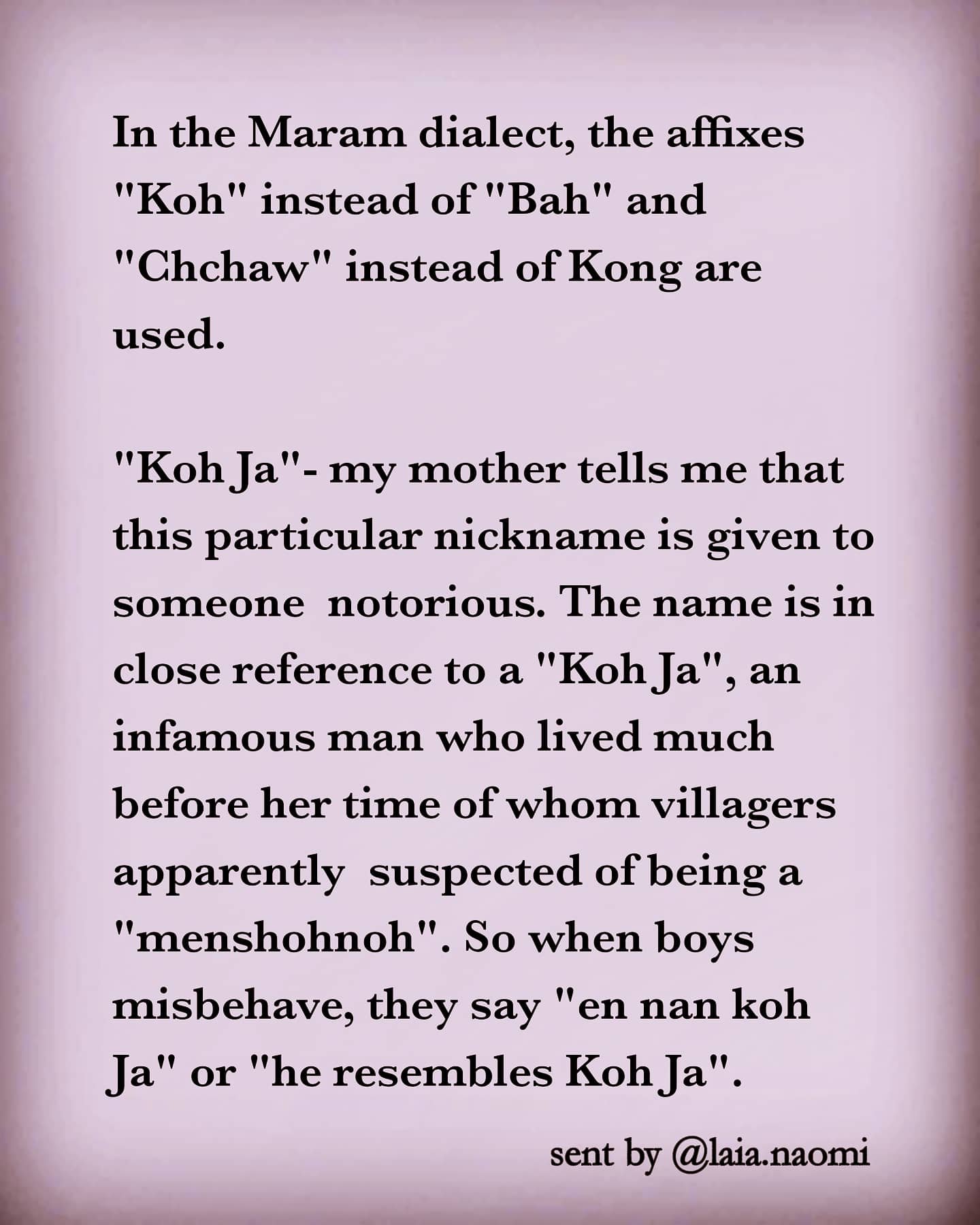
    In the Maram dialect, the affixes "Koh" instead of "Bah" and "Chchaw" instead of Kong are used. "Koh Ja"- my mother tells me that this particular nickname is given to someone notorious. The name is in close reference to a "Koh Ja", an infamous man who lived much before her time of whom villagers apparently suspected of being a "menshohnoh". So when boys misbehave, they say "en nan koh Ja" or "he resembles Koh Ja".

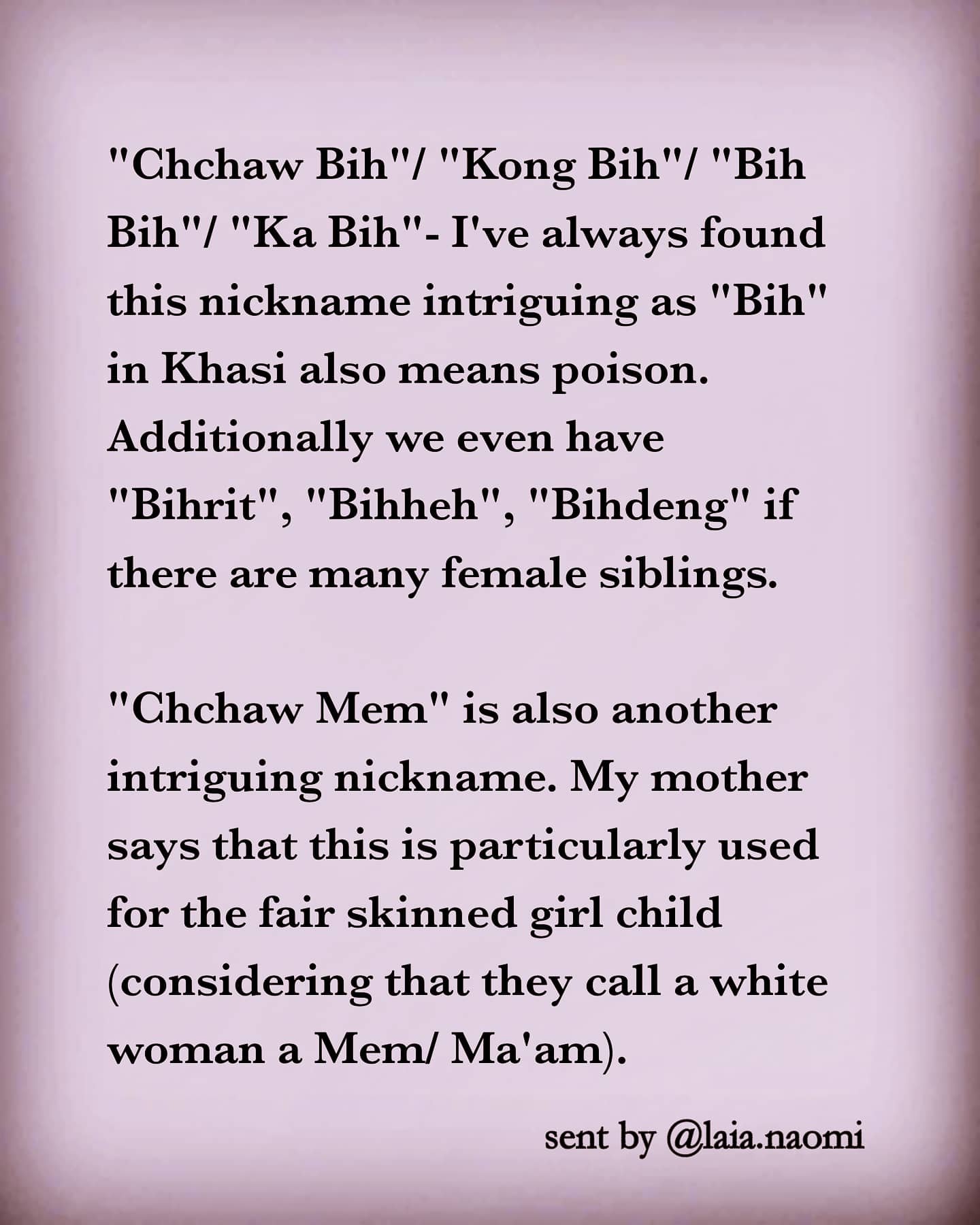
    "Chchaw Bih"/ "Kong Bih"/ "Bih Bih"/ "Ka Bih"- I've always found this nickname intriguing as "Bih" in Khasi also means poison. Additionally we even have "Bihrit", "Bihheh", "Bihdeng" if there are many female siblings. "Chchaw Mem" is also another intriguing nickname. My mother says that this is particularly used for the fair skinned girl child (considering that they call a white woman a Mem/ Ma'am).

    The Maram dialect is spoken in the West Khasi Hills District of Meghalaya. The variety of dialects spoken enriches a language giving it depth and scope. 🗣️🗣️

    Thank you @laia.naomi for this contribution! 🤗🤗