Blog

  • Mynsiem Katno ka Dap Jingkmen

    Mynsiem katno ka dap Jingkmen

    Ban peit iapha ko Mei mariang

    Hapneh Jongpha Nga heh nga long

    Jingkmen Jong nga hapha ka shong

    Haba nga peit ki lum ki wah

    Ki sim ha Jingsngewbha Ki pah

    Ha Mei mariang Ki kmen Ki Suk

    Pha Ker Pha ri riewspah ne duk

    Ki lum Ki wah wat Ki pyntha

    Baroh ha Jingsumar Jong pha

    Mynsiem ka ban peit ngam ngiah

    Syntiew Ki skud hapha Ki speh

    Ki um ba shngiam ha wah ba tuid

    Rymphum Ki kshaid Ki Noh laitluid

    Sha thwei ba ingum Ki Noh arsut

    Bad Jingsawa naki ka put

    Hynrei phew se kala kylla

    Syllen Ki khlaw Ki ba nylla

    Ki sim Ki doh tiew laiphew jait

    Hangno kin rieh ban ioh shongthait

    Tang Jingjakhlia bad Jingbymman

    Namar Ki riew ieid RI la dam

    Sa tang Ki ing khong shyllangmat

    Ban ioh pynjot Ki sngew tynnad

    Kim salia i'u ksuid i'u khrei

    Kim don ka Jing pyrkhat eiei

    Tang ban heh la u Saipan

    Ki thom wat ia u briew u blei

    Kim don Jingmap para Maki

    Wat ban iarap Ki ia kli kti

    Tang ban biang ka malade

    Ki tla bunsien ki pynthame

    Shaei kein ka Jingtiplem

    Ban iarap i'u biej i'u them

    La jyrsieh tang a Jing sniew

    Ka bih ha shyllangmat la kiew

    Ka Mei mariang bapli ka iam

    Namar bynriew u la Leh tam

    Marwei Katno ka pait dohnud

    Hala mynsiem marwei ka ud

    Mynta ka shong ha nga ha phi

    Ban thaw thymmai iala ka ri

    Wat shong jai pdeh ha la ka dpei

    Lada phi pyrkhat ia ka kawei

    Original Khasi poem "Mynsiem Katno ka Dap Jingkmen" written by @samsan_yt

    Thank you for this poem which has a lot to teach us! 🌲🏞️🌬️🌤️🌄

    The poem portrays the beauty of Nature and the environment. The bountiful resources that exist in it but are shamelessly exploited by man. We all know this story. We have heard this a million times! Do we really care about what is happening to the environment? Will we be able to survive if its degradation continues? The poem concludes with the fact that it depends on us to help Nature regain her true value and strength, which will in turn enrich human existence.
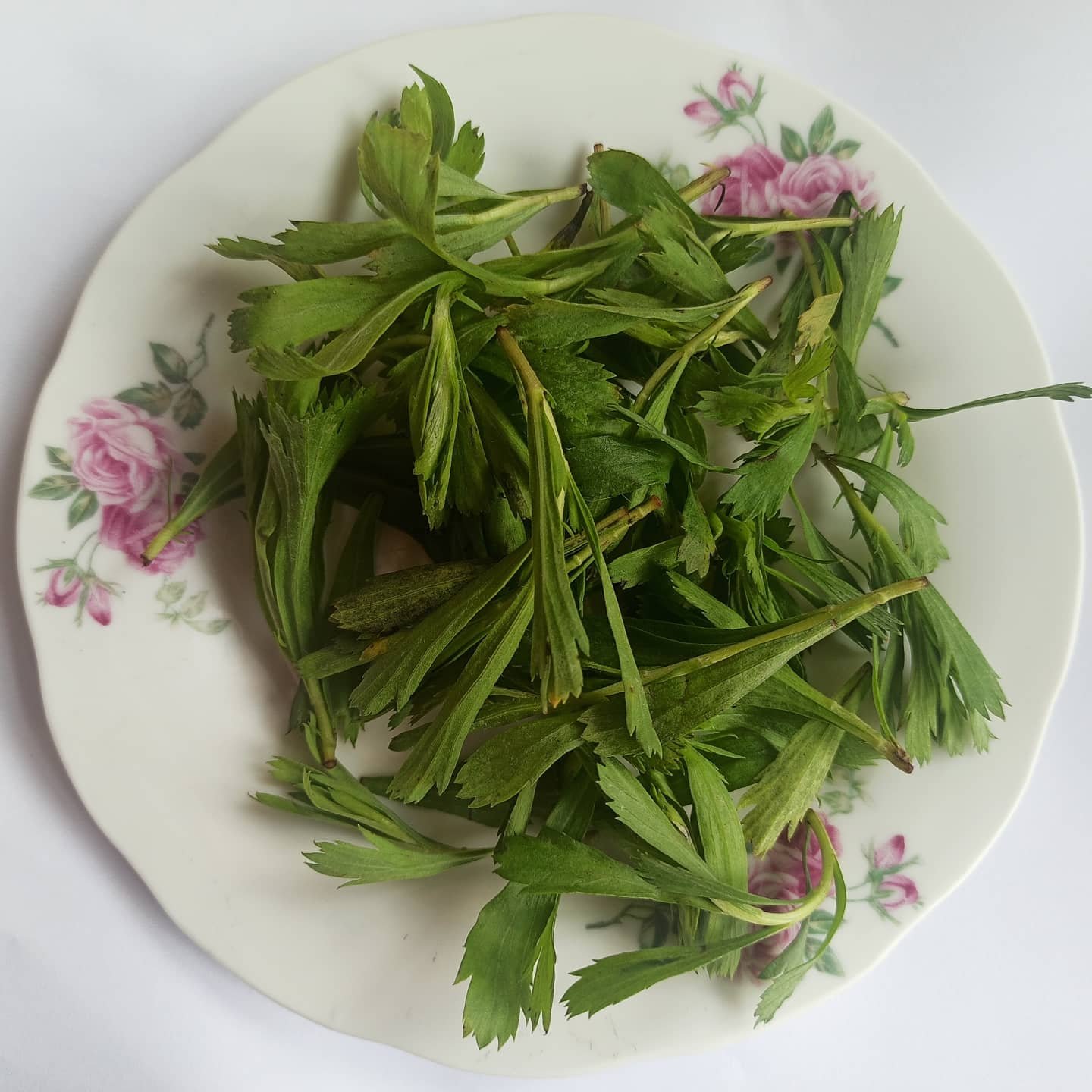
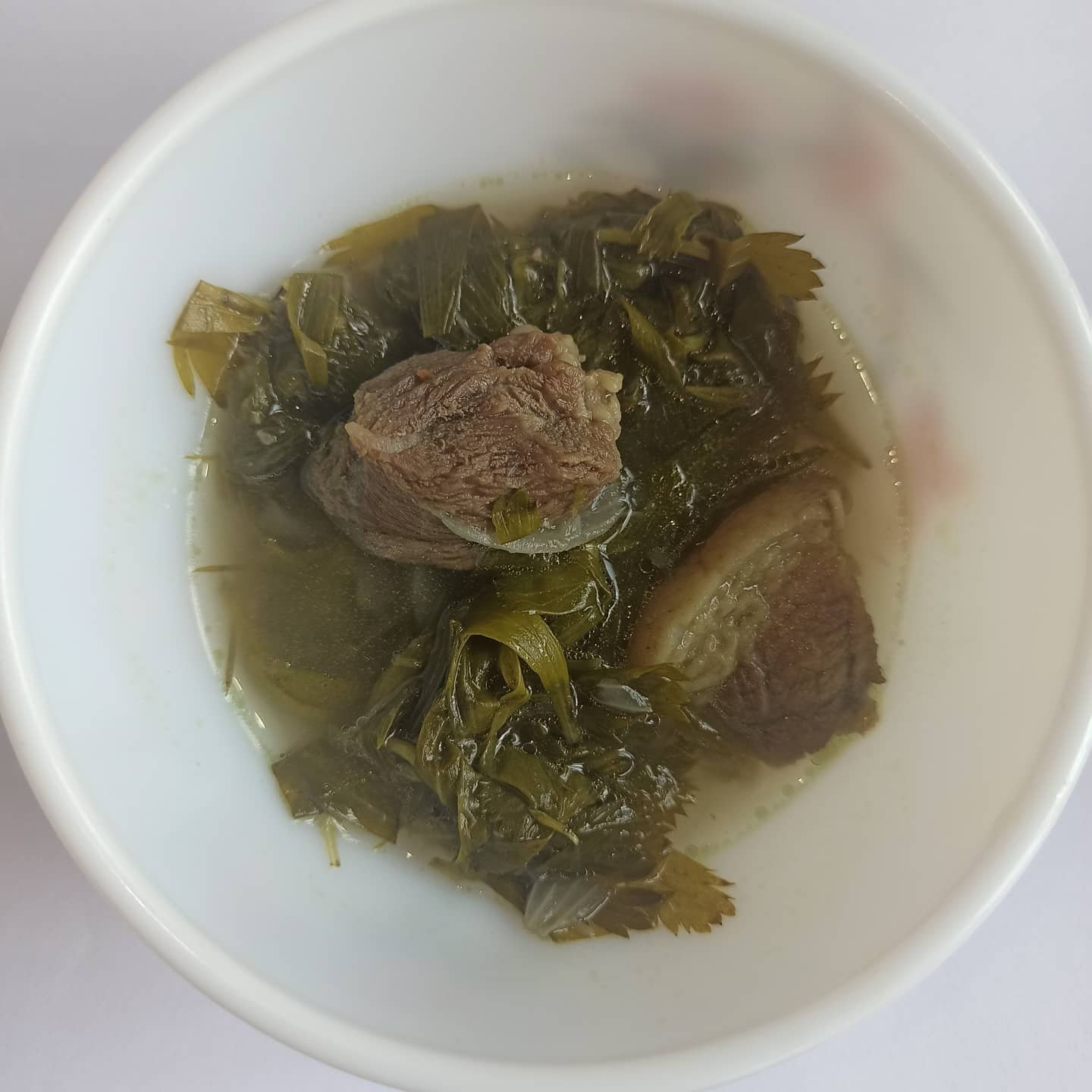
  • Jaralud bad dohsniang

    "Jaralud" (Khasi)/ "Yaralud" (Pnar) cooked with "dohsniang" (pork) is a Pnar dish but it is also eaten by Khasis. "Jaralud" is a low lying shrub that grows in pine forests. It grows in the summer season and is a refreshing addition to the summer diet. "Jaralud" also has a distinctive smell and flavour that some might not find appealing. But for those who love it, we say thank you for the chlorophyll! 😋😋😋

  • Ka Behdieñkhlam

    "Chad dei mynsien maya Blai

    Chad dei wa tipbru tipblai

    Ya ka khlam yoh u kh'lah khatai

    Napoh i mynder napoh i pyrthai."

    Daohi says:

    The Behdieñkhlam festival is a popular harvest festival celebrated by tribal communities in the Jaiñtia Hills District of Meghalaya. The festival is observed by followers of the "Niamtre" faith (indigenous faith).

    In many parts of the world, a successful harvest is always a time to celebrate or appease the gods to ensure a bountiful crop.

    "Behdieñkhlam" is a combination of three words, "Beh" (to get rid of), "Dieñ" (wood or log) and "Khlam" (plague). Together, these words become one and translate into ‘to get rid of plague’. The prime objective of the festival is to pray to God for good health and harvest.

    Ka Behdieñkhlam wasuk wakmen ya phi waroh! 🙏🙏🙏

    "Ka Behdieñkhlam" sent by @xdtnoahjupejackllthmanar Thank you for this entry!

  • Stories by Badondor Diengdoh

    Stories

    A fly on the wall–still,

    dead, curious, alive; listening

    as a story fades; pieces

    of a tale absorbed by the

    turmeric stained jainkyrshah, only

    to be washed away.

    A fly on the wall flies

    with yearning; flying

    behind a story that rises

    with smoke from

    the rooster's feathers. Smoke

    paints the air, drenching

    it with rays of unfaithful peacocks

    and stubborn stags. Air

    now memory, colour and scent,

    swallowed by cicadas who vibrate

    hymns of faithful clothespins

    like weary red strings. But

    can a story fade or

    does it fly to find other stories to

    listen

    smile

    laugh

    cry? Like

    people, stories too can

    meet in jadoh stalls and pata. Some

    stories like winter,

    melt with butter in a steel bowl

    on restless charcoal. Some

    stories bigger than most, like

    the diengiei cast

    a

    shadow

    over

    others. Some

    stories lose their way

    to fall back as dew on

    windshields of new lovers

    and starving drivers. Some

    stories like an eclipse

    turn daylight into night,

    staying longer than a candidate

    who visits you for votes. Some

    stories too painful, as

    other sensitive stories flee like

    the tiger upon licking the

    blade of an axe. Some

    stories fold themselves into

    a grocery list of mother slipping

    into pockets of

    absent-minded fabric. Some

    stories unheard but

    familiar as the taste

    of tungtap: formless

    and edgeless, though bites

    like cold mountain spring,

    cuts through rock,

    dampens a matchbox–to

    then trickle down into the

    stillness of a well, only

    to be washed away

    as smoke meets water.

    -Badondor Diengdoh

    Original poem "Stories" by @a_pocketful_of_plums 🔥🔥🔥 Thank you so much for sending this poem! 💚💚💚

    This is a moving and beautiful poem. The evocative style paints layered Khasi cultural allusions like the peacock who abandoned the sun for a garden of mustard flowers and Sier Lapalang. Words, language, stories gain a body in a tribute to our oral tradition, where a story transcends time and space because it is constantly moulded by the one who tells it. The poem exhorts the power of the spoken word. It is a testament to the persistence of Khasi collective consciousness as smoke and water rise from the hearth.

  • “Peit Cheitai Cheitu” da Saweini Laloo

    Dang step dang step, chong u woh Ephrin

    Ha ka ben kawa rong soo

    Ka kot khubor ha kti beit, hajan

    Peit u cheitu, peit u cheitai

    Man da dep pure u

    Te chong u chi slem

    Peit u ia ki bru

    Wa lai cheitai cheitu

    Oh Papun o! Oh Papun o!

    Khana ia nga yi ioo phi cheitai?

    Ki jingmut u ioosar cha jngai

    Ham kylli jingkylli ware o ksu

    Peit cheitai, peit cheitu

    Wa lai ki kari wa ki bru

    Dang step, dang step, chong u woh wa ka ksu u

    Ha ka ben kawa rong blue

    Ka kot khubor ha kti ïong o

    Peit ki waroh arngut cheitai, cheitu.

    Original Pnar poem: "Peit Cheitai Cheitu" by @nini_sasa_23 😄😄 Thank you for the poem!

    This is a quaint and evocative poem about her "Papun" (grandfather) reading his newspaper in the veranda and then spending hours observing and ruminating on passersby and cars. 🌻🌻💞💞

  • Kren amrang

    Ka jingong "Kren amrang" ka batai ïa ka jinglong jong u ne ka briew, ha kaba ki saitlah rhing tang ban lah ka nia la jong. Kiba kren amrang ki pyneh ïa la ki jong ki nia khlem pynjem ïano ïano ruh bad ka jingïohi jong ki ïa kiei kiei ruh ki neh pyrkhing beit kum kaba ki mut. Ïa ka ktien "amrang" la ju pyndonkam ruh ha ka die ka thied ïa ki briew kiba pyneh ïa ka dor jong ki tiar ki tar.

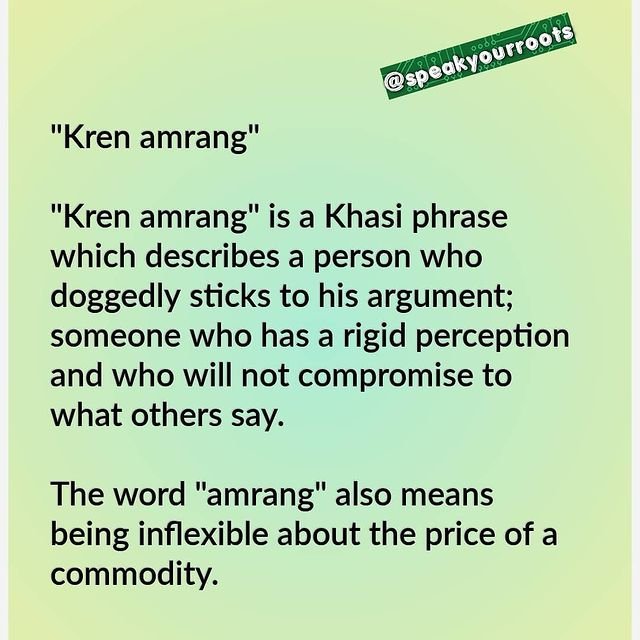
    "Kren amrang" is a Khasi phrase which describes a person who doggedly sticks to his argument; someone who has a rigid perception and who will not compromise to what others say. The word "amrang" also means being inflexible about the price of a commodity.

    "Kren amrang" is a Khasi phrase which describes an unrelenting and unyielding outlook.

  • Ap jon, ap jon by Careen J. Langstieh

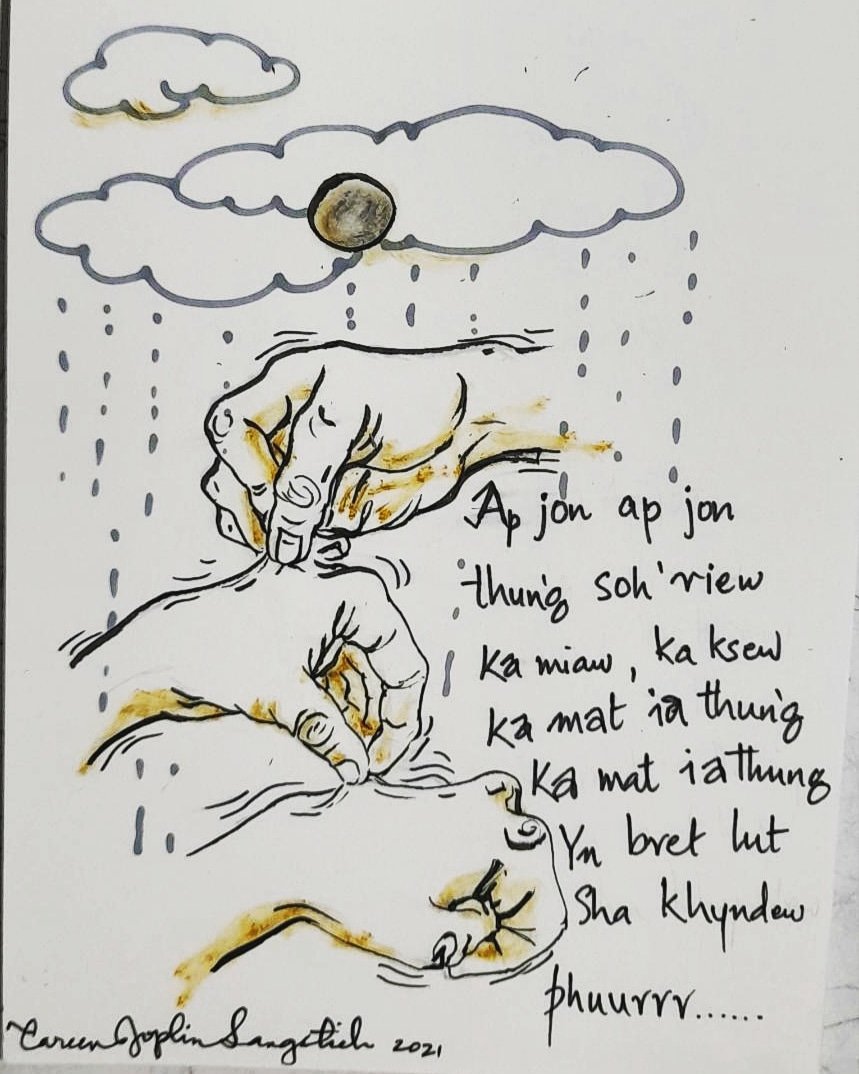
    "Ap jon, ap jon,

    thung soh 'riew,

    ka miaw, ka ksew.

    Ka mat ia thung,

    ka mat ia thung.

    Yn bret lut sha khyndew.

    Phurrrrrr…..”

    "Ap-jon" or "Ap-jan" is a favourite children's pastime played with as many participants present. It involves pinching each other's hands one on top of each other to make a ladder-like formation. The rhyme is then sung while rocking the chain of hands up and down. The song ends with 'phurrrr' which signals letting go of the hands and immediately is followed by children tickling each other. When I was little, I always knew who was going to give me the sharpest pinch so I'd try to put my other hand on top of that kid's hand to counter myself. But we carry no grudges because in the end we would end up laughing hysterically by tickling each other.

    "Ap jon, ap jon" sent by @careenjoplinlangstieh 😄😄😄 This is a beautiful art piece on the childhood game! 🤩🤩🤩❤️❤️👏👏

    "Ap jon, ap jon" is a childhood game that most Khasi children will know. Like the post says it is a popular pastime during play. Remember those painful pinches with voices anticipating the tickles at the end? 😅😂 Khublei shibun Kong @careenjoplinlangstieh for this entry! ❤️🤍💜💙

  • Bood Late da Daohi Manar

    PARA KHYNROO, KHYNTHAI NE CHYNRANG,

    ALAE! CHIRUP HAM CHAH CHAKAE NE CHAH PHALANG

    NUKSA WA BHA TOA CHDOOH TOA ÏAH,

    ÏOW LY'OH WADOOM, HAM IEH U WAN KAH.

    ÏOW PHOOHÏOW PHEIÑ I HEI MANBRU;

    HAM ÏYNDONG I SNIAW,TO PYRKHAT YLLU.

    LA KA MYRIED, U SEINDUR NADUH MYNTU,

    ALAE! DUHAI ÏOW LEIT NEI CHAH BEIÑ NE CHAH MYNTHU,

    SAJIAR-SYNDONG, NA KI KAM THALA,

    PYNCH’KEH KI TYRPAIÑ PYNEH KI TYMPHA.

    NEI KYIAD, U BHANG WÖW DROK WÖMHOI;

    HEI MIAT I BHA, TE IOH I U POI.

    KYLLA I POR, NEI WARIM CHEI THYMME

    ALAE! ÏEI SIH HAM BOOD ÏONG TON HAM BOOD LATE,

    PYN-NA PAN, PYN-NA WA YEIÑ, PYN-NA TOH,

    CHA KA BHAH KA NASIB HAM KYNNOH.

    HAM KHLOT HA WA SNIAW, NE THLAH HA WA ÏOO;

    ÏEI SNEIÑ I KROO KA BEI U PA, TOA KSOH-KYNMOO.

    HA JAR JAIT KI RONG,DA BOOH U WA NAJRONG,

    ALAE! ÏEI BUROM AKOR TOA RI KYNDONG,

    JINGEH HEI JINGIM U ÏEIN IALEH,

    I DIÑ WA R’HI, HAM ÏEH U PLEH.

    PEIT TOA BOOD, ÏEI MAN I LONG U TKHU;

    HAM KDAW KTI PARA I, TOA IA SNEIÑ IA KYNTU.

    PYRCHANG ÏONG I, IM SNGI DU HEI BHA,

    PANCHNIAT I BUROM, U KUP U DEIÑ WAROH CHI RTA

    -DAOHI MANAR

    Daohi says about the poem:

    "Today the 26th June, the whole world is observing the International Day against drug abuse and illicit trafficking.

    The poem "Bood late" simply means 'imitating'. This poem reminds us not to get influenced by evil or allow bad examples to influence us. Follow only what is good. In general, this poem reminds us that drug use, drug dependency and drug abuse was and is a silent killer in our society. This poem encourages everyone especially youth to not take drugs or any toxic substances, to not get influenced by such bad examples.

    As we are aware, cases of HIV/AIDS are high in the Jaiñtia region and Meghalaya is also one among leading states in Northeast India. So, to stop and prevent that, the poem encourages us to abstain and avoid any form of drug consumption and selling of these substances.

    For example the lines "Ham ya kdaw kti para i toa ya sneiñ ya kyntu" means let's not judge or point fingers at others, we can help one another to come together to unite, so that we can overcome or fight against this silent killer in our society. This poem aims to educate people about drugs and also steps to eliminate drugs and illicit trafficking to save lives."

    An original Pnar poem "Bood Late" by @xdtnoahjupejackllthmanar 👏👏 Khublei Chiboon @xdtnoahjupejackllthmanar for the poem! 👍👍

  • U Jangew

    "U Jangew" sent by @bada_boombam

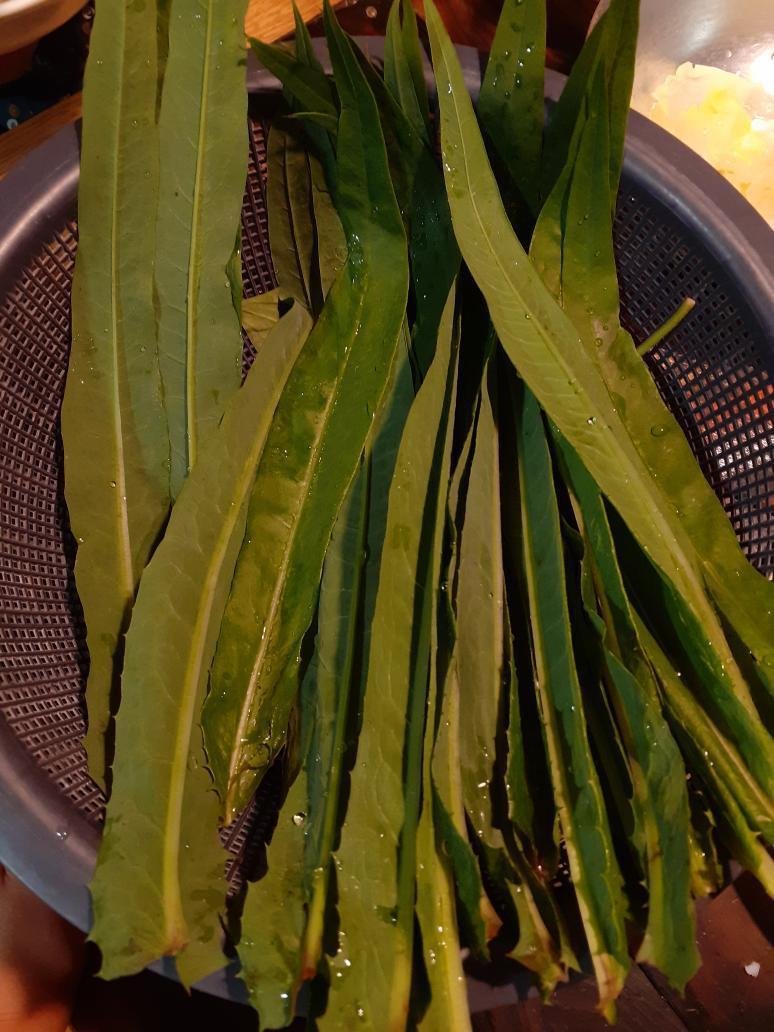
    She says: "U Jangew is a local wild herb that has been made famous by the mourning song of the mother of U Sier Lapalang (the folktale of the stag who is killed). It is slightly bitter but peppery in taste.

    I am pretty sure it has a lot of health benefits, some that I know are detoxification and Blood pressure and Diabetes controller. Sadly, we mostly see it as 'ñiut' (weeds/ wild plants) forgetting that this unseeming plant can benefit us so much.

    Ours just grows randomly in our yard and we pick them when we want to eat them. Both lockdowns have taught our family to treasure such plants as they become our only source of fresh herbs/ vegetables for our salad."

    Thank you @bada_boombam for this entry! 🌱🌱

  • Khasi words that share the same spelling with English words but carry different meanings

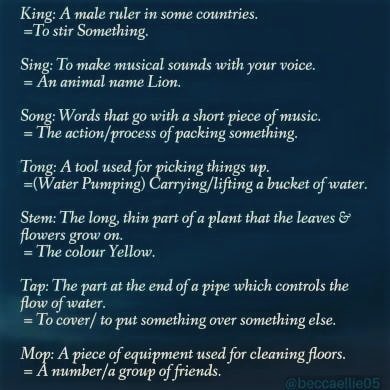
    King: A male ruler in some countries. In Khasi "king" means to stir something.

    Sing: To make musical sounds with your voice. In Khasi "sing" means lion.

    Song: Words that go with a short piece of music. In Khasi "song" means the action or the process of packing something.

    Tong: A tool used for picking things up. In Khasi "tong" means carrying, ladling or lifting a bucket of water.

    Stem: The long, thin part of a plant that the leaves and flowers grow on. In Khasi "stem" is the colour Yellow.

    Tap: The part at the end of a pipe which controls the flow of water. In Khasi "tap" means to cover or to put something over something else.

    Mop: A piece of equipment used for cleaning floors. In Khasi "mop" means a number or a group of friends

    "Song", "King", "Tong"…here are some Khasi words who share the same spelling as English words but have completely different meanings! Thank you @beccaellie05 for this entry! 💙💙💙