Blog

  • Tana

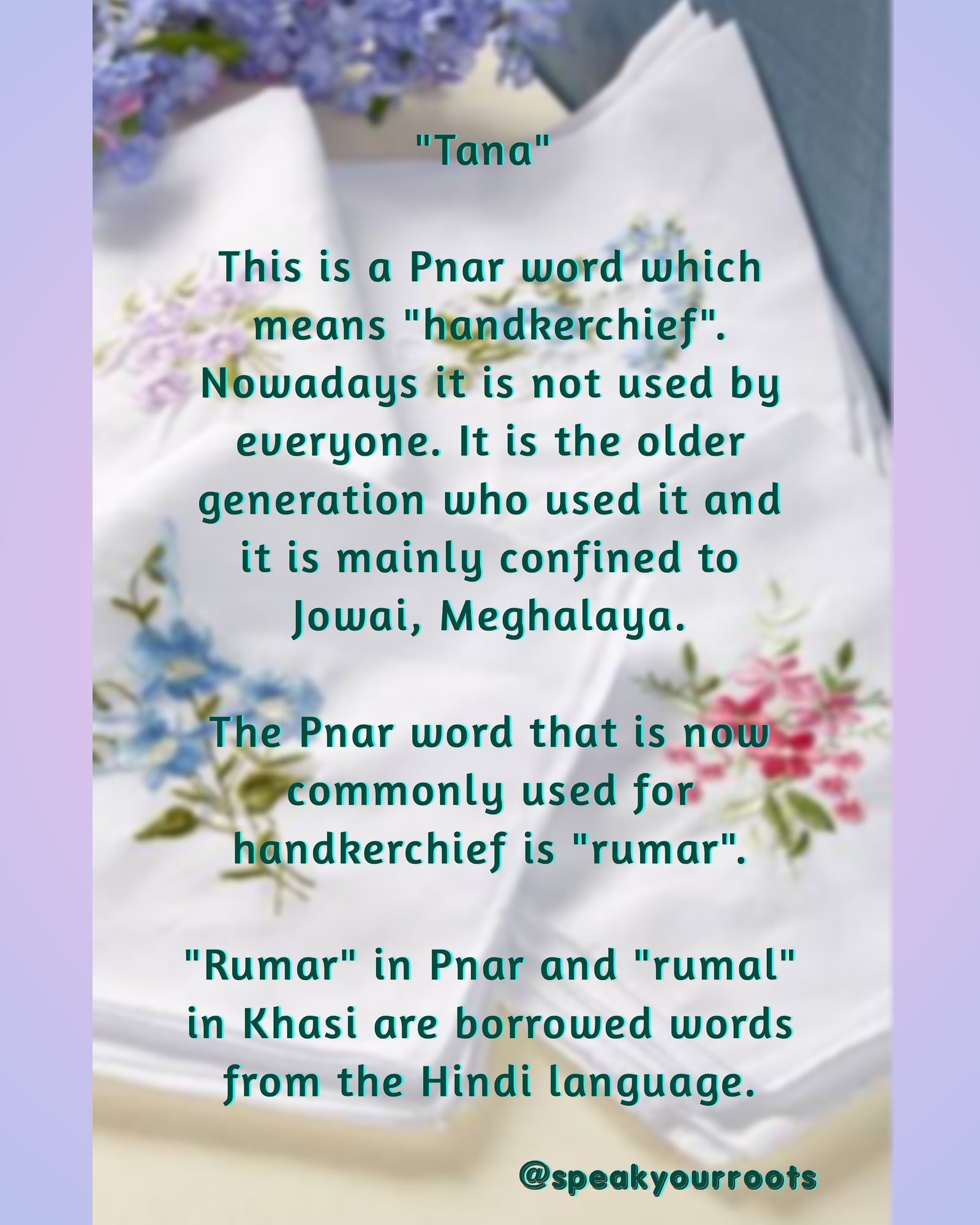
    "Tana" is a Pnar word which means "handkerchief". Nowadays it is not used by everyone. It is the older generation who used it and it is mainly confined to jowai, Meghalaya. The Pnar word that is now commonly used for handkerchief is "rumar". "Rumar" in Pnar and "rumal" in Khasi are borrowed words from the Hindi language.

    Thank you @shiny_joan !

  • “Ki Arngut Shipara” da Garmylo Pdang

    The younger took one with a prayer

    Lord make me an instrument of your peace

    "Shim bahbah, to jied hi ma phi," ong u hynmen

    Ki don ki ba stang, ki don ki ba rben.

    "Haduh katno baje phin shong hangne?" nga shu kylli

    Haduh ban da lut ong u hynmen

    "Ngi hap ban die lut, la da ka miet kan ap slem

    Lym kumta, ka pisa ban thied khaw, kam dap, ba u rem."

    "Phi shong phi sah ha ei?" Nga kylli biang

    Ha Wahingdoh u hymen u jubab

    "Ani ka jngai balei phi wan die shane?"

    "Ba bun ki khynnah riewspah ba pule."

    "Ko hep," u ong u hymen, "hatei to khie leit tyrwa,"

    "Hatei ha jan jingkhang ka dukan ja

    Wat peit shapoh ba ioh mai ki briew

    Da husiar ar tad ioh hap ka pisa."

    Slimmed they stood next to the restaurant

    Bookmarks were on their hands

    A black hat on the eldest' head

    On the younger, a sweater that's red

    Their faces shone the Bosco Square

    Amidst the gloomy, happy faces of the students' there

    Two rupees for one, and 5 for three

    To the younger child crying they gave one for free

    Their pants torn and hair unkempt

    On the younger's sweater, his mom's jainsem

    The pure floral tradition scent

    Their mom bought long before the season of sullen.

    Ko bah, "shim kawei seh tang ar tyngka

    To shim seh bah", u barit u ban

    "Lada phi shim, ngin ai san! san tyngka

    To shim ban bah," u hymen run u ban

    "Ap shwa khyndiat nga kwah ban ia kren," nga ong

    "Em bahbah," u hymen u ong, "don bun ba dang sah

    "Tang san minit, ka por, dei ba kordor bahbah,

    Tang san minit, nga kular," bad ha dew bilat ngi shong.

    "Phi leit skul ne em?" Nga sdang kylli

    Ki nguh ka khlieh, bapli ki rangli

    "Ani balei, ka jia aiu ia phi

    Ngim don ka pisa ban siew ka skul fee."

    U pa u trei kaei, nga kum lorni

    Ngim tip, lah lai snem mynta, u ieh ia ngi

    I mei pat i trei jingtrei aiu?

    I mei i thiah ha iing ba i ioh pang TB.

    Garmylo says:

    "The poem is based on a real experience with the two boys (who are brothers) who were selling bookmarks at Don Bosco Square in Laitumkhrah, Shillong. It's about how we often forget to look at the other side of us, which is the spirit of humanity. We are so busy with the clanging of the world that our sights are limited to "The Us, We and I".

    "Ki Arngut Shipara" is original bilingual poem by @_gar_my.lopdang . Thank you for this touching poem! ❤️

    It is a narrative poem about two brothers who at a very young age become bread earners for their family. This is because their mother had been diagnosed with TB and their father on knowing about it, left her and the two sons.
  • “Pahsyntiew” by Indari S. Warjri

    I heard of your beauty

    Blushing daughter of the deities

    Sheltered in your cave of chastity

    No man dare explore.

    A dark cascade rises from

    your shoulders

    But a tender lily

    Should not be bruised by

    hostile rocks.

    Your slender hand will stretch

    Towards the flower in the man's hand

    For in his hand man hold

    Unnamable delight.

    And you became mine,

    sweet maiden.

    O be the mother of my sons!

    But also the warm nest for

    my love.

    O children, may you be noble

    May you possess the

    strength of rocks

    May you protect the weak

    May you be suckled on knowledge

    For the celestials beckon

    And I must return.

    The sons became men, royal in stature

    Having wisdom gifted by the gods

    They came to rule the misty hills;

    To dwell in pinewood mansions

    Where carpets of clouds

    And cloaks of rain

    Conserve the forests of the Khasi hills.

    O mother, giver of life,

    See your sons-the syiems.

    "Pahsyntiew" by @indariwarjri based on the legend of Ka Pahsyntiew 🌹

    Indari S. Warjri (Associate Professor) is Head of the Department of English, St. Mary's College, Shillong.

    The Legend of Ka Pahsyntiew has been published in English, in the book Around the Hearth: Khasi Legends (Folktales of India) by Kynpham Sing Nongkynrih. The book is published by Penguin Books.

  • “Jar I hok – Jngai nei thok – Kamai ia ka hok” da Daohi Manar

    Phet jngai na ka bamsap, phet jngai na ka bamsap

    Ileh Cha kamni, sa du i wöm ioo tipsap-tiptap?

    Jar jar lei hok, u ia k'bai-kyrha

    Ileh Cha kamni, dap da ki jingeh suda?

    Kylli oa pûn na nga

    Wa angnood iei jingkylla…

    Chirup u ieiñ tylli, Myllin noh i sniawpher u wi ia ka wi

    U rah iei roi i par, thrang i hei jingim

    Ka wait iong i tip i stad, kani toh u chim

    Ham sniaw salajong, Toa iyn-ia pûnku pûnkynrong

    Khlem niaw, Wei khlem da thaw

    U wa lieh, wa stem, wa soo ne wa u iong

    "Jar I Hok, Jngai nei Thok, Kamai ia ka Hok" is an original Pnar poem by @xdtnoahjupejackllthmanar

    The poem speaks of bringing about a change in society, through truth, unity and a thirst for knowledge. A change that is for the greater good of all. A change that creates an awareness of not only our rights but also our duties as a community and as citizens of the state and country.

  • “The Sun, the Peacock and I” by Badondor Diengdoh

    Spirited like the jaiñkyrshah

    flapping with the wind.

    Noisy like the sound of

    a bolbaring indenting tarmacs.

    The girls of summer

    The boys of winter.

    The blue rubber ball.

    targeting stacked rocks.

    Now

    still figuring out my life

    with unmatched socks

    Wish I could still be that

    kid from the block

    who daydreamed of

    the sun and the peacock.

    According to Khasi folklore, it is said that the Peacock and the Sun were together in heaven as lovers. But one day the peacock, while looking down on the earth, saw a garden full of mustard flowers. To him the garden looked like a beautiful girl in yellow and green clothes. He instantly fell in love with what he saw. The peacock left the sun and flew down to earth. The sun was heartbroken and her golden tears descended on his feathers creating the golden spotted pattern we all know.

    To the peacock's utter disappointment, upon landing on earth, he realised that what he saw was only a patch of mustard flowers. Now it was the peacocks' turn to cry. Full of regret he tried to fly back to the sun but could not. That is why the peacock is flightless to this day.

    "Bolbaring" is a wooden toy vehicle made out of small wooden poles and having rotating ball bearings as wheels.

    The rubber ball and stacked rocks refers to a traditional game known as "Mawpoiñ" in the Khasi language. It is like dodgeball, while introducing a new element into the game in the form of stacked rocks. It involves one team hitting their opponents with a ball or destroying the stacked rocks while the other team either dodges or re-stacks the rocks .

    "Jaiñkyrshah" is the traditional Khasi apron which is worn as a loop from one shoulder and its design is always a chequered one of different colours.

  • “Ka Likai (An Ending Retold)” by Clarissa Giri

    Calmly by the fire,

    She sits staring at the flames before her.

    Ember sparks burn freckles on weathered

    floorboards,

    Restless charcoal crackle uneasily in the dpei,

    While vapour fumes from her drenched

    kyrshah.

    Smoke and ash cling to her damp hair,

    A hot tear makes its way down her cheek,

    The wait glistens bloody at her heel,

    And she watches the shadows form on the

    wall before her

    As her ancestors dance for war.

    The rueful dish cooked to perfection,

    She feeds him a mouthful of this concoction-

    A stew of his own fingers; there will be no

    leftovers.

    How he tossed her daughter's tiny fingers like

    refuse in the shang-kwai,

    No. This butcher will devour his.

    There is a Khasi folktale about a widow named Likai who had a daughter whom she loved more than life itself. She was remarried after some time, to a man who later turned out to be abusive and dangerous and who eventually murdered her only daughter, while Likai was toiling in the fields. He butchered her and cooked a stew with the remains which Likai ate unknowingly. She found out after her meal when she was about to consume "kwai", a combination of betel leaf, lime and areca nut (a traditional edible) where she saw the remains of her daughter's fingers in the "shang-kwai" (areca nut basket).

    This caused a cacophony of chaos in her, driven by immense heartbreak and in a rage she ran after the man with a "wait" (a Dao or large bladed knife). Being unable to find him, in her madness-driven rage and being unable to endure life because of such a tragedy, Likai threw herself off of a waterfall. The waterfall is named after her fall "Noh Ka Likai" falls (Literally, Where Likai Jumped).

    This poem is a twist on that ending, as folktales go, there is always an ending of "What if?" and in this one there is no mention about what happened to the murderer and if ever he was given what he deserved. In this poem, I ask what if Likai found her daughter's murderer cowering in the forests of "Sohra" (Cherrapunji), and she was able to avenge her daughter before deciding upon her own fate?

    "Dpei" – hearth, "Kyrshah" – traditional khasi apron

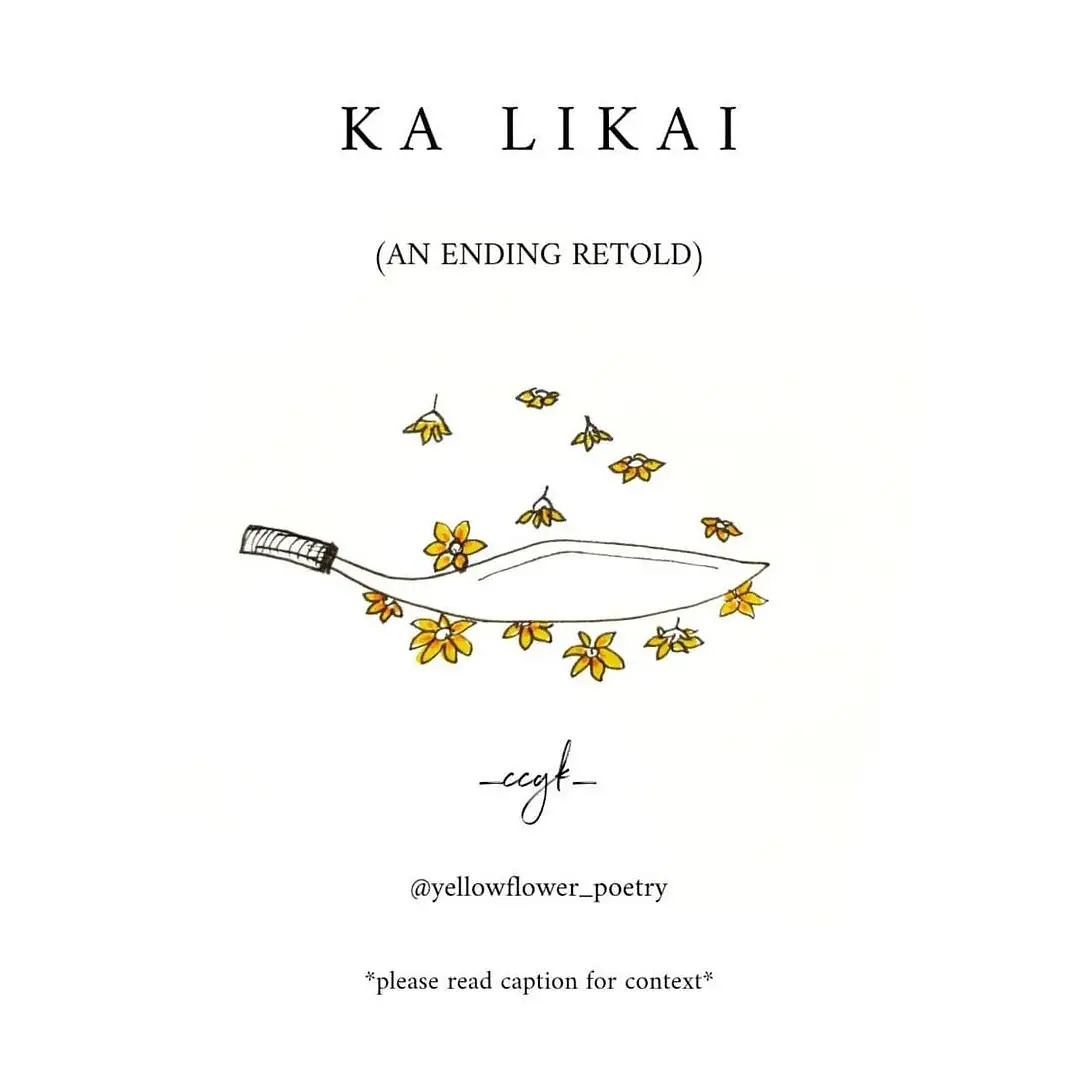
    Caption and original artwork by @yellowflower_poetry

  • Kynjat Tin

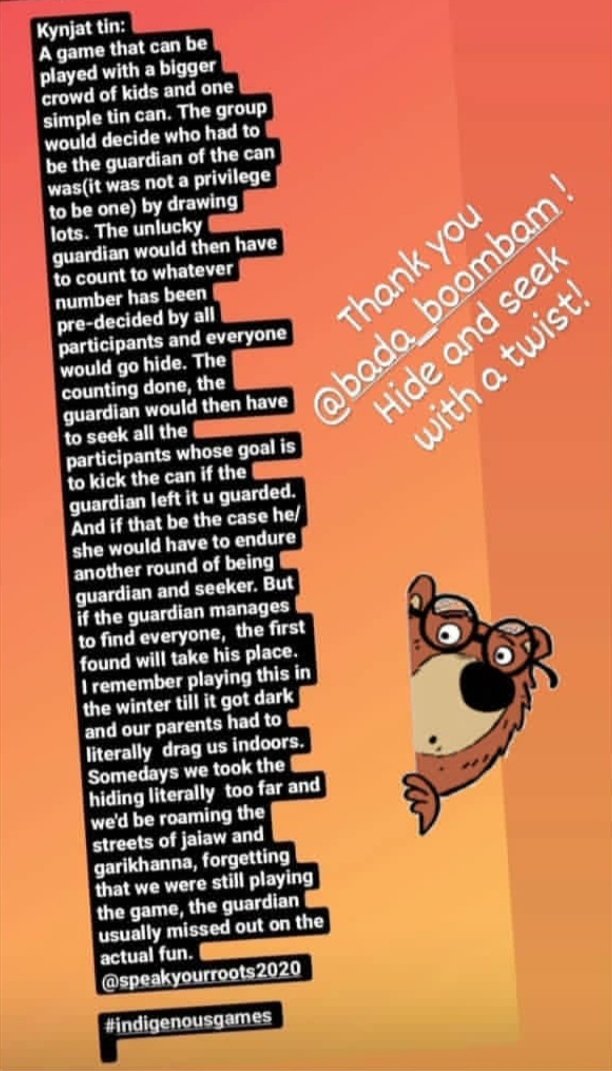
    A game that can be played with a bigger crowd of kids and one simple tin can. The group would decide who had to be the guardian of the can (it was not a privilege to be one) by drawing lots. The unlucky guardian would then have to count to whatever number has been pre-decided by all participants and everyone would go hide. The counting done, the guardian would then have to seek all the participants whose goal is to kick the can if the guardian left it unguarded. And if that be the case, he/she would have to endure another round of being guardian and seeker. But if the guardian manages to find everyone, the first one found will have to take his place. I remember playing this in the winter till it got dark and our parents had to literally drag us indoors. Some days we took the hiding literally too far and we would be roaming the streets of Jaiaw and Garikhana, forgetting that we were still playing the game, while the guardian usually missed out on the actual fun.

  • Thias!

    There are contesting stories as to the origin of this Khasi term, pronounced "Thi-yass”, beginning with a low "Thi" ending with a high "yass”. Taxi drivers swear it began with them. An expression of something good or perfect.

    For instance, if someone asks them "How were your earnings for the day?" If they earned well they would say "Thias!" Another version is that it is a popular term to describe a drunken state, like "Nga lah thias leh!" (I am high) or “To ngin ia thias noh!" ( Come let's get high now). The expression has come a long way now and is used in common day parlance to describe everything good, be it food, earnings, the weather or somebody's look!

    This entry is sent by Dr. Ellerine Diengdoh (Assistant Professor, English, St. Mary's College, Shillong). Thank you for sending this! 😂😂

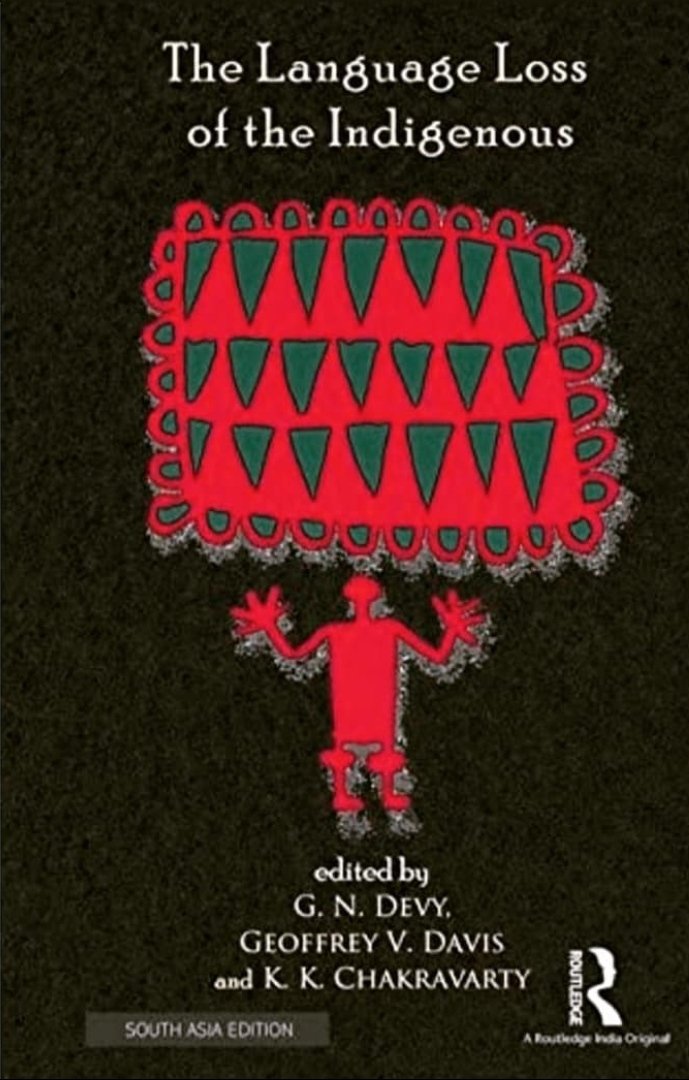
  • The Language Loss of the Indigenous, edited by G.N Devy, Geoffrey V. Davis and K. K Chakravarty

    This volume (published in 2016) traces the theme of the loss of language and culture in numerous postcolonial contexts. It establishes that the aphasia imposed on the indigenous is but a visible symptom of a deeper malaise – the mismatch between the symbiotic relation nurtured by the indigenous with their environment and the idea of development put before them as their future.

    The essays here show how the cultures and the imaginative expressions of indigenous communities all over the world are undergoing a phase of rapid depletion. They unravel the indifference of market forces to diversity and that of the states, unwilling to protect and safeguard these marginalised communities.

    This book will be useful to scholars and researchers of cultural and literary studies, linguistics, sociology and social anthropology, as well as tribal and indigenous studies.

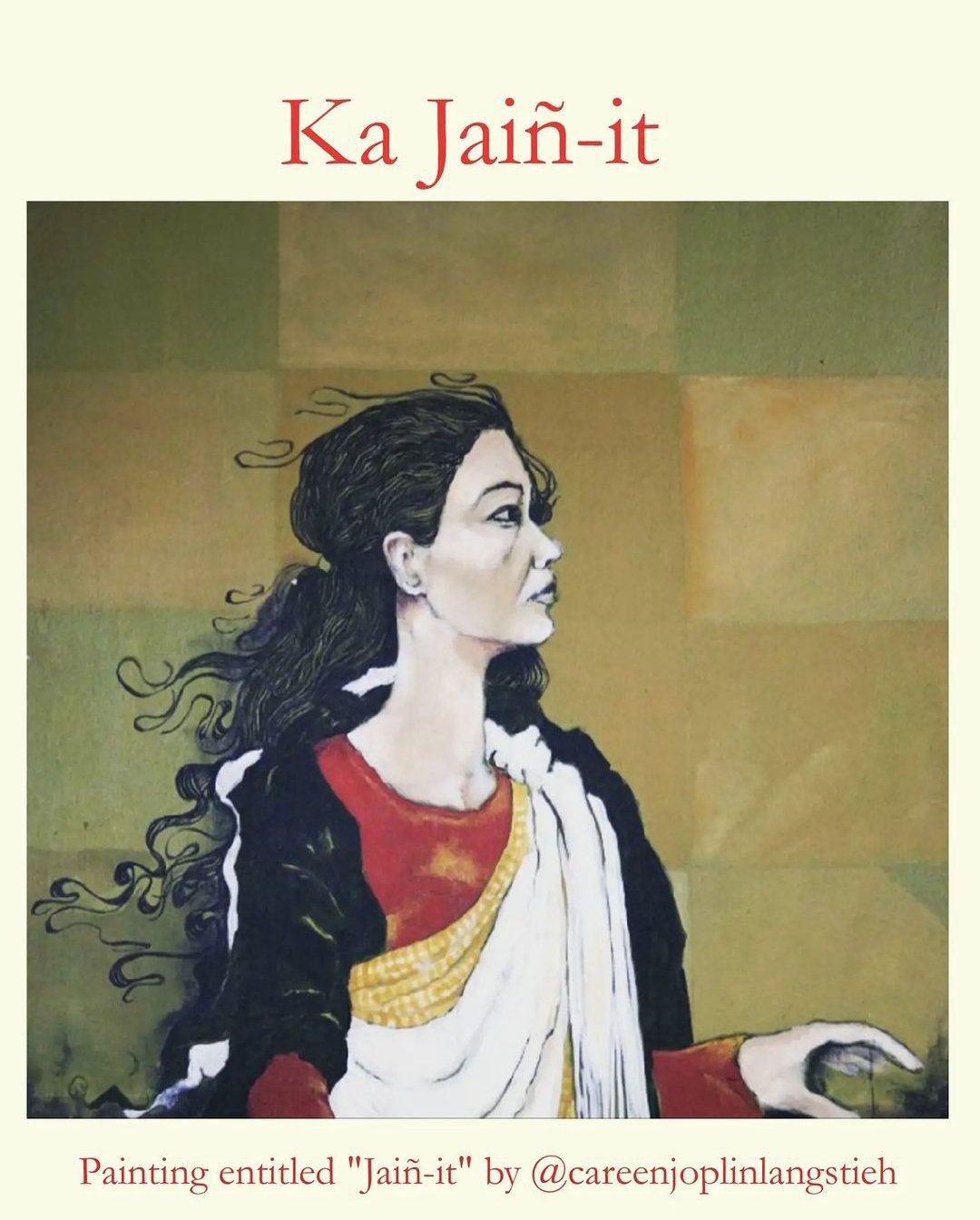
  • Ka Jaiñ-it by Careen J. Langstieh

    "Ka jaiñ-it" ka dei ka jaiñ bah ïa ki khyllung ne ki khun rit; ka dei ruh ka jaiñ kaba pynskhem haba bah ne kit.

    Ka jaiñ-it ka dei ka jaiñ ba pyndonkam da ki Khasi ha ka por ba ki bah ïa ki khunrit. Lah ban ong ba ka dei ka jaiñ ba jrong lynter ba la thaiñ na ki sai kynphad balieh bad don ruh ki jingthaiñ da ki ksai ba saw sha tduh jong ka jaiñ. Ha kylleng sawdong ka Ri Khasi bad Jaiñtia, ki longkmie ki ju pyndonkam da kane ka jaiñ ban kit ne bah ïa ki khyllung ne khunrit hadien met khnang ba kin lah ban trei ban ktah ruh ha kajuh ka por-lada dei hapoh ïing ne shabar, khlem da pynsepei ïa ka por.

    Ki kynthei Khasi ki dei kiba smat bad bunsien ngi ju ïohi ïa ki longkmie kiba bah khun da kaba pyndonkam ia ka "jaiñ-it" ha ka por ba ki trei ïa kano kano ka kam: lada dei ka kam shet, kam sait, kam khlieng ne haba ki leit sha la ki bri ban trei kam rep kam riang. Ka jaiñ-it ka dei ruh kaba ju ai sngewbha da ka Meikha ïa ki ksiew. Kane ka dustur ka dang im sah haduh ki por mynta ruh, tangba lehse ka jingpyndonkam ïa ka jaiñ-it ka lah kham duna ha ki thaiñ sor.

    Ïa ka jaiñ-it lah ban pyndonkam baroh shi snem lynter bad ka kham ïarap khamtam eh ha ki por tlang ha kaba i khyllung i ïohthiah ha syndah ka met jong ka kmie bad i ïoh ruh ka jingsyaid na ka met jong ka. Ki pyndonkam ruh sa da ka jaiñ-kup ha kaba ka kmie ka kup ïalade da katei ka jaiñ ban sop syaid ia i khyllung iba ka bah.

    "Ka jaiñ-it" is a traditional baby sling-wrap used by Khasis and Pnars which may be described as a long strip of cotton cloth made from big strands of white thread with red stripes at the ends. In the Khasi and Jaiñtia hills, mothers use this cloth to carry a baby on their backs, so as to be able to perform work in the house or outside.

    Khasi women are never idle sitters. We see mothers carrying babies securely and safely fastening them with the jaiñ-it while they go about their daily work, be it cooking, washing and sometimes tilling the field.

    The jaiñ it is traditionally gifted by the paternal grandmother to her grandchildren. This practise is still alive and well. However, the use of the jain-it is lessening in the urban areas. The jain-it can be used all year round and is particularly handy in the winter months when the baby is snugly fastened and then a "jaiñ-kup" (flannel shawl) is wrapped around the baby to keep it warm.

    Most of us have a picture of ourselves tied by a "jaiñ-it" on our mother's back when we were babies ☺️☺️

    Kudos to our mothers for being the symbolic "jaiñ-it" who bind our families together with their unconditional love 🧡🧡🧡

    Thank you Kong @careenjoplinlangstieh for allowing us to use your artwork! 🙏🙏