
"Ka dur te kum sahep, tangba ngin ïa bam da u sohmynken bep." 🤡🤡
Today, tomorrow and always we lay claim to and are proud of our indigenous lineage language history culture.
✊✊
"Ka dur te kum sahep, tangba ngin ïa bam da u sohmynken bep." 🤡🤡
Today, tomorrow and always we lay claim to and are proud of our indigenous lineage language history culture.
✊✊
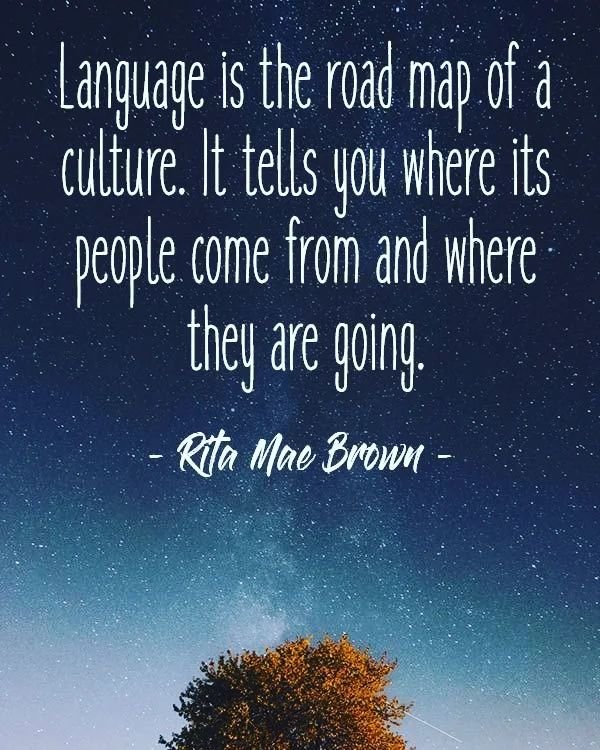
"Language is the road map of a culture. It tells you where its people come from and where they are going."
– Rita Mae Brown
Rita Mae Brown, born in 1944 is an American feminist writer, best known for her coming-of-age autobiographical novel, "Rubyfruit Jungle". Brown was active in a number of civil rights campaigns.
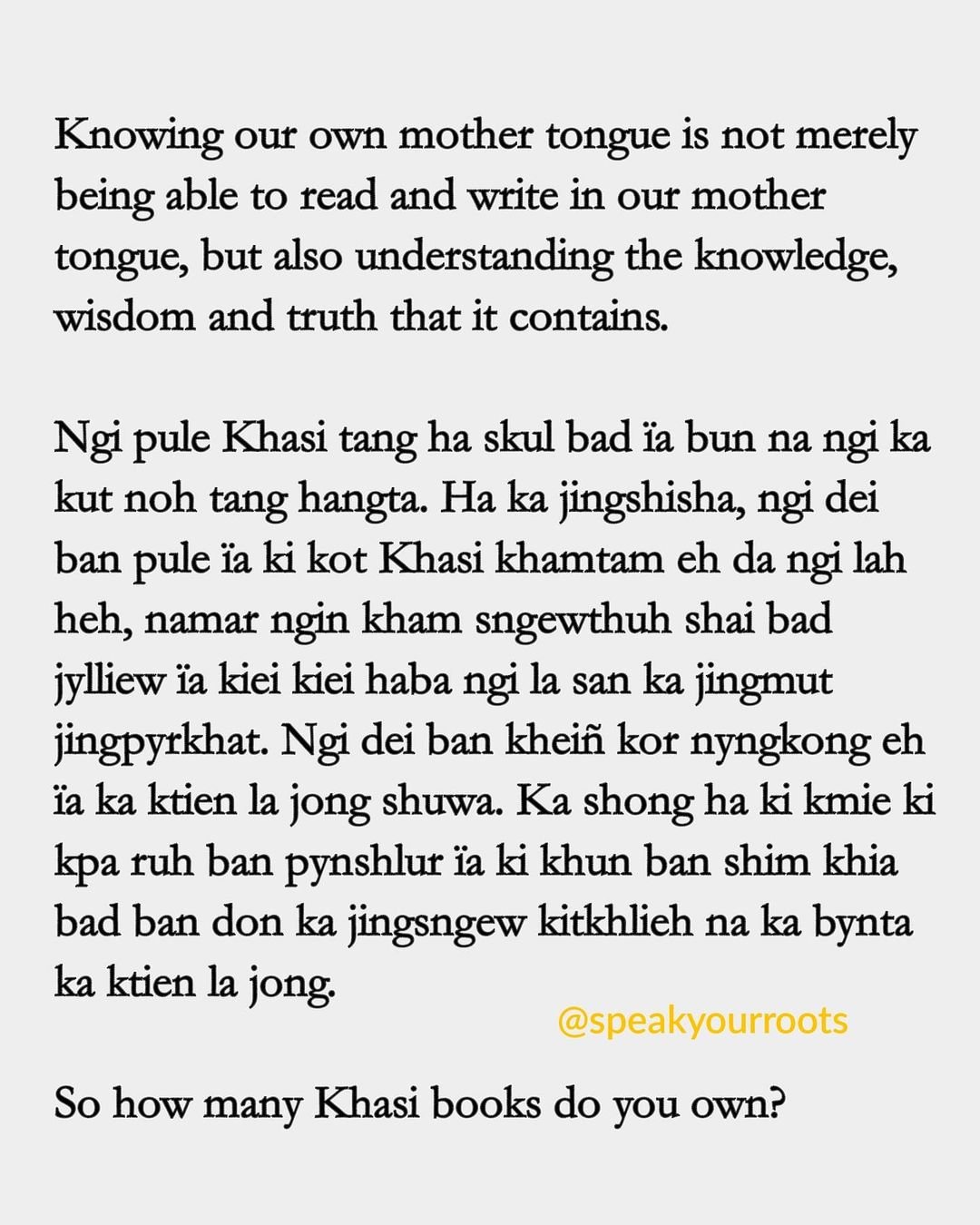
Knowing our own mother tongue is not merely being able to read and write in our mother tongue, but also understanding the knowledge, wisdom and truth that it contains.
Ngi pule Khasi tang ha skul bad ïa bun na ngi ka kut noh tang hangta. Ha ka jingshisha, ngi dei ban pule ïa ki kot Khasi khamtam eh da ngi lah heh, namar ngin kham sngewthuh shai bad jylliew ïa kiei kiei haba ngi la san ka jingmut jingpyrkhat. Ngi dei ban kheiñkor nyngkong eh ïa ka ktien la jong shuwa. Ka shong ha ki kmie ki kpa ruh ban pynshlur ïa ki khun ban shim khia bad ban don ka jingsngew kitkhlieh na ka bynta ka ktien la jong.
So how many Khasi books do you own?
Some food for thought…💭🗯️💬

Ka jingong "Kren amrang" ka batai ïa ka jinglong jong u ne ka briew, ha kaba ki saitlah rhing tang ban lah ka nia la jong. Kiba kren amrang ki pyneh ïa la ki jong ki nia khlem pynjem ïano ïano ruh bad ka jingïohi jong ki ïa kiei kiei ruh ki neh pyrkhing beit kum kaba ki mut. Ïa ka ktien "amrang" la ju pyndonkam ruh ha ka die ka thied ïa ki briew kiba pyneh ïa ka dor jong ki tiar ki tar.
"Kren amrang" is a Khasi phrase which describes a person who doggedly sticks to his argument; someone who has a rigid perception and who will not compromise to what others say. The word "amrang" also means being inflexible about the price of a commodity.
"Kren amrang" is a Khasi phrase which describes an unrelenting and unyielding outlook.
Ha sla pyrthei la kha ia nga,
Nga san longbriew, nga im pura;
Ryngkat jingieid i mei i pa,
Ha la ka ktien ba ngan kren bha.
Ym tang ban kren kumta la biang,
Hynrei ban thoh te ba ngan nang;
Kumta jingstad sawdong ka phriang,
A-B, ka jinghikai ka sdang.
Ka ktien khasi shisha ba iar,
Ha ri khynriam bad ha ri pnar;
'Sohra'- Ka ieng 'tien salonsar,
Ban ia biang lang, ban ym kulmar.
U Thomas Jones na ri sepngi,
U la wanlam dak thoh khasi;
ia jait bynriew ban lam lynti,
Ban ym sah dum bynriew khasi.
I'u la tip haduh kine ki sngi,
Kum u kpa ki dak thoh khasi:
Khlem don ma u ba prat lynti,
Ngi lah sah dum ha la ka ri.
Ki longshuwa da buit ba iar,
Lyngba jingeh ki khih ki ksar;
Ban roi ban iar ka thoh ka tar,
Ban ym sah bieit, sah dum jynjar.
Rai-eh Rai-dam, hei! ka bym kai,
Kam dei ka mutdur pyrkhat rngai;
Kat ban sawar ka ktien shongsbai,
La ha ka kren khana ne rwai.
Maitang! haram kam dei ho phi,
la longshuwa baieid jong ngi;
Burom shi junom bhor Ia ki,
Shikit-iapar kam long na ngi.
Kumne Ia la ka ktien ngin ieid,
Ngin kren ngin thoh te khlem jingriej;
Nangne pateng kan khih kan smiej,
Sha jngai kan phet ka dum ka bieit.
-Labianglang Diengdoh
Original poem: "Ka Ktien Khasi Jong Ngi" written by @_i_g_d_r_e_a_m_e_r_
Thank you for sending this entry! 🎉🎉
Speaking, reading and writing in our indigenous language may be described as a persistent and consistent act of resistance to forces that may endanger it.
"There are 600 potentially endangered languages in India…each dead language takes away a culture system".
In the interview, Ganesh Devy spoke about the dying and dead languages of India, how some languages gain popularity while others remain marginalised, and the impact of colonisation on the language system of India.
Written By Adrija Roychowdhury | New Delhi |
Updated: May 3, 2020 8:32:15 am
When renowned literary critic and activist Ganesh Narayan Devy set out to map the linguistic diversity of India, he had no inkling he would encounter languages that are barely known in the states in which they are spoken. Among his interesting discoveries were 200 words describing snow in the Himalayan region alone, an old form of Portuguese spoken in villages close to Mumbai, a form of Japanese spoken in parts of Gujarat, and a language from Myanmar that is popular in the islands of Andaman. Devy, who documented 780 Indian languages while conducting the People's Linguistic Survey of India in 2010, also, shockingly, found that 600 of these languages were dying. He added close to 250 languages in India had already died over the past 60 years. When a language dies, as Devy notes, “a unique way of looking at the world disappears". In an exclusive interview with Indianexpress.com, the critic spoke about the dying and the dead languages of India. In the interview, he also dwells on how some languages gain popularity while others remain marginalised, and the impact of colonisation on the language system of India.
According to UNESCO, any language that is spoken by less than 10,000 people is potentially endangered. In India, after the 1971 census, the government decided that any language spoken by less than 10,000 people need not be included in the official list of languages. In India, therefore, all the languages that are spoken by less than 10,000 people are treated by the state as not worthy of mention and treated by the UNESCO as potentially endangered. As per my survey, there are close to 780 languages in India, out of which about 600 are potentially endangered. The census of 1991 and 2001 show not more than 122 languages. So, most others have to be called potentially endangered.
Examples of such languages would be Wadari, Kolhati, Golla, Gisari. These are languages of nomadic people in Maharashtra, Karnataka and Telangana. Then there are several tribal languages as well, such as Pauri, Korku, Haldi, Mavchi. In Assam, there is Moran, Tangsa, Aiton. There seems to be about 250 languages that disappeared in the last 60 years. There used to be languages called Adhuni, Dichi, Ghallu, Helgo, Katagi. The Bo language in Andaman disappeared in 2010 and the Majhi language in Sikkim disappeared in 2015. But we need to remember that it is impossible to show a language dying in the last moment of its life. A language is not a single life system. It is a very large symbolic system. When the symbols collapse they do not do so in a single moment. The collapse is sprayed over a large time. When a language dies, its speakers decide to migrate. First, they migrate to another language and then they physically start migrating to another region. The second thing that happens is that their traditional livelihood patterns go down. They may have some special skills and that disappears. Thirdly, a unique way of looking at the world disappears. Every language is a unique worldview.
How do some languages gain popularity while others get marginalised?
There are a few major reasons for this. One is that some languages as against other alternate languages in the area gain popularity because of an easier syntax. For instance, in Hindi, you can say 'ladka chalta hain' and you can also say 'chalta hain ladka.' So the syntax is flexible. But it's not always that easy in English. This is one major reason but not the reason always. Secondly, the social dominance by any group leads to the language of that group becoming more popular in that society. For instance, Sanskrit became popular in ancient India because of social domination by speakers of Sanskrit. Or English has become popular because of colonial rule. Thirdly, when a language becomes useful in a marketplace, that language gains greater currency. For instance, we in India speak one language at home, maybe another in the office, but when we go to the market we might use neither. For example in Delhi, you might use Punjabi or Bengali at home, English in the office, but in the marketplace, one tends to use the Hindi language. So the patterns of political domination, use in the marketplace and ease of syntactic structuring are three reasons why some languages become more popular than other languages.
What is the impact of colonisation on Indian languages?
Quite surprisingly, in other continents, the colonial impact wiped out the native languages. In India that did not happen. Our languages survived. However, colonial times brought us print technology and only very few of our languages got printed. The one that got printed eventually got states to themselves since in India our states are designed in linguistic terms. The other languages did not get states for them, they did not get official recognition and therefore became secondary citizens in the language republic of India.
How is the language we speak related to our worldview?
In every manner without any exception, the language we learn or use is the absolute condition of our narrative of the world and the way we see the world. There is no escape from it. A given language only has a certain kind of ability to narrate the world and the consciousness can enter the world only to the extent that languages can allow it to enter the reality surrounding it. If a language has seven terms for distributing colours, then the speaker of the language will see the world only in those colours. But if there is another language which has more colour terms, then the distribution of the world is more multicoloured. For instance, in Marathi, there is a colour term called more multicoloured. For instance, in Marathi, there is a colour term called Kirmizi that cannot be translated into any English term at all. It is brownish, greenish, bluish, it's almost like the colour combination we see in a firefly. It is impossible to replicate that perception in the English language. But in the English language, we have navy blue or sky blue and many other languages might not have the exact colour term that translates the same. This is how language allows or disallows us in interpreting the world.
Ganesh N. Devy is an Indian literary critic and former professor. He is known for the People's Linguistic Survey of India and the Adivasi Academy created by him. He is credited to start the Bhaashaa Research and Publication Centre. He writes in three languages—Marathi, Gujarati and English. His first full length book in English "After Amnesia" (1992). He has written and edited close to ninety books in areas including Literary Criticism, Anthropology, Education, Linguistics and Philosophy.
This interview appeared in The Indian Express on 3rd May 2020 and is written by Adrija Roychowdhury.