Tag: khasiliteratureintranslation

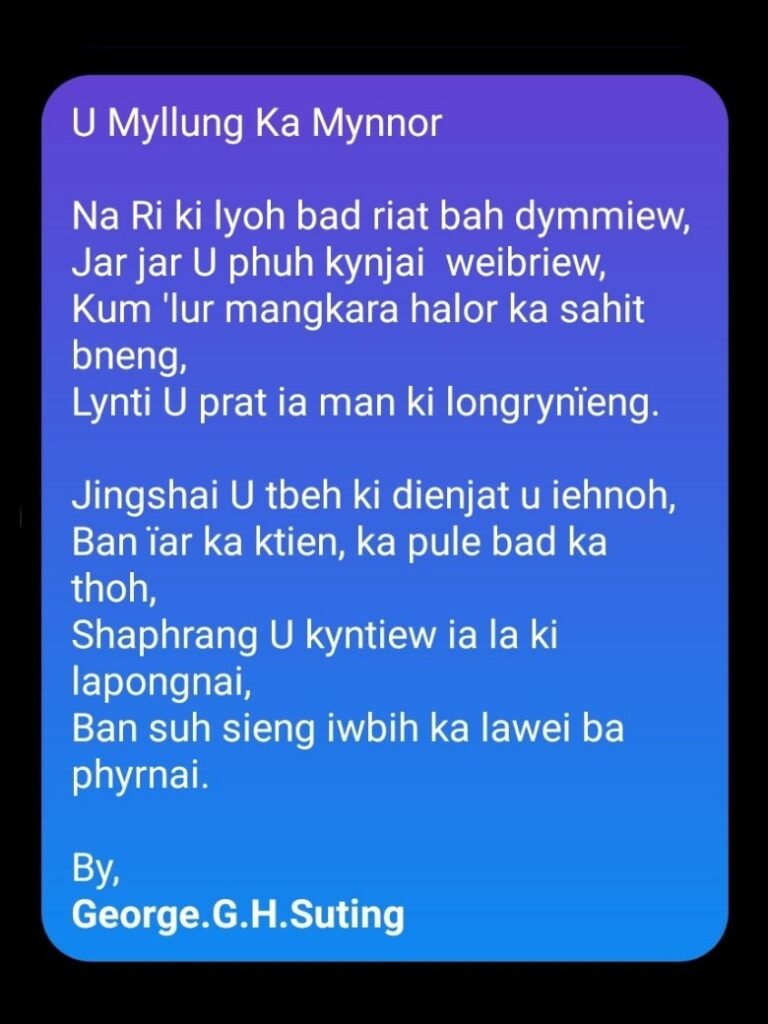
  • “U Myllung ka Mynnor” da i George H. Suting

    SOSO THAM WEEK 12th December – 18th December 2023

    "U Myllung Ka Mynnor" is an original Khasi poem by @george_suting11 Khublei Shibun ba phi la phah ïa kane ka poim! 😄🙏

    Wat lada ka kyrteng jong ka poim ka dei "U Myllung Ka Mynnor" ka jingshai jong ka jingim bad ka bor jong ki ktien kiba la thoh da u myllung Soso Tham ki dang ïeng bad trei ha ka jingim jong baroh kiba pule ïa u.

    The poem talks about Soso Tham as a a forger of a new path, whose impact is still strong and relevant and this is a sign of the power of his poetry.

    #sosotham #khasipoetlaureate #khasipoet #khasipoetry #khasiliterature #khasilanguage #khasilanguageconservation #indigenouslanguageconservation #speakyourroots #speakyourrootschallenge #talklocal

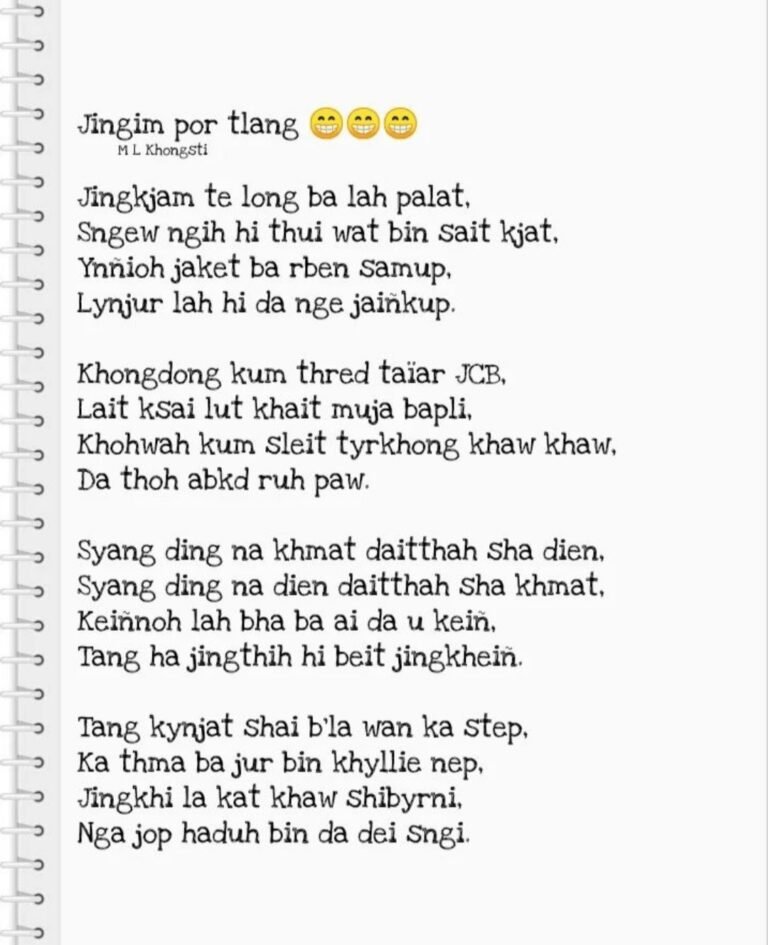
  • Jingim Por Tlang da i Mebatei L. Khongsit

    Jingim por tlang

    Jingkjam te long ba lah palat,

    Sngew ngih hi thui wat bin sait kjat,

    Ynñioh jaket ba rben samup,

    Lynjur lah hi da nge jaiñkup.

    Khongdong kum thred taïar JCB,

    Lait ksai lut khait muja bapli,

    Khohwah kum sleit tyrkhong khaw khaw,

    Da thoh abkd ruh paw.

    Syang ding na khmat daitthah sha dien,

    Syang ding na dien daitthah sha khmat,

    Keiñnoh lah bha ba ai da u keiñ,

    Tang ha jingthih hi beit jingkheiñ.

    Tang kynjat shai b'la wan ka step,

    Ka thma ba jur bin khyllie nep,

    Jingkhi la kat khaw shibyrni,

    Nga jop haduh bin da dei sngi.

    "Jingim Por Tlang" is an original Khasi poem written by @mebatei_l_khongsti 🥶🥶
    Khublei Shibun ba phah phi ïa nge ne nge jingthoh biria jong phi 😂😂 Nang sngew bang shuh ba thoh phi da ka ktien Laitlyngkot. Shisha sa tang nge jaiñkup hi bin syaid ka met ka phad! 🔥💯

    @mebatei_l_khongsti i ong: "Nga thoh ha ka dur ba biria da ka jingshem lajong bad nga ngeit ba baroh baroh hi ngi ïa shem kumne ha ka por tlang, khamtam kito kiba im sha ki shnong ba jur u thah kum sha shnong jong nga."

    Translation: "I wrote this poem in a funny way based on my own experience and I know most of us also experience the same things during the winter, especially those of us who stay in places where there is heavy frost like in my village."

  • Excerpt from the Introduction of “Ki Khanatang bad U Sier Lapalang” by Primrose Gatphoh (1937)

    U Primrose Gatphoh u ong:

    "Ki Puriskam, ki Purinam, ki Parom bad ki Khanatang ki don sawdong kane ka ri jong ngi, ha ki trep bad ki skum, sawdong ka lyngwiar dpei ba syaid bad ba rhem jong u khun Khasi Pnar baroh. Hynrei ka long kaba eh shibun ban lum ban lang, bad ban tai ban peh bha ïa ki shuwa ban pynsah ïa ki ha ka thoh ka tar kum ki mar kynti ka ri.

    Kam long ka kam kaba suk ban lum na kaba shu ïohsngew ka shkor, bad kaba shu kem na ka hamsaïan shaphang kiei kiei kiba ngi ju ïohsngew bad ïa kren barabor hapdeng jong ngi, kum ïa ki khlawait, ki thma, ki kut, ki kharai bad ka jingngeit ki briew ïa ki ryngkew ki basa kiba don sawdong ki lum bad ki wah jong ngi…

    Ngim lah ban ieit ïa la ka ri khlem da tip ïa ki Khanatang ki longshuwa jong ngi. Ban bud dien bad ban wad ïa ka kpait ka rukom pyrkhat hyndai, ka long ka jingsdang kaba shi kyrdan sha ka jingieit ri kaba shisha. La ki nongthoh bad ki nongïathuh ki ïapher, hynrei ki thymmei bad ki jingthmu na kiba ki la mih ki long kijuh."

    "Fairytales, fables, folktales and myths are all around our hills, in huts and homes, around the warm and fiery hearth of Khasi and Pnar families. But it is arduous to collect, to select, to sift and sieve through these stories before they are preserved in the written form as valuable heritage. It is not an easy job to gather from what is heard by the ears, and to grasp from unclear accounts that are heard from here and there, about what we usually hear and talk about among ourselves, about brave warriors, warfare and the belief in forest guardians who are present in our hills and rivers…

    We cannot love our community without knowing the myths and folktales of our ancestors. To follow and to search for the tracks of the old ways of thinking, is to begin at the first step towards a true and real love for community. Even though writers and story tellers are different, but the source and the aspirations from which they arise are the same."

    Bunsien ngim ju kham pule ïa ki "Shi Kyntien" jong ki nongthoh kaba ki ai ha kaba sdang jong ki kot jong ki. Kane ka dei na ka kot jong u Primrose Gatphoh. ✒️📖 Ki dei ki ktien kiba ai jingtip, jinghikai bad ki pynsngew ruh ïa ka jingsngew kitkhlieh na ka bynta ka ri la jong. 🏞️🌧️

    Often we do not read the introductions or the forewords given by writers at the beginning of their books. This introduction is from the book of Primrose Gatphoh. ✒️📖 These are words which give knowledge and teaching. They also reflect a sense of responsibility for the community 🌧️🏞️

    🟡 English translation by @speakyourroots

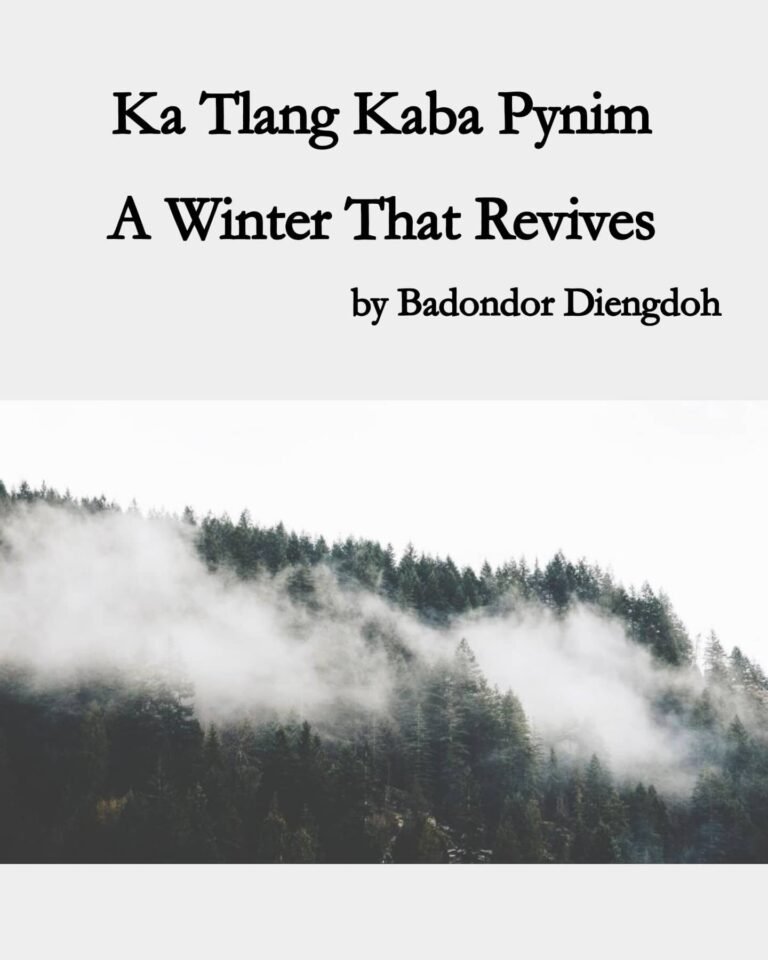
  • Ka Tlang Kaba Pynim (A Winter That Revives) by Badondor Diengdoh

    U briew, u symbai, u jingthung,

    da u lah tynneng palat,

    u jynrat hi naduh tyllong

    dalade ïalade.

    Nga ïohi ia u lyoh khyndew

    u ba ju ïai wan sop ïa ka

    longrynïeng jong nga

    bad man ba u leit phai pat,

    u shim noh shi dkhotmet

    na ka syrngiew jong nga.

    Haba ka tlang ka la sdang ban

    wan siaw na sha lyndet ki kynroh,

    da kaba sem artat da ki lai rong

    jong u sohmynken khnai-

    Hangta keiñ ngan sa ïohi

    biang ïa ka dur

    briew jong ki sur bad ki khana

    kiba ju ïai ksaid ban im,

    ynda ki mih biang pat

    na ka met jong ki

    'riewhyndai kum ka jynhaw.

    Haba u 'sai ka duitara u

    sdang ban slor-

    hato ngi bujli bad kylliang ïa u

    da ki sur nongwei?

    -Badondor Diengdoh

    A man, a seed, a plant,

    in desperation to ape others,

    uproots his own self from

    the source.

    I watch the mist

    who always arrives to cloak

    my being,

    and every time it departs

    it carries away a part of my body

    from my shadow.

    When winter starts to whistle

    from beyond the walls

    dressed in the

    three colours of u sohmynken khnai

    It is there that I see once again

    the human face

    of songs and stories

    who struggle to remain alive,

    when they rise from

    the body of ancestors like vapour.

    When the thread of the duitara

    begins to wither-

    do we change and replace it

    with foreign songs?

    -translated by Daiarisa Rumnong

    "Ka Tlang Kaba Pynim ("A Winter That Revives") is an original Khasi poem by Badondor Diengdoh.

    When winter arrives will we understand the change it brings? Will we return to what rooted us since the beginning? The poem is an evocative response emerging from a depth of experience. Khublei Shibun for sending your poem!

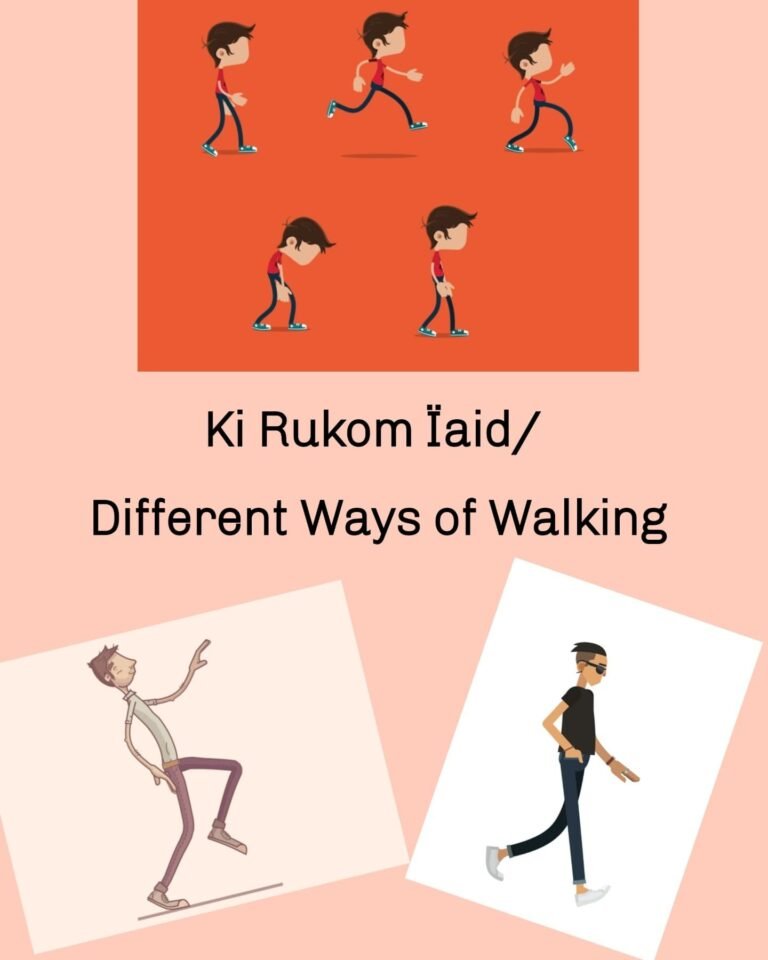
  • Ki Rukom Ïaid /Different Ways of Walking

    Ïaid-khning-khning ka dei haba ïaid kynjing lem bad ki khohwah kiba rit i kum ban kheiñ noh/ to walk tip toe with legs that are so thin they look like they will break.

    Ïaid-khrup-khrup ka dei kaba ïaid kyrdem da ki juti halor ka madan/ to walk with thumping stomps.

    Ïaid-kjik-kjik ka dei haba ïaid ba pynsting ïa ka met, i kumba ym i kwah pyndei khyndew ïa la ki kjat / to walk while trying to lighten the weight of the body, appearing not to want the feet to touch the ground.

    Ïaid kniah-kniah ka dei haba ïaid bhabriew, i kumba ym i kwah ïakren briew shuh/ the walk of someone who feels so beautiful or handsome that they don't seem to want to talk to anyone anymore.

    Ïaid-knip-knip ka dei haba ïaid dkoh i kumba shon maw rit iba nep ha ki pohjat/ to walk with a limp as if there is a small stone poking the foot.

    Ïaid rynthew ka dei haba ïaid khlem da klum ne syndong ïa la ki jaiñ kiba noh/ to walk carelessly without gathering one's clothes around one's body.

    Ïaid shutïew ka dei haba ïaid suki than eh bad ïaid khlem rah ki kjat / to walk in an extremely slow manner without lifting the feet.

    Ïaid pawang ka dei haba ïaid kyreit bad pawang la ki kti haba ïaid, i kumba ym suitñiew briew/ to walk pompously not seeming to be bothered about other people.

    Here's a collection of different kinds of walks 🚶🏃🕺💃😂😂 There are still so many more but these are all we can "walk" with right now..phew! 😅

    Phi mynjur ne em ba tang na ka rukom ïaid lah ithuh ïa ki jinglong jong ngi? Can others guess how we are just by the way we walk? 😄🤔

    🟡 Source: Rev. Dr. Ïarington Kharkongor

    🟡 English translation by @speakyourroots

  • Jngai na pyrthei da i Bhu Ianz

    JNGAI NA PYRTHEI KHLEM JINGKHUSLAI – NGAN SUH BEIT

    WIAW SHABA NGEN U BNAI

    KHLEM ARTATIEN NE JINGPYRWA – LA STANG NE RBEN KA PLA

    BAN LAIT NA JINGTYRHA MYNSIEM – HA PNEH RAM-EW AI

    NGAN SUHSIENG

    KHOP KHOP HA LA JINGLONG SHI SUR – NGAI LYNGNGAI HA

    JINGMUTDUR

    NGAN KLET LUT KHOIT IA SPAH BAD PHEW – TANG

    JINGKYNMAW BA NGAN KYNSHEW

    JNGAI NA BAROH RUH NGAM SNGEWPHER – JINGDIAW NGAN

    PIAM HA LA KI SNER

    LAIT TANG JINGMUT HA SUIÑ BAN PER – SET SLUNG LADE

    SHA KI HAJAR MER

    "Jngai na pyrthei" an original Khasi poem by @bhu_ianz ✒️📃 Thank you for the poem! 🙏

    The poem expresses a brave yearning for an escape and a freedom from the human world ☀️🌙💫

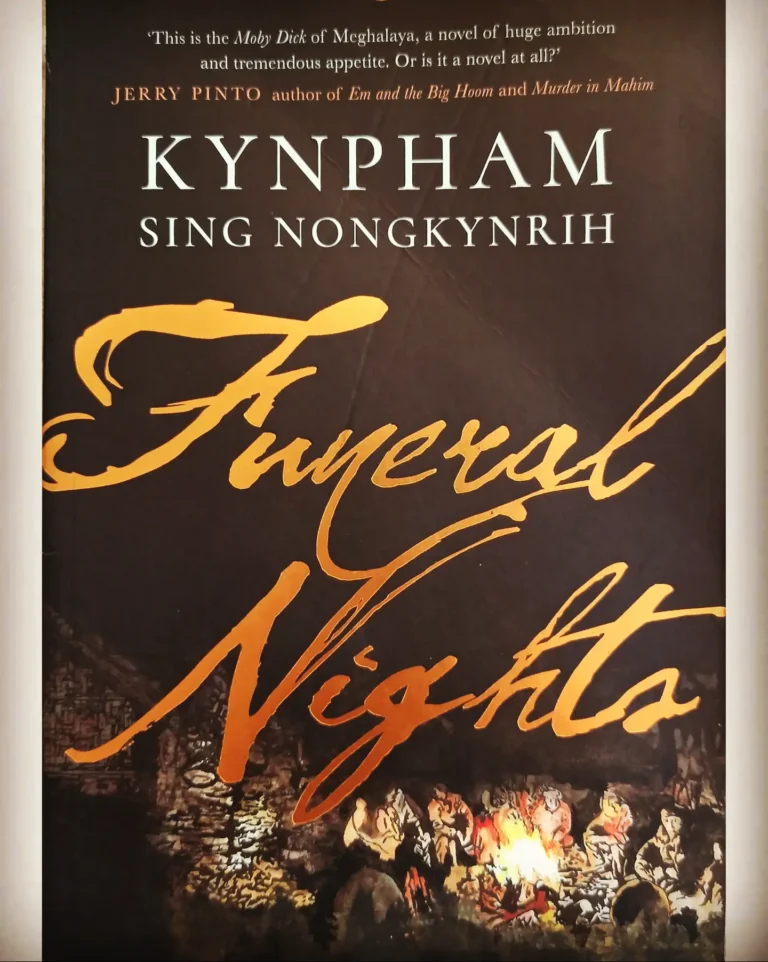
  • “Funeral Nights” by Kynpham Sing Nongkynrih

    Funeral Nights by Kynpham Sing Nongkynrih has been receiving wonderful reviews by writers as well as readers 😀😀

    The book is based on "Ka Phor Sorat" which is a funeral ceremony which was performed in the village of Nongshyrkon. We are so excited to read this book! It is available on amazon.in

    Dr. Kynpham Sing Nongkynrih is currently a Professor in the Department of English, North-Eastern Hill University, Shillong.

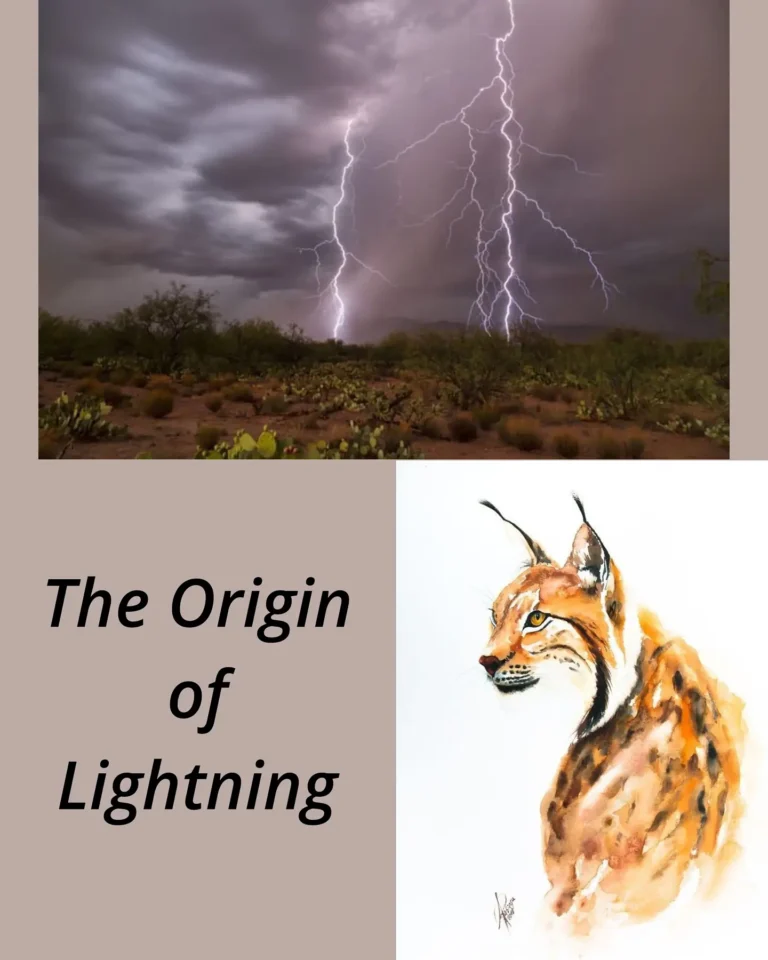
  • The Origin of Lightning

    Mynhyndai eh, mynba ki sim-ki-doh, ki khniang ki puit, ki mrad ki mreng baroh ki dang ïakren bad ïasngewthuh kawei ka ktien, la don ka hima-bah jong u laiphew mrad laiphew mreng baroh. Baroh ki ïashong ïa-im ha ka suk ka saiñ, ka jingïaieid ïabha bad ki ïaleit ïawan ruh ryngkat. Kim tip kata ka ïashun ïapen, ka ïakajia majia, ka ïadait ka ïapyniap para ki hi.

    Ha kawei ka sngi, u Shakyllia, u Diengkhied bad u Risang haba ki dang ïa ïaid knmih shnong khmih thaw, ki wan poi hajan kawei ka lympung, ha kaba u khun bynriew u ïashad ïamastieh shisien shisnem. Kine baroh lai ki la sngew shohmynsiem ïa kata ka leh u bynriew bad ki la ïapyrkhat ba kan long kaba sngewbha bad itynnat lada kin lah ban pynlong kum kata hapdeng u laiphew mrad baroh. Kumta haba ki la leit phai, u Diengkhied bad la ka shaw-shaw, u Shakyllia bad la ka tangmuri, u Risang bad la ka ksing, ki la ïaput ïatem haduh ba la sawa ka khlaw baroh kawei.

    Kane ka tem ka put basngewtynnad, ka la pynkhih ïa u laiphew mrad baroh ban wan ïapeit bad ïasngapkai. Katto katne na ki, ki la ïaong ba haba ki la don ki nongput nongtem kiba kum kita, balei ba kim lah ban pynlong sa ka shad ka kmen, kumba leh lem u bynriew?

    Kumta ki la ïabuh ïa uwei uba kham-nang kham tip ka talat kam shane shatai, bad uba kham tbit ruh ha ki kam sngewbha. Une u long u Pyrthat. Ma u pat, ban leit pyntip ïa ka hima sima baroh kawei ban long kum kata ka phur ka siang, u la shna kawei ka nakra kaba lah ban ïohsngew shaduh jngai bah, bad u la tied da kata kyndung shi kyndung bad step bad sngi. Ynda kata ka ïa ka la poi, u laiphew mrad phew mreng baroh u la ïawan poi ha ka lympung kaba la khreh lypa hangta ha khlaw. Baroh ki la ïa riam ïa beit da ki kup-ki-sem tyngkai, ki ïarkhie bad iphuhmat.

    Ka Shrieh ka la pynsad pynkhyllong bha ïa la ki khun bad ka la rkhie phuhmut phuhmat haduh ba ka dam sa ka khmut ka khmat. U Sñiang ruh u la sum la sleh jriang bad u la ïaid wiat-samrkhie haduh ba la ang shynded sa ka khmut, kum ka shata. Ka Dkhoh ka la sad la khyllong bha, bad ka la nap tang ka peit ït haduh ban da plaid ki irmat bad byrie. Bad u Dkhan pat uba la rkhie ïap-ang ïap-ler ïa ka, u la dam la rit sa ki khmat. U 'Labasa bad u 'La-thapsim, ki la sei da ki khor ki khriam bad ki la kup la deng baroh shirynïeng.

    Te, haba la sdang ka put ka tem, ka ksing, ka tangmuri, ka lympung ka la shit ir. Ka kmen ka risa kum kata ym pat ju don. Ha kata ka por la wan pol u Kui, u phong u kup da ka khor ka khriam khyrwang, kaba phyrnai na khlieh ha kjat bad u la rah ruh la ka waitlam rupa kaba u la phah shna khnang na ka bynta ka shad ka kmen. Tang shu poi tiap ha lympung, u mastieh ir, u pynshad wait sha kadiang bad sha kamon haduh ba u paid peitkai u la shoh biej thiaw bad u ïarisa shaw shi shaw. U Kui pat u la sngewsarong sngewmeng haduh bym lah ong shuh.

    Haba la shong thait u Kui, u Pyrthat u la ïapankai ïa ka wait jong u ba un khalai kai shipor. U Kui u la sngewbynnud ban ai, ïoh u Pyrthat un shad kham bha ban ïa u bad ïoh baroh kin ïaroh. Kumta u la kren da rapjot da kumne kumtai, hynrei um banse ban ai, haba baroh baroh ki ban ia u ba u dei ban ai, namar ka jingheh jingkhraw jong kata ka shad ka kmen ka long na ka jingtrei shitom jong u Pyrthat. Te u Pyrthat, u tang shu ïoh ïa kata ka wait, u king-u-mastieh, haduh ba la i biria hi khait. Baroh ki la ïarisa bad ïaroh ia u.

    Hynrei hapdeng kata ka jingïarisa, u Pyrthat u tied u talaiñ shane shatai ïa kata ka wait haduh ba u laiphew mrad baroh bad baheh bad barit u la sheptieng ym don pyrthei shuh bad u ïaphet sakma. Hapdeng kane ka jingkulmar, u Pyrthat, u kiew de soit sha sahit bneng, u rah jyndat bad ksing bad wait. U Kui u la sngewsih shibun ba u la duh noh ïa la ka wait, bad u ïai pyrshang ban ïoh kiew sha sahit ban ïoh knieh biang na u Pyrthat uba la shukor ïa u.

    Naduh kata, sa mih ka jingïashun ïabitar hapdeng u laiphew mrad baroh.

    In the early days of the world, when the animals fraternised with mankind, they tried to emulate the manners and customs of men, and they spoke their language. Mankind held a great festival every thirteen moons, where the strongest men and the handsomest youths danced “sword dances” and contested in archery and other noble games, such as befitted their race and their tribe as men of the Hills and the Forests—the oldest and the noblest of all the tribes.

    The animals used to attend these festivals and enjoyed watching the games and the dances. Some of the younger and more enterprising among them even clamoured for a similar carnival for the animals, to which, after a time, the elders agreed; so it was decided that the animals should appoint a day to hold a great feast.

    After a period of practising dances and learning games, U Pyrthat, the thunder giant, was sent out with his big drum to summon all the world to the festival. The drum of U Pyrthat was the biggest and the loudest of all drums, and could be heard from the most remote corner of the forest; consequently a very large multitude came together, such as had never before been seen at any festival.

    The animals were all very smartly arrayed, each one after his or her own taste and fashion, and each one carrying some weapon of warfare or a musical instrument, according to the part he intended to play in the festival. There was much amusement when the squirrel came up, beating on a little drum as he marched; in his wake came the little bird Shakyllia, playing on a flute, followed by the porcupine marching to the rhythm of a pair of small cymbals.

    When the merriment was at its height U Kui, the lynx, arrived on the scene, displaying a very handsome silver sword which he had procured at great expense to make a show at the festival. When he began to dance and to brandish the silver sword, everybody applauded. He really danced very gracefully, but so much approbation turned his head, and he became very uplifted, and began to think himself better than all his neighbours. Just then U Pyrthat, the thunder giant, happened to look round, and he saw the performance of the lynx and admired the beauty of the silver sword, and he asked to have the handling of it for a short time, as a favour, saying that he would like to dance a little, but had brought no instrument except his big drum. This was not at all to U Kui's liking, for he did not want any one but himself to handle his fine weapon; but all the animals began to shout as if with one voice, saying “Shame!” for showing such discourtesy to a guest, and especially to the guest by whose kindly offices the assembly had been summoned together; so U Kui was driven to yield up his silver sword.

    As soon as U Pyrthat got possession of the sword he began to wield it with such rapidity and force that it flashed like leaping flame, till all eyes were dazzled almost to blindness, and at the same time he started to beat on his big drum with such violence that the earth shook and trembled and the animals fled in terror to hide in the jungle. During the confusion U Pyrthat leaped to the sky, taking the lynx’s silver sword with him. U Kui was very disconsolate, and has never grown reconciled to his loss. It is said of him that he has never wandered far from home since then, in order to live near a mound he is trying to raise, which he hopes will one day reach the sky. He hopes to climb to the top of it, to overtake the giant U Pyrthat, and to seize once more his silver sword.

    The Khasi folktale about the origin of lightning has for its protagonists the animals of the forest participating in a dance that would change their lives. The Khasi and English versions that have been used here have been abridged from Ki Khanatang u Barim by H. Elias, S.D.B and Folktales of the Khasis by Mrs. Rafy.

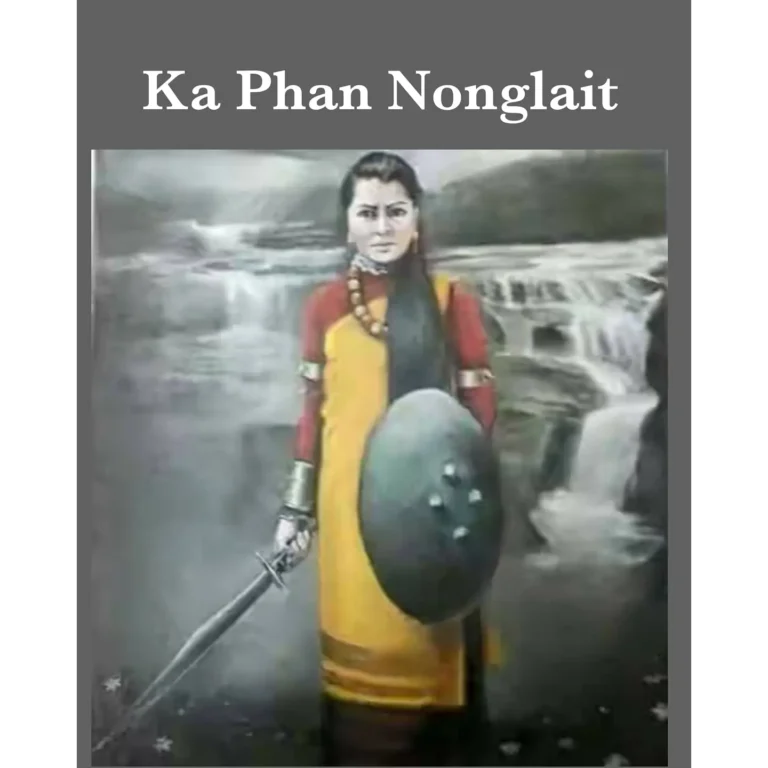
  • Ka Phan Nonglait by Tony Slong

    Ka Phan Nonglait is one of the Khasi women freedom fighters and is considered one of the bravest women of that time. Most women were either raped, molested or ill-treated by the British soldiers. This made Ka Phan Nonglait and some women from Hima Khatsawphra to take matters into their own hands with the help of Mon Bhut. With his help Ka Phan Nonglait was able to trap the British soldiers by offering them alcohol. When they were inebriated, she took all the weapons of the soldiers and threw them into one of the rock holes in the Nongrmai falls (now known as Phan Nonglait Falls). Due to this act, she is remembered in the stories that have been retold for generations. Then U Mon Bhut along with other soldiers killed 32 British soldiers. This was in the year 1829.

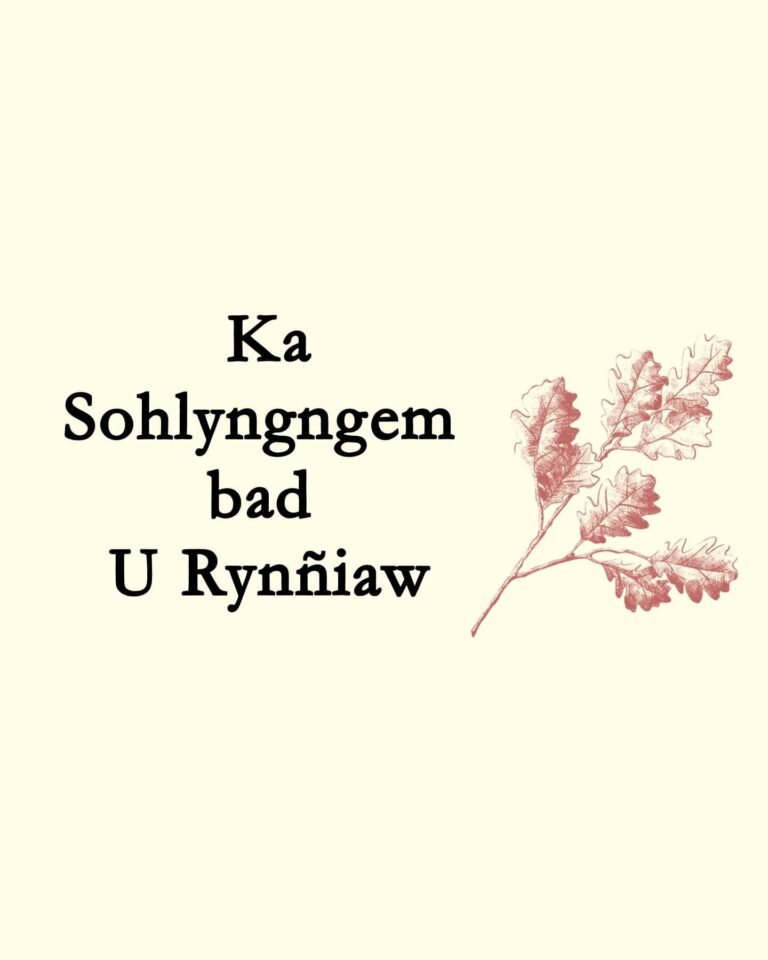
    In Ka Jait Nonglait: Ka Thymmei bad ki Dienjat written by T. Daniel Stone Lyngdoh Nonglait, the historical contexts of the Nonglait Clan has been given. Since ours is a society that relies on oral narratives, I have heard of the valour and bravery of ka Phan Nonglait. It has intrigued me to do further research upon this narrative. Yet, there is more to be unearthed. From the British perspective, the only record made was on U Mon Bhut who fought gallantly against the British. He was U Tirot Sing's most trusted general. The records about the Nongkhlaw incident were said to be the first spark that led to the war of the Khasis against the British. Among those killed, two British officers named Lieutenant Bedingfeld and Lieutenant Burlton were killed. In a letter to Lamb by David Scott, dated 10th April 1829, he mentioned that this fateful incident happened either on the 4th or 5th of April, 1829. This incident shook the Britishers and was recorded in the memoir of the Late David Scott, esq.

    On this Independence Day we remember Ka Phan Nonglait as the first Khasi woman freedom fighter. The achievements of Khasi women who fought against the British are often not recorded by history. Ka Phan Nonglait is remembered as one of those freedom fighters who have made a mark on Khasi history.

    This entry has been contributed by @carey_lynz Thank you so much! 🙏🙏 Our gratitude also goes to @tonyslong 😃🙏

    🟡 Picture 1: Painting of Ka Phan Nonglait by @tonyslong

    🟡 Picture 2: http://wikimapia.org/21065891/Phan-Nonglait-Falls-Nongrmai

    🟡 Picture 3: Ka Jait Lyngdoh Nonglait: Ka Thymmei bad ki Dienjat written by T. Daniel Stone Lyndoh Nonglait.

    🟡 Picture 4: A Memoir of the Late David Scott, Esq. written by Major Adam White (1831, 1st edition)

  • Ki Ktien Kynnoh

    Ki Ktien Kynnoh are a pair of words which complement one another. The second word emphasises and enhances the meaning of the first word. Ki Ktien Kynnoh may be described as Akin words. There is a catchy rhythm to the pair too as they contain the same number of syllables, which makes saying them fun and more importantly gives depth and meaning to a sentence. The following ktien kynnoh are taken from The Khasi Encyclopedic Dictionary: Ka Dienshonhi by Rev. Dr. Ïarington Kharkongor. They have been translated by @speakyourroots.

    Danda – Phulit

    Danda: Ka mut ka jingkren ne jingïathuh ïa kiei kiei ki bym shisha da kaba pyndonkam ïa ki ktien ne ki khana nangno nangno bad sa pynkut ha kata ka rukom tang ban ïoh ban pynsngewbha ïa ki briew.

    Phulit: Ka thew ïa ka rukom kren biria kai te hynrei don ki biria kiba ïa jinghikai bad jingmyntoi.

    Danda is a conversation or the telling of a story that is not based on real fact, but is taken from many sources, with the purpose of making people laugh at the end.

    Phulit is a particular way of talking humourously with a lesson at the end of the story.

    Ngiah – Shoin

    Ngiah: Ka dei ka ktien kyllum kaba mut ba la dap ne pura bha lane bym sngewtynnat shuh ïa kiei kiei.

    Shoin: Ka kham thew ïa ka jingbam kaba la bam bad la dap pura haduh ryndang ne rmiang shyntur bym long shuh ban pynrung jingbam. Ïa ka jingbam haba dang ngiah dang long ban bam hynrei haba la dap shoin ym long shuh ban bam. Haba ngi ong pat 'ngiah shoin' ka mut kaba la palat ban ïa kaba ju long.

    Ngiah is a feeling of fullness and satiation or having had enough of something, which might also cause unpleasantness.

    Shoin is more of a reference to food that cannot be eaten anymore. In the case of 'ngiah' food can still be eaten but when we use the word 'shoin', it means there is no chance of being able to eat.

    Maitang – Maitait

    Maitang: Ka mut ba kyndiah ne ieh noh shisyndon khamtam ïa ka jingmlien kaba sniew.

    Matait: Ka mut ka jingkular ne jingsmai ban iehnoh ne kyntait shi syndon ïa kaei kaei ka bym ïadei bad ka jingim longbriew manbriew.

    Maitang is to abstain from or completely leave something, especially a bad habit.

    Maitait is a promise or oath to avoid or reject that which hampers or damages the balance of our physical, emotional and mental well-being.

    "Ki Ktien Kynnoh" lend so much quality and character to the Khasi language! They are really quite a unique feature of the language. 😃😃 We have tried to find the English word for them but it appears there is none. "Akin words" seems to describe them best.