Tag: speakyourroots

  • Some Pnar Phrases

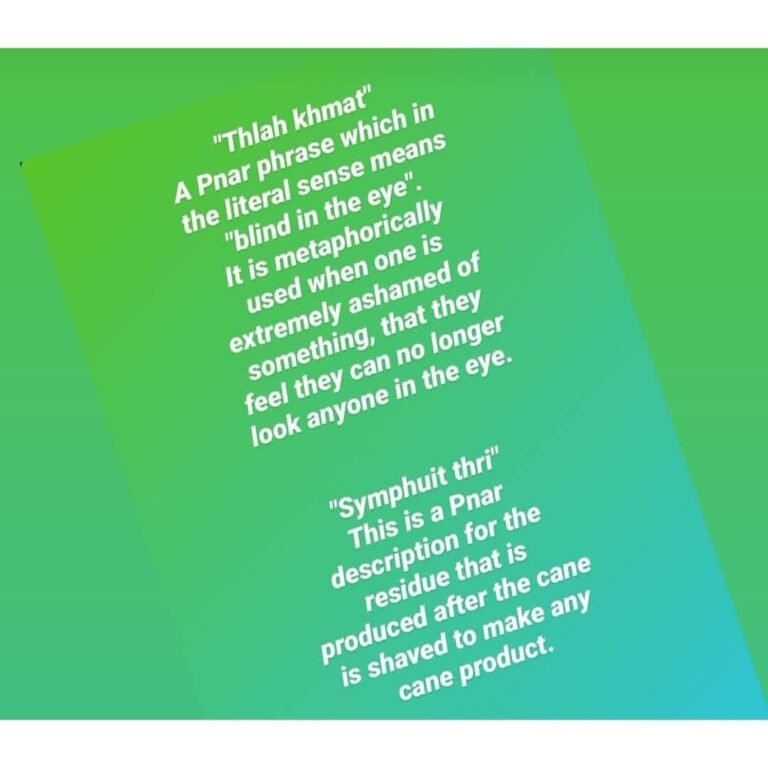
    Pnar phrases

    "Ka buit ïyrngam"

    "Ka buit ïyrngam" is a cunning idea that a person thinks of.

    "I kam wasmet"

    "I kam wasmet" is a good cause that will help and benefit people and bring a promising future.

    "Sing chylliah"

    "Siang chylliah" is to breathe one's last breath.

    The books of (L) Mrs. P. P. Pasleiñ are a precious find! 😃 Here are some Pnar phrases from her book The Depth of Thwai Syiem (2001) 🍃🌱

  • U sohmarit im

    What we call "u sohmarit im" in Khasi or green peppercorns are a spicy addition to our "ja bad jyntah" (rice and curry). The aromatic crunch is a great "sidekick" (pun intended 😄😂) for lunch or dinner! The bunch in the picture is almost finished! 😋

  • U Duma Kyllaiñ

    "U Duma Kyllaiñ" or rolled tobacco which is the Khasi rolled cigarette can still be seen in use. 😄😄 This picture was taken by @kronosynchronicity in Nongstoiñ.

    Khublei Shibun @kronosynchronicity for sending this! 🙏🙏

  • “Lai rukloo-rukloo” from the Tuber dialect

    "Lai rukloo rukloo" from the Tuber dialect sent by Ribait Phawa

    Kawei ka kyntien nga kwah ban bynrap ha kaba ki ju kren ha ki por mynshwa bad ïa mynta tang ki riewtymmen ki kham pyndonkam ïa kane ka kyntien ha ka dialect Tuber.

    "Lai rukloo-rukloo" ka mut ban leit kloi-kloi sha ka kam ba lah phah, la haka leit shim ki tum ki tam ne ban leit thied jingthied. Ne kino kino ki jingphah kiba kham san ki phah da ka jingkyrkieh.

    "Lai rukloo-rukloo" is a phrase in the Tuber dialect that was used before and which is now used mostly by the elderly.

    The phrase means to do a task with a sense of hurry and urgency, whether if it is to take something or to buy something. It is also used when the elderly send us on an urgent errand.

    "Lai rukloo-rukloo" is a phrase from the Tuber dialect which means to do something quickly. Khublei Shibun @b.a.i.t_phawa_ for sending this! 😃🙏

  • “Ki Mawbah”

    "KI MAWBAH"

    AN EXCERPT FROM KI DIENJAT JONG KI LONGSHUWA" FROM THE CHAPTER

    KI MAWBYNNA, KI MAWNIAM BAD KI KOR

    WRITTEN BY REV. FR. J. BACCHIARELLO, S.D.B.1974.

    Ki mawbah ki long ki mawthep shyieng jong ka kur, shisien lano, haba kata ka kur ka sngewdonbor. Ka jingheh jong u mawbah ka long kat kum ka jingheh jong ka kur. La ker kut baroh sawdong da ki maw, bad la tap na jrong da uwei u mawlyngknep ba la shah pynbiang sbak. Ïa ki mawbah ym ju don ba nud leh dusmon, namar ki Khasi ki burom bha ïa ki nongïap. Nalor kata ki tieng artat ïa ka snaïap ne ïa ki 'suidïap ba ki ju khot.

    "Mawbah" are stones that are erected as bone chambers of a clan, when the clan deems it suitable or possible to do so. The size of "Mawbah" is decided according to the size of the clan. Smaller stones form a surrounding circle which are then covered by a bigger flat stone called "u mawlyngknep", which is properly fitted as a cover. No one vandalises "Mawbah" because Khasis respect their dead and also because of the belief in spirits and ghosts.

    "Ki Mawbah" serve a significant purpose in Khasi belief 🙏🕯️ Khublei Shibun @sooki65 for sending this excerpt! 😄

    Photo credit: @sooki65
    Location: Nartiang

    English translation by @speakyourroots

  • Laitlyngkot dialect

    Some words in the Laitlyngkot dialect contributed by @mebatei I khongsti given in the order of Lailyngkot – Standard Khasi – English.

    Ma ï – Mangi – Us

    Bileh – Balei – Why

    Ynñioh – Ynnai – No need

    Jyrwoi/Khynning – Kynjing – Disgusting

    Mieh – Wad – Search

    Lyntun – Tyllun – Roll

    Diei – Dei – Correct/ Right

    Bliei – Blei – God

    Kynthiei – Kynthei – Girl/ Woman

    Syir – Syiar – Hen

    Sning – Sniang – Pig

    Pding – Pdiang – Accept

    Sohlah – Phan – Potato

    Bitlun/ Pitlun – Patlun – Pants

    Bam jia – Bamja – To eat rice

    Dih shia – Dih sha – To drink tea

    Here are some words according to the Laitlyngkot dialect contributed by @mebatei_l_khongsti Khublei Shibun! 😀🙏

  • New Khasi words

    Lyntied – Kum haba shoh phria ne u slap praw/ the way in which hail or

    a sudden shower falls.

    Skor – Plung, man bha, san kloi/ fresh and youthful, thriving, growing fast.

    Dusa – Khlem myntoi/ without benefit.

    Ka Thynram – Ka dieng ba slor noh ki sla; ka dieng lyngkhot dieng ïap/ a tree with withered and fallen leaves; a piece of dry dead wood.

    Ka Mangkarong – Ka jingpyni rong; kaba pynpaw rong ïa kano kano ka mar habar/ a display or a show.

    Some new Khasi words for the coming year! 🗯️💭🗣️

    Let's try something… please make sentences with these words in the comments section! 😀

    🟡 English translation by @speakyourroots

  • Jingïathuhkhana ksuid

    Tell us the ghost stories you heard from your family or friends! 👻👻
    The glow of the fire in the hearth, the voice of the storyteller, the shadows on the walls, the sounds from outside 😅😅😆😂

    The art of storytelling has to be nurtured in us and in the next generation so that the depth and power of the oral tradition remains in our hearts and minds! 🌲☀️

  • Radish salad

    Radish and radish leaves are a scrumptious salad in any Khasi or Pnar household which are usually eaten in winter. The salad in the picture is of radish, radish leaves and perilla seeds. You can also add onion and some lemon to the mix! 🥗🥙

    U muli bad u sla muli ki dei ki jhur im kiba ju bam ha ki ïing Khasi-Pnar bad ju bam ïa ki ha ka por tlang. Ka jingkhleh ha ka dur ka dei kaba la khleh ïa u muli, u sla muli bad u neilieh. Phi lah ban ai u piat bad u sohjew ruh kat kum ka jingbang jong phi! 🥙🥗

  • Ka Jaiñ Banat/ Ka That Wanat

    La pynïakhlad ïa u kpieng sop ksiar na u paila, da i jaiñ banat basaw. Ine i jaiñ banat saw ym tang ba i shat pynitynnat haba peit hynrei i ïada ruh ba u paila un ym kyrshut bad pynkhoh phler ïa ka 'siarsla ba la sop ha u kpieng ksiar.

    Da pyngkhlaad ya'u kpieñ ksiar na u paila, da ka wanat waso, kani ka wanat ym toh du kat u pynyoo suk eh ko hawa pait, pyllait haroh ko na i khoi wa ya kyrchut u paila wa i ksiar.

    The gold bead is separated from the coral bead (paila) by a red piece of red cloth called "ka jaiñ banat basaw" in Khasi and "ka that wanat waso" in Pnar. Not only does the banat/ wanat cloth bring beauty but it also prevents the friction between the "paila" and the gold bead.

    "Ka jaiñ banat basaw" (Khasi) or "ka that wanat waso" (Pnar) is the red cloth that forms a separation between the paila (coral beads) and the golden beads that form the Khasi Paila necklace.

    Thank you @xdtnoahjupejackllthmanar for sending this interesting post about the Paila necklace! 😄🙏
    Khublei Chiboon Anvil wa pûnïarap phi u pûnkylla cha ka ktien Pnar ya kani ka post 🙏😄

    🟡 Photo credit: @xdtnoahjupejackllthmanar
    🟡 Khasi excerpt: Kong Sweetymon Rynjah
    🟡 Pnar translation: Anvil Laloo
    🟡 English translation is by @speakyourroots