Tag: talklocal

  • U Swet Titiaw

    Have you ever met a person who says no but they actually mean yes? If you offer them something they refuse and act as if they don't want it but in reality they do. In the Pnar language, they have a name for people like this. They call them "Swet Titiaw".

    The story goes that "U Swet Titiaw" is a farmer from Jowai. He has a peculiar quality and that is when people ask him something he acts as if he doesn't want to answer or when they offer him something he refuses but in his heart he wants to answer and he wants to accept the offer.

    In Pnar they say: "Leh u kam u wym bien tangwa napoh napoh kwah u naduh mynsien. Neite i daw haduh katni leh ia ki bru wa man kam o juh sin ki ki dei pyrtuid u 'Swet Titiaw'."

    "U ong tae ym bien ym bien

    tangwa ki kti ner ner nei dien.”

    "He will say no, no but his hands

    are already open from behind.”

    The Pnar nickname "U Swet Titiaw" sent by @laloorisa 😅😅😂😂 Thank you for your entry!

    "U Swet Titiaw" is quite the satiric nickname for someone who says no but actually means yes…🤡🤡

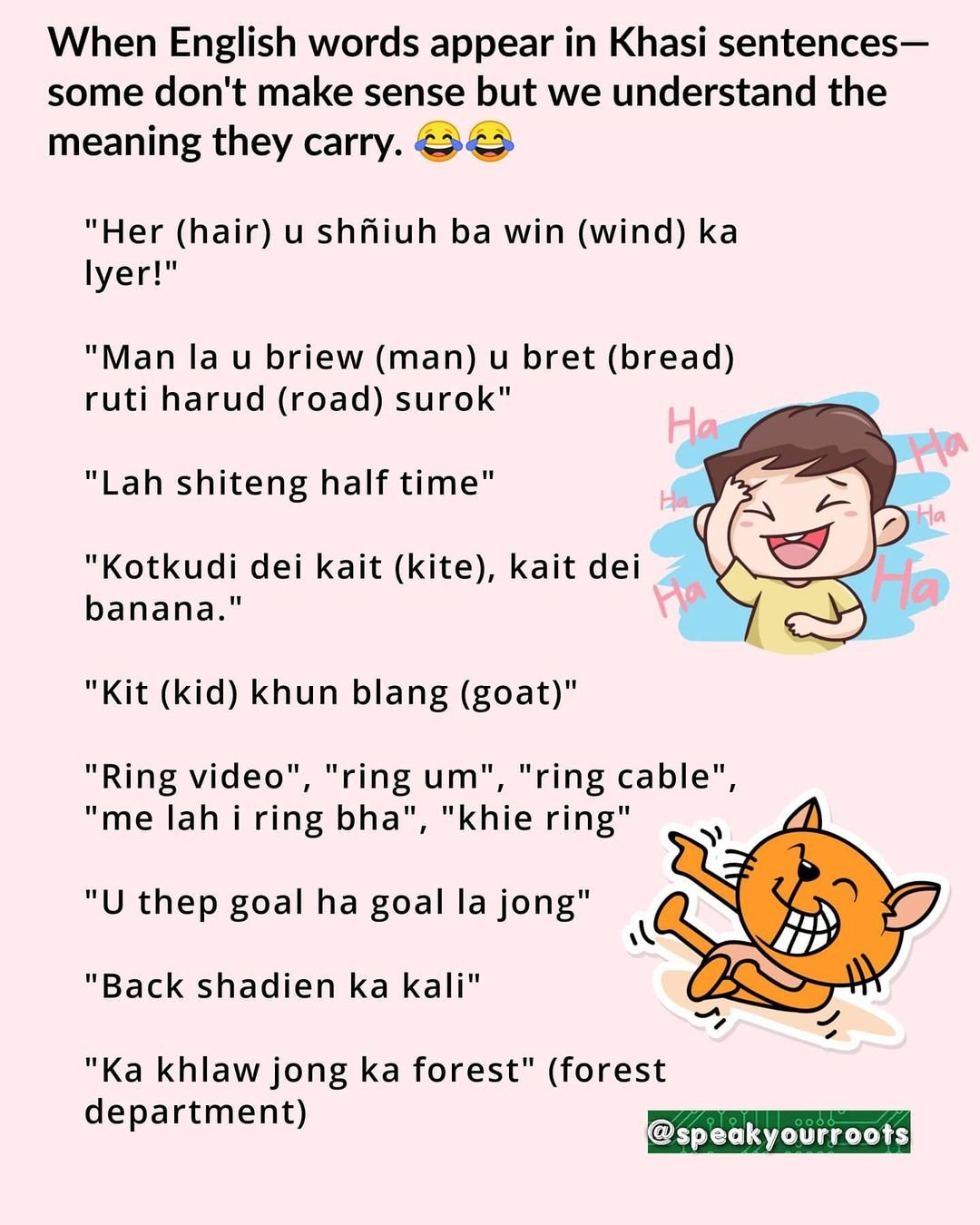
  • When English words appear in Khasi sentences

    When English words appear in Khasi sentences, some don't make sense but we understand the

    meaning they carry. Here are a few examples:

    "Her (hair) u shniuh ba win (wind) ka lyer!"

    "Man la u briew (man) u bret (bread) ruti harud (road) surok."

    "Lah shiteng half time."

    "Kotkudi dei kait (kite), kait dei banana."

    "Kit (kid) khun blang (goat)"

    "Ring video", "ring um", "ring cable", "me lah i ring bha", "khie ring."

    "U thep goal ha goal la jong."

    "Back shadien ka kali."

    "Ka khlaw jong ka forest." (forest department)

    The merging of languages is bound to happen and creates funny and interesting expression! 😂😂😂

    Thank you @_catherinemelam @esra_syiem @shillongftw @jeanrichardmawa @a_pocketful_of_plums @courageaity @longnamkharpuri @wthongnj for your contributions! 😆😆😆

  • “Panur” (War) and “Diñ Kum” (Pnar)

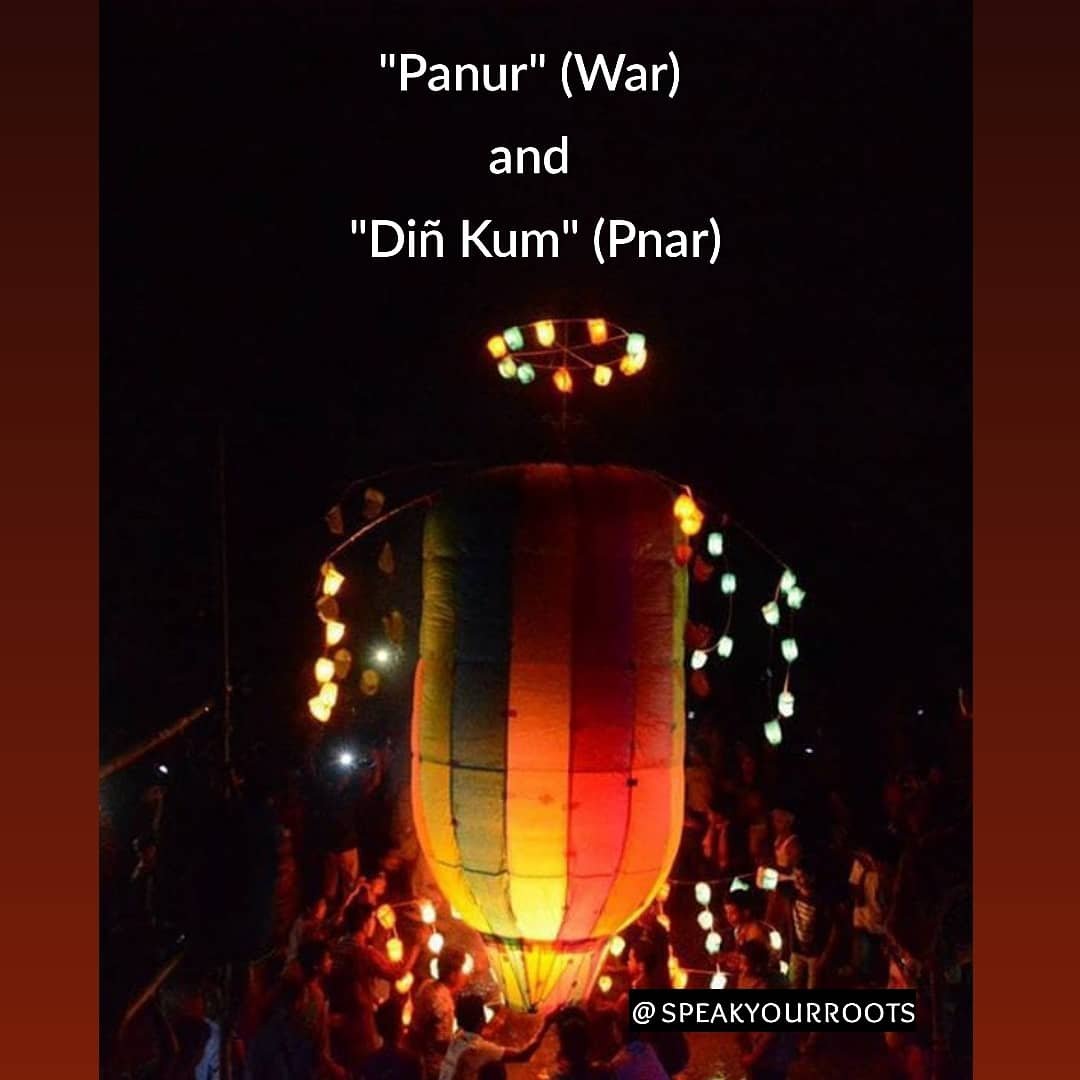
    "Panur" (War) and "Diñ Kum" (Pnar) are traditional sky lanterns made by the War and Pnar communities. These particular sky lanterns are however different in appearance from the usual sky lanterns.

    "Panur" and "Din Kum" are long and cylindrical in shape and are made of many rectangular pieces of kite paper joined together. The main lantern is called "Ka Kmie" (mother) and there are smaller lanterns called "Ki Khun" (children) as shown in the picture. "Panur" and "Diñ Kum" are made when there are festivals or any festive occasion. Alighting and flying them is done with great fervour and excitement.

    "Panur" (War) and Diñ Kum (Pnar) are traditional sky lanterns that are painstakingly made by the members of the community. They look beautiful when they are lighted up and create a feeling of oneness and belonging, accompanied with chants and "phawar".🎈🎈🎈

    Picture credit: @speakyourroots. Location: Nongjri, East Khasi Hills District.

  • Months of the year in the Pnar language

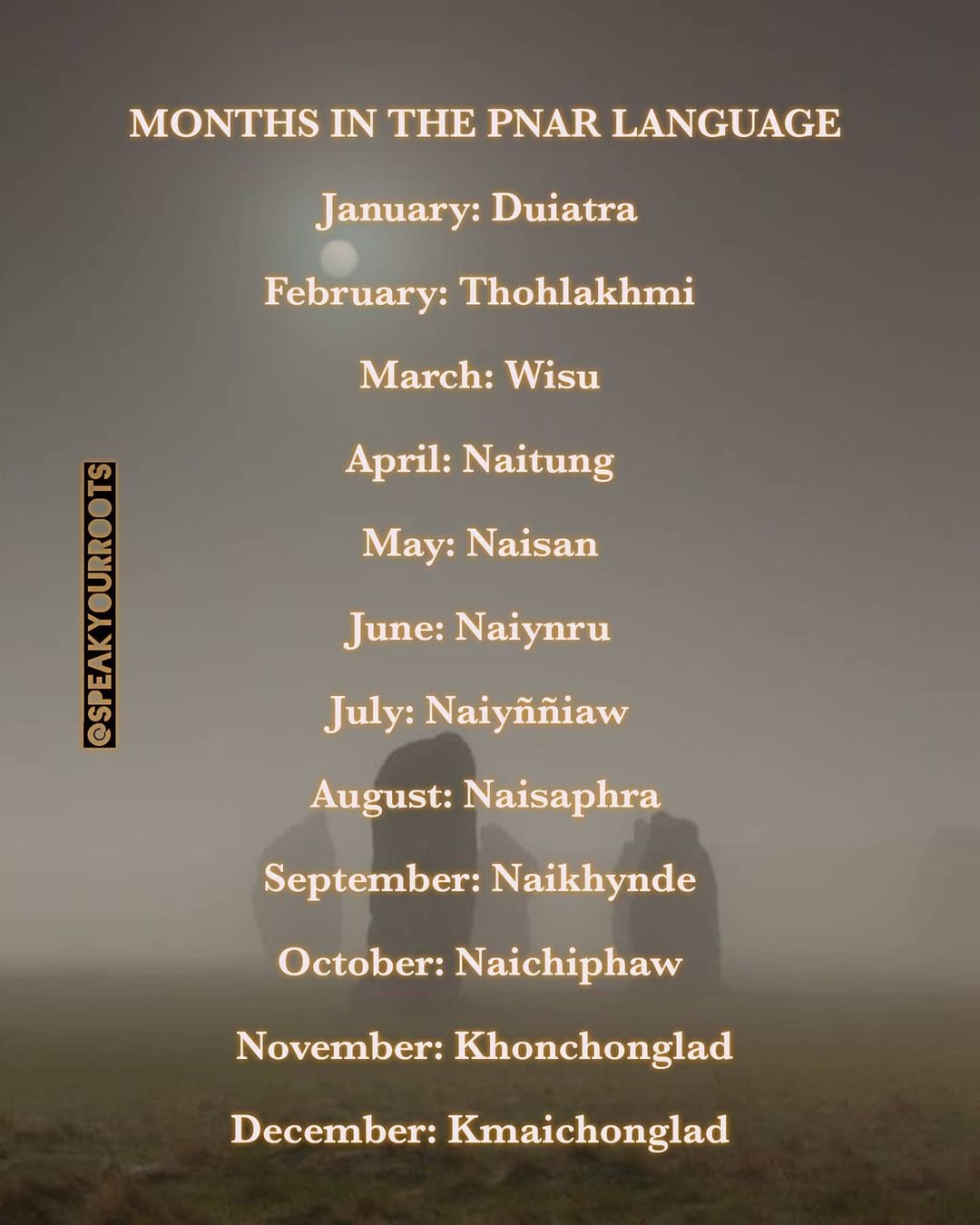
    January: Duiatra

    February: Thohlakhmi

    March: Wisu

    April: Naitung

    May: Naisan

    June: Naiynru

    July: Naiyññiaw

    August: Naisaphra

    September: Naikhynde

    October: Naichiphaw

    November: Khonchonglad

    December: Kmaichonglad

    These are the months of the year in the Pnar language. 📆📆 The Pnar/ Jaiñtia language is mostly spoken in the Jaiñtia Hills District of Meghalaya.

  • “Ki jingbishar na la tnum” da Vancouver Shullai

    Ha la ka tnum nga ïeng bam lyer.

    Nga artatien ïa ka jingkhuid jong ka,

    Haba ym sma shuh kum ka jingai sngewbha ka mariang,

    Hynrei, sma pynban kum ka jyntah sah-miet u paramarjan.

    Hapdeng ki ïing paki-dulan ka Laitumkhrah-

    Khlem dieng, khlem siej, khlem ñiut, khlem ñier:

    Nga 'i tang ki dongmusa u 'riewstad

    Ba phalang blar-blar khlem jingim.

    Kim pynshahshkor ïa ka lyer sah-miet

    Kaba kawut shane-shane, shatai-shatai.

    Ha khrum ka sahit bneng pat,

    Ïa kaba ki khlur ki ksoh

    Bad ki lyoh ki bitnah kum ka dpei jhieh-

    Sngew kumba ka don ka jingïatainia noh-shiliang.

    Ka khyndew ka kyrhuh da la ki kali, ki khiew-siaw, ki 'sew-lamwir,

    La sngew kumba ka khyllew sha ka bneng, "Kham riewspah manga!"

    Ka bneng pat, jai-jai ha la ka jingsngur,

    Ka sammut da ka 'leilieh hangne hangtai.

    Manga, tang kum u nongpeitkai,

    Ïa kata ka jingïatainia noh-shiliang;

    Nga lam biang sha ka jingsma ka jyntah sah-miet.

    Uei mo u ban shet 'tungrymbai hapdeng ka lyïur?

    Original Khasi poem "Ka Jingbishar Na la Tnum" written by @vancouvershullai 📜📜 Thank you for another fantastic entry! 🌌🏠🌩️🌥️

    Vancouver says: "Ki Jingbishar Na La Tnum" (which translates to "Judgements from the Roof") is a poem describing observations of the world around from a rooftop. The tranquillity of the sky and the cacophony of the earth under the sky, are interpreted as a one-sided argument, where the earth is loud and boastful of its disorganisation, while the sky only responds with occasional flickers of lightning, interpreted as indifferent grins. There is a deflection to the smell of Tungrymbai – almost as a surrender to the bigger powers of earth and soil that one could not possibly meddle with. The poem has environmental undertones that is left to the reader to discover and make meaning of."

  • Ko Pyrthei Shongbasa da i Vianney B. Nongrum

    Ko pyrthei shongbasa,

    ngam bynnud iapha.

    Ki riewshetkylla, ki

    riewharam, ki riew khwan

    lalot suda, nga lah i

    ngiah shisha.

    Sa tang ka jingpihuiñ,

    sa tang ka jingbishni,

    shisha la dap da ka jingijli.

    Mynsiem isynei,

    mynsiem ia tiplem,

    lah tyllep khlem

    jingsngewrem.

    Ah, ko jingim ioh pha ong

    ba nga bynnud ia ka pyrthei;

    Em hynrei nga puson ia

    kaei ba nga pynsepei.

    Ban ngan da ioh ban kheit

    ia kiei kiei ba nga lah duh;

    ngan Jin da kmen da jingsahuh.

    -Vianney B. Nongrum

    Original Khasi poem "Ko Pyrthei Shongbasa" by @vi.vianney_nongrum_b 😄😄😄 Thank you for this thought provoking poem!

    The poem talks about the world as a temporary home. How betrayal, ingratitude and selfishness has marred human existence. Compassion and conscience have disappeared. She says to life that she thinks about what is lost; if only she could get them back how happy she would be.

  • U Men Lyngkhung

    Ha ri Khasi, hyndai ki ong,

    u don u men lyngkhung;

    kat shaba leit u kieng iarong,

    ka khoh u kit kyndung.

    U don ki tmaiñ ba jrong shipruh,

    ka khlieh kaba syllen.

    U kyllan khleiñ ba kan mih shñiuh,

    u tah d'u sohmynken.

    La sat syllang um lah shah shuh

    teng teng u shad kulmar.

    Ani! Ynnai… ka kwah mih shñiuh,

    pleng dei kaba jynjar!

    Rough translation:

    "There once was Men Lyngkhung,

    in Khasi times of old.

    Wherever he went he carried his iarong

    and a huge khoh on his back.

    His beard and moustache were a feet long

    and his head was bald.

    He applied fat on his head hoping it would revive some hair.

    He even used chilli!

    Oh the heat on his head, he couldn't bear it!

    He danced in a frenzy…

    My goodness! Oh no! This wanting hair

    is much too difficult!"

    "U Men Lyngkhung" 😃😃😃 Remember those days when we were kids, how we would sing this? Another song that we should teach our kids!

  • Janor

    The Khasi word "Janor" means the mind and its reasoning power. In colloquial conversation it may refer to the brain. The actual word for brain is "Jabieng".

    Covid times conversation: a guy was frustrated trying to explain vaccination and said: "Uuuuu, ka janor ba kot tang shi peris! Ba lah ong ruh sa katno ban ong biang, ban iada ialade, ka iada ia kiwei ruh!”

    Rough translation: "Uuuuu, a brain that has the depth of a saucer! I've said that it will protect you and it will protect others too!”

    "Janor" sent by @longnamkharpuri 😂😂😂 The "Janor" is inside the "Maloi" and so is the "Jabieng". Thank you for bringing this up in the "Maloi" comments! 💀💀💀

    Loving the analogy between the mind and the saucer! 🤣🤣

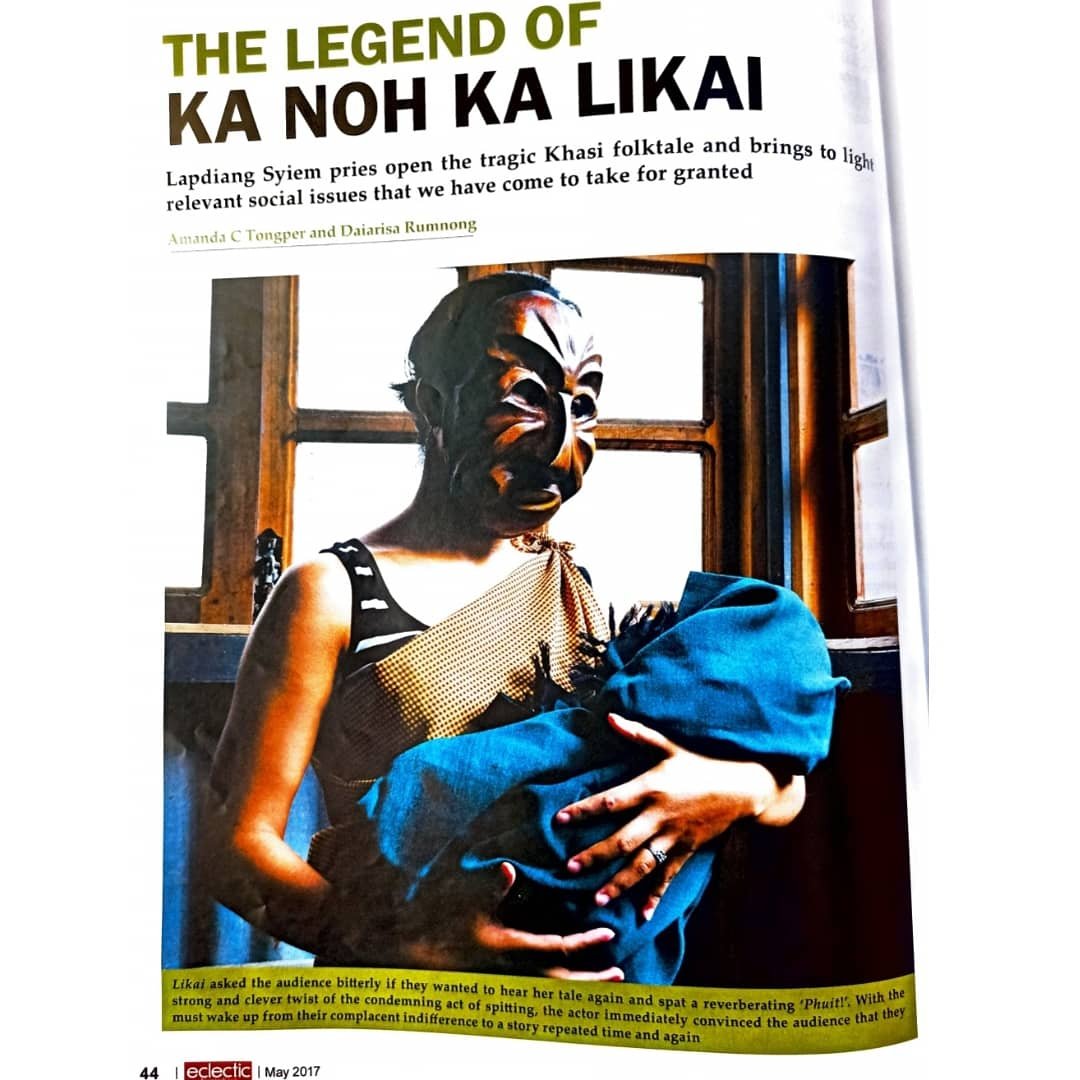
  • Review of “The Legend of Ka Noh ka Likai” by Lapdiang Syiem

    Lapdiang Syiem’s Dramatisation of The Legend of Ka Noh Ka Likai: A Review by Dr. Amanda C. Tongper and Dr. Daiarisa Rumnong

    Nothing prepared us for the phenomenon which is Lapdiang Syiem. As we were ushered in into the enclosed space at Dylan’s Café, we were greeted by a figure framed atop a mula, transfixed with a baby in her arms. We stopped for a second, looking for traces of life in that mannequin of a being even though we knew at the back of our minds, that it is the actor, Lapdiang Syiem.  The first achievement of the actor was accomplished in the very first seconds of the play, as we later realised that we did not just enter the room where the performance was to take place – we were pulled into the orbit of the actor with a grip that was to hold us for the rest of the performance. 

    Lapdiang, through the character of Likai, pried open the tragic story of Ka Noh Ka Likai that has been encapsulated in time and brought to light relevant social issues muted within a tale that we have come to take for granted. Likai asked the audience bitterly if they wanted to hear her tale told again and spat a reverberating “Phuit!” With the strong and clever twist of the condemning act of spitting, the actor immediately convinced the audience that they must wake up from their complacent indifference to a story repeated time and again. The spit cautioned the audience that in this re-telling, they cannot rely on their rote-memory of the story. The spit challenged the collective conscience of the audience who may have known the narrative of Ka Noh Ka Likai, but has never thought to understand the story of Ka Likai, the being with thoughts and emotions of her own.

    Lapdiang Syiem’s performance provokes a fresh look at the oft-told story of Likai. Entering the venue, the image of Lapdiang whose face was covered by a mask, holding a baby seemed to be suspended in purgatory, adrift in limbo. The image is at once a detonating symbol. It evokes the pre-conceived notion that a woman is pitiable, weak, unsettled on her own and a man is her only anchor. This notion that rises from a deep-seated, almost genetic conditioning remains such an inescapable factor even in this 21st  century stage of our lives. The orbit we were drawn into had a familiar ring to it. But were we looking hard enough to notice the reflection we should see of ourselves; of how much the motif of a woman jumping to her death actually echoes all those stories of violence, dispossession and death?  Why is it that a woman is expected to be tied to a man? Why does a part of a so-called “binary” cannot exist alone? In the performance of Ka Noh Ka Likai, Likai after living as a widow was told by other women in her community that she should marry another man. A man it appears embodies security. However, this “security” that society perceives as normal or good may actually lead to irrevocable despair.  

    The only device that aided Lapdiang’s performance was the music played by Apkyrmen Tangsong. Apkyrmen played original compositions on the maringud, ksing and besli. All three instruments moulded themselves into the performance, even eerily voicing out the muffled cries

    of Likai’s baby. The poignant and haunting pieces feel like the past knocking on our foreheads saying: “Don’t get too comfortable, too familiar with showing me off. Try to understand my relevance for the present and even the future!” The music, words and gestures of the performance swayed the audience, dug out tears, drawing us breathless with questions that perhaps are desperate to break free. It made us feel uncomfortable…in all the right places.

    In Lapdiang’s performance, there is a curious blend of acting and telling, so that one is compelled to say, the oral is still with us. One usually speaks of the oral tradition with a sense of

    nostalgia, as a thing of the papyral past. However, with Lapdiang’s performance, one witnesses that this form of communication has never really left us. We only have to engage with it once again. The gusts and ripples of ka Ka Noh Ka Likai echo everyday, do we listen?

    As the play came to its end, there was silence among the audience. It was a sacred moment to watch Lapdiang give Likai life with such heart, strength and intelligence.


    Lapdiang Syiem is a force to be reckoned with.  

    Lapdiang A. Syiem was born and brought up in Shillong. She is a graduate from National School of Drama, Delhi with a specialisation in Physical Theatre from the Commedia School, Copenhagen. In 2016, Lapdiang, along with Keshav Pariat and Juban Lamar founded an artistic commune called, The Unhinged Commune. They blog regularly at kinongbamsohlah.wordpress.com

    This is a review of a fantastic and heart-wrenching performance by @lapdiangsyiem of "The Legend of Ka Noh ka Likai" in 2017. Folktales transformed into theatre is something else! 💫💫💫

    The review was published in @eclectic_northeast magazine and has been written by Dr. Daiarisa Rumnong (Assistant Professor, St. Mary's College) and Dr. Amanda C. Tongper (Assistant Professor, St. Anthony's College).

    Thank you @lamar.juban for the beautiful pictures used in this review!

    Please send an email to speak.your.roots@gmail.com if you would like to read the review!
  • Maloi

    The Khasi word "Maloi" has come to gain the status of an urban slang in common parlance. "Maloi'" actually means the coconut shell and "Maloi khlieh" means the skull. Nowadays the word "Maloi" has gained a different meaning altogether implying the fun, laughter and crackpot experiences shared between friends. Besides this, the word is also used when someone says something silly or stupid like: "Nili uto uwei te lah maloi shisha phi." It is also used as a term of endearment between friends: "Ei maloi!" "Oi malois!"

    The Khasi word "Maloi" has attained a life of its own and is now used widely in conversation between friends and family 😂😂😂 Don't we love our Malois! ❤️❤️❤️🤡🤡🤡🤡

    Tag your Malois! 😄😄