Tag: talklocal

  • “The Sun, the Peacock and I” by Badondor Diengdoh

    Spirited like the jaiñkyrshah

    flapping with the wind.

    Noisy like the sound of

    a bolbaring indenting tarmacs.

    The girls of summer

    The boys of winter.

    The blue rubber ball.

    targeting stacked rocks.

    Now

    still figuring out my life

    with unmatched socks

    Wish I could still be that

    kid from the block

    who daydreamed of

    the sun and the peacock.

    According to Khasi folklore, it is said that the Peacock and the Sun were together in heaven as lovers. But one day the peacock, while looking down on the earth, saw a garden full of mustard flowers. To him the garden looked like a beautiful girl in yellow and green clothes. He instantly fell in love with what he saw. The peacock left the sun and flew down to earth. The sun was heartbroken and her golden tears descended on his feathers creating the golden spotted pattern we all know.

    To the peacock's utter disappointment, upon landing on earth, he realised that what he saw was only a patch of mustard flowers. Now it was the peacocks' turn to cry. Full of regret he tried to fly back to the sun but could not. That is why the peacock is flightless to this day.

    "Bolbaring" is a wooden toy vehicle made out of small wooden poles and having rotating ball bearings as wheels.

    The rubber ball and stacked rocks refers to a traditional game known as "Mawpoiñ" in the Khasi language. It is like dodgeball, while introducing a new element into the game in the form of stacked rocks. It involves one team hitting their opponents with a ball or destroying the stacked rocks while the other team either dodges or re-stacks the rocks .

    "Jaiñkyrshah" is the traditional Khasi apron which is worn as a loop from one shoulder and its design is always a chequered one of different colours.
  • “Ka Likai (An Ending Retold)” by Clarissa Giri

    Calmly by the fire,

    She sits staring at the flames before her.

    Ember sparks burn freckles on weathered

    floorboards,

    Restless charcoal crackle uneasily in the dpei,

    While vapour fumes from her drenched

    kyrshah.

    Smoke and ash cling to her damp hair,

    A hot tear makes its way down her cheek,

    The wait glistens bloody at her heel,

    And she watches the shadows form on the

    wall before her

    As her ancestors dance for war.

    The rueful dish cooked to perfection,

    She feeds him a mouthful of this concoction-

    A stew of his own fingers; there will be no

    leftovers.

    How he tossed her daughter's tiny fingers like

    refuse in the shang-kwai,

    No. This butcher will devour his.

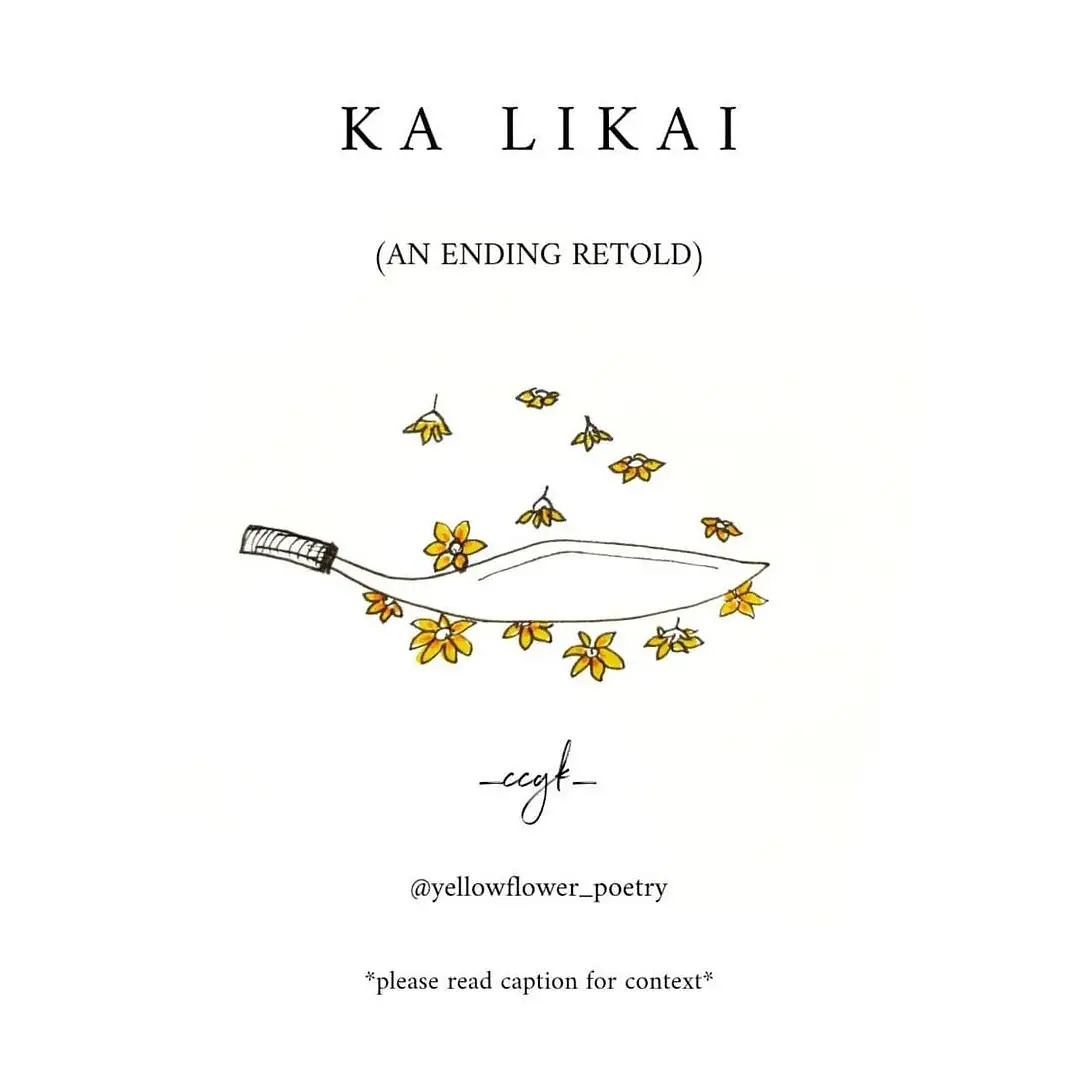
    There is a Khasi folktale about a widow named Likai who had a daughter whom she loved more than life itself. She was remarried after some time, to a man who later turned out to be abusive and dangerous and who eventually murdered her only daughter, while Likai was toiling in the fields. He butchered her and cooked a stew with the remains which Likai ate unknowingly. She found out after her meal when she was about to consume "kwai", a combination of betel leaf, lime and areca nut (a traditional edible) where she saw the remains of her daughter's fingers in the "shang-kwai" (areca nut basket).

    This caused a cacophony of chaos in her, driven by immense heartbreak and in a rage she ran after the man with a "wait" (a Dao or large bladed knife). Being unable to find him, in her madness-driven rage and being unable to endure life because of such a tragedy, Likai threw herself off of a waterfall. The waterfall is named after her fall "Noh Ka Likai" falls (Literally, Where Likai Jumped).

    This poem is a twist on that ending, as folktales go, there is always an ending of "What if?" and in this one there is no mention about what happened to the murderer and if ever he was given what he deserved. In this poem, I ask what if Likai found her daughter's murderer cowering in the forests of "Sohra" (Cherrapunji), and she was able to avenge her daughter before deciding upon her own fate?

    "Dpei" – hearth, "Kyrshah" – traditional khasi apron

    Caption and original artwork by @yellowflower_poetry

  • Kynjat Tin

    A game that can be played with a bigger crowd of kids and one simple tin can. The group would decide who had to be the guardian of the can (it was not a privilege to be one) by drawing lots. The unlucky guardian would then have to count to whatever number has been pre-decided by all participants and everyone would go hide. The counting done, the guardian would then have to seek all the participants whose goal is to kick the can if the guardian left it unguarded. And if that be the case, he/she would have to endure another round of being guardian and seeker. But if the guardian manages to find everyone, the first one found will have to take his place. I remember playing this in the winter till it got dark and our parents had to literally drag us indoors. Some days we took the hiding literally too far and we would be roaming the streets of Jaiaw and Garikhana, forgetting that we were still playing the game, while the guardian usually missed out on the actual fun.

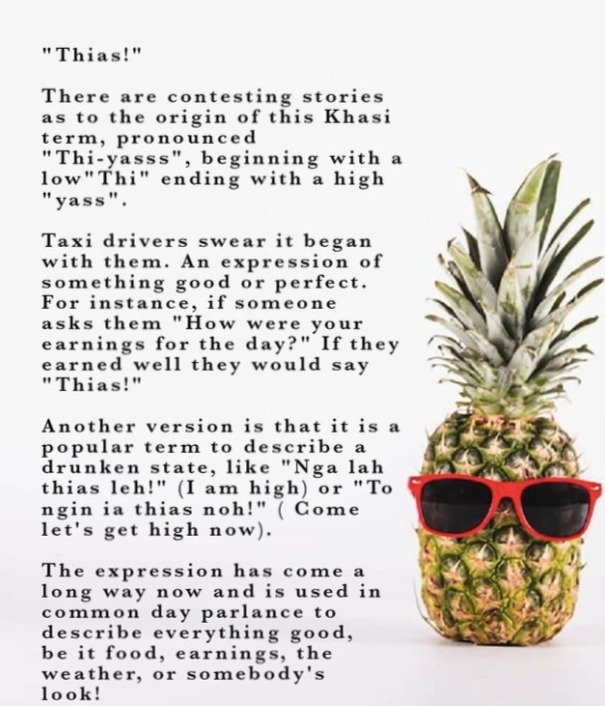
  • Thias!

    There are contesting stories as to the origin of this Khasi term, pronounced "Thi-yass”, beginning with a low "Thi" ending with a high "yass”. Taxi drivers swear it began with them. An expression of something good or perfect.

    For instance, if someone asks them "How were your earnings for the day?" If they earned well they would say "Thias!" Another version is that it is a popular term to describe a drunken state, like "Nga lah thias leh!" (I am high) or “To ngin ia thias noh!" ( Come let's get high now). The expression has come a long way now and is used in common day parlance to describe everything good, be it food, earnings, the weather or somebody's look!

    This entry is sent by Dr. Ellerine Diengdoh (Assistant Professor, English, St. Mary's College, Shillong). Thank you for sending this! 😂😂

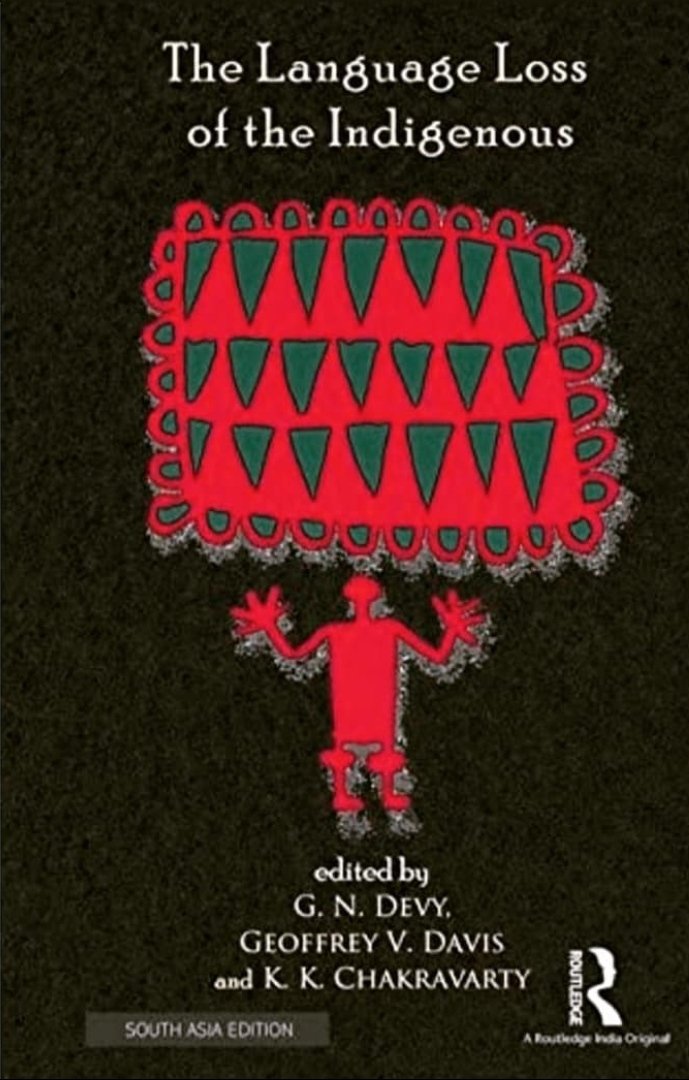
  • The Language Loss of the Indigenous, edited by G.N Devy, Geoffrey V. Davis and K. K Chakravarty

    This volume (published in 2016) traces the theme of the loss of language and culture in numerous postcolonial contexts. It establishes that the aphasia imposed on the indigenous is but a visible symptom of a deeper malaise – the mismatch between the symbiotic relation nurtured by the indigenous with their environment and the idea of development put before them as their future.

    The essays here show how the cultures and the imaginative expressions of indigenous communities all over the world are undergoing a phase of rapid depletion. They unravel the indifference of market forces to diversity and that of the states, unwilling to protect and safeguard these marginalised communities.

    This book will be useful to scholars and researchers of cultural and literary studies, linguistics, sociology and social anthropology, as well as tribal and indigenous studies.

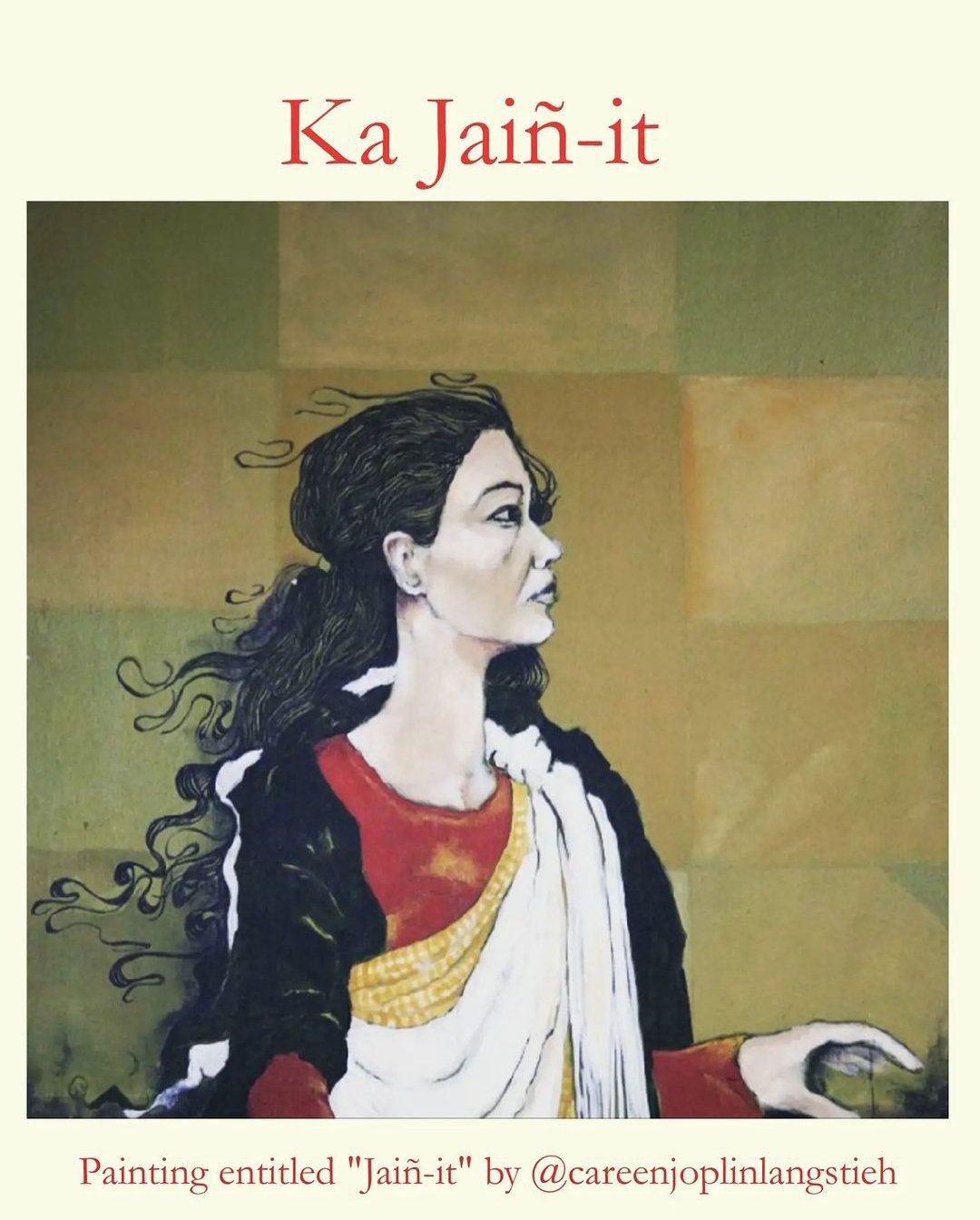
  • Ka Jaiñ-it by Careen J. Langstieh

    "Ka jaiñ-it" ka dei ka jaiñ bah ïa ki khyllung ne ki khun rit; ka dei ruh ka jaiñ kaba pynskhem haba bah ne kit.

    Ka jaiñ-it ka dei ka jaiñ ba pyndonkam da ki Khasi ha ka por ba ki bah ïa ki khunrit. Lah ban ong ba ka dei ka jaiñ ba jrong lynter ba la thaiñ na ki sai kynphad balieh bad don ruh ki jingthaiñ da ki ksai ba saw sha tduh jong ka jaiñ. Ha kylleng sawdong ka Ri Khasi bad Jaiñtia, ki longkmie ki ju pyndonkam da kane ka jaiñ ban kit ne bah ïa ki khyllung ne khunrit hadien met khnang ba kin lah ban trei ban ktah ruh ha kajuh ka por-lada dei hapoh ïing ne shabar, khlem da pynsepei ïa ka por.

    Ki kynthei Khasi ki dei kiba smat bad bunsien ngi ju ïohi ïa ki longkmie kiba bah khun da kaba pyndonkam ia ka "jaiñ-it" ha ka por ba ki trei ïa kano kano ka kam: lada dei ka kam shet, kam sait, kam khlieng ne haba ki leit sha la ki bri ban trei kam rep kam riang. Ka jaiñ-it ka dei ruh kaba ju ai sngewbha da ka Meikha ïa ki ksiew. Kane ka dustur ka dang im sah haduh ki por mynta ruh, tangba lehse ka jingpyndonkam ïa ka jaiñ-it ka lah kham duna ha ki thaiñ sor.

    Ïa ka jaiñ-it lah ban pyndonkam baroh shi snem lynter bad ka kham ïarap khamtam eh ha ki por tlang ha kaba i khyllung i ïohthiah ha syndah ka met jong ka kmie bad i ïoh ruh ka jingsyaid na ka met jong ka. Ki pyndonkam ruh sa da ka jaiñ-kup ha kaba ka kmie ka kup ïalade da katei ka jaiñ ban sop syaid ia i khyllung iba ka bah.

    "Ka jaiñ-it" is a traditional baby sling-wrap used by Khasis and Pnars which may be described as a long strip of cotton cloth made from big strands of white thread with red stripes at the ends. In the Khasi and Jaiñtia hills, mothers use this cloth to carry a baby on their backs, so as to be able to perform work in the house or outside.

    Khasi women are never idle sitters. We see mothers carrying babies securely and safely fastening them with the jaiñ-it while they go about their daily work, be it cooking, washing and sometimes tilling the field.

    The jaiñ it is traditionally gifted by the paternal grandmother to her grandchildren. This practise is still alive and well. However, the use of the jain-it is lessening in the urban areas. The jain-it can be used all year round and is particularly handy in the winter months when the baby is snugly fastened and then a "jaiñ-kup" (flannel shawl) is wrapped around the baby to keep it warm.

    Most of us have a picture of ourselves tied by a "jaiñ-it" on our mother's back when we were babies ☺️☺️

    Kudos to our mothers for being the symbolic "jaiñ-it" who bind our families together with their unconditional love 🧡🧡🧡

    Thank you Kong @careenjoplinlangstieh for allowing us to use your artwork! 🙏🙏

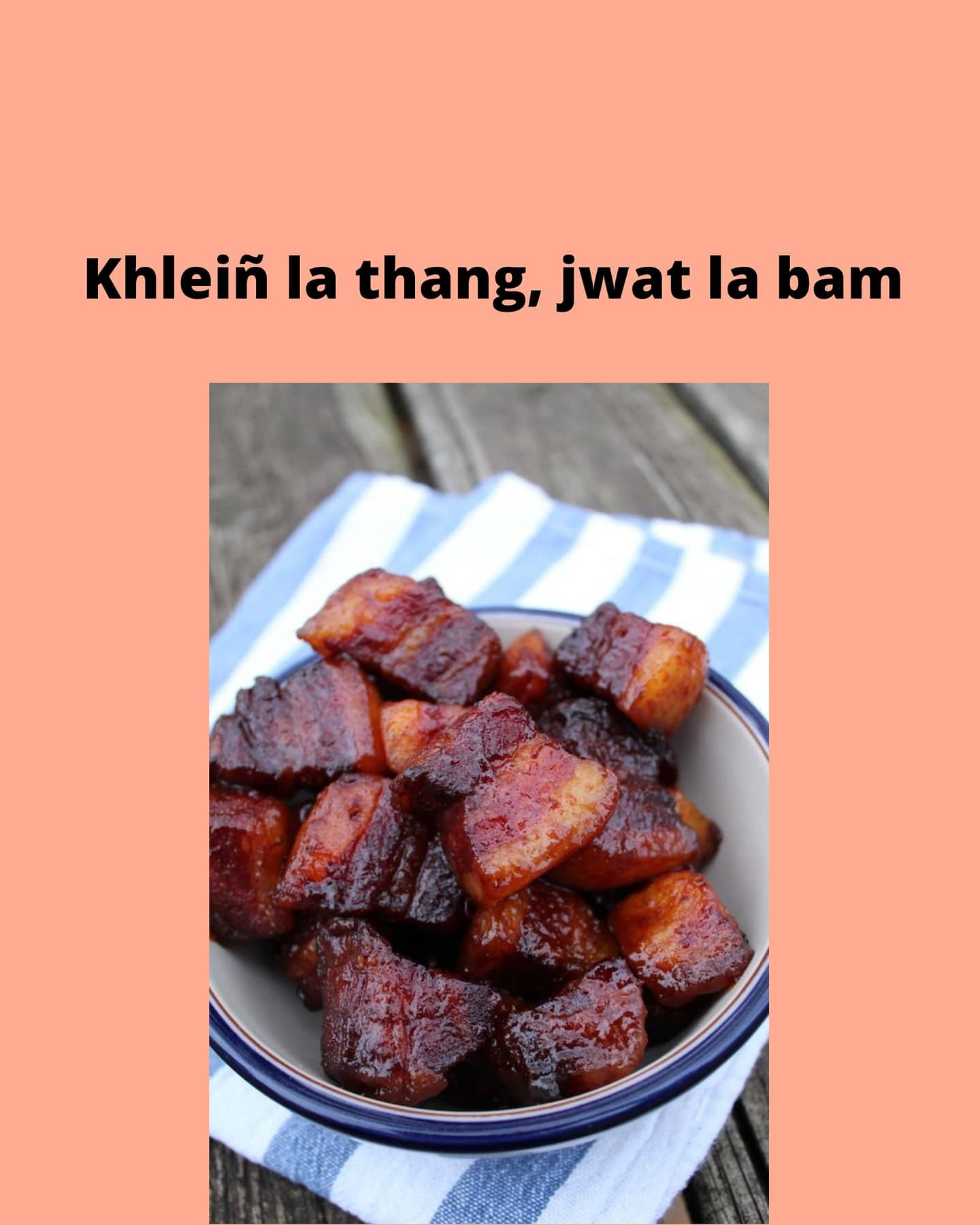
  • Khleiñ la thang, jwat la bam

    @laia.naomi says:

    " 'Khleiñ la thang, jwat la bam' literally translates to the delicious looking droops of fat when a piece of meat is smoked in a traditional fire but which is instead tough and difficult to break when eaten. The phrase is used to describe a person who is a sweet talker; someone rather too sweet to be genuine. My Dad introduced this phrase to me with the explanation 'when you have to work together with them you find that they are the exact opposite of what they actually portrayed themselves to be.' "

    "Khleiñ la thang, jwat la bam" is a translation of the moral of a story from Aesop's Fables, translated by Khasi Poet Laureate Soso Tham.

    When the meat looks beautiful but the beauty lies so deep you can't sink your teeth into it 😂😂😂 Thank you @laia.naomi for sending this! 🤭🤭

  • Mynsiem Jong i Mei

    @dr.taniavaid says:

    "Mynsiem jong i Mei" meaning Mother's soul/spirit… A phrase I have been using a lot since I became mommy! Feels most right when expressed in Khasi.

  • Bam ja mo

    @venelizapariat says:

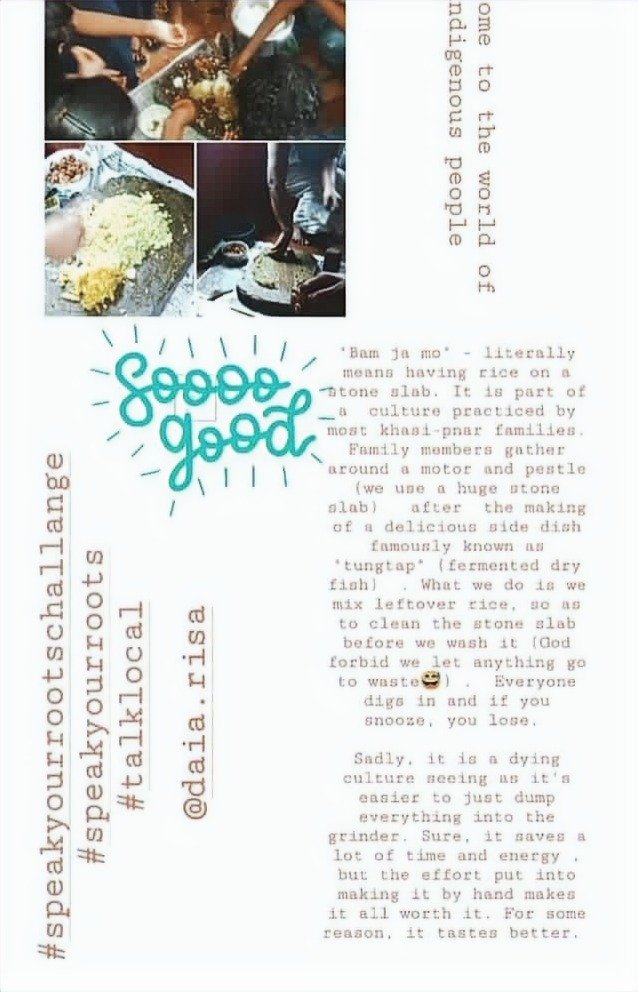
    "Bam ja mo" literally means having rice on a stone slab. It is part of a culture practised by most Khasi-Pnar families. Family members gather around a mortar and pestle (we use a huge stone slab) after the making of a delicious side dish famously known as "tungtap" (fermented dry fish). What we do is we mix leftover rice, so as to clean the stone slab before we wash it (God forbid we let anything go to waste!). Everyone digs in and if you snooze, you lose. Sadly, it is a dying culture seeing as it is easier to just dump everything into the grinder. Sure, it saves a lot of time and energy but the effort put into making it by hand makes it all worth it. For some reason, it tastes better!

  • Tip Briew, Tip Blei

    The Khasi precept "Tip Briew, Tip Blei" literally translates to "Know man, know God". It is one of the three tenets of Khasi socio-religious cultural worldview, which can be understood as knowing man (in all the sense of knowing) is knowing God. One simply cannot approach to an understanding or a relationship with God if he/she cannot do so with his/ her fellow human beings. It does resonate with one of the laws that Jesus gave which is "to love thy neighbour" or even to the English proverb "service to man is service to God". For a Khasi, this phrase also gives one an ontological understanding of oneself.

    "Tip Briew Tip Blei" sent by @bada_boombam 😀💖💖💖 Thank you for another fantastic contribution Bada!

    "Tip Briew Tip Blei" is translated as Know Man, Know God. This Khasi precept is one of the three tenets of the Khasi socio-religuious cultural worldview. The other two being "Kamai Ïa Ka Hok" and "Tip Kur Tip Kha". These tenets should govern life in all aspects for the growth of a healthy and mindful collective consciousness.