Tag: khasi

  • Laiphew

    The connotation or the Khasi term "Laiphew" which literally means thirty, as a limit ordinal is without a successor and it is a marker of a process of constitution of a community. It is not just a representation of the number 30, but it is supposed to be an idiolect of 'all types'. For example, "Laiphew Syiem'' means many chiefs; "Laiphew Mrad" means many animals. Philosophically speaking the Khasi concept of all and many as a generic concept is simultaneously concrete and general. Concept of numbers to instantiate all or many are place markers within the structure of all or many, which is simultaneously predicative and impredicative. Such predicative and impredicative application of linguistic concepts in describing the constitution of Khasi society is a narrative construction of Khasi selfhood.

    "Laiphew" sent by @manbha.syiemlieh Thank you! An extremely interesting entry! 😄😄

    Idiolect: the language or speech pattern of one individual at a particular period of life.
  • Tan u khiewja

    There is a real phenomenon known as the "return trip effect". It may be said to be caused by the human weakness of perceiving time. Sometimes our sense of how much time has passed is influenced by our surroundings, our mood or the amount of attention we spend on something.

    We have all made that one trip to an unfamiliar place right? It feels like forever when we are going to it, but on the return trip back home, the journey feels shorter.

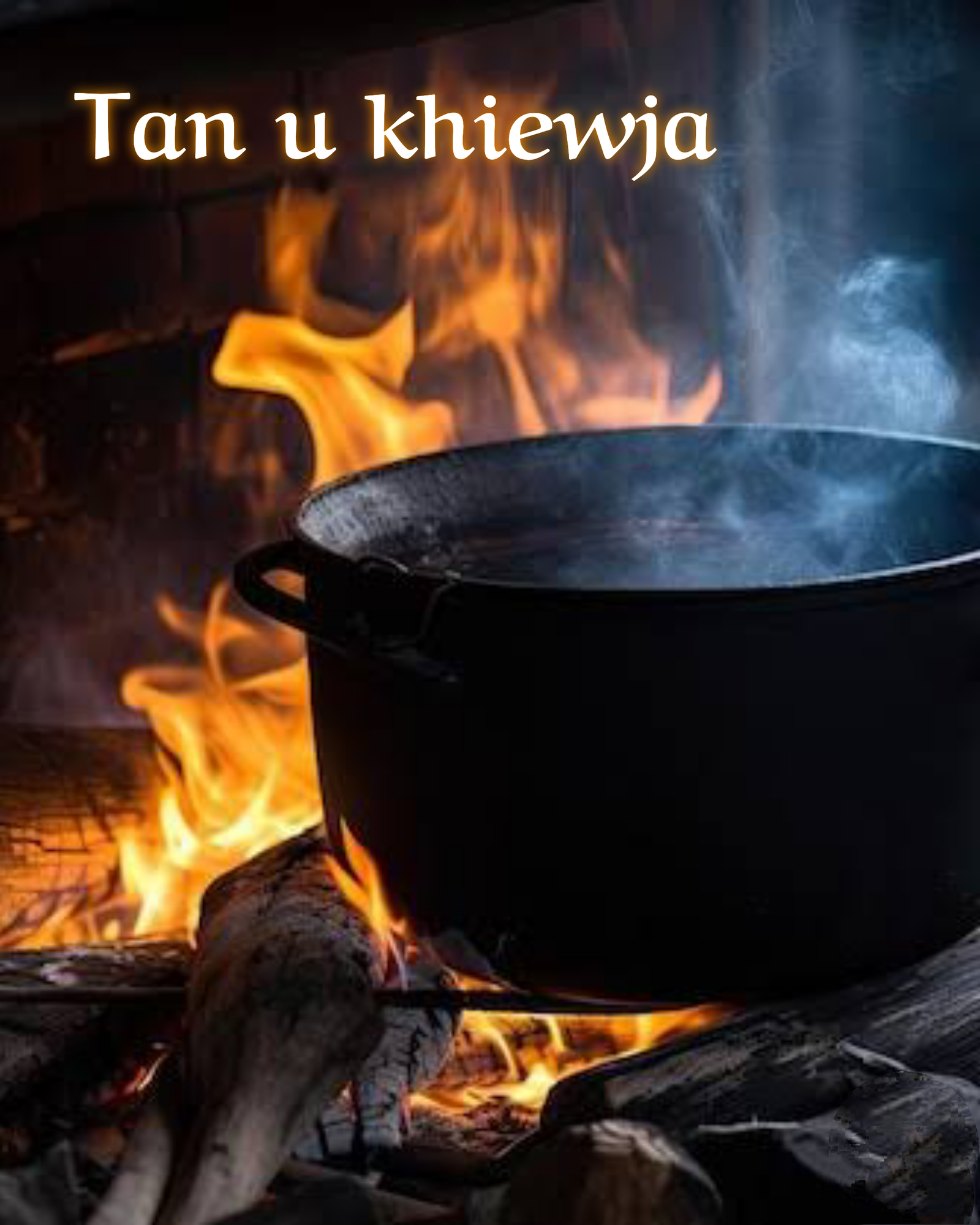
    The Khasis describe this phenomenon as "Tan u khiewja". Literally, it is translated as the pull of the rice pot. The rice pot is synonymous with the warmth of the hearth, the centre of home and family. Thus, this metaphorical idiom expresses the pull of home or of the hearth, where one finds love and joy after returning from somewhere.

    Khublei Shibun @a_pocketful_of_plums for sending this!🔥🔥

    Acknowledgement for this post is also given to Dr. Ellerine Diengdoh, Assistant Professor, Department of English, St. Mary's College, Shillong.

  • International Mother Language Day Poems

    La Akor Burom Ngin Kyntiew,

    Ban lai Pynphuh Pynphieng La Jaidbynriew:

    Ngin lai Sumar La Ka Ktien Lajong,

    la Ka Ruh Hi Ngin Ri Kyndong.

    by @bawanshwa_syiemlieh

    La ka ktien lajong ngin niewkor

    Ba ha ka long ka spah kordon,

    Ban pynsah nam baroh shyrta;

    la ka ktien nongmei nongpa

    Shirta ia ka ngim dei ban klet:

    La shibun jingeh kin wan tyllep

    la ktien lajong gin sngewsarong

    La ha sor ne ha nongkyndong.

    by Darisha Marweiñ

    Ka Ktien Khasi khara;

    Ka Ktien khasi paka

    Ka Ktien burom ki longshuwa

    Ka dei ka ktien sohra.

    Ka ktien nongmei nongpa

    B’la kren ha nigl inaduh mynshue

    Ka 'tien sneng 'tien kyntu

    Ban neh ban sah ha jingim ba bha

    by Battilang Kharkongor @battie626

    Wat la ngi nang ka

    ktien nongwei,

    Ngim dei ban klet

    ka ktien i mei i pa:

    Kunmaw ko khun

    khasi khara han

    burom ka ktien

    nongmei nongpa.

    by Pynbianglin Thabah @thabahpynbianglin

    "Shano ngin phet?

    Ko kmie baieid

    La lut ki ummat

    Kiba ju shlei ai jingim,

    Naba pha iam sngewsih

    Jingleh u briew

    Uba kam ba u ieid

    Thep mynsiem ia pha ko Ri.

    Pha plie ia la ka mynsiem

    Pha kyrkhu kyrdoh

    la u khun bynriew,

    Khlem suit niew

    U kam ei ka pyrthei

    Kaba theh ki jingai ei

    Ha man ki kti jong u.

    Mynta marwel

    Pha shong

    Kajingbitar

    Ka rhem kum thylliej ding,

    Ah ka a pot

    Shano ngin phet

    La ka khyndew kan khih win?

    By @wordyramblings

    "Ka Ktien Khasi Jong Ngi"

    Ha sla pyrthei la kha ia nga,

    Nga san longbriew, nga im pura;

    Ryngkat jingieid i mei i pa,

    Ha la ka ktien ba ngan kren bha.

    Ym tang ban kren kumta la biang,

    Hynrei ban thoh te ba nan nang;

    Kumta jingstad sawdong ka phriang,

    A-B, ka jinghikai ka sdang.

    Ka ktien khasi shisha ba ïar,

    Ha ri khynriam bad ha ri pnar;

    "'Sohra'- Ka ïeng 'tien salonsar,

    Ban ïa biang lang, ban ym kulmar.

    U Thomas Jones na ri sepngi,

    U la wanlam dak thoh khasi;

    la jait bynriew ban lam lynti,

    Ban ym sah dum bynriew khasi.

    l'u la tip haduh kine ki sngi,

    Kum u kpa ki dak thoh khasi;

    Khlem don ma u ba prat lynti,

    Ngi lah sah dum ha la ka ri.

    By Labianglang Diengdoh

  • Tana

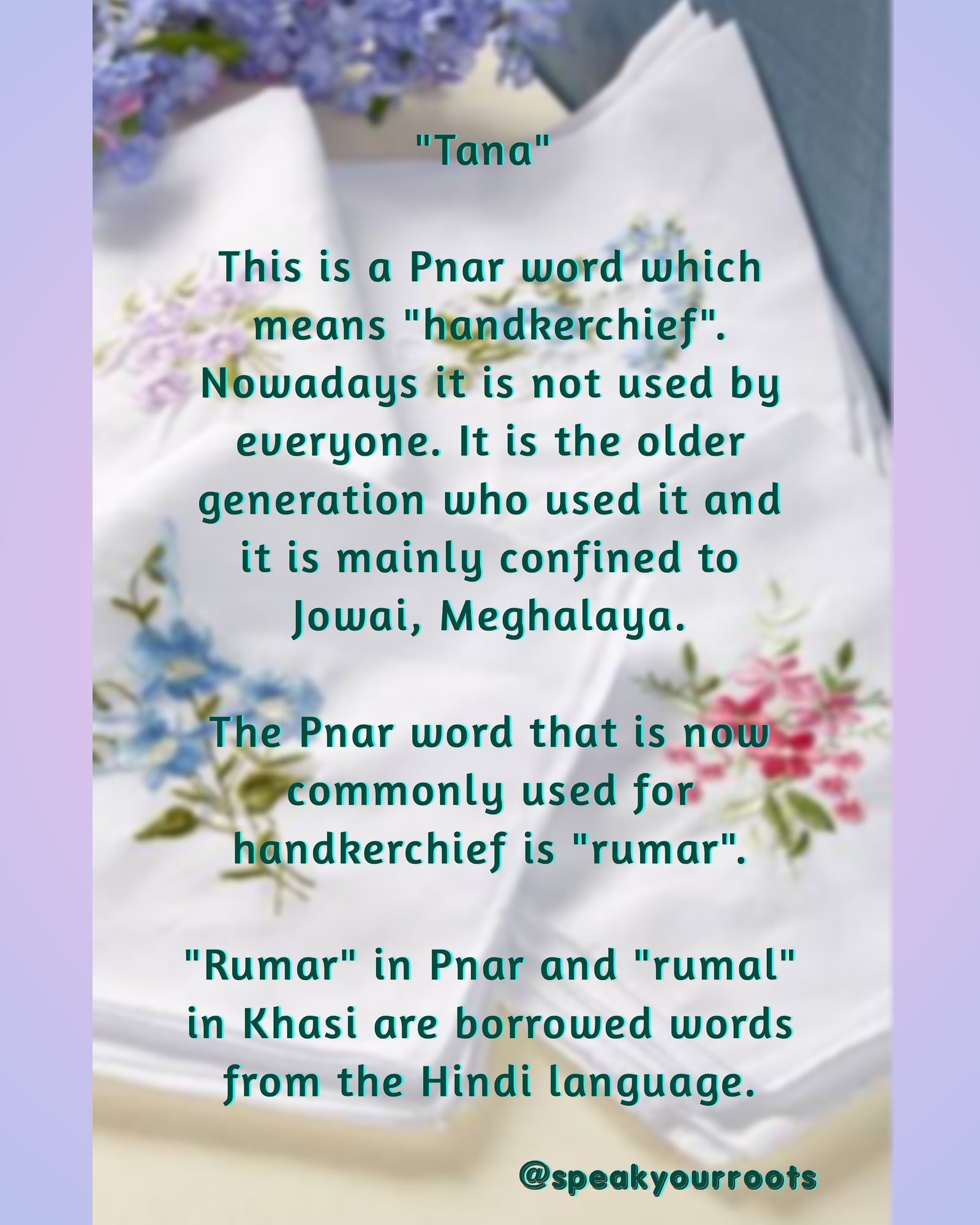
    "Tana" is a Pnar word which means "handkerchief". Nowadays it is not used by everyone. It is the older generation who used it and it is mainly confined to jowai, Meghalaya. The Pnar word that is now commonly used for handkerchief is "rumar". "Rumar" in Pnar and "rumal" in Khasi are borrowed words from the Hindi language.

    Thank you @shiny_joan !

  • “Pahsyntiew” by Indari S. Warjri

    I heard of your beauty

    Blushing daughter of the deities

    Sheltered in your cave of chastity

    No man dare explore.

    A dark cascade rises from

    your shoulders

    But a tender lily

    Should not be bruised by

    hostile rocks.

    Your slender hand will stretch

    Towards the flower in the man's hand

    For in his hand man hold

    Unnamable delight.

    And you became mine,

    sweet maiden.

    O be the mother of my sons!

    But also the warm nest for

    my love.

    O children, may you be noble

    May you possess the

    strength of rocks

    May you protect the weak

    May you be suckled on knowledge

    For the celestials beckon

    And I must return.

    The sons became men, royal in stature

    Having wisdom gifted by the gods

    They came to rule the misty hills;

    To dwell in pinewood mansions

    Where carpets of clouds

    And cloaks of rain

    Conserve the forests of the Khasi hills.

    O mother, giver of life,

    See your sons-the syiems.

    "Pahsyntiew" by @indariwarjri based on the legend of Ka Pahsyntiew 🌹

    Indari S. Warjri (Associate Professor) is Head of the Department of English, St. Mary's College, Shillong.

    The Legend of Ka Pahsyntiew has been published in English, in the book Around the Hearth: Khasi Legends (Folktales of India) by Kynpham Sing Nongkynrih. The book is published by Penguin Books.

  • “The Sun, the Peacock and I” by Badondor Diengdoh

    Spirited like the jaiñkyrshah

    flapping with the wind.

    Noisy like the sound of

    a bolbaring indenting tarmacs.

    The girls of summer

    The boys of winter.

    The blue rubber ball.

    targeting stacked rocks.

    Now

    still figuring out my life

    with unmatched socks

    Wish I could still be that

    kid from the block

    who daydreamed of

    the sun and the peacock.

    According to Khasi folklore, it is said that the Peacock and the Sun were together in heaven as lovers. But one day the peacock, while looking down on the earth, saw a garden full of mustard flowers. To him the garden looked like a beautiful girl in yellow and green clothes. He instantly fell in love with what he saw. The peacock left the sun and flew down to earth. The sun was heartbroken and her golden tears descended on his feathers creating the golden spotted pattern we all know.

    To the peacock's utter disappointment, upon landing on earth, he realised that what he saw was only a patch of mustard flowers. Now it was the peacocks' turn to cry. Full of regret he tried to fly back to the sun but could not. That is why the peacock is flightless to this day.

    "Bolbaring" is a wooden toy vehicle made out of small wooden poles and having rotating ball bearings as wheels.

    The rubber ball and stacked rocks refers to a traditional game known as "Mawpoiñ" in the Khasi language. It is like dodgeball, while introducing a new element into the game in the form of stacked rocks. It involves one team hitting their opponents with a ball or destroying the stacked rocks while the other team either dodges or re-stacks the rocks .

    "Jaiñkyrshah" is the traditional Khasi apron which is worn as a loop from one shoulder and its design is always a chequered one of different colours.

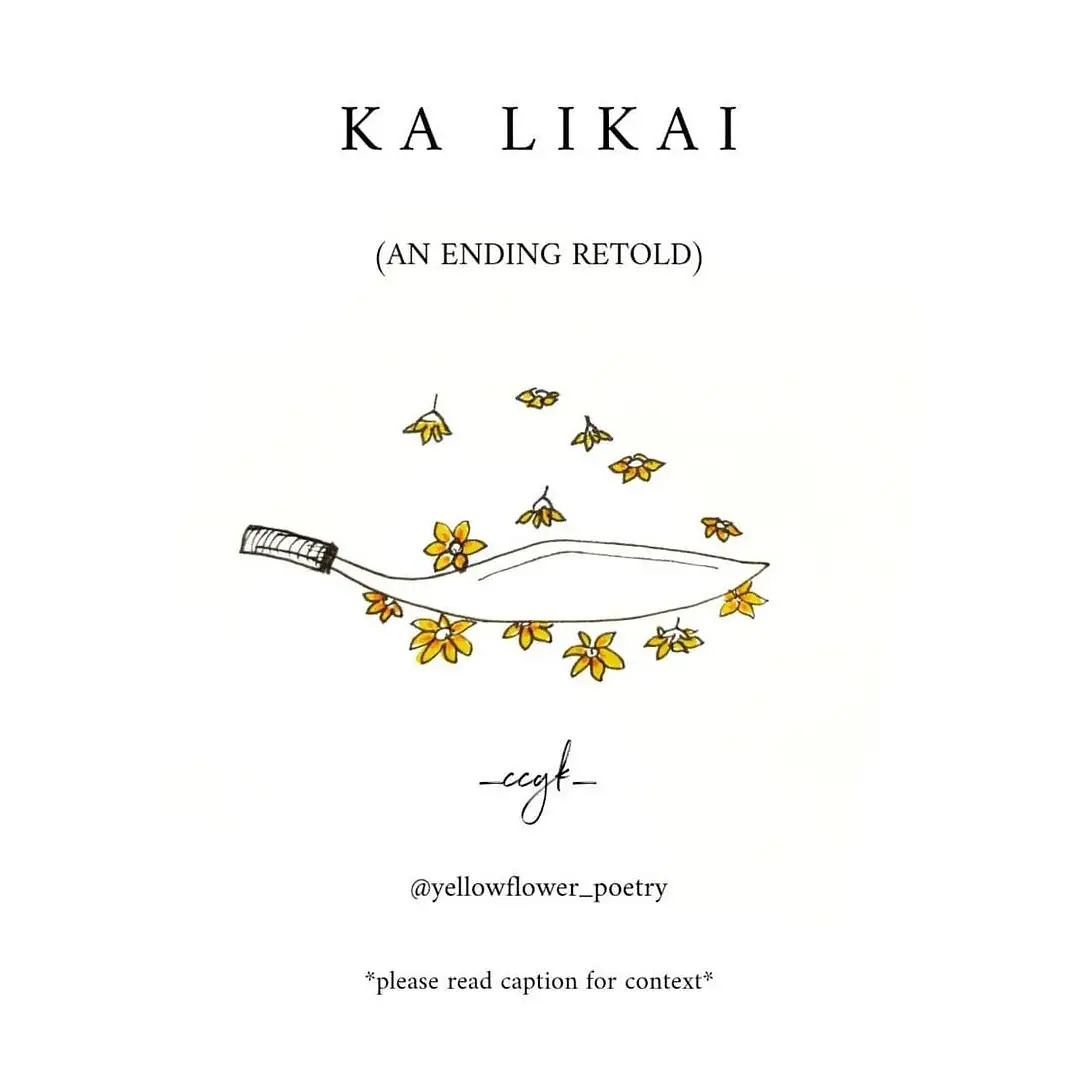
  • “Ka Likai (An Ending Retold)” by Clarissa Giri

    Calmly by the fire,

    She sits staring at the flames before her.

    Ember sparks burn freckles on weathered

    floorboards,

    Restless charcoal crackle uneasily in the dpei,

    While vapour fumes from her drenched

    kyrshah.

    Smoke and ash cling to her damp hair,

    A hot tear makes its way down her cheek,

    The wait glistens bloody at her heel,

    And she watches the shadows form on the

    wall before her

    As her ancestors dance for war.

    The rueful dish cooked to perfection,

    She feeds him a mouthful of this concoction-

    A stew of his own fingers; there will be no

    leftovers.

    How he tossed her daughter's tiny fingers like

    refuse in the shang-kwai,

    No. This butcher will devour his.

    There is a Khasi folktale about a widow named Likai who had a daughter whom she loved more than life itself. She was remarried after some time, to a man who later turned out to be abusive and dangerous and who eventually murdered her only daughter, while Likai was toiling in the fields. He butchered her and cooked a stew with the remains which Likai ate unknowingly. She found out after her meal when she was about to consume "kwai", a combination of betel leaf, lime and areca nut (a traditional edible) where she saw the remains of her daughter's fingers in the "shang-kwai" (areca nut basket).

    This caused a cacophony of chaos in her, driven by immense heartbreak and in a rage she ran after the man with a "wait" (a Dao or large bladed knife). Being unable to find him, in her madness-driven rage and being unable to endure life because of such a tragedy, Likai threw herself off of a waterfall. The waterfall is named after her fall "Noh Ka Likai" falls (Literally, Where Likai Jumped).

    This poem is a twist on that ending, as folktales go, there is always an ending of "What if?" and in this one there is no mention about what happened to the murderer and if ever he was given what he deserved. In this poem, I ask what if Likai found her daughter's murderer cowering in the forests of "Sohra" (Cherrapunji), and she was able to avenge her daughter before deciding upon her own fate?

    "Dpei" – hearth, "Kyrshah" – traditional khasi apron

    Caption and original artwork by @yellowflower_poetry