Tag: khasilanguage

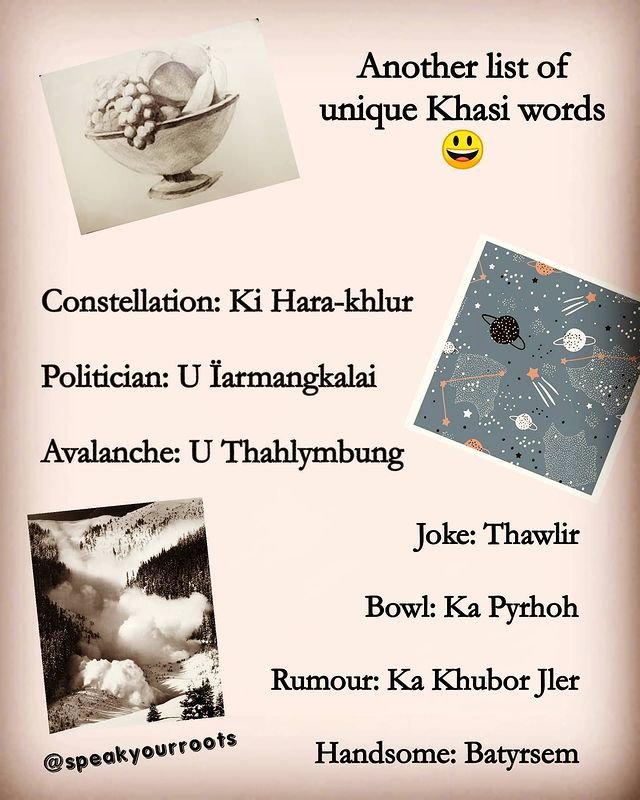
  • Another list of unique Khasi words

    Constellation: Ki Hara-khlur

    Politician: U Ïarmangkalai

    Avalanche: U Thahlymbung

    Joke: Thawlir

    Bowl: Ka Pyrhoh

    Rumour: Ka Khubor Jler

    Handsome: Batyrsem

    Here is another collection of unique words in Khasi! 🤩🤩🤩 The more we dig, the more we find. So men aren't "bhabriew" anymore, you are "batyrsem" 😎😎🤵🤵

    Source: Ka Dienshonhi: The Khasi Encyclopaedic Dictionary by Rev. Dr. Ïarington Kharkongor

  • Ki Kyrteng Sin Part I/ Khasi Nicknames Part I

    The Khasis have a practice of giving nicknames and besides the usual Bahduh, Theiheh, Kongdeng, Bahrit, which denote a specific position among siblings based on age, there are other kinds of nicknames that are given because of a context related to the person concerned. Here are some:

    Ka Smaw (ba ïong, ba jaing/ being dark and dirty)

    U Satlew (ba heh bad khlaiñ/ big built and strong)

    U Ren (ba bun ka shang/ always going out)

    U Dum (as in lyndum/ bald)

    Ka Taiñtabul (for timetable)

    U Koted (like the air horn of Bedford buses)

    U Buit (rit, buittuh, shu shyit briew beit/ small, wiry, likes to pinch others)

    U Tamuiñ (saw ki khmat bad ka ïambait/ red eyes and a cry baby)

    U Lo (pronounced like the word Law)

    Ka Bon

    U Been Loons

    U Sahep Laitkor

    Ka Samap (raikhoh/ stang shñiuh/ skinny, limp hair)

    U Bring

    Ka Rai (namar ba bang Krai/ because she likes millet)

    Bah Ling Saphu (a girl's nickname because she was scared of a beggar with this name)

    U Ro

    Ka Thre (named after a woman obsessed with cleanliness)

    U Lui

    U Jon Snai (named after a man who stole roosters to make them fight)

    Shnuit

    Ïong (dark complexion)

    'Ngaid (sngaid/ fat)

    Bung

    Lew Lew (from Pyllew/ big eyes)

    Pit Pit (namar ba sympit/ small eyes)

    Mem Syndem (ba syndem/ flat nose)

    Dem (ba syndem/ flat nose)

    "Ki Kyrteng Sin" or Khasi nicknames

    Don't we love our nicknames?! 😄😄😄😂😂😂 Here are some Khasi nicknames contributed by @indariwarjri @carey_lynz @bibianaryntathiang. Thank you for sending them! 😄

    Some have a context and some don't, but please do enjoy them and come up with your own interpretation!

    Please tell us about your funny nicknames! 🤡🤡😎🤓😎🤠🤠

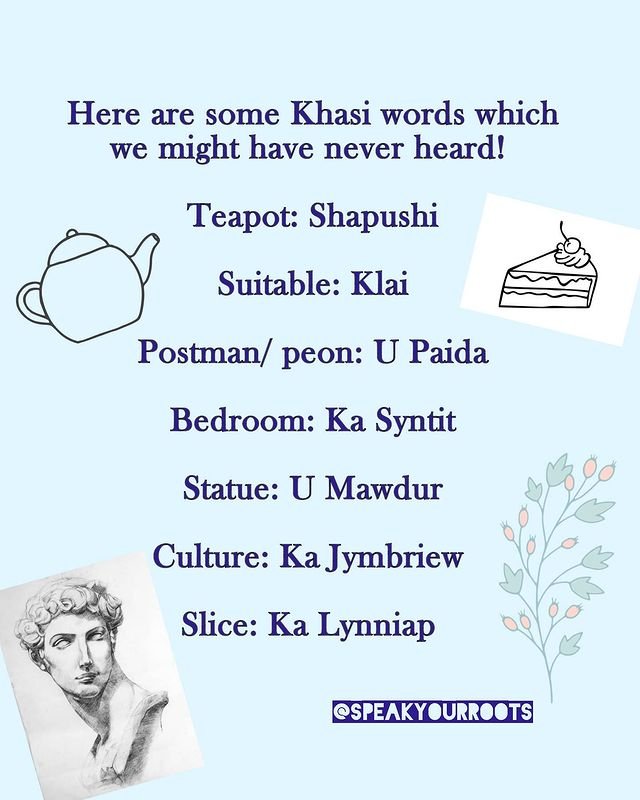
  • Some Khasi words which we might have never heard!

    Teapot: Shapushi

    Suitable: Klai

    Postman/ peon: U Paida

    Bedroom: Ka Syntit

    Statue: U Mawdur

    Culture: Ka Jymbriew

    Slice: Ka Lynniap

    Look at these words! Many of us will not know of them at all! 😲😮

    The Khasi language has a wealth of words which are no more in use today. We should make it a point to find out more words like these and use them in daily life! 🌄🏞️🌲🌤️

    Source: Ka Dienshonhi: The Khasi Encyclopaedic Dictionary by Rev. Dr. Ïarington Kharkongor

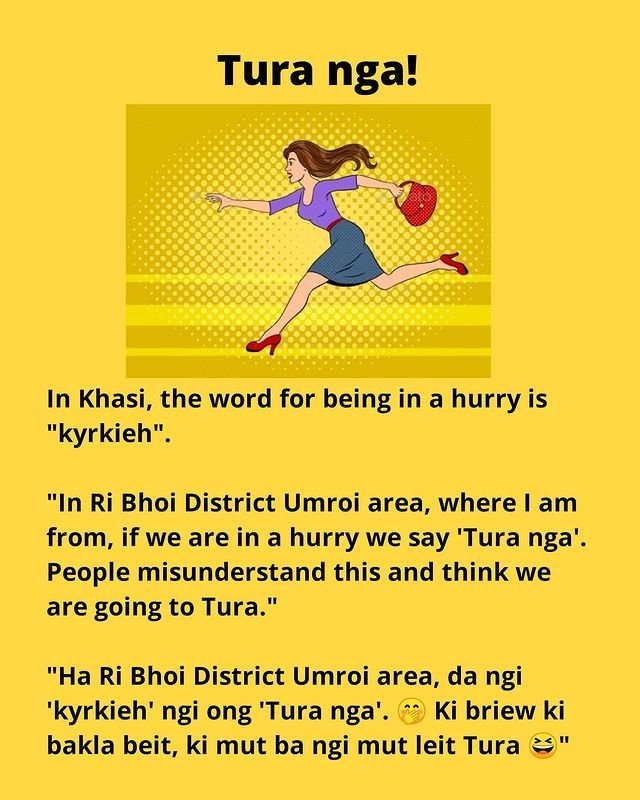
  • Tura nga!

    In Khasi, the word for being in a hurry is "kyrkieh".

    "In Ri Bhoi District Umroi area, where I am from, if we are in a hurry we say 'Tura nga'.

    People misunderstand this and think we are going to Tura."

    "Ha Ri Bhoi District Umroi area, da ngi 'kyrkieh' ngi ong 'Tura nga'. Ki briew ki bakla beit, ki mut ba ngi mut leit Tura.

    "Tura nga" sent by @adele__miss_dreamy 🏃🏃🏃 for when you are in a big hurry!!

    There are so many dialects present among the Khasi people. This is one from Ri Bhoi District. 😀 In this instance, people think it means "Tura" in the Garo hills. Thank you @adele__miss_dreamy for sending this!

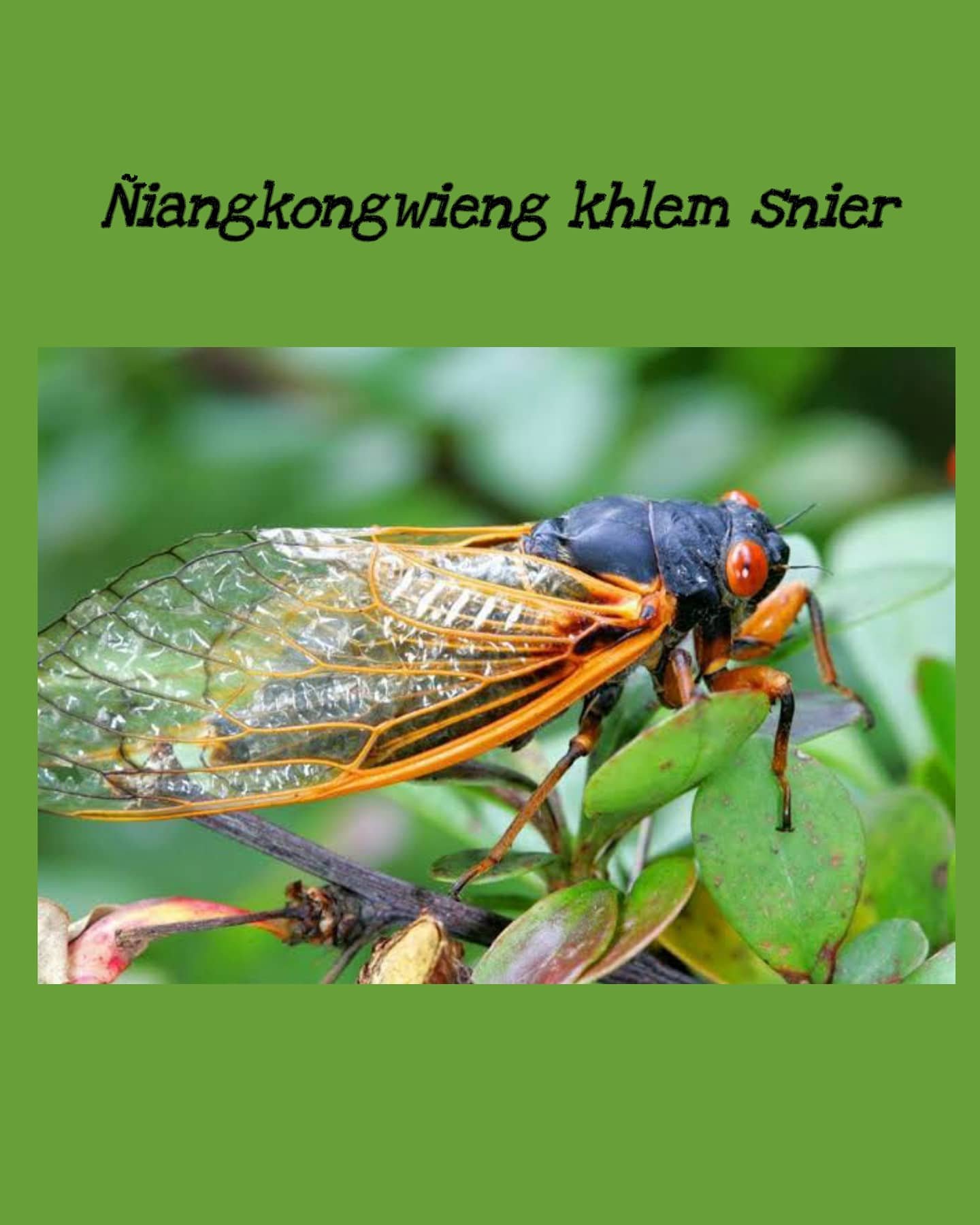
  • Ñiangkongwieng khlem snier

    Ka jingong Khasi "ñiangkongwieng khlem snier" ka ring jingmut na ka jingpah kaba mih na ka kpoh jong ka ñiangkongwieng kaba dap da ka lyer, hynrei kaba lah ban pah baroh shi sngi. Kane ka jingong ka thew ïa u briew uba heh tang ka tyngam bad ka khlem kam; u briew uba put ronsing ïalade tangba ubym larkam eiei ruh.

    In Khasi "Ñiangkongwieng" is the cicada and "Snier" are the intestines. The phrase above describes the cicada's body, in particular the abdomen because they breathe through "Spiracles" which are small holes in the abdomen. These spiracles are responsible for the sound of the cicada.

    This Khasi phrase focuses on the loud sound emanating from the porous abdomen of the cicada, to describe a person who is a big talker but never accomplishes anything. He likes to blow his own trumpet but in reality, he is useless and has no substance.

    "Ñiangkongwieng khlem snier" is a Khasi phrase which describes a big talker, whose arrogance is as loud as his voice when he talks of himself. 🗣️🗣️

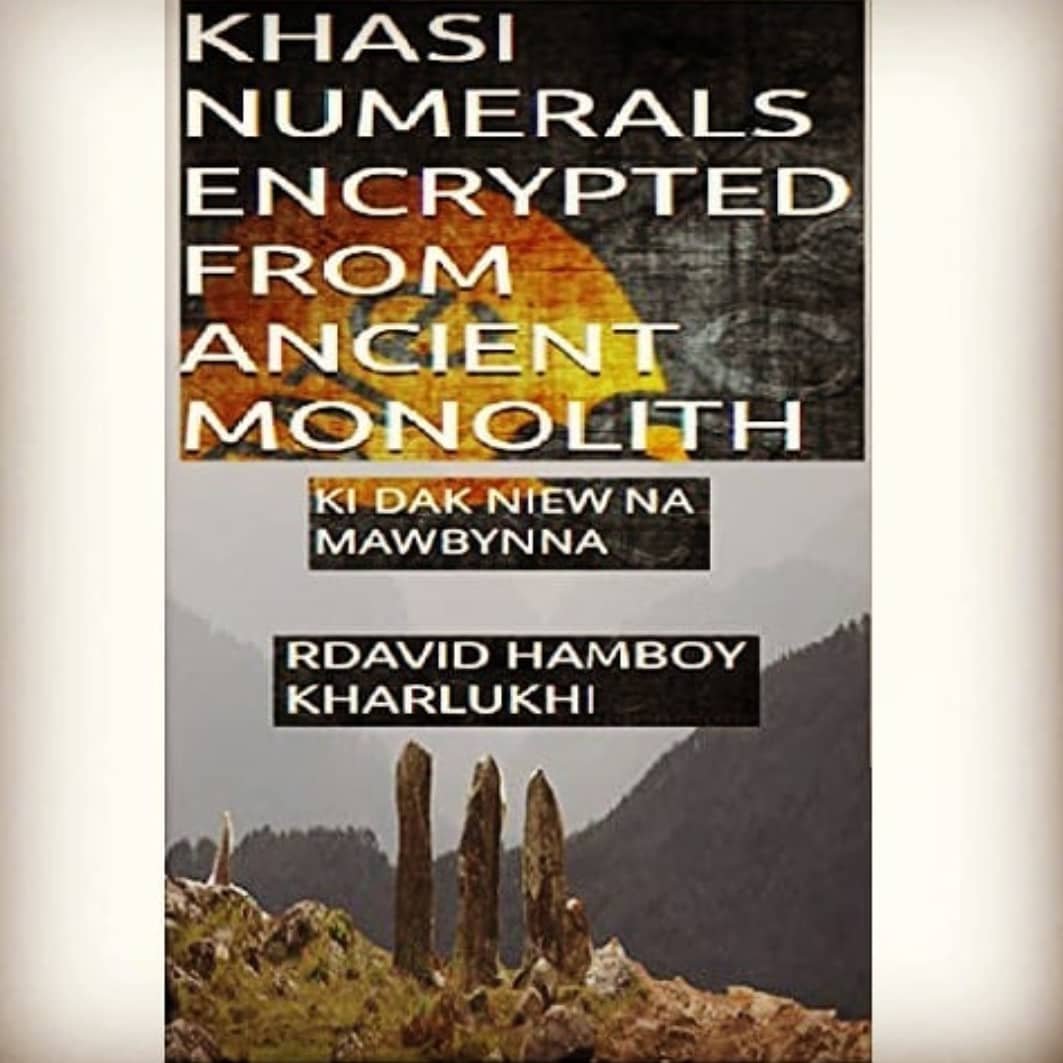
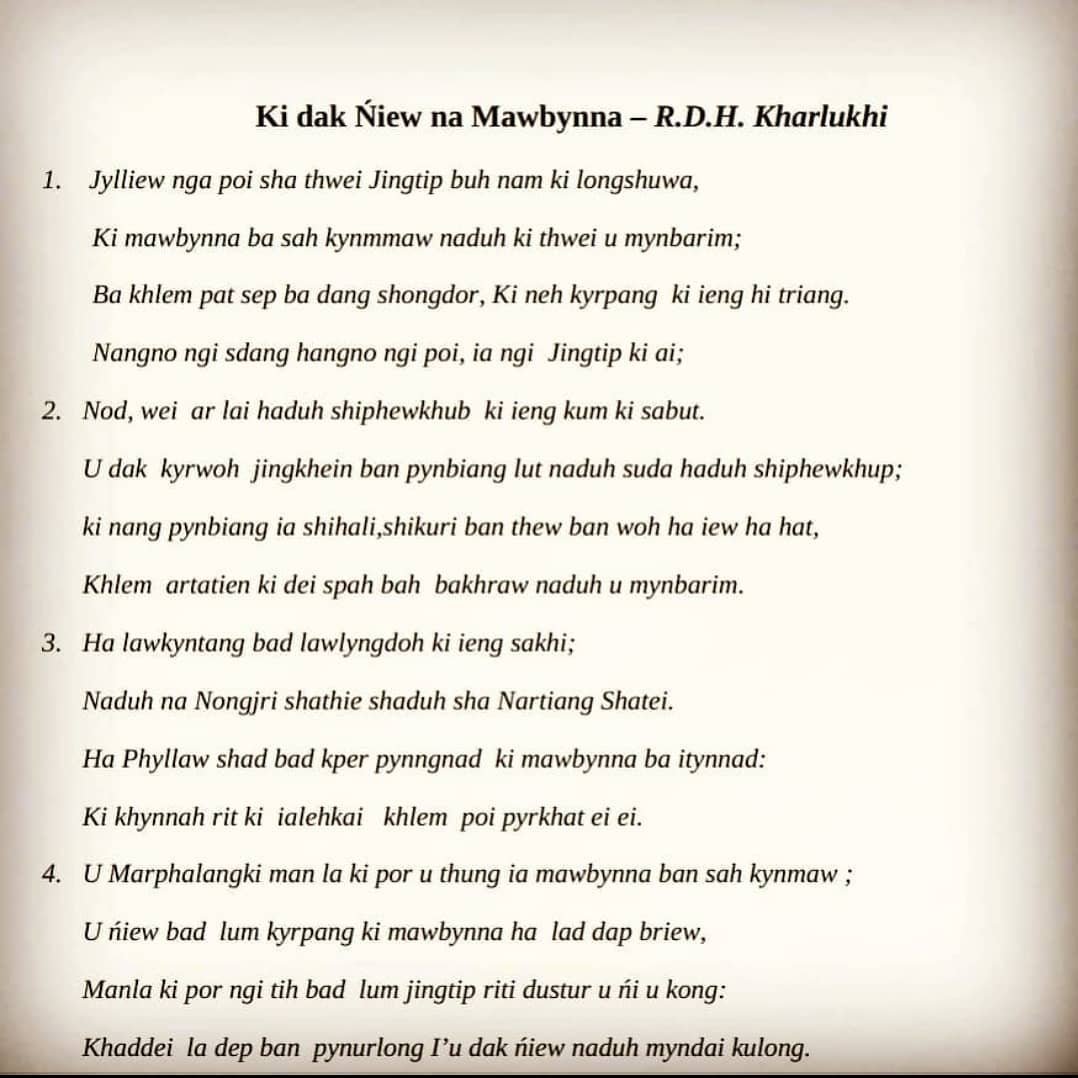
  • Ki Dak Ñiew na Mawbynna by R.David Hamboy Kharlukhi

    1. Jylliew nga poi sha thwei Jingtip buh nam ki longshuwa,

    Ki mawbynna ba sah kynmmaw naduh ki thwei u mynbarim;

    Ba khlem pat sep ba dang shongdor, Ki neh kyrpang ki ieng hi triang.

    Nangno ngi sdang hangno ngi poi, ia ngi Jingtip ki ai;

    2. Nod, wei ar lai haduh shiphewkhub ki ieng kum ki sabut.

    U dak kyrwoh jingkhein ban pynbiang lut naduh suda haduh shiphewkhup;

    ki nang pynbiang ia shihali, shikuri ban thew ban woh ha iew ha hat,

    Khlem artatien ki dei spah bah bakhraw naduh u mynbarim.

    3. Ha lawkyntang bad lawlyngdoh ki ieng sakhi;

    Naduh na Nongjri shathie shaduh sha Nartiang Shatei.

    Ha Phyllaw shad bad kper pynngnad ki mawbynna ba itynnad:

    Ki khynnah rit ki ialehkai khlem poi pyrkhat ei ei.

    4. U Marphalangki man la ki por u thung a mawbynna ban sah kynmaw;

    U ñiew bad lum kyrpang ki mawbynna ha lad dap briew,

    Manla ki por ngi tih bad lum jingtip riti dustur u ñi u kong:

    Khaddei la dep ban pynurlong I'u dak ñiew naduh myndai kulong.

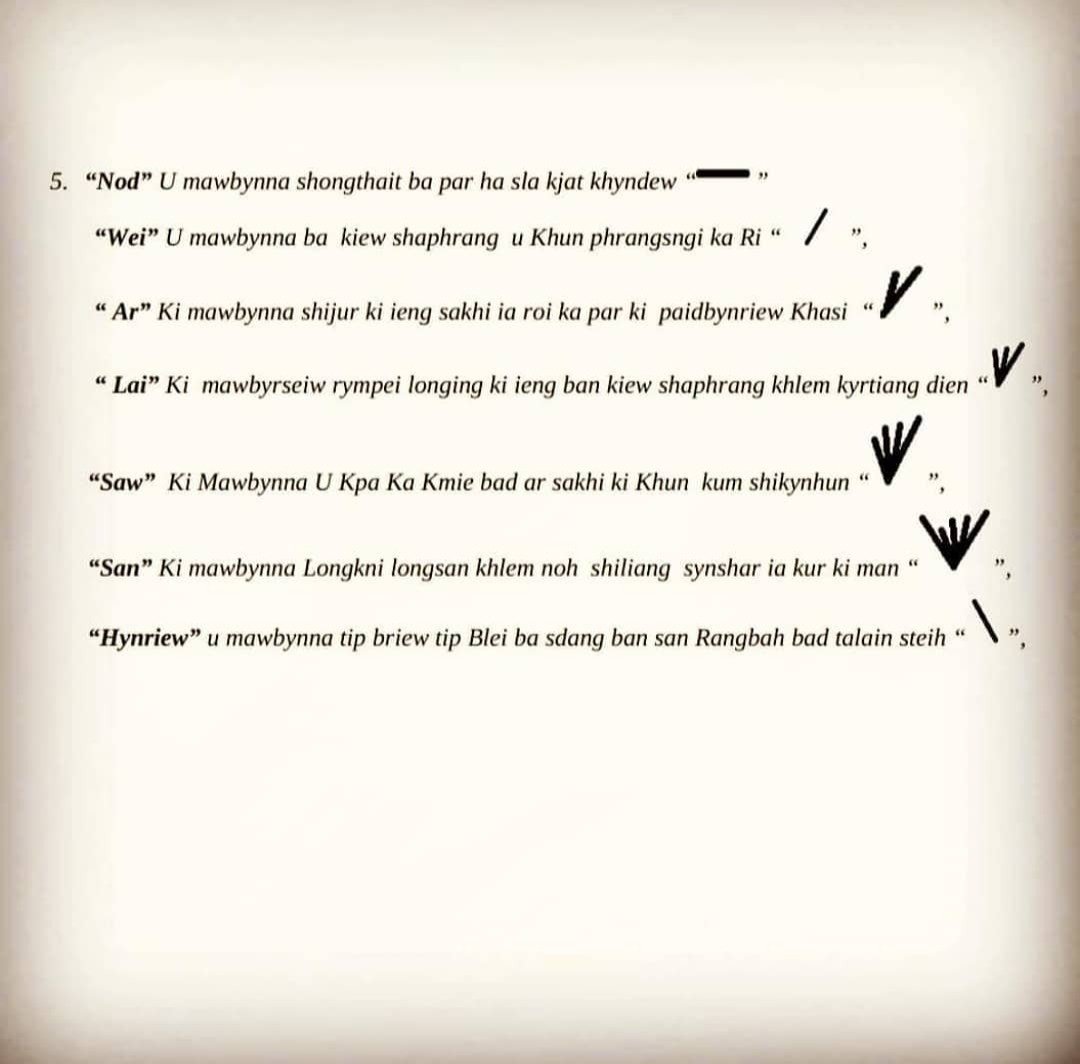
    5. "Nod" U mawbynna shongthait ba par ha sla kjat khyndew

    "Wei" U mawbynna ba kiew shaphrang u Khun phrangsngi ka Ri

    " Ar" Ki mawbynna shijur ki ieng sakhi i-a roi ka par ki paidbynriew Khasi

    " Lai" Ki mawbyrseiw rympei longing ki ieng ban kiew shaphrang khlem kyrtiang dien

    "Saw" Ki Mawbynna U Kpa Ka Kmie bad ar sakhi ki Khun kum shikynhun

    "San" Ki Mawbynna Longkni longsan khlem noh shiliang synshar ia kur ki man

    "Hynriew" u mawbynna tip briew tip Blei ba sdang ban san Rangbah bad talain stieh

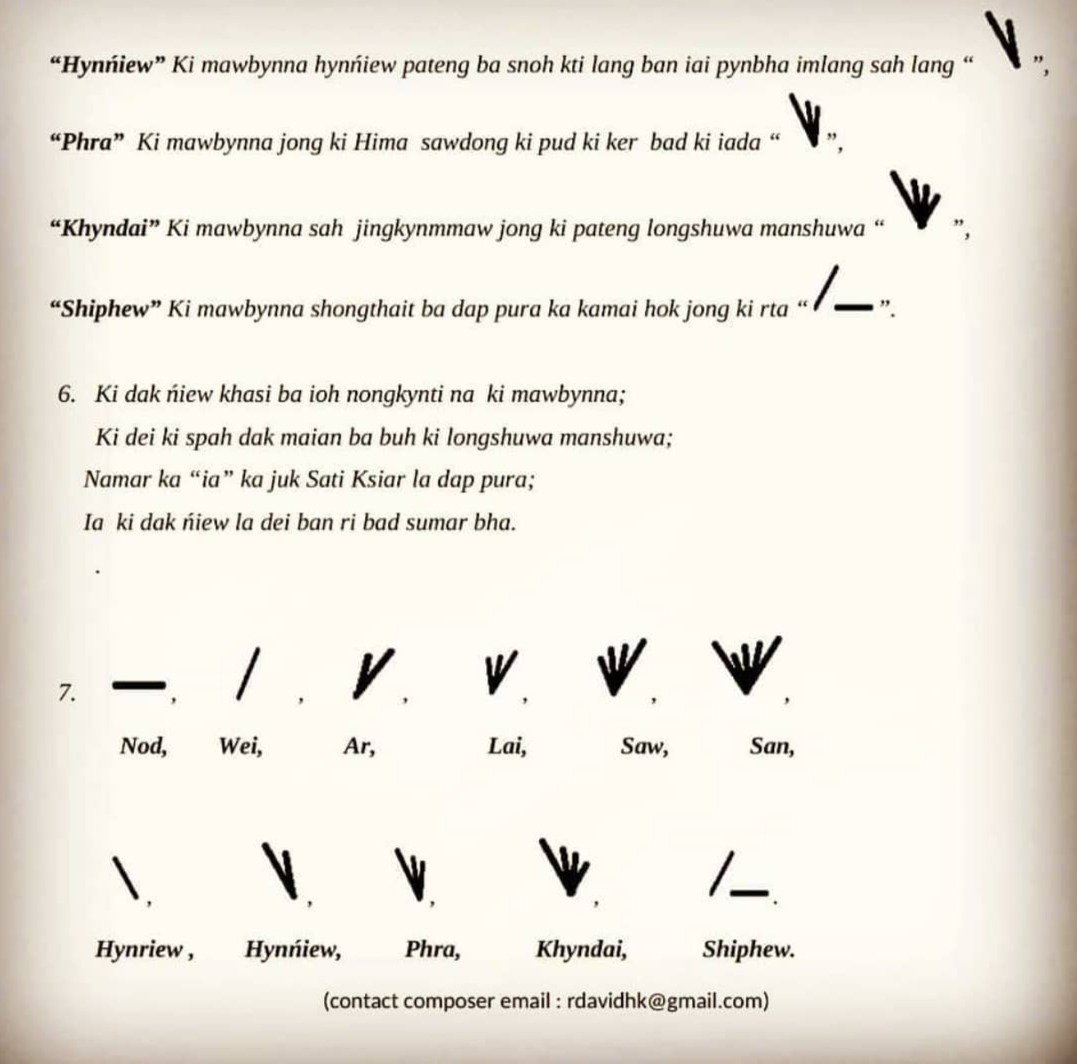
    "Hynñiew" Ki mawbynna hynñiew pateng ba snoh kti lang ban iai pynbha imlang sah lang

    "Phra" Ki mawbynna jong ki Hima sawdong ki pud ki ker bad ki iada

    "Khyndai" Ki mawbynna sah jingkynmmaw jong ki pateng longshuwa manshuwa

    "Shiphew" Ki mawbynna shongthait ba dap pura ka kamai hok jong ki rta

    6. Ki dak ñiew khasi ba ioh nongkynti na ki mawbynna;

    Ki dei ki spah dak maian ba buh ki longshuwa manshuwa;

    Namar ka "ia" ka juk Sati Ksiar la dap pura;

    Ia ki dak ñiew la dei ban ri bad sumar bha.

    "Ki Dak Ñiew Na Mawbynna” by R. D. H. Kharlukhi @davidkharlukhi is an original Khasi poem.

    This beautiful and well-crafted poem brings together Khasi numbers and the different kinds of "mawbynna" (monoliths) that Khasi and Pnar culture possess, to create an ingenious symbolism. It is a significant effort to create an awareness of the deep, inextricable bond between man and nature. Most importantly, the poem highlights the lessons encrypted in nature which many of us do not perceive.

    Thank you to Mr. R. D. H. Kharlukhi @davidkharlukhi for giving the permission to post his poem! This poem is available on amazon.in.
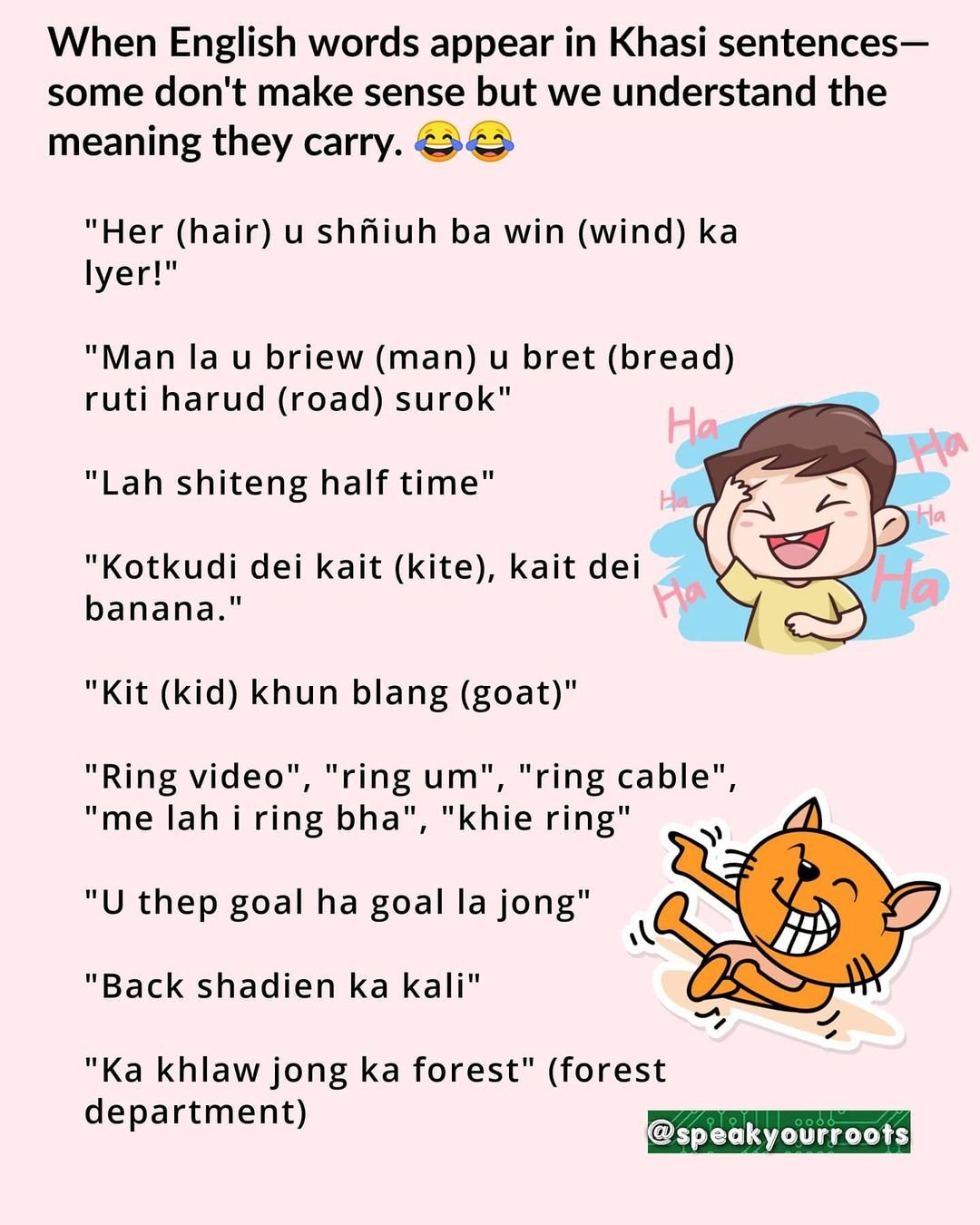
  • When English words appear in Khasi sentences

    When English words appear in Khasi sentences, some don't make sense but we understand the

    meaning they carry. Here are a few examples:

    "Her (hair) u shniuh ba win (wind) ka lyer!"

    "Man la u briew (man) u bret (bread) ruti harud (road) surok."

    "Lah shiteng half time."

    "Kotkudi dei kait (kite), kait dei banana."

    "Kit (kid) khun blang (goat)"

    "Ring video", "ring um", "ring cable", "me lah i ring bha", "khie ring."

    "U thep goal ha goal la jong."

    "Back shadien ka kali."

    "Ka khlaw jong ka forest." (forest department)

    The merging of languages is bound to happen and creates funny and interesting expression! 😂😂😂

    Thank you @_catherinemelam @esra_syiem @shillongftw @jeanrichardmawa @a_pocketful_of_plums @courageaity @longnamkharpuri @wthongnj for your contributions! 😆😆😆

  • Review of “The Legend of Ka Noh ka Likai” by Lapdiang Syiem

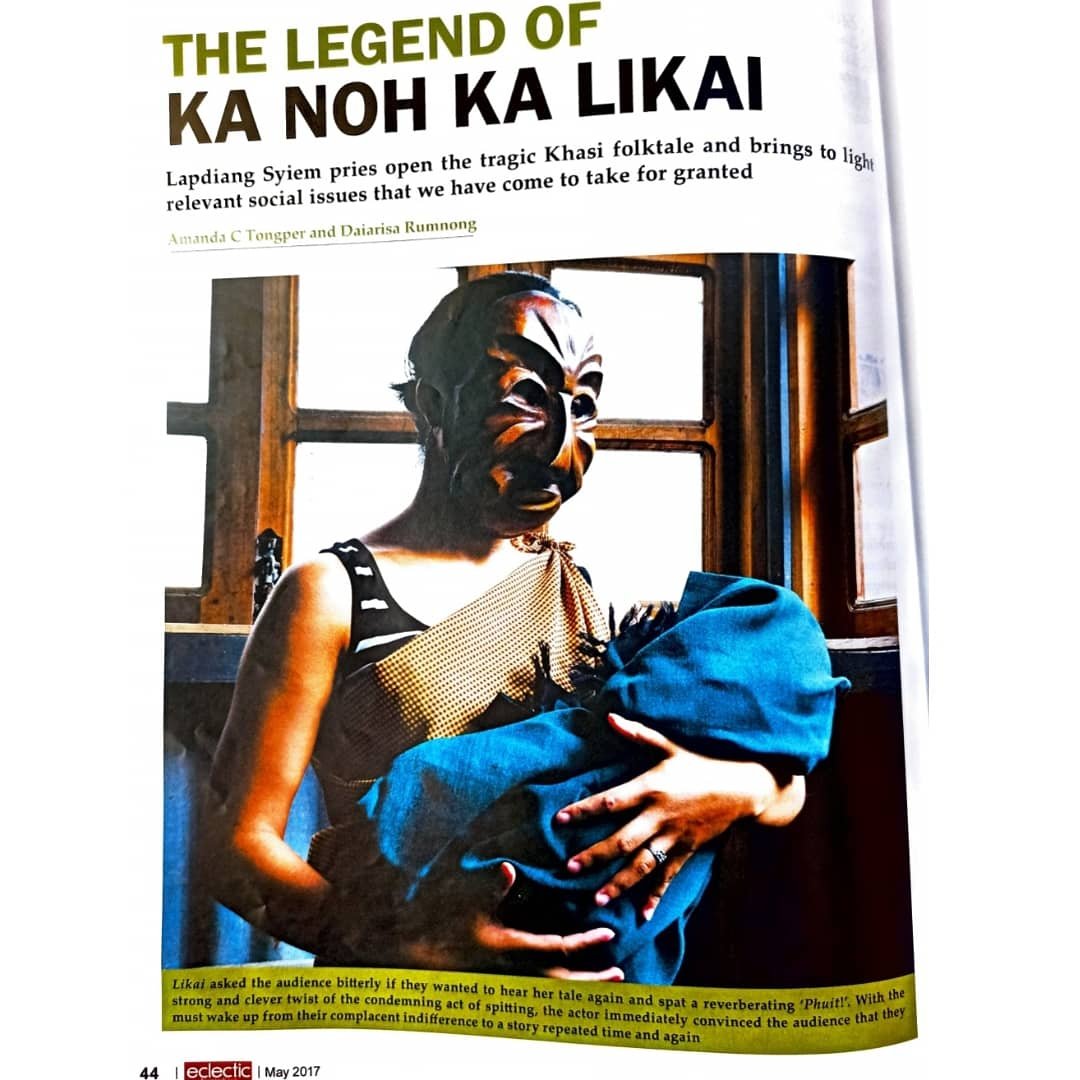
    Lapdiang Syiem’s Dramatisation of The Legend of Ka Noh Ka Likai: A Review by Dr. Amanda C. Tongper and Dr. Daiarisa Rumnong

    Nothing prepared us for the phenomenon which is Lapdiang Syiem. As we were ushered in into the enclosed space at Dylan’s Café, we were greeted by a figure framed atop a mula, transfixed with a baby in her arms. We stopped for a second, looking for traces of life in that mannequin of a being even though we knew at the back of our minds, that it is the actor, Lapdiang Syiem.  The first achievement of the actor was accomplished in the very first seconds of the play, as we later realised that we did not just enter the room where the performance was to take place – we were pulled into the orbit of the actor with a grip that was to hold us for the rest of the performance. 

    Lapdiang, through the character of Likai, pried open the tragic story of Ka Noh Ka Likai that has been encapsulated in time and brought to light relevant social issues muted within a tale that we have come to take for granted. Likai asked the audience bitterly if they wanted to hear her tale told again and spat a reverberating “Phuit!” With the strong and clever twist of the condemning act of spitting, the actor immediately convinced the audience that they must wake up from their complacent indifference to a story repeated time and again. The spit cautioned the audience that in this re-telling, they cannot rely on their rote-memory of the story. The spit challenged the collective conscience of the audience who may have known the narrative of Ka Noh Ka Likai, but has never thought to understand the story of Ka Likai, the being with thoughts and emotions of her own.

    Lapdiang Syiem’s performance provokes a fresh look at the oft-told story of Likai. Entering the venue, the image of Lapdiang whose face was covered by a mask, holding a baby seemed to be suspended in purgatory, adrift in limbo. The image is at once a detonating symbol. It evokes the pre-conceived notion that a woman is pitiable, weak, unsettled on her own and a man is her only anchor. This notion that rises from a deep-seated, almost genetic conditioning remains such an inescapable factor even in this 21st  century stage of our lives. The orbit we were drawn into had a familiar ring to it. But were we looking hard enough to notice the reflection we should see of ourselves; of how much the motif of a woman jumping to her death actually echoes all those stories of violence, dispossession and death?  Why is it that a woman is expected to be tied to a man? Why does a part of a so-called “binary” cannot exist alone? In the performance of Ka Noh Ka Likai, Likai after living as a widow was told by other women in her community that she should marry another man. A man it appears embodies security. However, this “security” that society perceives as normal or good may actually lead to irrevocable despair.  

    The only device that aided Lapdiang’s performance was the music played by Apkyrmen Tangsong. Apkyrmen played original compositions on the maringud, ksing and besli. All three instruments moulded themselves into the performance, even eerily voicing out the muffled cries

    of Likai’s baby. The poignant and haunting pieces feel like the past knocking on our foreheads saying: “Don’t get too comfortable, too familiar with showing me off. Try to understand my relevance for the present and even the future!” The music, words and gestures of the performance swayed the audience, dug out tears, drawing us breathless with questions that perhaps are desperate to break free. It made us feel uncomfortable…in all the right places.

    In Lapdiang’s performance, there is a curious blend of acting and telling, so that one is compelled to say, the oral is still with us. One usually speaks of the oral tradition with a sense of

    nostalgia, as a thing of the papyral past. However, with Lapdiang’s performance, one witnesses that this form of communication has never really left us. We only have to engage with it once again. The gusts and ripples of ka Ka Noh Ka Likai echo everyday, do we listen?

    As the play came to its end, there was silence among the audience. It was a sacred moment to watch Lapdiang give Likai life with such heart, strength and intelligence.


    Lapdiang Syiem is a force to be reckoned with.  

    Lapdiang A. Syiem was born and brought up in Shillong. She is a graduate from National School of Drama, Delhi with a specialisation in Physical Theatre from the Commedia School, Copenhagen. In 2016, Lapdiang, along with Keshav Pariat and Juban Lamar founded an artistic commune called, The Unhinged Commune. They blog regularly at kinongbamsohlah.wordpress.com

    This is a review of a fantastic and heart-wrenching performance by @lapdiangsyiem of "The Legend of Ka Noh ka Likai" in 2017. Folktales transformed into theatre is something else! 💫💫💫

    The review was published in @eclectic_northeast magazine and has been written by Dr. Daiarisa Rumnong (Assistant Professor, St. Mary's College) and Dr. Amanda C. Tongper (Assistant Professor, St. Anthony's College).

    Thank you @lamar.juban for the beautiful pictures used in this review!

    Please send an email to speak.your.roots@gmail.com if you would like to read the review!

  • Kren amrang

    Ka jingong "Kren amrang" ka batai ïa ka jinglong jong u ne ka briew, ha kaba ki saitlah rhing tang ban lah ka nia la jong. Kiba kren amrang ki pyneh ïa la ki jong ki nia khlem pynjem ïano ïano ruh bad ka jingïohi jong ki ïa kiei kiei ruh ki neh pyrkhing beit kum kaba ki mut. Ïa ka ktien "amrang" la ju pyndonkam ruh ha ka die ka thied ïa ki briew kiba pyneh ïa ka dor jong ki tiar ki tar.

    "Kren amrang" is a Khasi phrase which describes a person who doggedly sticks to his argument; someone who has a rigid perception and who will not compromise to what others say. The word "amrang" also means being inflexible about the price of a commodity.

    "Kren amrang" is a Khasi phrase which describes an unrelenting and unyielding outlook.

  • Thomas Jones Day

    Reverend Thomas Jones kum kpa ki dak thoh khasi,

    Dak a, b, k, d ba ngi nang dei ba

    phi hikai ïa ngi.

    -Daohi Manar

    The 22nd of June, the day that marks the arrival of Thomas Jones in Sohra is commemorated as Thomas Jones Day in Meghalaya. Thank you @xdtnoahjupejackllthmanar for sending this!

    Thomas Jones was a Welsh Christian missionary, who worked among the Khasi people of Meghalaya and Assam in India and of Bangladesh. He recorded the Khasi language in Roman script and the inscription on his gravestone calls him "The founding father of the Khasi Alphabet and literature".