Tag: khasilanguage

  • Sawdong ka Lyngwiar Dpei

    "Sawdong ka Lyngwiar Dpei" or "Around the Hearth"

    "Sawdong Ka Lyngwiar Dpei" ka dei ka jingong ne ki kyntien kiba ngi ju pyndonkam ban batai ïa ka por kyrpang ha man ki thliew ïing jong ka jaitbynriew Khasi ha kaba baroh shi ïing shi sem ki ju ïa shong harud ding, ban ïa sngap ban ïa khana. Dei ha kane ka por ba ki khanatang bad ki puriskam u mynbarim ki khie im lyngba ki riew rangbah ne ki riew tymmen kiba dei ki nongkren nongkhana. Ha kane ka por ruh, ki tymmen ki ju shim ïa ka kabu ksiar ban sneng ban kraw, khamtam eh ïa ki khun ki ksiew ki ban dang san ki ban dang samla, namar ba baroh shi ïing shi sem ki ïa don lang ha kane ka por.

    Katba ngi dang jam sha ka ïa jong ka pyrthei stad pyrthei thymmai, kata ka ding lane ka lyngwiar dpei jong ka ïing kum ban shu ong noh ka lah sang ban jah noh namar bun na ngi, ngi la ïa tei da ki ïing ki ban ïahap bad ki por mynta, kumba ngi ïohi ha ki phlim, ha ki TV, ki magazine bad kumta ter ter. Kuma, ngi la hap ban shu mutdur noh ïa kata ka ding lyngba ki dur ne haba ïohsngew ha ki khana. Te kumno ngin pynim ban pynneh biang ïa kata ka ding kaba la sdang ban duh noh-Ka ding kaba wanrah ïa ka jingsngew shngaiñ, sngew shongshit haba ngi sngap ïa ki khanatang, ki puriskam bad ki jingsneng-jingkraw kiba shongñia, kiba shong nongrim bad lehse bun na ngi, ngi lah duh noh ïa ka da kaba im tynneng kum ki nongwei.

    Hooid lehse ngi dang lah ban pynim ïa kane ka ding jong ka lyngwiar dpei kaba dei ka rukom tynrai jong ngi da kaba ïalum shi ïing shi sem, shi paralok ban ïa kren ïa phylliew jingmut shaphang ka jymbriew, ka histori bad ka ktien ka thylliej. Ngi hap ban shim ïa kane ka sienjam wat lada dei tang harud ka miej bamja, haba ïa shong dih sha, haba ïa shong pyllun ïa ka shawla ne ha kano kano ka por wat lada kam don shuh kata ka ding ne ka lyngwiar dpei, hynrei kan ïai rhem hapoh jong ngi lada ngi pynneh ïa ka rukom ïathuhkhana bad ïa sneng ïa kraw ha ki por kyrpang kiba sngewbit ha man la ki longïing.

    Ma ngi hi shimet ngi dei kita ki lyngwiar dpei ki ban pynpaw ïa ka jingstad bad jingshemphang jong ki longshuwa-manshuwa jong ngi.

    "Sawdong ka Lyngwiar Dpei" or "Around the Hearth" are words that are used to describe the time in a Khasi family when family members would sit around the hearth, the flames giving them warmth and light. It is at this time that stories are told, our oral tradition becomes alive, from the words and expressions of an elder of the family.

    As we move into the first quarter of the 21st century, the physical hearth has gone absent from our modern homes and we are left to imagine the embrace of the warm flames of a hearth from pictures or from books. How do we recreate that atmosphere, that feeling of being together almost as one breath and one mind as we listen to folktales, legends, myths and ponder on teachings which contain truths that we may have lost in our rush into globalisation?

    Perhaps we can recreate the hearth by gathering our family and friends to talk about our culture, history and language. Because we need to revive the interest and love for what is our own, for what we belong to. We may not have our physical hearth but we can create a symbolic "lyngwiar dpei" by talking, by listening, by reading, by understanding with clear hearts and minds. A clear heart and mind with a need to know who I am and what am I going to become?

    In a way, we are the hearth, we are the "lyngwiar dpei", we are a walking talking hearth who emanate the light of our ancestors' knowledge and wisdom.
  • Rangbah Joit

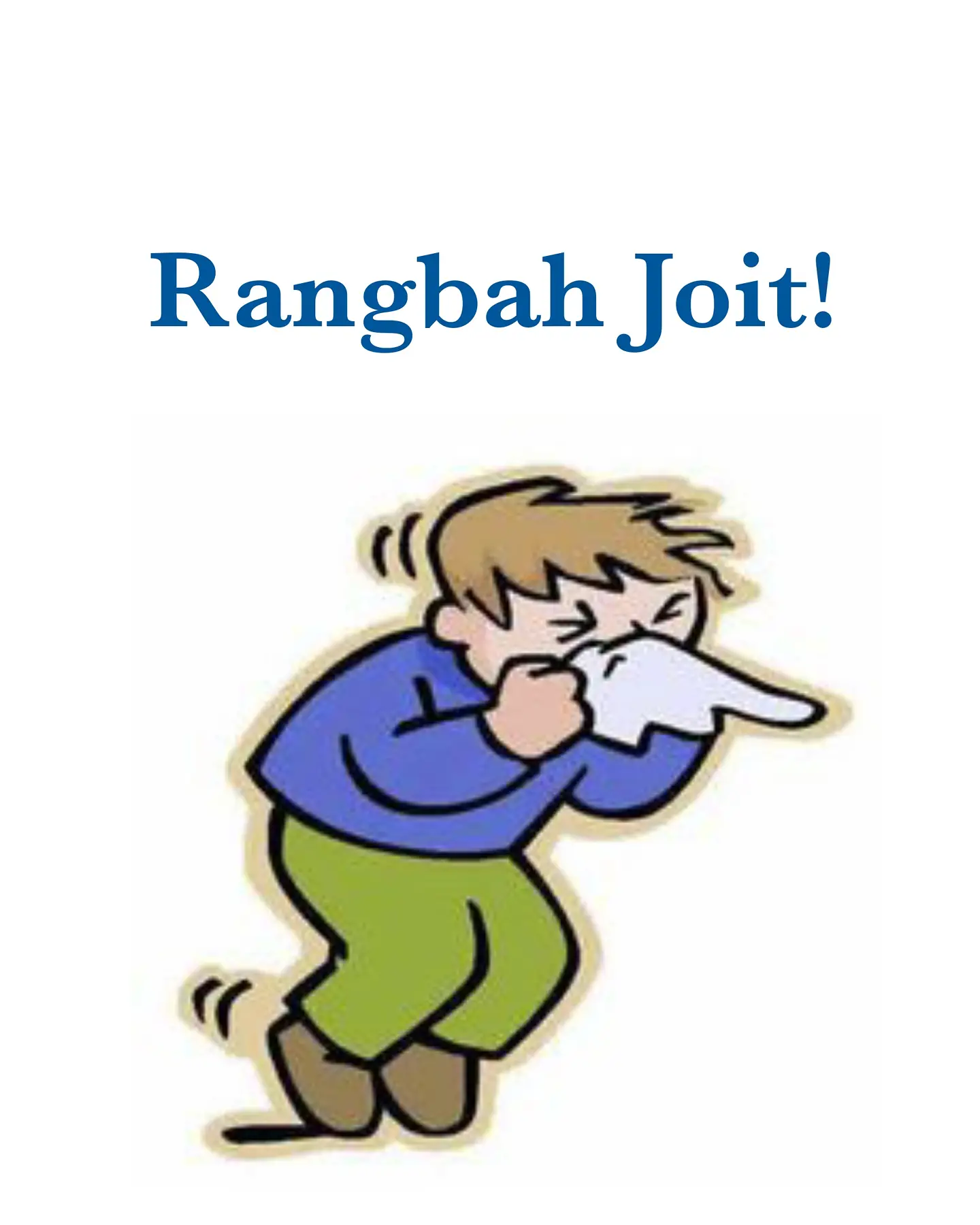
    Ngi ju ong "Rangbah Joit!" haba ki khynnah ki synriah. Kane ka rukom kren ka long kum ka jingkyntu ïa ki hep barit ba kin heh kin san, ba kin koit kin khiah.

    The Khasi word "Rangbah" means an adult or a grown up. The word "joit" means to do (or act) something immediately or quickly and also implies the motion of standing or moving up. Together the words form a phrase that is said when a child sneezes. When said after a child sneezes, the phrase is a kind of exhortation for the child to grow and develop in good health and spirit, without obstacles.

    Here are some responses to sneezing from different countries:

    In Dutch they say "Gezondheid" which means "Health!", the equivalent of "Gesundheit" as said in English or if the person has sneezed three times "(Drie keer) morgen mooi weer" which means "(Three times) the weather will be nice tomorrow."

    In Albanian they say "Shёndet" (shuhn-det) which means "Health!".

    In Assamese they say মঙ্গল হওক (môngôl hôwk) which means "May good happen."

    In Bulgarian they say "Наздраве" (Nazdrave) meaning "To your health" or "Cheers".

    In Cambodian they say សុខភាព (sokhpheap) which means "Health".

    In Hawaiian they say "Kihe", "a mauli ola", or simply "Ola" meaning "Sneeze, and you shall live", or simply "live"

    "Rangbah Joit!" is an expression in Khasi that is said when a child sneezes. It echoes a sense of comfort and well-being that is a great way to make a child feel! 🧍🧍🌻🌻

  • Ym lap lieng and Kylla lieng

    Kylla lieng

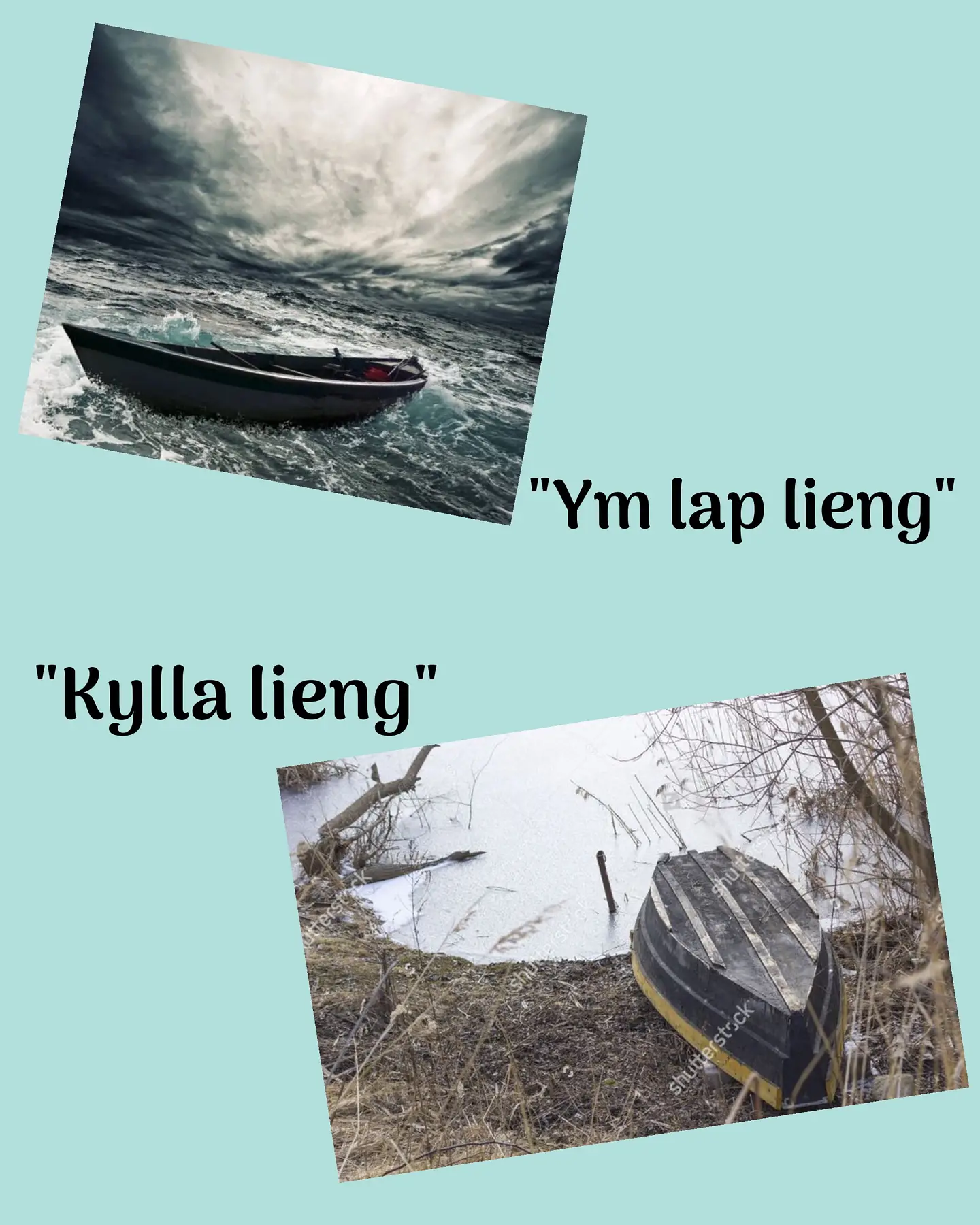
    Ka jingong "kylla lieng" ka thew ïa ka jingwan shoh tyndep ka pyrthei nemsniew ban pynduk pynshitom ïa u ba don ba em. Ka dei ruh ka jingkylla khongpong ka jingim na ka im suk im saiñ sha ka kordit tam. Shuh shuh, kine ki kyntien ki batai ïa ka jingshah lynshop ha ka jingsniew bok, ba wan ban ka jingpang jingshitom haduh ba u briew um lah bteng shuh ïa ka kam ba u la pyrshang.

    The Khasi phrase "kylla lieng" is the harrowing arrival of famine or an epidemic causing suffering and poverty for even those who are well-to-do. The phrase also refers to the reversal or the turning upside down of an easy life to calamity and ruin. Further, the words also mean to be wracked by bad luck, that is caused by illness to the point that a person cannot continue with his work.

    Ym lap lieng

    Ka jingong "ym lap lieng" ka batai ïa ka jingkyrkieh kum bym don por ne lap briew shuh. Ka kren ruh ïa ka jingsheptieng ba ïoh shah iehnoh bym lap kem shuh ïa ka lieng.

    The Khasi phrase "ym lap lieng" is to be in so much haste that we are out of time or we cannot find the people we need to meet. The phrase also talks about the fear that one experiences in case they don't arrive on time to reach the boat.

    "Ym lap lieng" and "Kylla lieng" are two Khasi idioms using a boat as the metaphor ⛵🚤🛥️

    🟡 Sources: Rev. Dr. Ïarington Kharkongor and by Primrose G. Gatphoh.

    English translation by @speakyourroots

  • Khasi Adverbs

    Btáj-btáj ka mut kaba kynja ba dambit ne bit nah/ soft and sticky.

    Wur-wur ka mut kaba kylluid ne kaba ïar/ something loose or wide.

    Wap-wap, wep-wep ka mut ba jem tlot, kumba jem u briew ba pang swai/ someone who is frail and delicate because of ill health.

    Ryngmang-ryngmang ka mut kaei kaei kaba long kyndit khlem da pyrkhat ne khmih lynti lypa/ something unexpected and unforeseen.

    Jngaiñ-jngaiñ ka mut kaba ïong shikatdei kum ka um ba jylliew/ something dark like very deep water.

    Ngaiñ-ngaiñ ka mut kaba dum tliw bad ka thew ïa ka jingdum jong ka bneng/ very dark and usually refers to the darkness of the sky.

    Pharúh-phareh ka mut ha ka rukom ka bym suitniew/ careless, reckless, clumsy.

    Khasi adverbs bring character and substance to the Khasi language! 💬🗯️💭 They describe actions, colour, emotion and so many things with a dramatic effect that is not easily translated.

  • Ki Ktien Kynnoh

    Ki Ktien Kynnoh are a pair of words which complement one another. The second word emphasises and enhances the meaning of the first word. Ki Ktien Kynnoh may be described as Akin words. There is a catchy rhythm to the pair too as they contain the same number of syllables, which makes saying them fun and more importantly gives depth and meaning to a sentence. The following ktien kynnoh are taken from The Khasi Encyclopedic Dictionary: Ka Dienshonhi by Rev. Dr. Ïarington Kharkongor. They have been translated by @speakyourroots.

    Danda – Phulit

    Danda: Ka mut ka jingkren ne jingïathuh ïa kiei kiei ki bym shisha da kaba pyndonkam ïa ki ktien ne ki khana nangno nangno bad sa pynkut ha kata ka rukom tang ban ïoh ban pynsngewbha ïa ki briew.

    Phulit: Ka thew ïa ka rukom kren biria kai te hynrei don ki biria kiba ïa jinghikai bad jingmyntoi.

    Danda is a conversation or the telling of a story that is not based on real fact, but is taken from many sources, with the purpose of making people laugh at the end.

    Phulit is a particular way of talking humourously with a lesson at the end of the story.

    Ngiah – Shoin

    Ngiah: Ka dei ka ktien kyllum kaba mut ba la dap ne pura bha lane bym sngewtynnat shuh ïa kiei kiei.

    Shoin: Ka kham thew ïa ka jingbam kaba la bam bad la dap pura haduh ryndang ne rmiang shyntur bym long shuh ban pynrung jingbam. Ïa ka jingbam haba dang ngiah dang long ban bam hynrei haba la dap shoin ym long shuh ban bam. Haba ngi ong pat 'ngiah shoin' ka mut kaba la palat ban ïa kaba ju long.

    Ngiah is a feeling of fullness and satiation or having had enough of something, which might also cause unpleasantness.

    Shoin is more of a reference to food that cannot be eaten anymore. In the case of 'ngiah' food can still be eaten but when we use the word 'shoin', it means there is no chance of being able to eat.

    Maitang – Maitait

    Maitang: Ka mut ba kyndiah ne ieh noh shisyndon khamtam ïa ka jingmlien kaba sniew.

    Matait: Ka mut ka jingkular ne jingsmai ban iehnoh ne kyntait shi syndon ïa kaei kaei ka bym ïadei bad ka jingim longbriew manbriew.

    Maitang is to abstain from or completely leave something, especially a bad habit.

    Maitait is a promise or oath to avoid or reject that which hampers or damages the balance of our physical, emotional and mental well-being.

    "Ki Ktien Kynnoh" lend so much quality and character to the Khasi language! They are really quite a unique feature of the language. 😃😃 We have tried to find the English word for them but it appears there is none. "Akin words" seems to describe them best.

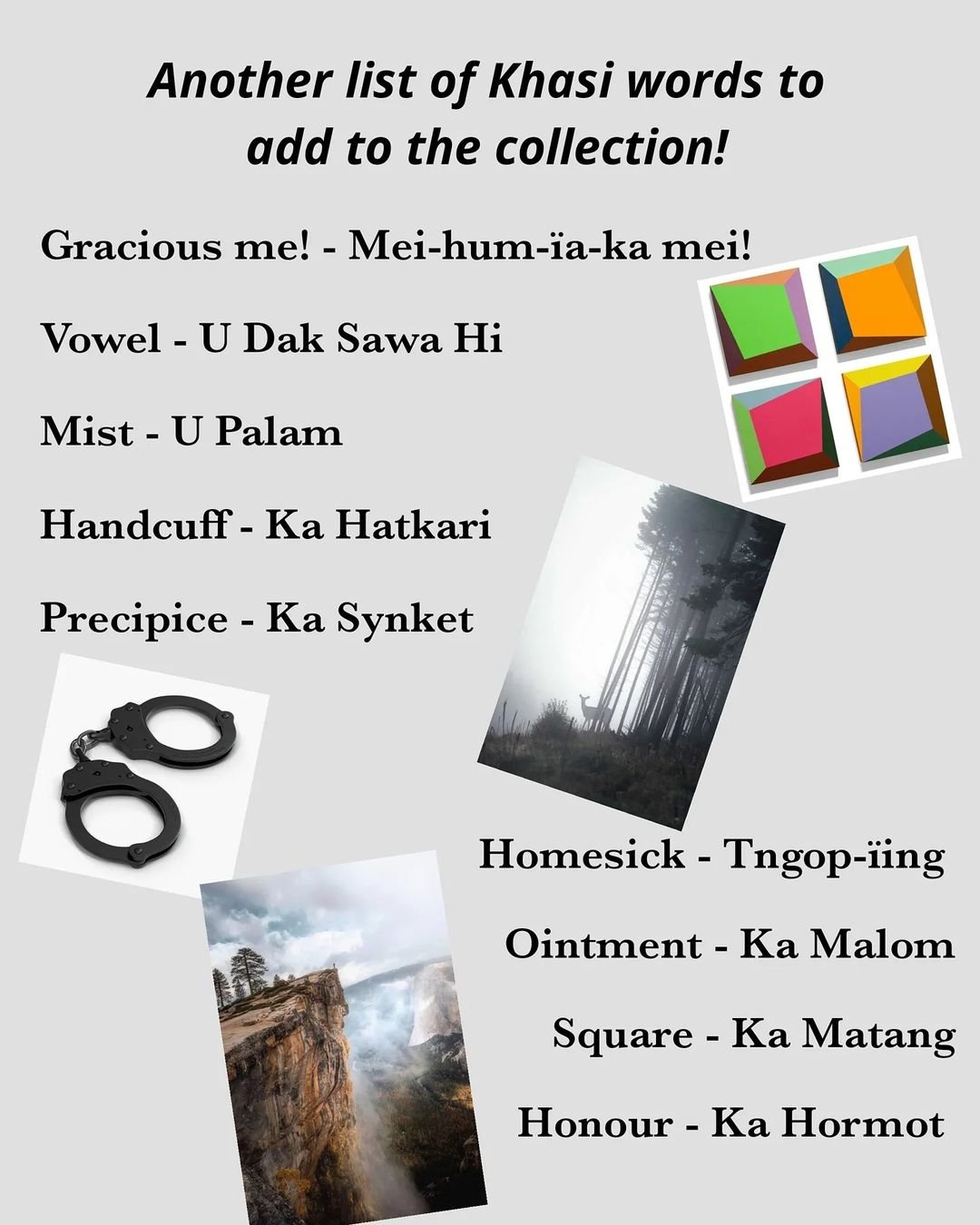
  • Another list of Khasi words to add to the collection!

    Gracious me! – Mei-hum-їa-ka mei!

    Vowel – U Dak Sawa Hi

    Mist – U Palam

    Handcuff – Ka Hatkari

    Precipice – Ka Synket

    Homesick – Tngop-їing

    Ointment – Ka Malom

    Square – Ka Matang

    Honour – Ka Hormot

    Here is another list of Khasi words to start using! 😃🤓🗣️🗣️

    🟡 Source: Ka Dienshonhi: The Khasi Encyclopaedic Dictionary by Rev. Dr. Ïarington Kharkongor

  • U Wah Sdai/ Sdie

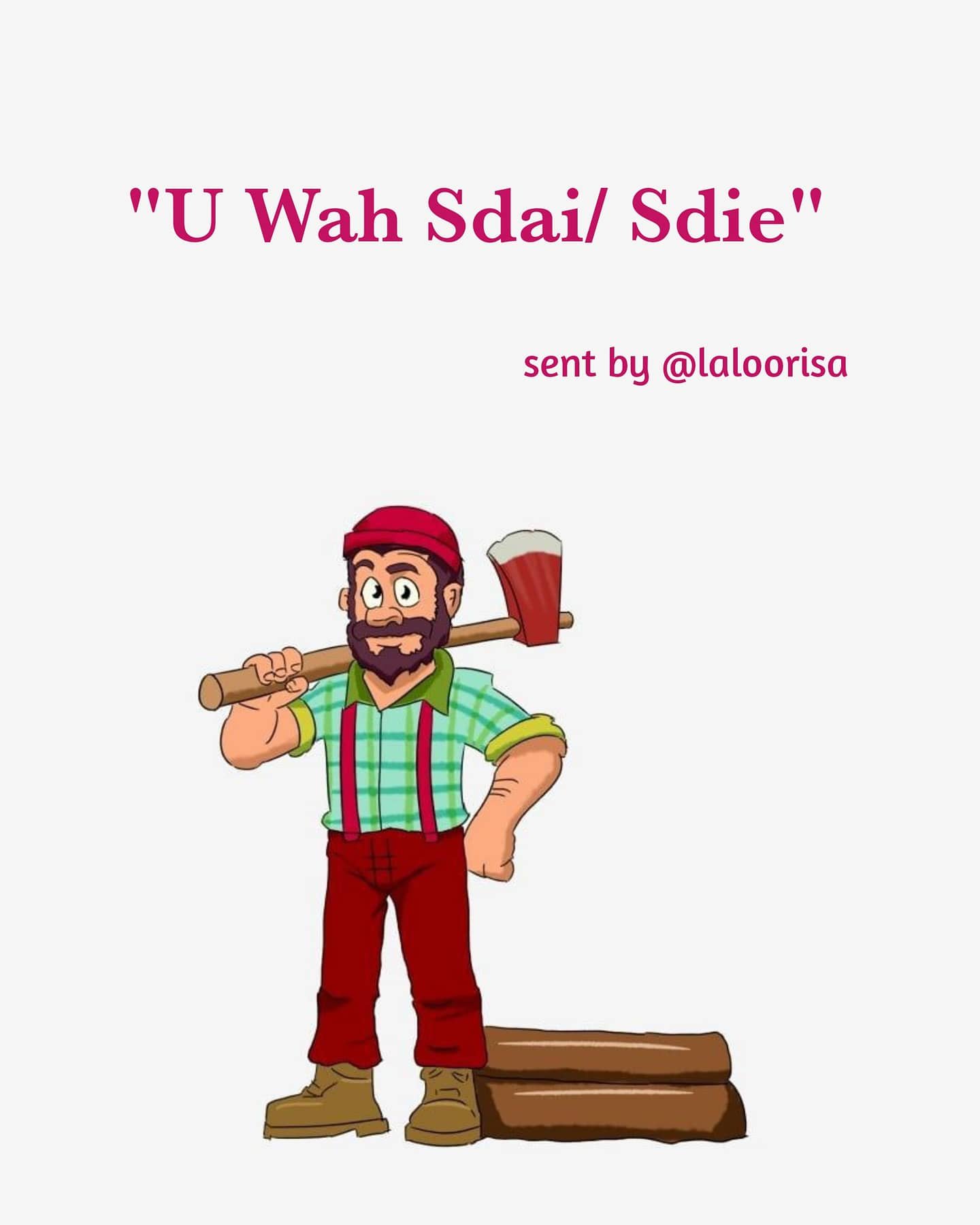
    "U Wah sdai/sdie" u dei nongrep na shnong Jowai, uba trei shitom hynrei uba klet biej. Ha kawei ka sngi, u thlieh dieng baroh shisngi. Hadien katto katne por, u shong thait bad u bam kwai. Ynda u la mut ban bteng biang їa la ka kam, um lap shuh ïa u sdie jong u. U la pyrshang ban kynmaw hangno ba u la buh їa u ruh, um lah kynmaw satia. Khatduh ki paralok kiba їa trei lang bad u haba ki їohi ba u їai wad kumne kim banse ban kylli, "Phi wad aїu kumto naduh mynne khlem lap shuh?" "Nga wad їa u sdie" u la jubab. "Phi khlem їohi hangno nga la buh?" Kita ki paralok ki la їa rkhie їa u bapli namar u sdie jong u, une lydui ha ka tyrpeng jong u hi. Namar ba kane ka wan jia barabor ha une u paralok, na kata ka daw u sa ioh їa ka kyrteng sin kum "U Wah sdai/ sdie". Na kane, їa kum kine ki briew kiba klet biej khamtam haba ki klet jaka buh їa kano kano ka tiar, ka sa kylla long ka rukom ban khot їa ki da ka kyrteng sin "U Wah sdai/sdie".

    There once was a farmer from Jowai who was hard working but quite forgetful. One day he had been cutting wood for a long time. So he sat down to rest and have some kwai. When he stood up to continue with his work, he couldn't find his axe. He couldn't remember where he kept it, even though he tried hard to remember where he left it. Finally, when his friends saw him searching, they asked him what he was looking for. He replied that he was searching for his axe. "Did you see where I left it?" he asked. His friends burst out laughing because the poor man did not realise that his axe was hanging from his shoulder. So because of his forgetfulness being a regular occurrence, his friends gave him the name of "Wah sdai/ sdie". For this reason those who easily forget where they keep things, are given the name "Wah sdai/ sdie".

    "Wah" means to hang something.

    "Sdai" (Pnar) and "Sdie" (Khasi) means axe.

    The Pnar nickname "U Wah Sdai/ Sdie" 🪓🪓 Another story about a nickname sent by @laloorisa 😄😄

    Khublei Chibun wa phah phi kini ki pyrtuit siñ! You've become our regular supplier of them! 😂😂

  • Gender in the Khasi language

    The English language does not have a grammatical gender as many other languages do. This means that it does not have a masculine gender or a feminine gender for nouns. The Khasi language however, gives gender to nature and objects. The two genders are distinguished only by means of the articles "U" for masculine and "Ka" for feminine in the case of singular nouns. For example, Cooked rice is "Ka ja" (feminine), A tree is "U dieng" (masculine), A road is "Ka surok" (feminine), A bed is "Ka jingthiah" (feminine), Chilli is "U sohmynken" (masculine), Cough is "U jyrhoh" (masculine) and Fever is "Ka shitmet/ jingshit" (feminine).

    Many other languages also give gender to animate and inanimate objects. Some of these include German, Hebrew, French and Kashmiri.

    Here are some words to compare:

    Spoon: In Khasi "ka shamoit" is feminine, while in German "der Löffel" is masculine.

    Salt: In Khasi "ka mluh" is feminine, while in French "le sel" is masculine.

    Crow: In Khasi "ka tyngngab" is feminine, while in Kashmiri "کاو" [ka.w] is masculine.

    Book: In Khasi "ka kot" is feminine, while in Hebrew "סֵפֶר" I/'sefer/I is masculine.

    In the Khasi language, nature and objects are given a gender. This is present in the French language too and is mentioned by Rev. H. Roberts in his book A Grammar of the Khasi Language (1891). Thank you @naphisabet1303 for initiating this in our conversations! ♂️♀️♂️♀️

    If anyone has studied Linguistics, we welcome your thoughts and observations in the comments section! 😀

  • “Koh” “Chchaw” Maram

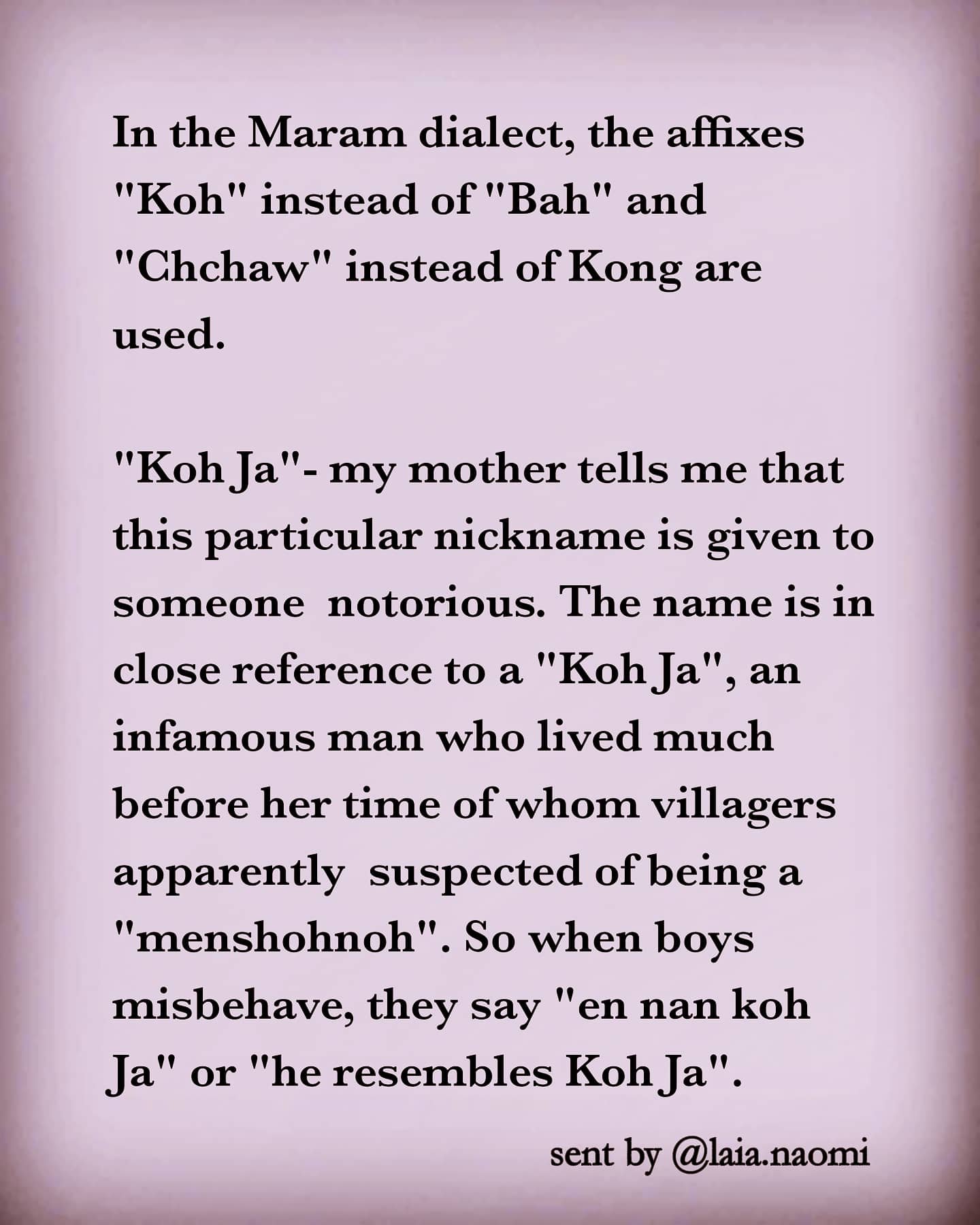
    In the Maram dialect, the affixes "Koh" instead of "Bah" and "Chchaw" instead of Kong are used. "Koh Ja"- my mother tells me that this particular nickname is given to someone notorious. The name is in close reference to a "Koh Ja", an infamous man who lived much before her time of whom villagers apparently suspected of being a "menshohnoh". So when boys misbehave, they say "en nan koh Ja" or "he resembles Koh Ja".

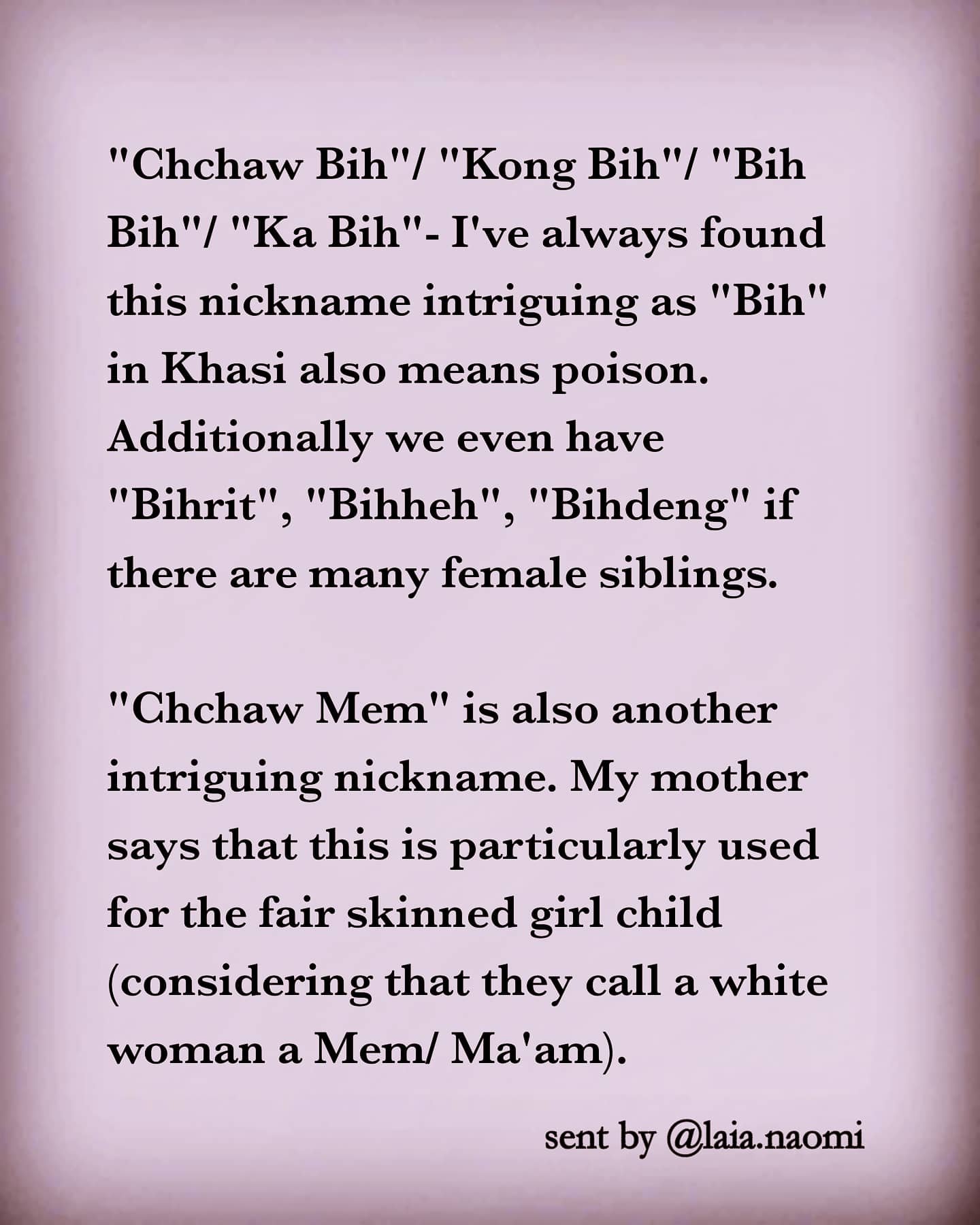
    "Chchaw Bih"/ "Kong Bih"/ "Bih Bih"/ "Ka Bih"- I've always found this nickname intriguing as "Bih" in Khasi also means poison. Additionally we even have "Bihrit", "Bihheh", "Bihdeng" if there are many female siblings. "Chchaw Mem" is also another intriguing nickname. My mother says that this is particularly used for the fair skinned girl child (considering that they call a white woman a Mem/ Ma'am).

    The Maram dialect is spoken in the West Khasi Hills District of Meghalaya. The variety of dialects spoken enriches a language giving it depth and scope. 🗣️🗣️

    Thank you @laia.naomi for this contribution! 🤗🤗

  • Biah Phongrai

    Ka "Biah Phongrai" ka dei ka pylleng ba kha u skaiñ ha ka kynja doh.

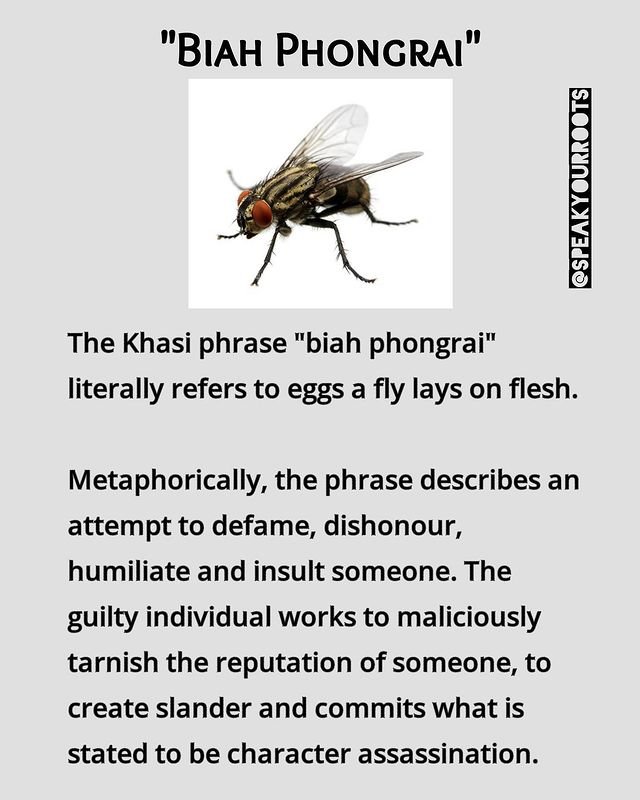
    The Khasi phrase "Biah Phongrai" literally refers to eggs a fly lays on flesh.

    Ka jingong "Biah Phongrai" ka dei ka jingpynbud nam sniew, jingpynjah burom bad ka jingleh ñiewbeiñ ïa uno uno u briew da u riewpoh, da kaba pyndonkam da ki ktien khlem akor bad ki ktien lamler.

    Metaphorically, the phrase describes an attempt to defame, dishonour, humiliate and insult someone. The guilty individual works to maliciously tarnish the reputation of someone, to create slander and commits what is stated to be character assassination.

    "Biah Phongrai" is a Khasi phrase which means to taint someone's reputation with malicious slander. Thank you @pyndap_r for bringing this up. 😊😊