Category: Book Excerpts

  • U ‘Nai-it

    U ’Nai-it u dei u bnai uba shiphew jong ka snem, u dei u bnai uba ar jong ka Synrai. U bnai ba nyngkong jong ka Synrai u dei u 'Nailar. U 'Nai-it u don saw taïew lane arphew phra sngi.

    Une u bnai u wan long kyrteng na ka jingpah u kbeit bad kiwei pat ki jait sim kiba her ha suiñ bneng. Ha une u bnai haba u kbeit u swait ha suiñ bneng ban kem sim ne kem khnai u ju pah ‘it it-it it’.

    U long u bnai ba ki sim laiphew jait ki sngewtynnat ban her suwari ha suiñ bneng ban kem khnai ne khñiang. Baroh ki jait khñiang, ki dkhiew bad kiwei pat ki kynja ba im ki sngewtynnat ban paw pyrthei ha une u bnai. Ki ïa mih na la ki jong ki jong ki trep ban ïalehkai bad rynsied sngewbha ha sla khyndew namar ka bneng ka la rang itynnat bad u kba u la sdang saw doh.

    "U 'Nai-it" is the tenth month of the year and it is the second month of Autumn. The first month of Autumn is " 'Nailar" (which roughly corresponds with September). "U 'Nai-it" has four weeks or twenty-eight days.

    This month gets its name from from the chirping of a bird called "u kbeit" (which the Khasi dictionary calls "a kind of hawk") and other kinds of birds. During this month "u kbeit" while hunting smaller birds and rats makes an "it it-it it" sound.

    Different types of birds go around flying everywhere during this month to hunt rats and insects. Many kinds of insects, ants and others like to emerge during this time. Animals and insects enjoy this time of the year as the weather is warm and sunny and paddy also begins to redden.

    It is interesting that the Khasi calendar has 13 months of 28 days (except in a leap year). The calculation of the months corresponds to the phases of the moon.

    Source: Rev. Dr. Ïarington Kharkongngor

    English translation by @speakyourroots

  • U Thawlang

    Pateng la pateng, ka jaitbynriew ka tip ban burom la U Thawlang uba wan pynroi ïa ka jait ka khong. U shynrang uba leit shongkha nyngkong ha ka jait ki khot ïa u, U Thawlang.

    Kumba paw na ki long jait manjait, ki thawlang ki long ki briew kiba tip bha ïa la ka dustur, shibun ki la long lypa ki kynja kñi ha ka kur bad ka ïing, ki ri la ka burom bad ki burom ïa ka jait ka khong jong kiwei ruh khamtam lei lei ïa ka kur ka jait jong ka tnga bad ki khun.

    Ha ka kolshor ki Khasi, u Thawlang u ïoh ka jaka bakyrpang…..Ki don bun ki jingleh niam-kur ha kiba ki khunkha ki dei ban pyndep na ka bynta ka meikha, namar ba ki dap rynïeng da ka jingsngewnguh ba ka la ai ha ka kur jong ki ïa u Thawlang.

    U P. R. T. Gurdon ruh kumba u lyngngoh ban lap ïa ka jingburom kyrpang jong ki Khasi ïa u Thawlang, u ong: "Notwithstanding the strong influence of the matriarchate, we find that U Thawlang, the first father and the husband of Ka lawbei is also revered. To him on occasions of domestic trouble a cock is sacrificed, and a Jymphong, or sleeveless coat is offered. This puja is called "Ka Tap Thawlang"."

    Ka jingbatai u Gurdon ka pynphalang sa kawei pat ka liang, jong ki paid Khasi, ka pyni ba ki ngeit ba u Thawlang u lah ban ïarap ïa ki na ki jingeh. Ka jingduwai ba u ïoh lum na ki Khasi ka ong: "Oh. father, Thawlang, who has enabled me to be born, who hast given me my stature and my life, I have wronged thee, oh father, be not offended for I have given thee a pledge and a sign, (a red and white sleeveless coat). Do not deliver me into the power of illness, I have offered thee propitiatory cock that thou mayest carry me in thine arms, and that I may be aware of thee, my father Thawlang."

    U Thawlang u don ka hok ban ri ban sumar namar u la pynkha bad u la buh ïa u sohpet u ksai…Naduh nangne na pyrthei la pynbynta lypa ïa ka bhah jong u kpa bad jong u kñi-rangbah-kur. U kpa u long u nongpynkha u nongbuh ia u sohpet u ksai jong ki khun kynthei khun shynrang. U kpa u long u nongkamai nongkajih ban ym don ka thngan ka shah jingit, ban ym don ka lymboit lymbiang jong ka tnga bad ki khun.

    Na kine ngi sngewthuh ba u kpa u la don lypa ka deiti longkñi ha ïing kur la jong bad u la don bynta ruh ha la ka jong ka nongtymmen. Kumta ha ka kur u long uba tip ïa ka ïap ka im bad ha ïing khun, uba lah uba ïai.

    .

    .

    .

    .

    Generation after generation, the Khasis know how to revere their "Thawlang" who has come to grow and multiply the clan. The man who is the first to marry into a clan is called "U Thawlang".

    As is shown and understood in the working of clans, "U Thawlang" is a person who knows and understands his culture and custom well, many of them are already maternal uncles in their families and clans. "U Thawlang" preserves his honour and dignity and respects the clans of others especially the clan of his wife and children.

    In Khasi culture, "U Thawlang" has a special position… There are many rituals pertaining to the clans which the children of "U Thawlang" have to fulfil towards their paternal grandmother, because they are grateful to her for giving their clan "U Thawlang".

    P.R.T. Gurdon expresses his surprise on finding that the Khasis have a special reverence for "U Thawlang" and says: "Notwithstanding the strong influence of the matriarchate, we find that U Thawlang, the first father and the husband of Ka Ïawbei is also revered. To him on occasions of domestic trouble a cock is sacrificed, and a Jymphong, or sleeveless coat is offered. This puja is called "Ka Tap Thawlang"."

    Gurdon's analysis illuminates another important aspect of Khasi life and that is, the belief that U Thawlang can help in times of trouble. The prayer that Gurdon was able to collect goes as follows: "Oh, father, Thawlang, who has enabled me to be born, who hast given me my stature and my life, have wronged thee, oh father, be not offended for I have given thee a pledge and a sign, (a red and white sleeveless coat). Do not deliver me into the power of illness, I have offered thee propitiatory cock that thou mayest carry me in thine arms, and that I may be aware of thee, my father Thawlang."

    "U Thawlang" has the right to take care of his family because he has helped the clan grow and symbolically placed the navel and the thread. From this earthly world, there is a division of rights and duties of the father and the maternal uncle. The father facilitates the growth of the clan and he has symbolically placed the navel and the thread of his female and male children. The father is the breadwinner of the family, protecting them from hunger, looking after the well-being of his wife and children.

    Thus, we understand that the father in a Khasi family is already bestowed with the rights and duties of a maternal uncle and he also has his share of inheritance. In his own clan, the father takes care of affairs of life and death, while in his family he is their strong and reliable support.

    Ka long kaba sngewtynnat shikatdei ban pule shaphang "U Thawlang" bad ban tip ïa ka jingkordor jong u kpa ha ka longïing longsem Khasi 👫🧑‍🤝‍🧑❤️

    Wow! It's been great reading about "U Thawlang" and learning about the value of a father in a Khasi family 👫🧑‍🤝‍🧑❤️

    🟡 Source: Dr. Sr. Philomena Kharakor
    🟡 Adapted and collated by @speakyourroots
    🟡 English translation by @speakyourroots

  • Excerpts from the article “Poiphang Ka Thawhi Ban Peiphang” by Raphael Warjri

    Excerpts from the article "Poiphang Ka Thawhi Ban Peiphang" by Raphael Warjri,

    which appeared in u Nongsaiñ Hima on 15th June 2022

    Ki ktien ba thymmai ba la tyrwa ban shna thymmai ki long ki ba la shu thaw hi kat ba lah ban poiphang ha ka pyrkhat shimet bad lada ka long ka ba lah ban peiphang bad sngewthuh da ki paidbah, te ka shong sa tang ha ka bishar sani jong ki stad saiñktien bad ki thohjer thohnam na ki shlem ba kynsai jong ka imlang sahlang.

    La khmihlynti ba kiei kiei baroh kin long ki ba jynsur mynsiem bad ban husiar ban ym synjor, ban long ki ba kdup їa ki ktien mat na ki thaiñ kylleng sawdong bad ban pynneh longpdeng da ka ktien Khasi kaba don ka thymmei-na ka ktien Sohra. La pyrshang ruh ban buh artat bad ka jingmut ha ka ktien phareng khuang ban kham suk ha ka bishar bad tynjuh lada dei ban pdiang ne kyntait lada dei ban dan ai jingmut shuh shuh da kumwei.

    Aijubab ka mut ba ai ka jubab ha ka jingkylli ne kynthoh ha ka ba ai daw/ Response

    Aitishaniah ka mut ba aiti bad ba lah ban shaniah/ Faithful

    Aïomot aïomkheit ka mut ka por ba la ih ki jingthung bad la biang ban ot ne kheit/ Harvest

    Bamet ka mut ba tylli doh ne skhah/ Solid

    Bamteimet dihteimet ka mut ka dawai tei ïa ka met ka phad/Vitamin

    Bambsamet ka mut ka bam ba bsa met osa phad/ Nutrition

    Bankbia ka mut ka ba noh ne shah tynrong na jrong/ Pressure, Burden.

    Basabam basadih ka mut ka sem ba die bam die dih paidbah/Restaurant

    Batsaipan ka mut u nongbat pisa ha saipan/ Treasurer

    Borkhia ka mut ka kynja bor ba hap da ka jingkhia/ Gravity

    Borkhring ka mut ka kynja bor ba khring/ Magnetic

    Borkynsan ka mut ka kynja bor ba ban khia kynsan/ Impact

    Bortipthuh ka mut ka bor ba lah ban mad ne sngew/ Senses

    Buhthup ka mut ba buh thup kyrteng їa ki mar ki mata/Registration

    Buhthiar ka mut ba buh thiar tyngkai dulir/ Archive

    Buikyrteng ka mut ka bui buh kyrteng/ Registration

    Buitsniew ka mut ba buitpoh ban shet kylla/ Mischief

    Kabuhok ka mut ka kabu ba shonghok/ Privilege

    Kambymman ka mut ki kam batriem ba mynsaw/ Crime

    Kamroi ka mut ki kam pynroi ha ka imlang sahlang/ Scheme

    Kamtreilang ka mut ba syllok lang ban trei ryngkat/ Cooperation

    Kher Aihukum ka mut ki kynja riewdon kyrdan ba ïalam na phrang/ Commanding Officer

    Khieim Jyrngam ka mut ka juk ba rasong ka rep ka riang/ Green Revolution

    Khreh ktem ka mut kaba pynap lypa ban ïoh kdong/ Strategy

    Kiew snam hiar snam ka mut ba kiew ne hiar kaba kynshait ka snam na u klongsnam ka bym biang ka jingtuid ka snam lyngba ki thied snam/ Blood Pressure

    Kliarthong ka mut ba kot ban khajoh sha khlieh eh jong kano kano ka kam/ Zenith, Pinnacle

    Klit ka mut ka jingstet ba palat liam ban ther na kawei ka dong sha kawei pat/ Velocity

    Korkemdur korkemsur ka mut television/ Television

    Kotaibor kotibit /Syrnotaibor ka mut ka dulir ba la shah ban pyntreikam/ License

    Kpait-saiñ-kam ka mut kaba pruid dak lynter ban buh ryutih ki kam ba dei ban trei/ Policy

    Krehbiangkam ka mut ba pynїaidkam ryntih/ Management

    Kupar ïawai ka mut ka nusib ba la thoh haduh ba kut ka jingim/ Destiny

    Kyndeh thiedsnam a mut ba tied u thied u jaw na ba їaid ka snam/ Pulse

    Kyndon kdewlynti ka mut ba lam ne pyni lynti kumno ban leh kat kum ki mat ba la buh hukum/ Guidelines

    Kyndongduh ka mut ka thaiñ khappud bajngai palat na ka jaka pdeng/ Hinterland

    "Poiphang Ka Thawhi Ban Peiphang" is an article by award winning Khasi artist @warjri.raphael which was published in U Nongsaiñ Hima (Khasi newspaper) on the 15th of June 2022.

    This is a wonderful article wherein Bah Raphael has attempted to coin new words in Khasi while giving their English equivalents. Khublei Shibun Bah @warjri.raphael for this article! 😀🙏👏

    The coinage of words in a language will help it to grow, thereby sustaining it, adding to expression in speaking and writing. 🗣️✒️😄

  • U Slap

    U slap haba u hap ha sla khyndew u hap syngngeit bad hap lynsher. Ha ki jaka bym don phlang ne kino kino ki jynthung, u slap u don ka bor kaba khlaiñ ban ksam bad pynmong ïa ka khyndew. Mar ïa slap ki symboh khyndew ne shyiap ki shah kynting kumba Iai haduh san inshi na sla khyndew shalor bad shah bret sharud na ka jaka ba kine ki symboh ki don mynshuwa. La ïoh jingkheiñ da ki riewstad ba u lapbah u lah ban pynkynriah jaka ïa ki symboh khyndew symboh shyiap haduh shispah ton ha ka shi akar ha ka shikynta.

    When rain falls on the earth it falls in a forceful beating or grinding motion. In a place with no grass or plants, rain has the strong power to punch through and pound the soil. The instant it rains, soil or sand are thrown up about three to five inches from the ground and then they fall on a different place from where they were. Scientists have discovered that heavy rain can move 100 tons of soil from one acre in one hour.

    Haba u slap u hap halor ka khyndew bym don jynthung ki symboh khyndew symboh shyiap bani bin bin ki set noh ïa ki thliew ki syar (pores) jong ka syrtap khyndew syrtap maw. Ka umslap ba bun ka tuid noh wut tang nalor sla khyndew bad tang khyndiat eh ka ngam shapoh ñiamra. Ïa kane ka jingtuid umslap nalor ki jaka bym don ne duna jynthung la khot "ka tuid wut" (run off) katba ïa ka jingtuid umslap ha sla khyndew ha baroh ki jaka ba don khlaw ne bym don khlaw la khot "ka tuid lor" (overland flow).

    Kane ka tuid wut bad tuid lor jong ka umslap ki long ki bor bashyrkhei ban khrud bad pynkhoi ïa ka sla khyndew.

    When rain falls on a place that is empty of plants, the fine soil or sand that is moved by the rain covers and blocks the pores of the earth and of rocks. Most of the rain water flows quickly over the ground and only a little seeps through into the earth. This flow of rain water in a place where there is less or no vegetation is called run off, while the rain water that flows in a forested area or a non-forested area is called overland flow.

    Run off and overland flow of rain water are dangerous forces which scrub and erode the top soil.

    U slap bad ka rukom hap jong u…Sngewtynnat ban pule ïa kane ka jingthoh ha ka kot i Dr. Dondor Giri Nongkhlaw. 🌦️🌧️

    Rain and the way it falls…It is always a good idea to read books written by Dr. Dondor Giri Nongkhlaw. 🌦️🌧️

    Dr. Dondor Giri Nongkhlaw is a Geomorphologist who has written several Khasi books focussing on the elements of the environment and their bond with Khasi life and culture.

    🟡 English translation by @speakyourroots

  • Jylliew or June

    “Jylliew" ka thew ïa ka jingdap miar ka um ha ki jylli jong ka wah. "Jyl" ka mut ka “jingjrong" bad " 'liew" ka mut ka "thliew" ne ka "them khohruh-khohram". Haba ong "jylliew" ka mut ba ka um ka la dap miar ïa ka them ne ka thliew khohruh-khohram. Nalor kata, ka ktien "jylliew" ka don ka jingïadei kaba jan eh bad ka "phylliew".

    "Jylliew" ka mut ka jingpyndap um da ka mariang ïa ka them ne thliew khohruh-khohram, katba ka ktien ‘phylliew’ ka mut ka jingpyndap um ha u khiew u bym don ne uba duna um da ka kti u briew ne da kano-kano ka tiar. Ha u Jymmang, ka um ka la sdang ban kiew ha ki jylli jong ka wah katba ha u Jylliew ka um ka la dap miar ha ka phudwah ne wah bah.

    The Khasi word "Jylliew" refers to the fullness of water in parts of a river. "Jyl" means the length of something and " 'liew" means a hole or uneven crevices. When we say "jylliew" it means that water is filled to the brim in a hole or crevice. Besides that, the word "jylliew" has a close connection to the word "phylliew" which means to pour water into a vessel.

    "Jylliew" means the filling up of water by Nature in valleys or uneven crevices, while "phylliew" means the filling up of a vessel with water by hand or using a mug or other utensils. In May, the water rises and fills in the circles of water, while in June water is full to the brim in river beds and rivers.

    This gives a new understanding of the Khasi word "Jylliew" which is the name of the month of June. 🌦️⛈️🌧️🏞️ Jylliew is the swirling depth of water that fills to the brim!

    🟡 Source: Rev. Dr. Ïarington Kharkongor
    🟡 English translation by @speakyourroots

  • Prehistoric Cultures Through The Lens Of Archaeology: Marco B. Mitri (Excerpt)

    Chapter – 6 The Ethno-archaeology of Sohpet Bneng Hill

    While pursuing historical research with an archaeological approach, the contemporary traditional mode of life can contribute greatly in providing analogy about the ones in the past, since archaeological interpretation basically depends and ultimately rests on analogy. The significance of ethnology in archaeology can be understood from the remarks made by some archaeologists that archaeological reconstruction is an analogy with or without ethnological recourse In order to understand the material culture preserved in traditional practices, ethnoarchaeology? tries to study the possible correlation between the material culture of the people on one side and the unobservable social relations or spiritual life on the other. Thus the material data can be used to integrate knowledge to other non-material or intangible facets of the society which are reflected and embedded in tradition through an approach called folk archaeology! Archaeology can therefore contribute directly towards historical reconstruction when conventional historical sources are lacking or when other forms of preserved traditions require substantial support. By doing so, the mythical notion about the ancient ways of life, particularly the lifestyle of the pre-historic people is significantly reduced.

    Applying "Direct Historical Analogy" when there is temporal continuity between the archaeological culture and the ethnographic culture, the folk narrative of U Sohpet Bneng can become part and parcel of ethno archacological research, not as a partial and fragmentary record of the past, but as true elements that can be rescued from the clouding fantasy and helped to blend the two interacting modes of representing the past by using different accounts of the same events and objects.

    Inspired by the folk narrative, a systematic archaeological survey and exploration of the entire hill range around the areas close to Sohpet Bneng peak is conducted to gain empirical data from the area. During the course of exploration, which started in year 2003, the archaeological site of Lawnongthroh* which lies at the foot of the peak and along the ridge of Sohpet Bneng hill is discovered. Archaeological evidences of different cultural periods are observed at the site which stretched to more than a kilometer along the ridge.

    The site of Lawnongthroh is named after a village which is located in the northern slopes of Sohpet Bneng hill in the Ri-Bhoi district of Khasi hills, Meghalaya. On the ridge of the hill's northern slope that extends approximately 1.5 Kms in length and spread between 50-60 Meters in width, archaeological evidences like the Megalithic monuments, secondary burial Cist, cremation mound, Iron smelting area and wheel-made potsherds are found. Subsequent exploration of the ridge led to the discovery of 11 numbers of stone implements of Neolithic origin from the surface of a site which falls in one of the village's locality called Lum Mawbuh on the northern part of the village.

    According to informant the archaeological evidences recorded on the western slope of the ridge are associated with an ancient deserted settlement called, Mawbuh which lies a kilometer north of the present Lawnongthroh village. The source also added that it was the inhabitants of the Mawbuh village who were the first people to initiate religious ceremonies at the Lum Sohpet Breng peak. The ridge top of Lawnongthroh on the other hand, was an uninhabited area then and known to the inhabitants of ancient Mawbuh village by the name

    Synner, known for being an ancient route where the procession rested for a night before the ceremony at the apex of U Lum Sohpet Bneng.

    After the abandonment of the ancient Mawbuh settlement, there was a lull phase of human occupation on the hill till the appearance of the present village of Lawnongthroh which came into existence on the ridge only 30 years ago. These new occupants who formed the present village came in at different times from other nearby villages and also from distant places of Khasi hills to farm and cultivate on the ridge and its hill slopes. The reoccupation of the site after a long interval of abandonment is an important feature to help understand The settlement system on this hill and can also offer strong analogy on the pattern of human occupation of the area in archaeological past and an important pointer to the antiquity of settlement, giving the hill a unique character of being an area attraction. Archaeological findings from this area which are associated with different cultural periods of the past are clear evidence of human occupation pattern on the ridge and its surrounding slopes.

    Prehistoric Cultures Through The Lens Of Archaeology: A Report On The Archaeological Excavation Of Lawnongthroh, Sohpet Bneng, Khasi Hills, Meghalaya (2018) by Dr. Marco Babit Mitri is a wonderful treasure which documents the archaeological efforts in Lawnongthroh, Sohpet Bneng Hill.

    The book merges archaeology, geography, history and cultural studies to build a vivid understanding of life in the area. 📝⛏️⚒️📏📐📚

    The post shows excerpts from Chapter 6 which focusses on "The Ethnoarchaeology of Sohpet Bneng Hill" 🏞️🌄

    Dr. Mitri has lead an intensive research of the site and reading the book piques the imagination as one reads of Neolithic sites and stone artifacts in the Khasi and Jaiñtia Hills.

    Dr. Mitri is an Associate Professor at Union Christian College, Meghalaya. Dr. Mitri specialises in the fields of Archaeology and Prehistory.

  • Excerpt from the Introduction of “Ki Khanatang bad U Sier Lapalang” by Primrose Gatphoh (1937)

    U Primrose Gatphoh u ong:

    "Ki Puriskam, ki Purinam, ki Parom bad ki Khanatang ki don sawdong kane ka ri jong ngi, ha ki trep bad ki skum, sawdong ka lyngwiar dpei ba syaid bad ba rhem jong u khun Khasi Pnar baroh. Hynrei ka long kaba eh shibun ban lum ban lang, bad ban tai ban peh bha ïa ki shuwa ban pynsah ïa ki ha ka thoh ka tar kum ki mar kynti ka ri.

    Kam long ka kam kaba suk ban lum na kaba shu ïohsngew ka shkor, bad kaba shu kem na ka hamsaïan shaphang kiei kiei kiba ngi ju ïohsngew bad ïa kren barabor hapdeng jong ngi, kum ïa ki khlawait, ki thma, ki kut, ki kharai bad ka jingngeit ki briew ïa ki ryngkew ki basa kiba don sawdong ki lum bad ki wah jong ngi…

    Ngim lah ban ieit ïa la ka ri khlem da tip ïa ki Khanatang ki longshuwa jong ngi. Ban bud dien bad ban wad ïa ka kpait ka rukom pyrkhat hyndai, ka long ka jingsdang kaba shi kyrdan sha ka jingieit ri kaba shisha. La ki nongthoh bad ki nongïathuh ki ïapher, hynrei ki thymmei bad ki jingthmu na kiba ki la mih ki long kijuh."

    "Fairytales, fables, folktales and myths are all around our hills, in huts and homes, around the warm and fiery hearth of Khasi and Pnar families. But it is arduous to collect, to select, to sift and sieve through these stories before they are preserved in the written form as valuable heritage. It is not an easy job to gather from what is heard by the ears, and to grasp from unclear accounts that are heard from here and there, about what we usually hear and talk about among ourselves, about brave warriors, warfare and the belief in forest guardians who are present in our hills and rivers…

    We cannot love our community without knowing the myths and folktales of our ancestors. To follow and to search for the tracks of the old ways of thinking, is to begin at the first step towards a true and real love for community. Even though writers and story tellers are different, but the source and the aspirations from which they arise are the same."

    Bunsien ngim ju kham pule ïa ki "Shi Kyntien" jong ki nongthoh kaba ki ai ha kaba sdang jong ki kot jong ki. Kane ka dei na ka kot jong u Primrose Gatphoh. ✒️📖 Ki dei ki ktien kiba ai jingtip, jinghikai bad ki pynsngew ruh ïa ka jingsngew kitkhlieh na ka bynta ka ri la jong. 🏞️🌧️

    Often we do not read the introductions or the forewords given by writers at the beginning of their books. This introduction is from the book of Primrose Gatphoh. ✒️📖 These are words which give knowledge and teaching. They also reflect a sense of responsibility for the community 🌧️🏞️

    🟡 English translation by @speakyourroots

  • “Nga dei ka Nam…”

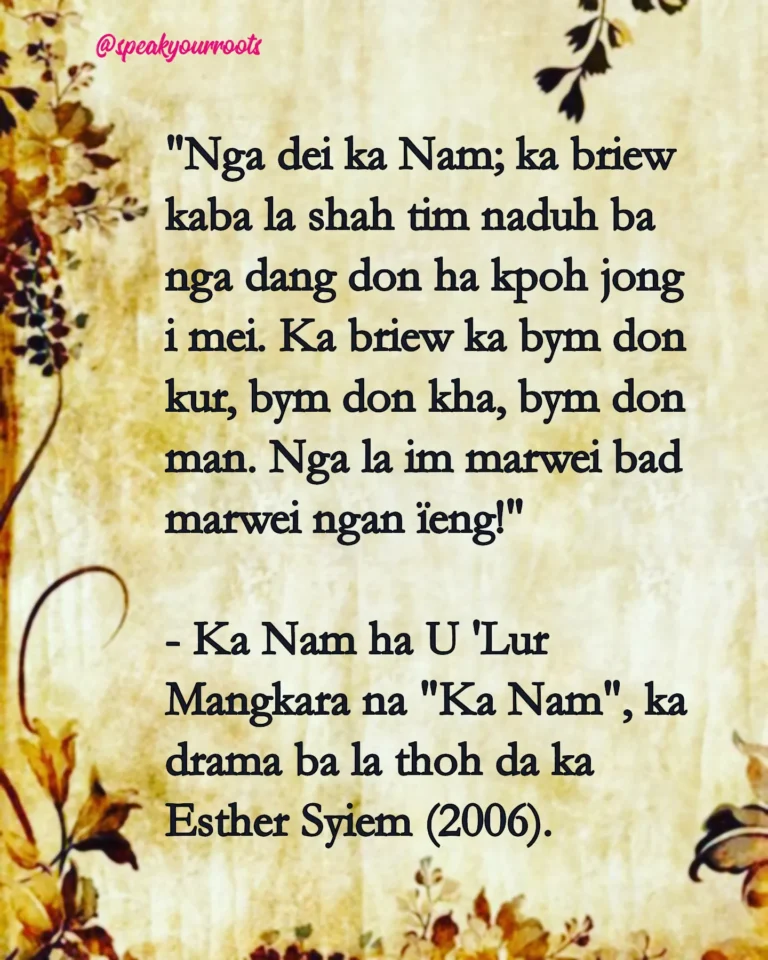
    "Nga dei ka Nam; ka briew kaba la shah tim naduh ba nga dang don ha kpoh jong i mei. Ka briew ka bym don kur, bym don kha, bym don man. Nga la im marwei bad marwei ngan ïeng!"

    -Ka Nam ha U 'Lur Mangkara na Ka Nam, ka drama ba la thoh da ka Esther Syiem (2006)

    "I am Nam; a woman who was cursed from her mother's womb. A woman with no relatives, no clan. I live and exist alone and alone I will stand."

    -Nam to 'Lur Mangkara from Ka Nam, a play written by Esther Syiem (2006)

    The story of "Ka Nam" is a story we have listened to since we were children. Have you told this story to the present generation? "Nam" denoting the perpetual strength of dignity, integrity and a good name.

    The adaptation of the folktale by Dr. Esther Syiem in the Khasi langauge is interesting and thought-provoking, weaving a feminist approach, together with themes of freedom, abandonment and the self. 🗣️📜

    Dr. Esther Syiem is a Professor in the Department of English, North-Eastern Hill University, Shillong.

    🟡 English translation by @speakyourroots

  • Ka Jingduwai Blei U Khasi/ The Prayer of The Khasi

    Ka Jingduwai Blei U Khasi, The Prayer Of The Khasi

    from U Khasi Hyndai (1959) written by Rash Mohon Roy Nongrum

    Naduh mynhyndai ba la mih la don ki symbai bynriew halor snieh i Mei Ramew, ma ngi ki Khasi haba ngi duwai ngi kyrpad ha ki pokjat U Pa Blei Trai Kynrad U Nongthaw Uba dap lut baroh sawdong, Uba ïohi lut baroh sawdong, ngi phai ka khmat sha mihngi bad la ki kti baroh arti, ngi dem khrup bad ngi duwai kyrpad ba Un ai ka jingkyrkhu ka jingisynei halor jong ngi ki symbai bynriew. Im ju dei ban phai khmat sha sepsngi.

    Kane ka long naduh kiba mynhyndai ba ki riewtymmen jong ngi haba ki duwai, ki phai khmat sha mihngi, haba ki jer kyrteng ïa i khunlung iba dang kha ba in koit in shait bha, ki duwai ha ki pohjat U Pa Blei Kyurad U Nongthaw da kaba phai sha mihngi. Ma ngi ki Khasi ngi ong ba kaba sang ban thaw dur ne ban mane ïa ka maw ka dieng ne ïa u para briew ba dang thaw dang buh hi U Pa Blei Trai Kynrad.

    Ngi leh bad ngi tip tang ka duwai da ka ktien kaba khuid kaba sugur ha U Pa Blei Trai Kynrad ka long kaba dei kaba biang.

    Since time immemorial with the existence of human beings on Mother Earth, we Khasis pray to God the Father the Creator who fills all space, who sees all things, by facing towards the east, with folded hands, bending and kneeling down, beseeching for blessings and mercy over humanity. It is forbidden to face the west while praying.

    This has been established since ancient times with elders facing the east while praying. During the naming ceremony for a baby too, performed for the health and well-being of the child, prayers are delivered at the feet of God the Father the Creator by facing towards the east. Khasis deem it sacrilegious as well as forbidden to create idols and to worship stones or trees or other fellow human beings created by God the Father the Creator. What is done and known by the Khasis is that, the words of a prayer are honest and pure, that this is right and deserving to be expressed to God the Father.

    An earnest prayer lightens the heart and clears the mind 😌✨ Many cultures and religions face the east while praying and this is found among the Khasis too 🙏🌞☀️🌄

    Ka jingduwai ka mih na ka mynsiem kaba sngew nguh, kaba dap da ka jingieit bad ka jingkyrmen 🙏✨

    🟡 English translation by @speakyourroots

  • Ki Lyer Pyrem (Part II)

    Ka 'Erkhwasi

    Ka 'Erkhwasi ka dei ka jait Iyer kaba kham beh jur ha ki bynta sepngi jong ka bri u Hynñiewtrep khamtam ha ki thaiñ Ri Lyngngam bad Khadsawphra. Haba wan kane ka lyer ki dieng ruh ki khyllem, ki mrad ruh ki her lamwir ha khlaw. La ïoh kyrteng ïa kane ka lyer na u Lum Nokrek u lum uba ki briew jong ngi ha Ri Lyngngam ki khot u Lum Khwasi.

    "Ka 'Erkhwasi" is a strong wind that blows in the west of the Khasi hills, especially in the Lyngngam and Khadsawphra areas. This wind is so powerful that it uproots trees and sends animals into a frenzy. "Er Khwasi'" gets its name from Nokrek Hill which the Lyngngam people call Khwasi Hill.

    Ka 'Erkyllang

    Ka 'Erkyllang ka long ka lyer kaba jur bad khlaiñ bha. Ha ki por ki por ba ka beh jur bad khlaiñ ka jynrat wat ïa ki ïing bad ïa ki dieng ruh. Ka tyllong jong kane ka lyer ka sdang na ka them Umkhrisynñia bad ka rukom beh ka long nangtei sepngi shatai sha mihngi bad ka jah ha ka them jong ka Wah Myntang. Ka 'erkyllang ka wan hadien ar taïew jong a 'erpyrhaw.

    "Ka 'Erkyllang" is another powerful wind, denoted by its name, "kyllang" meaning cyclone. This wind uproots not only trees but houses as well. The root of this wind starts from the Umkhrisynñia valley and the direction in which it blows is from the west to the east and it is absorbed into the valley of Myntang river. "Ka'Erkyllang" arrives two weeks after 'Erpyrhaw".

    Ka 'Erbatesi

    Hadien jong ka jingkhyrwit jong ka "'erkyllang, ka suiñbneng ka long jai jai bad duna lyoh. Ka lyer kaba beh ha kane ka por shuwa ban wan ka lyiur ka long suki jai jai. La ïoh kyrteng ïa ka 'erbatesi na ka jinglong jai jai ne tipsngi jong ka.

    Ïa kitei baroh ki Iyer lakdun haka lyer Pyrem.

    After the intensity of "ka 'erkyllang", the weather is calm with less clouds. "Ka 'erbatesi" blows gently during this time and arrives before the season of summer. "Ka 'erbatesi" gets its name from its calm and tranquil nature.

    All these winds are categorised under the winds of Spring.

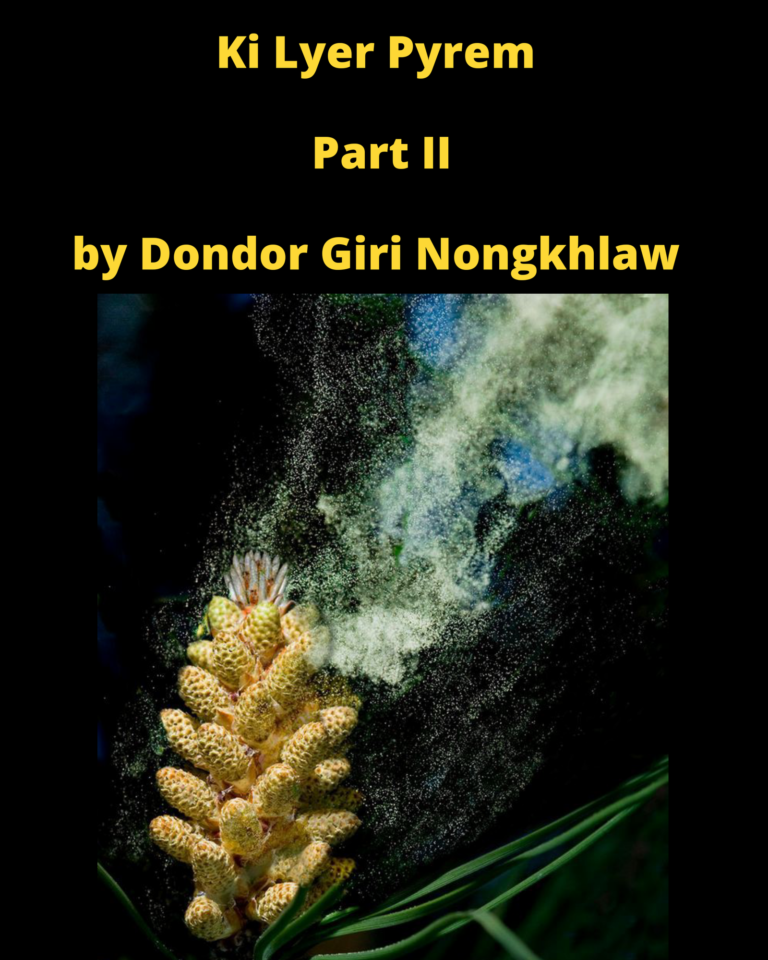
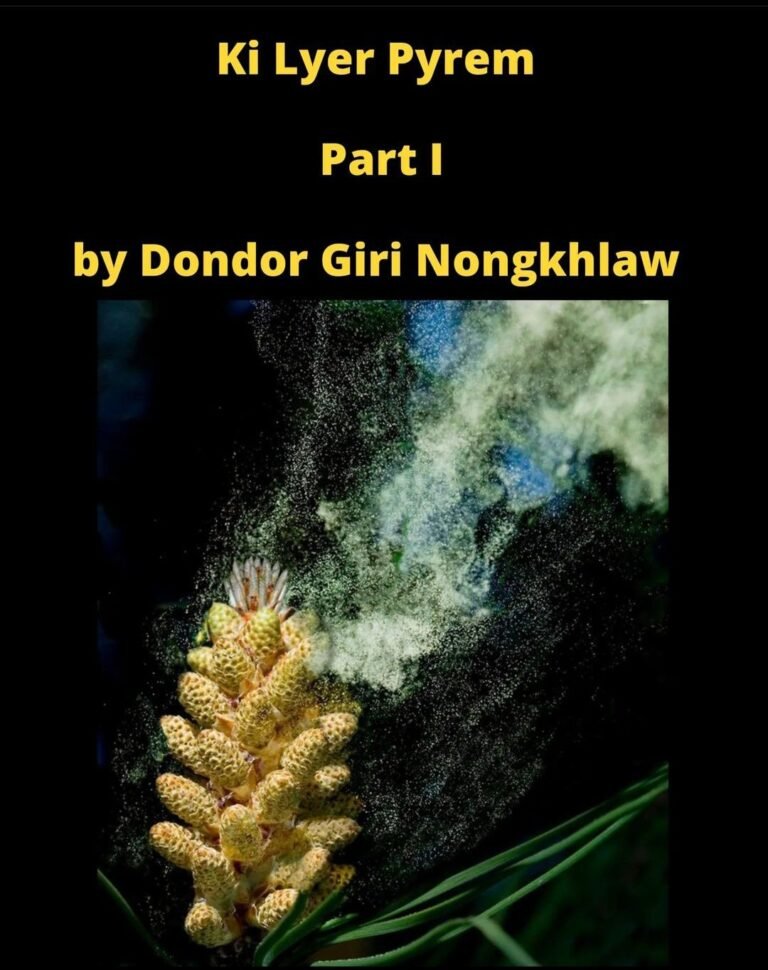
    This is Part II of "Ki Lyer Pyrem" or Spring Winds from the book Ka Meirisawkun, Ki Skid Jingim bad Ki Deiriti written by Dr. Dondor Giri Nongkhlaw. 🍃🌻🌀

    The books written by Dr. Nongkhlaw, who is a Geomorphologist, are treasures that contain research that has been meticulously explained in Khasi. What is even better are the words that he has coined using the different dialects of the Khasi language!

    Khublei Shibun Babu Nongkhlaw ïa ki jingthoh jong phi kiba ai jingtip bad jingshai shaphang ka ri jong ngi! 😃🙏

    🟡 English translation by @speakyourroots