Category: Poetry

  • “The Sun, the Peacock and I” by Badondor Diengdoh

    Spirited like the jaiñkyrshah

    flapping with the wind.

    Noisy like the sound of

    a bolbaring indenting tarmacs.

    The girls of summer

    The boys of winter.

    The blue rubber ball.

    targeting stacked rocks.

    Now

    still figuring out my life

    with unmatched socks

    Wish I could still be that

    kid from the block

    who daydreamed of

    the sun and the peacock.

    According to Khasi folklore, it is said that the Peacock and the Sun were together in heaven as lovers. But one day the peacock, while looking down on the earth, saw a garden full of mustard flowers. To him the garden looked like a beautiful girl in yellow and green clothes. He instantly fell in love with what he saw. The peacock left the sun and flew down to earth. The sun was heartbroken and her golden tears descended on his feathers creating the golden spotted pattern we all know.

    To the peacock's utter disappointment, upon landing on earth, he realised that what he saw was only a patch of mustard flowers. Now it was the peacocks' turn to cry. Full of regret he tried to fly back to the sun but could not. That is why the peacock is flightless to this day.

    "Bolbaring" is a wooden toy vehicle made out of small wooden poles and having rotating ball bearings as wheels.

    The rubber ball and stacked rocks refers to a traditional game known as "Mawpoiñ" in the Khasi language. It is like dodgeball, while introducing a new element into the game in the form of stacked rocks. It involves one team hitting their opponents with a ball or destroying the stacked rocks while the other team either dodges or re-stacks the rocks .

    "Jaiñkyrshah" is the traditional Khasi apron which is worn as a loop from one shoulder and its design is always a chequered one of different colours.
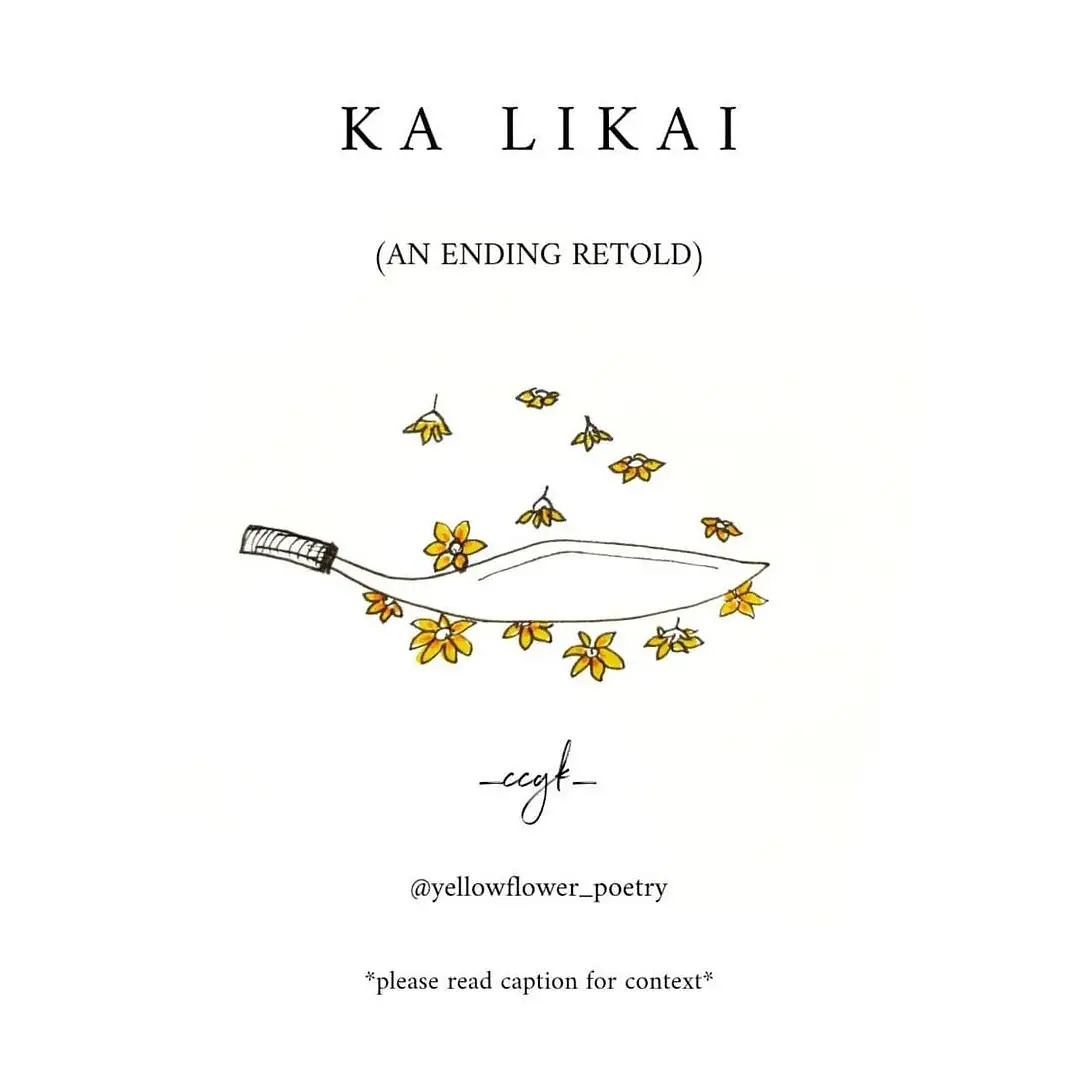
  • “Ka Likai (An Ending Retold)” by Clarissa Giri

    Calmly by the fire,

    She sits staring at the flames before her.

    Ember sparks burn freckles on weathered

    floorboards,

    Restless charcoal crackle uneasily in the dpei,

    While vapour fumes from her drenched

    kyrshah.

    Smoke and ash cling to her damp hair,

    A hot tear makes its way down her cheek,

    The wait glistens bloody at her heel,

    And she watches the shadows form on the

    wall before her

    As her ancestors dance for war.

    The rueful dish cooked to perfection,

    She feeds him a mouthful of this concoction-

    A stew of his own fingers; there will be no

    leftovers.

    How he tossed her daughter's tiny fingers like

    refuse in the shang-kwai,

    No. This butcher will devour his.

    There is a Khasi folktale about a widow named Likai who had a daughter whom she loved more than life itself. She was remarried after some time, to a man who later turned out to be abusive and dangerous and who eventually murdered her only daughter, while Likai was toiling in the fields. He butchered her and cooked a stew with the remains which Likai ate unknowingly. She found out after her meal when she was about to consume "kwai", a combination of betel leaf, lime and areca nut (a traditional edible) where she saw the remains of her daughter's fingers in the "shang-kwai" (areca nut basket).

    This caused a cacophony of chaos in her, driven by immense heartbreak and in a rage she ran after the man with a "wait" (a Dao or large bladed knife). Being unable to find him, in her madness-driven rage and being unable to endure life because of such a tragedy, Likai threw herself off of a waterfall. The waterfall is named after her fall "Noh Ka Likai" falls (Literally, Where Likai Jumped).

    This poem is a twist on that ending, as folktales go, there is always an ending of "What if?" and in this one there is no mention about what happened to the murderer and if ever he was given what he deserved. In this poem, I ask what if Likai found her daughter's murderer cowering in the forests of "Sohra" (Cherrapunji), and she was able to avenge her daughter before deciding upon her own fate?

    "Dpei" – hearth, "Kyrshah" – traditional khasi apron

    Caption and original artwork by @yellowflower_poetry