Blog

  • U Kiang Nangbah

    Kiang Nangbah Kiang Nangbah,

    Ya me da phrang dei mynsien dap chynrang,

    Ka yutran wa khia,

    kit mi neibynta ka ri,

    Tang wow im ka jaitbru,

    bynda mi da u radang ha u tylle pasi.

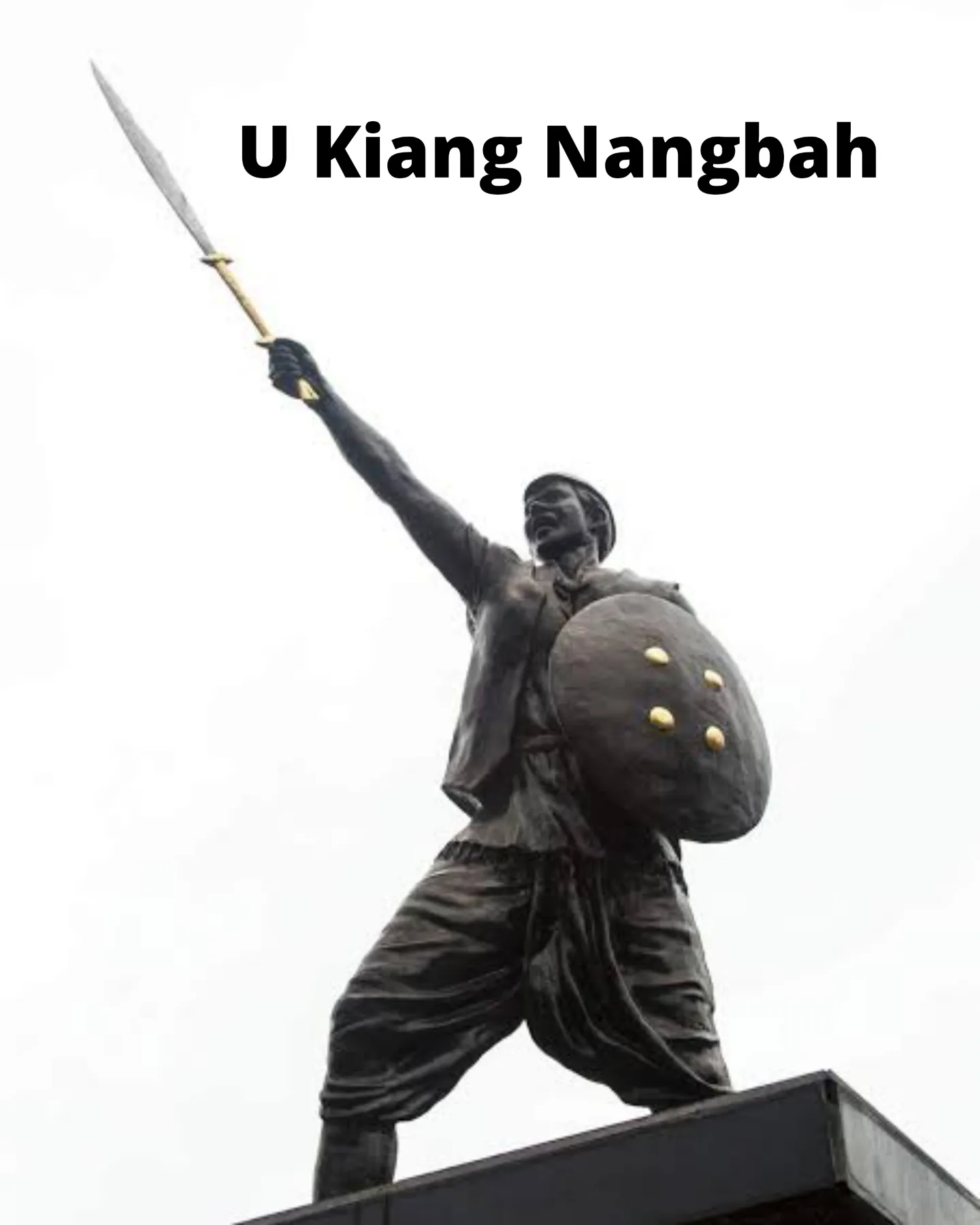
    Kiang Nangbah, the son of Ka Rimai Nangbah from the Soo Kpoh Clan, was an original settler of Jowai in a locality known as Tpep-pale. He fought a freedom battle against the mighty British force at a period almost coinciding with the 'First War of Independence' or the 'Indian Mutiny' or the "Sepoy Mutiny' of 1857.

    The Jaiñtia Revolt started in 1860 when the government introduced house tax on the people. It was U Kiang Nangbah who urged the people not to pay any tax to the government. It was because of this incident that Kiang Nangbah made up his mind to organise the Jaiñtia people against the British. Kiang Nangbah got the support of his work from all sections of the society.

    Kiang Nangbah rose to become one of the leaders of the resistance movement against the British. He organised military-style attacks on the British which were so successful as to threaten the colonial powers. Ultimately, he was captured by the British as a result of being betrayed by one of his own people. He was hanged to death by the British on 30th December 1862, in Jowai Town.

    His last words before he was hanged in the gallows were:

    "Lada khyr-uin i khmat o cha mihsngi,

    ka ri wa maia yong nga,

    hapoh chispah snem daw lait ko nei chah chakri:

    Lada khyr-uin wan i cha sepsngi,

    yanom bhor, kylla r'ta,

    Ka ri wa maia yong nga u chongbrō

    ko chirta".

    "If my Head turns to the east,

    my country will attain freedom within

    a hundred years,

    but if it turns westwards,

    we will remain slaves for eternity."

    U Kiang Nangbah was truly a man of courage who will continue to inspire our generation.

    Ha kane ka sngi, 30 tarik u Nohprah kaba dei ka lyngkhuh sngi ïap jong u Kiang Nangbah, ai ba ngin ïaid sha u snem thymmai da ka mynsiem kaba shlur, kaba dap da ka jingkyrmen, kaba lam lynti da ka jingshisha bad ka jingieit ïa ka jaitbynriew. 🏞️🌾

    Khublei Chibōn @warikasumer01 wa phah phi ya kini ki jingthoh wa kordor! 😄🙏

    🟡 Sources:
    – "The Legacy Of U Kiang Nangbah" by Mrs. Wa-i-sa Sumer.
    – "U Kiang Nangbah Bad Ka Jingialeh Ka Ri Jaiñtia naka bynta Ka Jinglaitluid" by (Late) S. Quotient Sumer.
  • Ka Por Kristmas da i Occyliana M. Syiemiong

    Ki jingpynkhreh kyrpang baroh.

    Naduh najrong haduh hapoh;

    Habar ka ïing lynti syngkein

    Thaba ki rong i phuh i phieng.

    Bun jingbakla dei ban pynbeit,

    Jingmut Kristmas la kum u kbeit;

    Shu her sha suiñ khlem hiar sha tbian,

    Sngew tang rong phong katta la biang.

    Phewse! Kristmas dei ka jingieit,

    Mynsiem pynbeit ba kan suh thied,

    B'u Khrist hangta Un sa wan hiar,

    Ki Jingkyrkhu kin sa tawiar.

    Ka por Khristmas dei por jingkmen,

    Jinglehsynei samla tymmen;

    Hangne baroh ba ïa kmen lang,

    Ka ding jingieit to ai kan klang.

    Khristmas basuk Khristmas bakmen,

    Mynsiem to ai ba kan shong tngen;

    Ki jingkyrkhu kyrhai to shim,

    Khristmas to ai ha ngi kan im.

    -Occyliana Mary Syiemïong

    "Ka Por Khristmas" ("The Time of Christmas") is an original Khasi poem written by @occyliana_ 🌲❄️🎄 Khublei Shibun ba phi la phah ïa ka jingthoh jong phi kaba kren ïa ka jingshisha ba donkam. 🙏🙏

  • Myllung Ka Ri da i Dameshwa Rymbai

    Myllung Ka Ri

    Na Ri ki lyoh bad ki kshaid.

    Ka shnong ba la bna nam.

    U Khun phrangsngi u mih,

    Jong I Hat Tongper, I Lyngkien Tham.

    Khun shynrang marwei bad ba lai,

    Kumba la thoh shun U Blei najrong,

    H'u khatphra spah hynniew phew lai.

    U kit ryngkat ka sap ka phong.

    U nonghikai ba kat u nonghikai

    Ia ktien khasi ban kyntiew nam.

    Synniang kham kordor ia ki sbai,

    Haduh mynta ki dang kren jam!

    U khulom ksiar bad ka sia jingstad.

    Uba dang iai pruid haduh mynta.

    Kyntien kum waitlam kaba prat,

    Ki sei shibun ki riewkhraw na jylla

    Ah! Lada long da u Mahon-mala,

    Ba pynkup burom ia phi myllung

    Burom jong phi la kat u patsha,

    Uba kit ka jingstad shi khung.

    Ah! Ei ban bteng ia lyngkor jong phi,

    Ki ktien jingstad ba tei imlang sahlang

    Ban pynneh, pynjanai ia ktien khasi,

    Shaei ki samla, ki thei bad ki rang?

    Hato ngin shu kut tang ka khana,

    Shaphang U myllung ba khraw ka Ri?

    Mano ban leit wad mawlynnai mawhira

    Jinghikai kiba Myllung u hikai ia ngi.

    Ban shu kut tang ha ka jingpule,

    la ki jingthoh ba kit symboh jingstad.

    Donkam ia ngi ba ngin da sule.

    Ha man la ki khep, haba plie ka lad.

    – Dameshwa Rymbai

    Sa kawei ka jingthoh poitri ban kynmaw ïa ka lyngkhuh sngi ïap jong u myllung Soso Tham mynta ka sngi ka dei "Myllung ka Ri" ba la thoh da i @damechwarymbai410 📖✍️

    Sa shisien phi la phah ïa ki jingthoh ba shoh jingmut, ba shoh mynsiem. Khublei Shibun! 🙏🙏

    #usosotham #sosothamdeathanniversary #khasipoetry #khasiliterature #khasipoetryintranslation #speakyourroots #speakyourrootschallenge #talklocal

  • U Khraw Pyrkhat da i Daohi Manar

    U KHRAW PYRKHAT

    – A poem honouring the life of U Soso Tham by Da0hi Manar

    Namar,

    "Kama ka ap haba la than eh ka suk"

    Bad la pyrdaiñ ruh shah teh mraw-

    Lada ngim len lade, ngim kyndit bynriew.

    Ynnai jingstad pyrthei,

    Lada lajong ngim tip ei ei;

    Ban long ba shemphang, ban thom ki jingeh,

    Ï'u khasi-khara, U da hikai ban shlur ïaleh.

    Ym tang katta,

    Dei na ka pyrkhat bakhraw,

    U thylleij ba pnah,

    Ki kyntien ba kordor,

    Ki lynghoh kti bakhlaiñ,

    Ka sap ba kyrpang,

    Ka nongrim ba skhem,

    ba sa lah ban sei waitlam – U Khulom Ksiar.

    Waitlam ba lah ban thwat lynti

    U long kum khlur ha ngi!

    Im ka kyrteng ha 'Duitara Ksiar',

    'Phawer u Aesop' bad'

    'Ki sngi barim u Hynniew-trep'

    La haka sneng ka kraw,

    Ka kyntu-kynpham,

    Ki kyntien shongsbai nylla,

    Ki symboh pyrkhat;

    Ki jinghikai – U KHRAW PYRKHAT.

    Longdien ban tang pyrto la nam kin burom,

    Bad ki matti kin nang ïai neh junom.

    Ha kane ka taïew baroh shi taïew ngi la ïoh ki poitri ba pher ba pher. Mynta ka sngi, ka 18 tarik u Nohprah, kaba dei ka lyngkhuh sngi ïap jong u myllung Soso Tham, ngin sah dak ïa ka poitri "U Khraw Pyrkhat" ba la thoh da u @xdtnoahjupejackllthmanar ✍️📖
    Khublei Chibōn Daohi wa phah phi ya ka poitri yong phi! 🙏🙏

    @xdtnoahjupejackllthmanar says: "U Khraw Pyrkhat" —A poem honouring the life of U Soso Tham is an ode. The poem talks about the work, dedication and the love of u Soso Tham for the Khasi-Jaiñtia community, U khun Hynñiew trep-Hynñiew skum. Meghalaya's greatest poet has tremendously contributed and dedicated his life to the needs of society.
    It isn't easy to write or to compose something about the life of a great personality and an excellent poet. I take at least 4 hours to really get into his life and present this poem to the world. I examine each word and I read aloud to make sure that readers can have a better understanding.
    At first, I thought of writing this poem in a bilingual style like I usually do. Yet, on second thought I chose to compose the poem in the way in which I think it needs to be told. The choice of language answers the second question. Hence, the Khasi language is used, the language in which my voice speaks best.
    "Namar" translates to "because" is the opening word of a poem. It represents the second line of the first stanza, the lines which U Soso Tham himself says, "Ka ma ka ap haba la than eh ka suk" these lines forge an immediate emotional connection to invoke the thematic intentions of the poem, and give an insight into my writing style.
    Soso tham was a great inspiration for many of the Khasis and Jaiñtias. We have been taught to choose the mightiest weapon – "U khulom", "the pen". Having said that, if you could recall from one of his poems the lines which say "Ïeng samla ha ka thoh kot" U Soso Tham never wanted us to "bud tynneng" , to not be brave. He taught us the true meaning of life, knowledge and wisdom, honest and trustworthy. He encourages us to hold on to our roots with pride and dignity and to stand firm "ha la ki jong ki kjat".

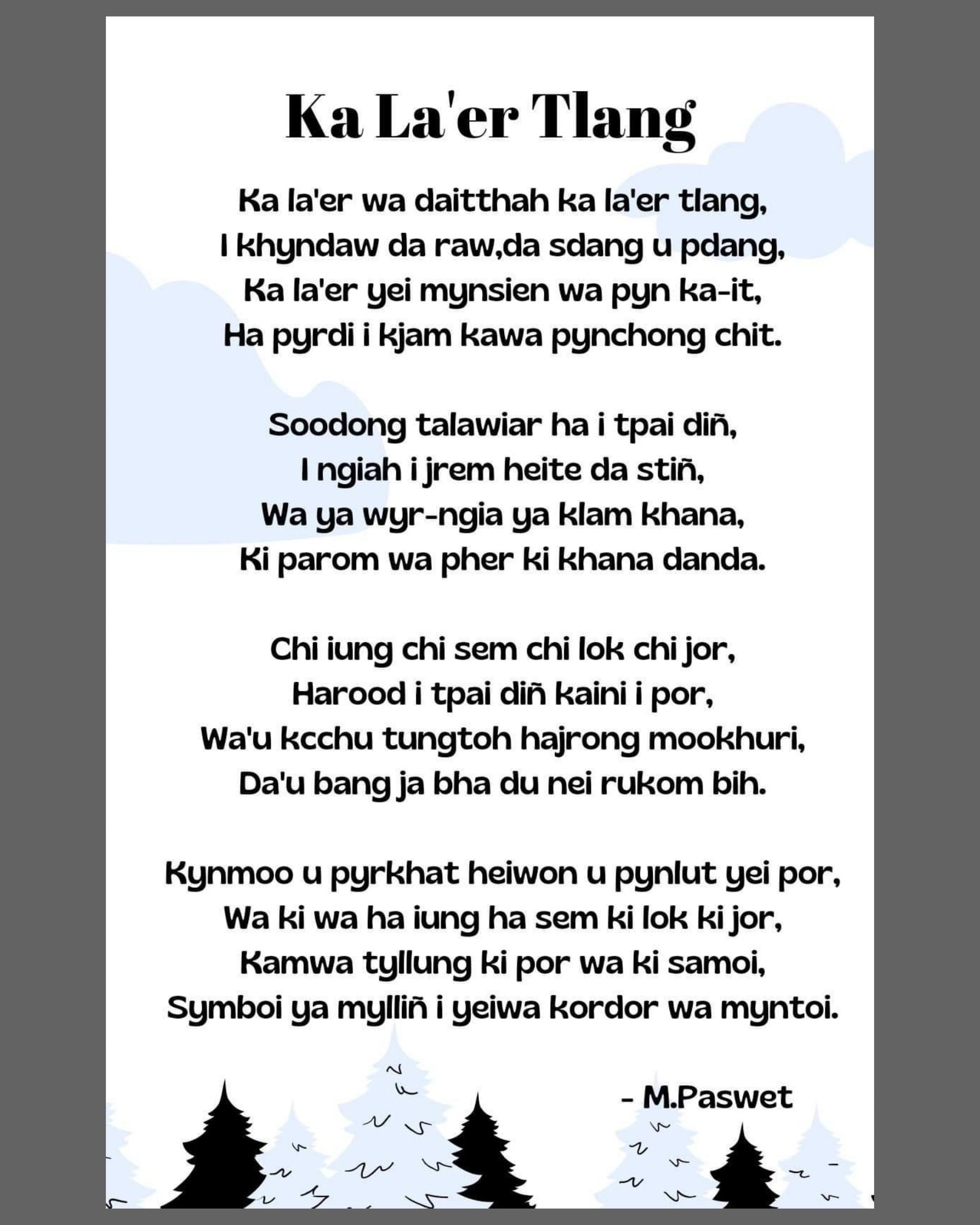
  • “Ka La’er Tlang” da i Manhaoo Paswet

    Ka la'er wa daitthah ka la'er tlang,

    I khyndaw da raw, da sdang u pdang,

    Ka la'er yei mynsien wa pyn ka-it,

    Ha pyrdi i kjam kawa pynchong chit.

    Soodong talawiar ha i tpai diñ,

    I ngiah i jrem heite da stiñ,

    Wa ya wyr-ngia ya klam khana,

    Ki parom wa pher ki khana danda.

    Chi iung chi sem chi lok chi jor,

    Harood i tpai diñ kaini i por,

    Wa'u kcchu tungtoh hajrong mookhuri,

    Da'u bang ja bha du nei rukom bih.

    Kynmoo u pyrkhat heiwon u pynlut yei por,

    Wa ki wa ha iung ha sem ki lok ki jor,

    Kamwa tyllung ki por wa ki samoi,

    Symboi ya mylliñ i yeiwa kordor wa myntoi.

    -Manhaoo Paswet

    "Ka La'er Tlang" toh ka poitri Pnar wa da thoh da u @wisu_02
    Khublei Chibōn wa phah phi ya kani ka poitri yong phi 🙏 iwa ya toh wa i por kjam, por bam tungtoh 😄😋

    Ym em de ha pyrthai kat i tlang ha yung wa ha chnong yong i ❤️❄️🏞️

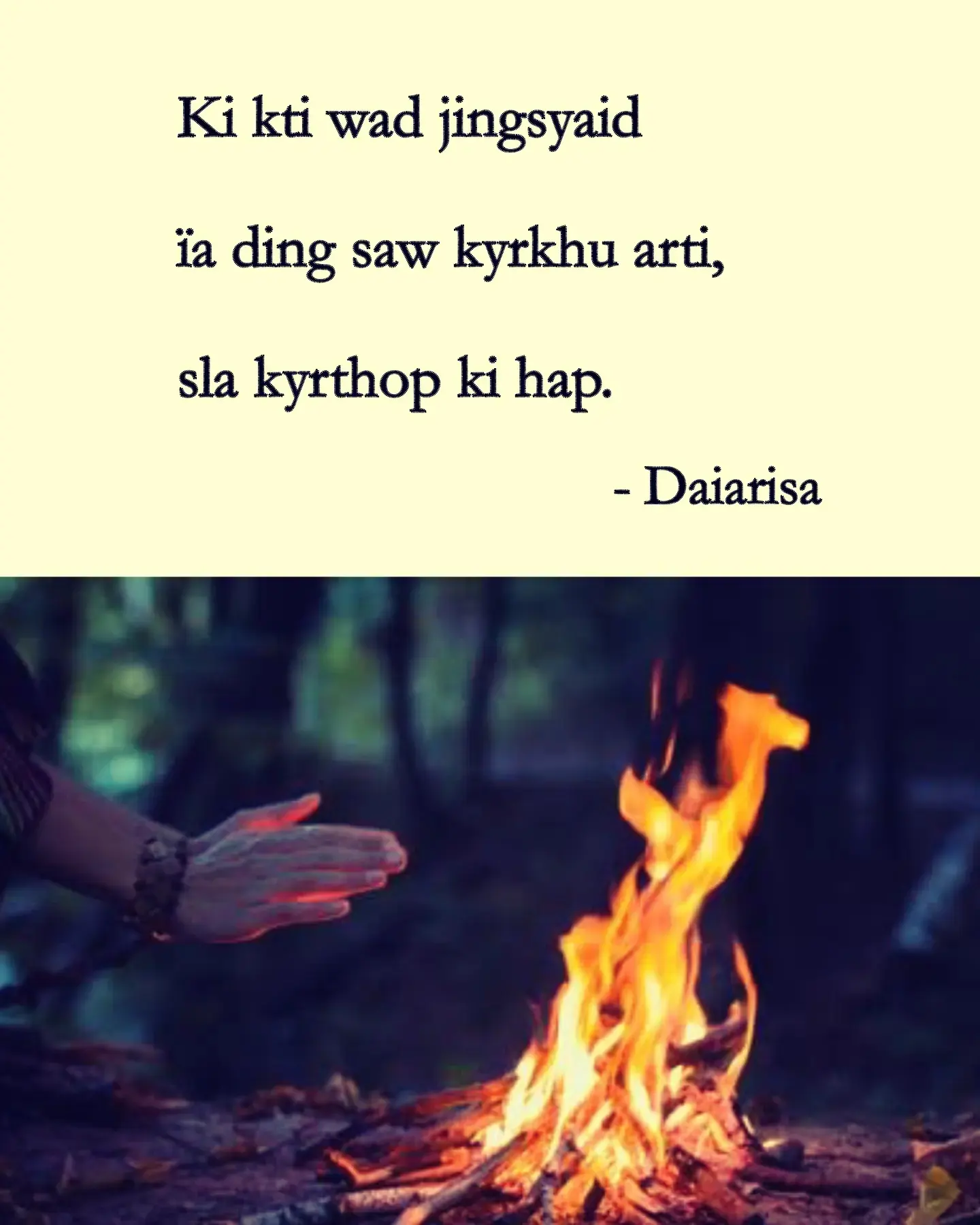
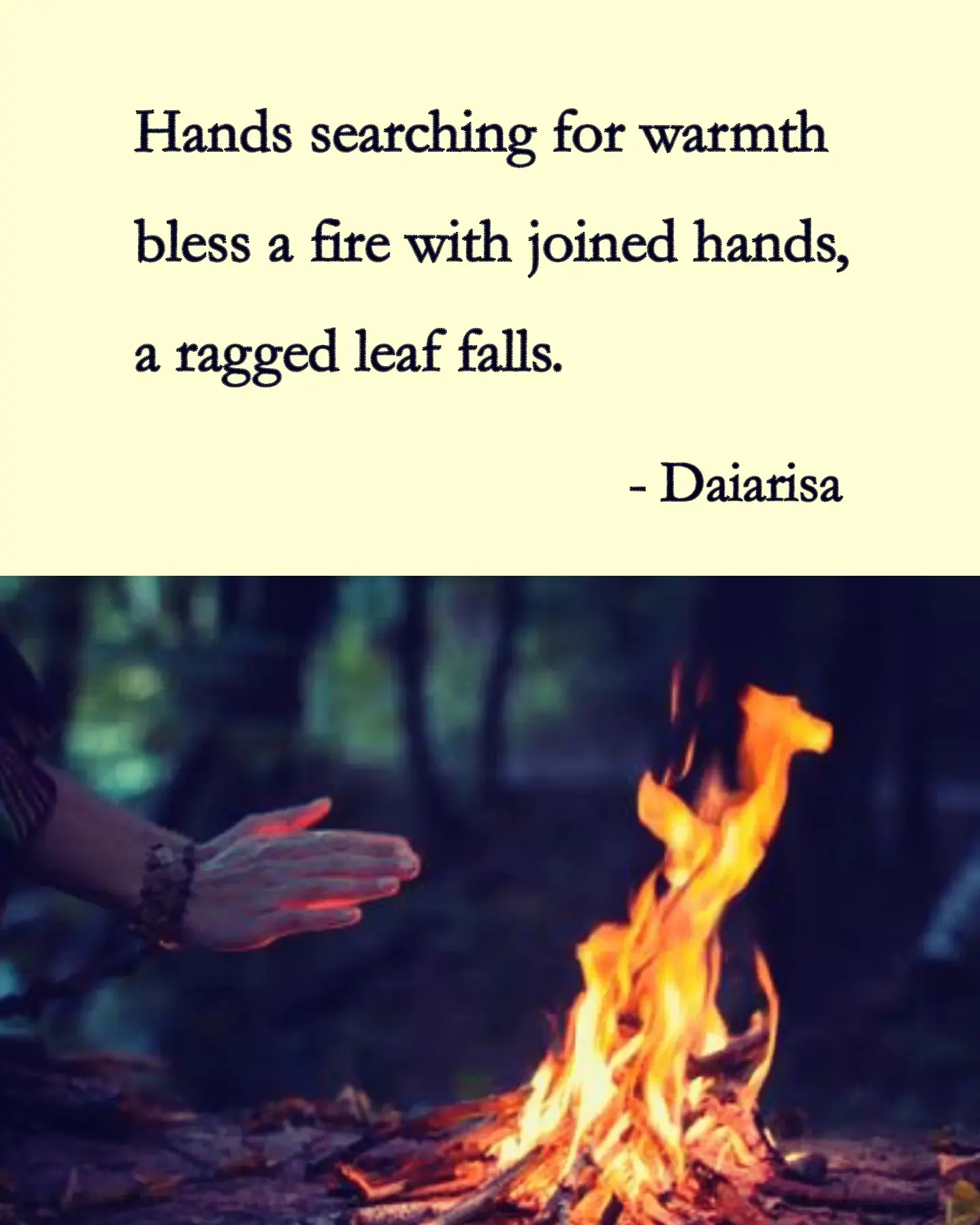
  • “Ki kti wad jingsyaid…” da Daiarisa Rumnong (Haiku)

    Ki kti wad jingsyaid

    ïa ding saw kyrkhu arti,

    sla kyrthop ki hap.

    – Daiarisa

    Hands searching for warmth,

    bless a fire with joined hands,

    a ragged leaf falls.

    – Daiarisa

    Ka haiku ka dei ka rukom thoh poitri kaba na ka ri Japan. Katba ngi wad jingsyaid ha kane ka tlang, ngin pyni ïa ka jingieit jong ngi ïa ka mariang bad ka meiramew, katba ka dang khih dang syar ban thaw thymmai ïalade 🌄🏞️🍃🌨️

    A haiku is a Japanese verse form of three unrhymed lines, of five, seven and five syllables. A haiku often features an image, or a pair of images, meant to depict the essence of a specific moment in time.

    Haiku poems are primarily used to express feelings about Nature. Traditional poems dealt with themes like time, nature, emotions and so on. They are meant as words of enlightenment for the readers.

    Despite its many adaptions into multiple languages and styles, the haiku remains a powerful form due to its economic use of language to evoke a specific mood or instance. Most often occurring in the present tense, a haiku frequently depicts a moment by using pair of distinct images working in tandem.

    Haikus written by @daia.risa

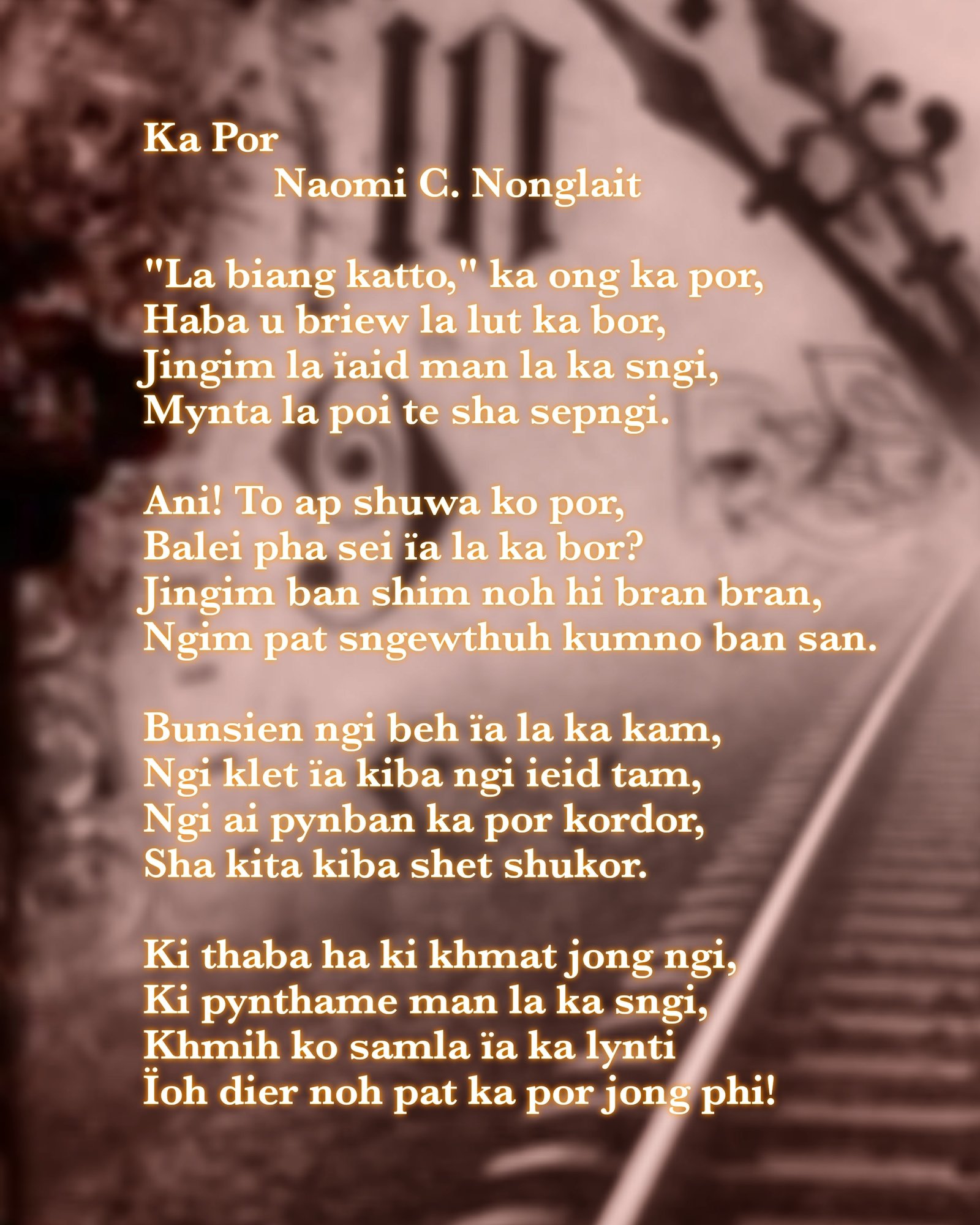
  • Ka Por da Naomi C. Nonglait

    "La biang katto," ka ong ka por,

    Haba u briew la lut ka bor,

    Jingim la ïaid man la ka sngi,

    Mynta la poi te sha sepngi.

    Ani! To ap shuwa ko por,

    Balei pha sei ïa la ka bor?

    Jingim ban shim noh hi bran bran,

    Ngim pat sngewthuh kumno ban san.

    Bunsien ngi beh ïa la ka kam,

    Ngi klet ïa kiba ngi ieid tam,

    Ngi ai pynban ka por kordor,

    Sha kita kiba shet shukor.

    Ki thaba ha ki khmat jong ngi

    Ki pynthame man la ka sngi,

    Khmih ko samla ïa ka lynti

    Ïoh dier noh pat ka por jong phi!

    "Ka Por" (Time) is an original Khasi poem by @carey_lynz who is a teacher and scholar 🤗❤️ Khublei Shibun @carey_lynz ba phi la phah ïa ka poitri jong phi kaba long ka jingpynkynmaw ba kordor 🕯️🪞🕜

    @carey_lynz says about the poem: "Time is a gift and yet a curse to one who does not know how to use it. This poem expresses how time can run out when we are in the rat race of becoming, or achieving or doing things which may not matter. But, while we hanker after the things of this world, they may not be important in another time as we may have lost our focus. For instance, if it is family it is not that we have forgotten them, but it is acts of thoughtfulness like making a phone call or saying kind words that makes a difference. Sometimes we need to look at the bigger picture beyond misunderstandings which may ultimately cost regret and pain. The poem issues a warning of the choices made or the path taken."

    Dr. Naomi C. Nonglait is an Associate Professor in the Department of English,
    St. Mary's College, Shillong, Meghalaya.

  • “Mylliem” by Esther Syiem

    Village of my ancestors

    secure in your remoteness

    where your men stoke their forges

    under makeshift shelters;

    shacks of molten fire that

    spark with the energy of limbs that

    strike…hit…strike..

    in an echoing canvas of sound and silence

    that will always lead me back to my distant beginnings.

    Mylliem of my ancestors

    your smithies have endured

    the treacheries of wind and rain

    your flames lick

    the shimmering cold, as they

    condense in vapours of liquid heat.

    You are the mirage,

    locked in metal.

    Must I turn to you again?

    as in your men and in your women

    I find an answering call

    in the aroma of smoked earth in them

    and in the unbeaten slant of a life

    that writes itself back into my present.

    -Esther Syiem

    Mylliem is a hamlet in East Khasi Hills, famous for its iron smelting works.

    "Mylliem" is an original Khasi poem by Dr. Esther Syiem @meiithei which appears in the collection entitled Oral Scriptings (Writers Workshop, Kolkata, 2005).

    If you are from Mylliem or have lived there, you will find that the poem is an evocative mix of the sounds and images from the village of Mylliem which we now don't hear anymore. Gone are the days when the strikes of the blacksmiths were a reassuring pace of the passing of life. But we are never rid of our memories. These sounds and images return to fill our dreams and our stories. ✍️✍️🗣️🗣️

    Dr. Esther Syiem is a professor in the Department of English, North-Eastern Hill University.

  • U Kba da i Rangskhembor Mawblei

    Kba u symbai

    u kba u soh,

    u khaw ka ïing

    man I'u symboh.

    Sara ne thung

    U ïeng hi joit,

    'dak ka pateng

    u briew u ïoh.

    Khyndew ka riew

    ba briew u doh,

    u long lang keiñ

    mariang ka snoh.

    La thaw kyrpang

    man I'u symboh,

    I'u stait la bret

    b'u met u soh.

    Ka dur b'u rah

    ïa u la ai,

    lada ngin peit

    ne bam kumjuh.

    Baroh ngin tip

    Ï'u kba lashai,

    ne mynta ruh

    u dak ka kpoh.

    "U Kba" is an original Khasi poem written by @rangskhembormawblei , who is a sculptor and installation artist. He teaches in Mairang Vidyajyoti Inclusive Secondary School. He completed his BFA & MFA from Visva Bharati University, Kala Bhavana, Santiniketan.
    Khublei Shibun @rangskhembormawblei ba phi la ai lad ban sah dak ïa ka poitri jong phi! 😄🙏

    U kba u dei uba ngi ithuh ha man la ka thliew ïing Khasi bad u long uba pyntyllun ïa ka jingim jong ngi bad ïa ki samoi ka mariang ruh. Ngi sngewtynnat ba kane ka poitri ka ai ka jingmut kaba jylliew, kaba ai ki symboh kba kiba kordor 🌾🌾🏞️

    Rice paddy is known to every Khasi household, it moves the circle of life and the circle of seasons too. We appreciate poetry like this because it gives us a depth of meaning, it gives in each paddy valuable seeds of thought. 🏞️🌾🌾

  • Saw Ka Tyngab

    "Saw ka tyngab" ka dei ka jingong Khasi kaba kren shaphang ka por kaba dangstep phyrngab. Ha ka jingbatai, ka ktien "phyrngab" ka dei ka por shuwa ban kynjat shai. Ngi lah ban ong ba "saw ka tyngab" ka dei haba ka bneng ka dang shu sdang ban kyan shai, ha kaba ka jngum jong ka miet ka shah pashat da ka saw jong ki kjat sngi.

    Sa kawei ka jingbatai kaba la ïoh ka long ba ka jingong "saw ka tyngab" ka thew ba ngin leh ïa kano kano katba dang kloi ne katba dang biang ka por khlem don ka jingbuhteng.

    "Saw ka tyngab" is a Khasi phrase which refers to the earliest time of the morning. The word "phyrngab" means the time before the arrival of dawn or the sun's rays. We may say that "saw ka tyngab" is when the night sky is just beginning to see a sliver of light, when the blue of night is coloured by the red of the sun's rays.

    Another explanation of "saw ka tyngab" is that the phrase refers to doing something early or while there is time and not procrastinating.

    The Khasi phrase "Saw ka tyngab" is one which we hear often but have not really read an explanation of. "Saw" means the colour red (or four) and "tyngab" means crow. Perhaps these also have a meaning but we have yet to know what they might signify. 🌄🌄

    Khublei Shibun ïa baroh ki nongbud jong ka page kiba la phah ïa ki jubab bad ki jingmut jong ki shaphang kane ka jingong! 🙏🙏

    🟡 Khasi and English explication by @speakyourroots