1. Ka ktien "folklore" ka mut aïu?
Folklore ka dei ka jingiasoh jong ki ar tylli ki kyntien: ‘Folk’ kaba mut ki briew – ym tang kito kiba don ha ki nongkyndong, bad ‘Lore’ kaba kdew ia ki khanatang, ki puriskam, ki purinam, bad ruh ki jingrwai ki phawar. Hynrei, ka Folklore kam kut tang katne; ka dei ruh ka jingwan lang jong ki jingmut jingpyrkhat, ki khana ba laiphewjait bad ruh ki rukom. Ka kynthup ruh ia ka kolshor bad rukom im, ki jingngeit bad kumjuh ruh ia ki jingohdur bad ki rukom shna bapher bapher. Ka kynthup ruh ia kiei kiei kiba ngi lah ban iohi bad ia kito kiba ngi shu lah ban sngap. Bad ju ong ruh ba ka Folklore ka dei ka jingstad ba khlem da hikai jong ka pyrthei.
1. What does the word "folklore" mean?
Folklore is a combination of two words: ‘Folk’ implying people – not necessarily just the rural population, and ‘Lore’ predominantly implying stories, myths, legends, as well as songs. However, Folklore is more than just these elements; it is the coming together of ideas, narratives, and practices. It encompasses culture and tradition, beliefs, as well as art and architecture. It includes that which can be seen and that which can only be heard. Folklore is sometimes considered as unofficial knowledge about the world.
2. Kumno ngin kham sngewthuh jylliew ïa ki riti dustur Khasi kiba la ïoh pateng na ka ktien ka thylliej?
Ka jingdonkam ba kongsan eh jong ka ia kaba mynta ka dei ba ngi donkam ban don ka lad ha kaba ki khun samla ki long kiba shah pynshlur bad kiba kloi ban tip shaphang ka kolshor bad ki rukom kiba long tynrai lyngba ki khana. Dang shen ruh nga sdang ia kawei ka projek ha St. Anthony’s College lyngba ka Design Innovation Centre, ha kaba ngi pyndonkam ia ki khanatang kum shi bynta na ki jingpyrshang jongngi. Lyngba kane ka projek, ki khynnah jong ngi ki ioh ban nang ki skill kiba thymmai bad ruh ki ioh ia ka jinghikai ban burom ia ki khana bad kin long kiba kloi ban wad jingtip ba kham janai na ki. Kumjuh ruh, ki don katto katne ki kot ba ngim da kham pule la ngi dei ki rangbah ne khynnah kiba lah ban ai jingmut shuh shuh shaphang ka ktien ka thylliej u Khasi.
Ngi donkam ruh ban don ka jingpynmlien ba pynshlur ban pule kot, khamtam kito ba lah thoh khnang katkum ka jingdonkam jong ka por ka ia jong ngi khnang ba ngin sngewthuh kham bha ia ka ktien ka thylliej u Khasi. Ka jingtip bniah ia la ka kolshor ka long kaba kongsan tam, da kaba ngi shim bynta ha ki cultural fest ne kino kino ki jingrakhe kiba iadei bad ka riti ka dustur jong ngi kum u Khasi. Ha kajuh ka por ruh, ki jaka pule (naduh kiba rit tam bad ter ter) ki lah ban noh synniang ha kane ka bynta. Kine ki lah ban wanrah ia ka jingsngewjan bad jingsngew sarong ia la ka jong ka kolshor. Ki literashor kiba iadei bad ki khynnah bad ki novel ba don bad ki dur ki dar kin iarap bha.
2. How do we deepen our understanding of Khasi orality?
One of the greatest needs of the hour is to create a situation where young people are encouraged and excited to learn about culture and traditional values through stories. I have recently started a project at St. Anthony’s College through the Design Innovation Centre, where we use folklore as the basis for our endeavours. Through this project, our students are not only learning new skills but are also being taught to find value in narratives and are encouraged to explore them. Additionally, there are a considerable number of books that are rarely read by both adults and children which can add towards the deeper understanding of Khasi orality.
A reading culture is needed as well, one that is tailored to the demands of the time in order to understand the conceptual idea of Khasi orality. Exposure to one’s culture remains highly necessary, with active participation in cultural festivities and celebrations being strongly encouraged. Simultaneously, academia (starting from the lowest level and so on) can contribute to this. It can foster a sense of connection and pride in one’s own culture. Children's literature and Graphic novels can truly add so much.
3. Kiei ki mat pdeng jong ka rukom ngeit rukom pyrkhat jong ki Khasi?
Ki phang pdeng jong ka jingpeit, jingsngewthuh bad ka jingiadei jong U Khasi bad ka pyrthei ka long halor ka bor jong ka jingiateh, kiba iaid ryngkat ha kiba bun ki bynta – bad U Blei, para briew, bad ka mariang. U Khasi um lah ban im khlem ka jingiadei bad la U Blei, kum ba u/ka kim lah ban im khlem ka iing ka sem bad ki kur ki kha. Shuh shuh, u Khasi u bym suitniew ia ka mariang bad baroh kiba ha ka u lah phet jngai noh na ki jingngeit tynrai jong ki Khasi kum naduh ka mynnor. Kine baroh ki paw shai bha haba ngi leit wad jingsngewthuh shuh shuh sha ki field (lyngba ki fieldwork). Haduh kine ki sngi, ngi lah ban shem ia ki ha ka folklore jong ki Khasi, ki jingrwai tynrai, bad ruh ki riti ki dustur. Ki snem ba nga pynleit ha ka fieldwork ka lah ailad ianga ba ngan sngewthuh ia kine baroh, bad ki pyni shai ia ka jinglong kylluid ka jingpeit, jingsngewthuh bad ka jingiadei jong U Khasi bad ka pyrthei ha kaba u im da kaba wad ia ka jingim kaba shongsuk shongsaiñ.
3. What are the salient features of the Khasi worldview?
The Khasi belief system centres around the strength of bonds, operating on multiple levels – with God, among humanity, and with nature. A Khasi cannot exist without a connection to God, just as he/she cannot exist without their family and clan. Moreover, a Khasi who lacks deep respect for the land and the natural world has deviated from the beliefs of their ancestors. These elements become evident when one engages with them in the field (through fieldwork). To this day, these aspects remain observable in Khasi folklore, folksongs, and religious traditions. My years in the field allowed me to observe all of these, and it speaks volumes about the inclusiveness of the Khasi worldview that yearns for harmonious existence.
4. Kumno ki rukom ngeit rukom pyrkhat jong ki nongwei ki ktah ïa ka rukom ngeit rukom pyrkhat jong ki Khasi?
Namar ba ka jingwad jingtip jong nga ka dei ha ki War-Khasi, ngan jubab ia kane ka jingkylli lyngba nga jingsngewthuh jong nga. Ka jingpeit, jingsngewthuh bad ka jingiadei jong ki phareng, khamtam ha ka niam ka jingngeit, ka paw ba ki don katto katne ki jingktah. Haba u Khasi u pdiang ia ki jingpeit, jingsngewthuh bad ka jingiadei jong u bad ka pyrthei kumba ki peit ki phareng, ngin shem ba ka jingiadei jong u bad la ka jong ka jaka ka hiar, watla U Blei u iai long ba kongsan ha ka jingngeit jong u. Ki khana bad ki riti ki dustur ki kylla noh bad u jngai noh na ki, teng teng lah pynjngai bad lah bthah leh klet noh. Hynrei, khyndiat eh kiba pynneh iaki. Ka jingsaphriang jong ki khanatang bad kumta ter ter ka hiar noh, bad ju iohi bha ia kane ha kiba dang kham samla. Hynrei, kito ba don ka jingieit ia la ka jong ka kolshor bad ki pyrshang ban pynneh ia ka jingpeit, jingsngewthuh bad ka jingiadei jong u Khasi bad la ka mariang hi. Kaba sngewsih ka long ba bun kiei kiei kiba dei bad ka kolshor ne ka jinglong Khasi ka paw shai ka la duna. Ngi lah ruh ban ong ba ki jingpyrshang bad ka jingshimkhia jong ki jaka pule ka ai jingkyrmen.
4. How have foreign worldviews affected the Khasi worldview?
Since my research has primarily focused on the War-Khasi, I will be addressing this issue from that perspective. Foreign worldviews, especially concerning religious beliefs, have exerted certain influences. When a Khasi adopts a foreign worldview, their connection to the land weakens, even though God remains central to their belief system. Belief narratives and practices related to the land become unfamiliar to them, often discouraged and even suppressed. However, a small minority strives to preserve them. The sharing of folklore diminishes as a result, a phenomenon sadly observable among the younger generation. Conversely, cultural lore is retained mainly by those who maintain a strong affinity with their own worldview. The erosion of cultural memory is evident in most cases. However, a rising trend in academic interest seems to be promising.
5. Kumno ki tiar stad ka juk mynta bad ki kor pathai jingtip kin nang bteng ban ïarap ban pynneh ïa ki riti dustur, ki rukom ngeit rukom pyrkhat bad kiwei kiwei jong ki Khasi?
Ki technology bad ki kor media kiba mynta ki ai ia ki lad ban leh ia ki documentation ba bun rukom ha kaba iadei bad ka Khasi folklore. Ngi lah ban leh digital recording bad archiving, pyndonkam online platforms bad databases ban pynneh pynsah ia ka folklore jong ngi bad ruh ngi lah ban thoh ban tar bad ban pynkylla ktien ia ki jingthoh jong ngi sha kiwei pat. Ngi lah ruh ban shna ki kot pule, lah ban wanrah design bad innovation, bad ter ter. Ki lad ki long kiba bun bha. Hynrei, ki snem kiba nga lah pynleit ha ka fieldwork ki kdew ba ki don katto katne ki bynta jong ka folklore jong u Khasi ba ym lah ban lym kat kum ki kor ki bor mynta bad kan long kaba bakla ban shu pynwan dur noh ia ki ha ki kot ne hapoh ki kor media bapher – donkam ban mad ban shem ia ki kumba ki long hi. Katba dang don ki nongioh kynti jong ki riti ki dustur jong ngi, kiba pynneh ban pyndep ia ki, ka folklore jong u Khasi kan neh. Watla katta ruh, ha kaba donkam, ki kor technology ba ngi don ki lah ban iarap ban pynneh ban pynsah ia ka. Ha kaba mynta, nga tip ba ki don katto katne ki projects kiba trei nylla ha kaban lum bad pynneh pynsah ia ka folklore u Khasi kaba donkam mynta mynta.
Ha kane ka artikl, nga lah pyrshang kat ba lah ban pyni ia kiba pule ba kin sngewthuh ia ka jingdonkam ban don ha ka field ban lum ban lang ia ka folklore. Kawei de ba nga lah ban kdew ka long ki riti ki dustur ba nga thoh ha kane ka artikle ki long ka Phur Nongjri bad ka Phur Sohbar ki bym shah ban ring ne shon dur ha kano kano ruh ka rukom, namar ka field hi ka kyntu ba ym baroh ki bynta jong ka folklore u Khasi ki donkam ban shah lum shah lang lyngba ki kor media kiba mynta.
“Lore and the Process of Tradition: Locating the Place of Narratives and Religion in Ka Phur Nongjri and Sohbar”. In Untold Narratives, Invisible Marks, Ethnographica et Folkloristica Carpathica, Ethnology and Folklore. No 23. Pp. 89-102. 2021. https://ojs.lib.unideb.hu/ethnographica/article/view/9223/9132
5. How will technology and media continue to help in the documentation of Khasi folklore?
Modern technology and media offer numerous incentives for the documentation of Khasi folklore. We can utilize digital recording and archiving, online platforms and databases for preserving folklore and folk traditions, transcribe and translate materials, create educational resources, develop adaptive designs and innovations, and much more. The potential is limitless. However, my years of experience in the field suggest that certain aspects of Khasi folklore defy archiving or documentation in textual or digital spaces – they must be experienced and felt in the moment. As long as custodians of folk traditions exist, who continue to articulate and practice them, Khasi folklore will endure. Yet, whenever the need arises, modern technology can assist. Presently, I am aware of a few projects that are diligently working towards documenting aspects of Khasi folklore that require immediate attention.
In this article, I have tried my best to direct the reader’s attention on the insistence of being in the field to be part of the documentation of folklore. The fact that the practices considered in this study ‘Phur Nongjri’ and ‘Phur Sohbar’ discourages documentation, the field itself suggests that not all aspects of Khasi folklore needs or can be documented.
“Lore and the Process of Tradition: Locating the Place of Narratives and Religion in Ka Phur Nongjri and Sohbar”. In Untold Narratives, Invisible Marks, Ethnographica et Folkloristica Carpathica, Ethnology and Folklore. No 23. Pp. 89-102. 2021. https://ojs.lib.unideb.hu/ethnographica/article/view/9223/9132
Happy World Folklore Day!
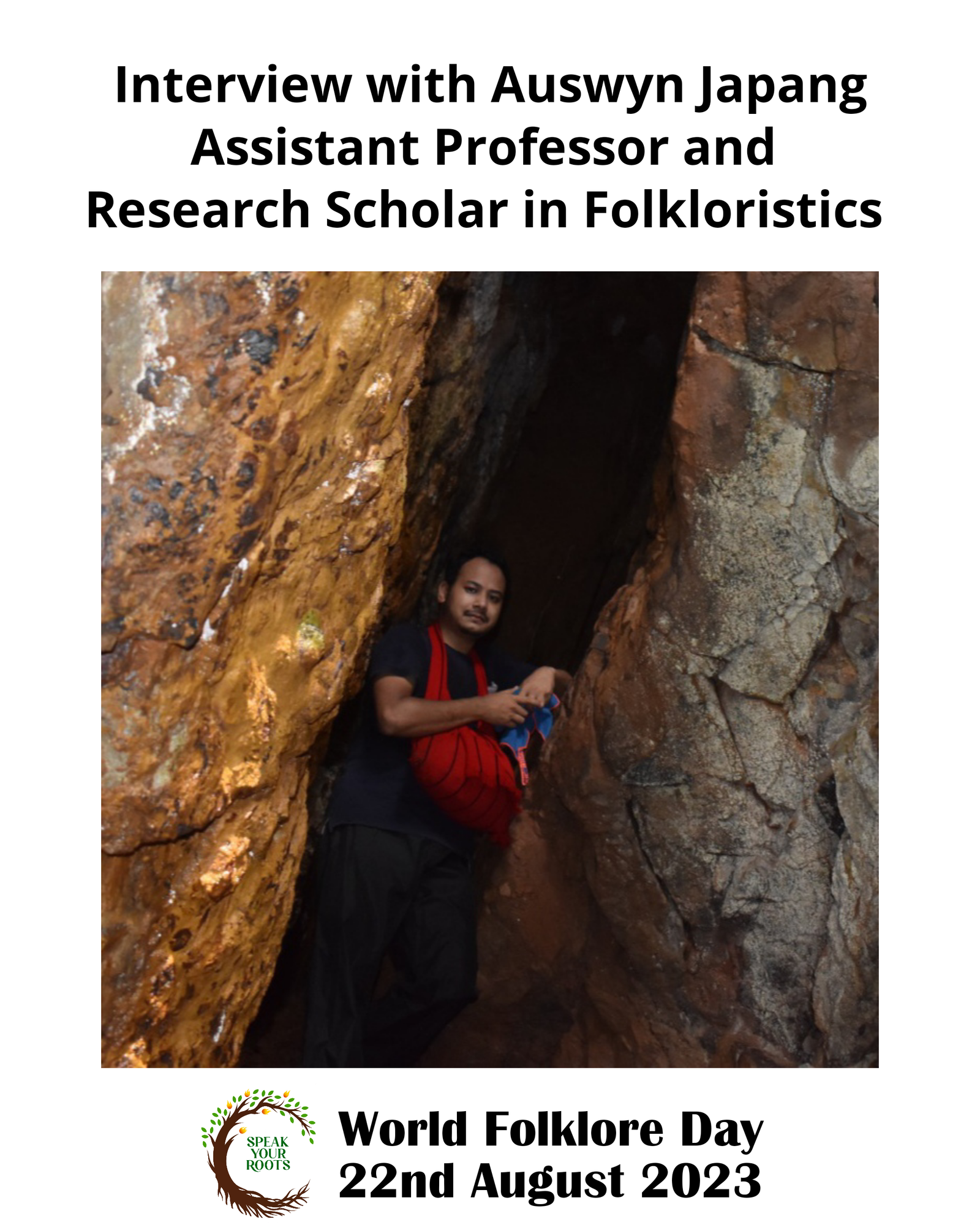
Today on World Folklore Day, 22nd August 2023, we have an interview with Auswyn Japang @ausjapang who is an Assistant Professor and a Research Scholar in Folkloristics 🏞️🌿
Khublei Shibun @ausjapang for expressing your thoughts and expertise on these questions, which have been made quite comprehensive! 😄🙏
Auswyn says about research and fieldwork: "While every now and then I do get to engage in fieldwork, this is where true folklore resides. Some fieldwork involves treks of tremendous distances and they sometimes happen late in the evening as well. Sometimes without a streetlight. And no roads. Fieldwork also demands a great deal of endurance. I had to go down a sharp decline to reach a cave of religious significance whose folklore is unknown to a great many."
We express our appreciation and gratitude for your hard work and the gruelling experiences that you have to go through to complete your research! 🙏🙏 Kudos to all research scholars who are who are plodding day and night to preserve and document Khasi folklore and folklife!