Tag: khasilanguageconservation

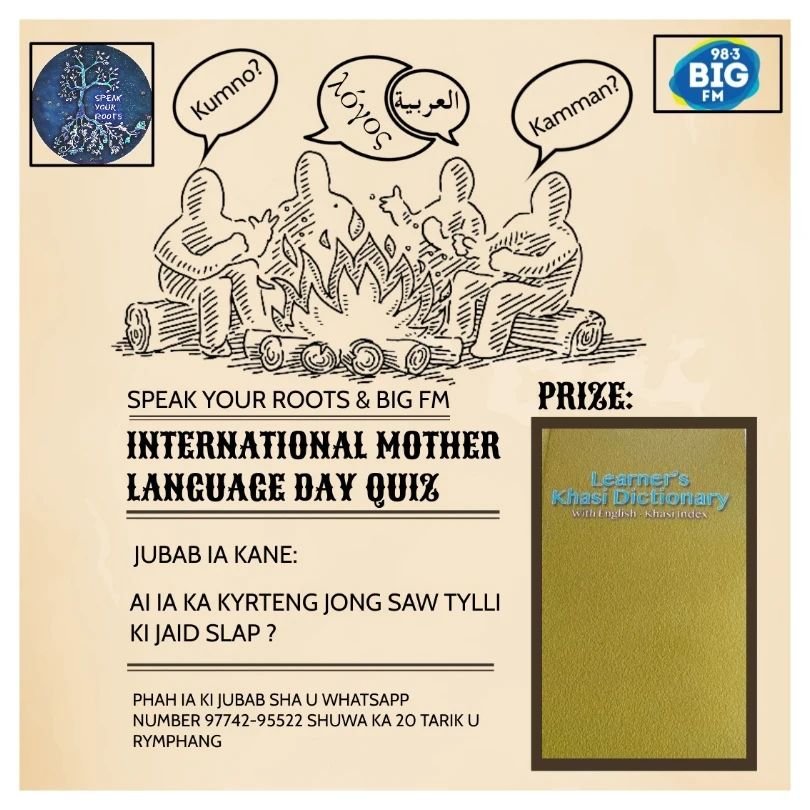
  • International Mother Language Day Quiz 1

    Kum shi bynta jong ka jingrakhe ïa ka International Mother Language Day, ka Big FM Radio bad ka Speak Your Roots ki wallam ha phi ïa ka International Mother Language Day Quiz! 🗣️🗣️🗣️

    Phah ïa ka jubab jong katei ka jingkylli ba phin jop ïa ka Learner's Khasi Dictionary kaba la pynmih da ka Don Bosco Publications. Wat nym duh ïa kane ka lad ban ïoh ïa kane ka kot kaba kordor!

    Kin don 4 tylli ki jingkylli ha kane taïew haduh ka 21 tarik u Rymphang!

    As part of the celebration of International Mother Language Day, Big FM Radio and Speak Your Roots bring to you the International Mother Language Day Quiz! 🗯️🗯️🗣️🗣️

    Send your answers to the question to the phone number given in order to win the Learner's Khasi Dictionary published by Don Bosco Publications. Don't miss the chance of winning this well-researched and valuable book!

    There will be 4 questions this week leading up to the 21st of February!
  • Dialect Display #2 and #3

    Ngi lah ïoh ïa ki entry ba ar bad ba lai ïa ka Dialect Display! 🗣️🗣️

    Kaba nyngkong ka dei na Jowai, khublei shibun @xdtnoahjupejackllthmanar bad kaba ar ka dei na Mairang, khublei shibun Nangsan Basaiawmoit! 😃🙏

    We have our second and third entries from Jowai and Mairang 🥳🥳

    Ngi dang khmih lynti shuh ïa ki videos na ki ktien shnong ba pher ba pher ka ri Khasi Pnar!

  • International Mother Language Day Big FM & SYR 2022

    Ka Big FM Radio bad ka Speak Your Roots ki ïa snoh kti lang ban rakhe ïa ka International Mother Language Day kaba dei ha ka 21 tarik u Rymphang. 🗣️🎙️📝🗯️

    🟡 Ïa katei ka dkhot ha ka video la shim na Ka Jingsneng Tymmen Shaphang Ka Akor Khasi Ha Ka Rukom Rwai Phawar, Part I ba la thoh da U Radhon Singh Berry Kharwanlang. Ka long kumne harum:

    "To mut bha, to kren beit bad to leh hok,

    Lada phi im phi ïap noh ruh syrtok;

    To ieit ïalade burom ïa kiwei,

    Ba phin suk ha pyrthei, phin suk h’'U Blei…”

    Ngi khmihlynti ïa ka jingïashimbynta jong phi ban pynsngew ïa ki ktien tynrai, ktien shnong jong phi ïa baroh! 😃😃

  • Orkyndok

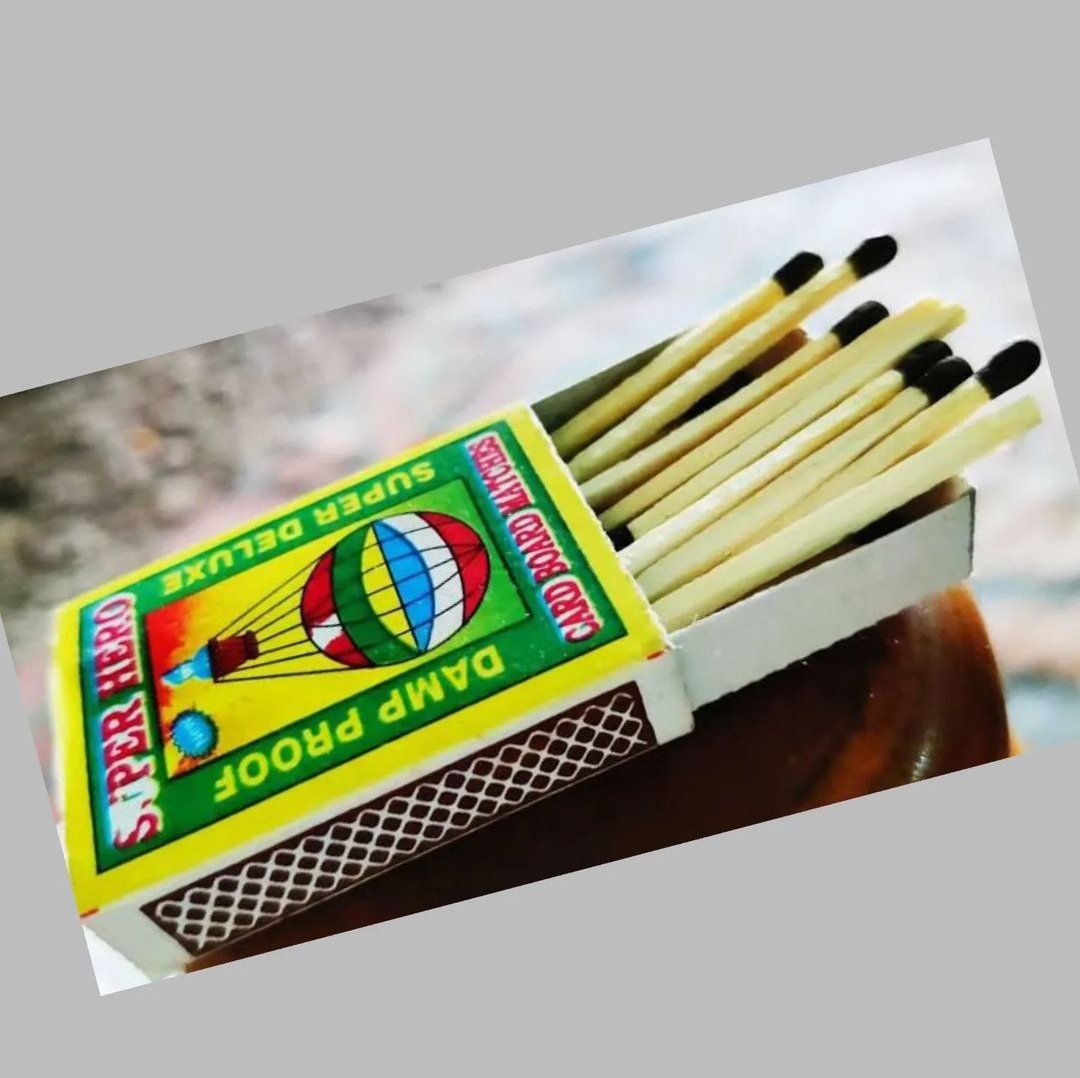
    Kaei ka "orkyndok"?

    Ka orkyndok ka dei ka synduk buh jingpruid.

    "Ka orkyndok" is the matchbox.

    A small package housing many fires 😂😂🔥🔥 "Ka orkyndok" feels quaint and quirky somehow.

  • War Jaiñtia Dialect

    Ma – Mei – Mother

    Pa – Pa – Father

    Bua ji – Bam ja – To eat rice

    Deh cha -Dih sha – To drink tea

    Rhen – Lynti – Road

    Am -Um – Water

    Ïu-nga/ Shnga – Sngi – Sun

    Pnu – Bnai – Moon

    Jeprow – Briew – Person

    Derow – Samla – Youth

    U Pra – U Blei – God

    Hun – Khun – Son/ Daughter

    Jeme/ Dia – Jaiñ – Cloth/ Clothes

    Pdeng – Lum – Hill

    Phliang – Suiñbneng – Sky

    Lia -Leit – Go

    Hynbo – Khynnah – Child

    Sere – Lyer – Wind/ Air

    These are some words from the War Jaiñtia dialect sent by Sunrise Pohtam 🏞️🌲
    Khublei Shibun for sending this list of words! 🙏😄

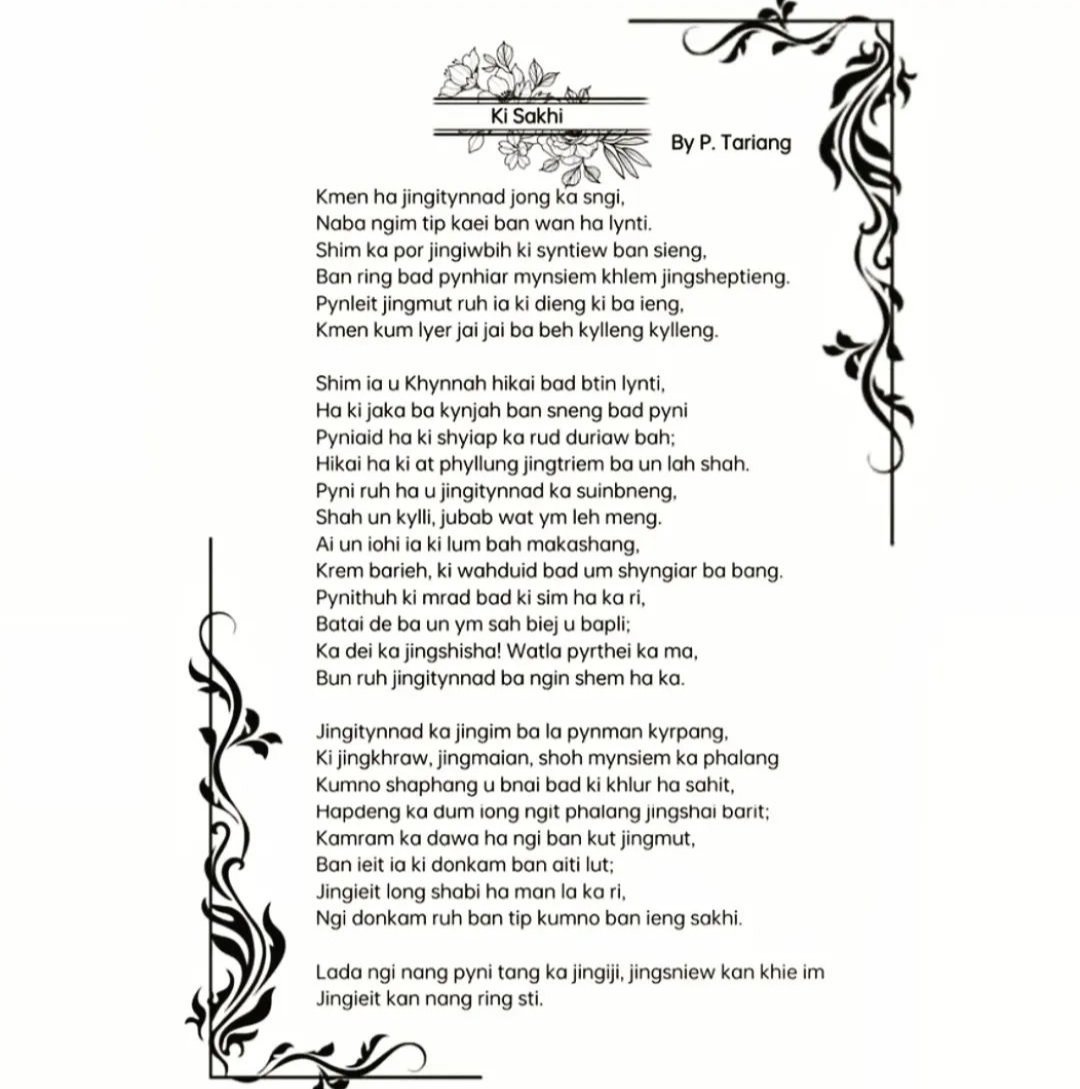
  • Ki Sakhi by P. Tariang

    Kmen ha jingitynnad jong ka sngi,

    Naba ngim tip kaei ban wan ha lynti.

    Shim ka por jingiwbih ki syntiew ban sieng,

    Ban ring bad pynhiar mynsiem khlem jingsheptieng.

    Pynleit jingmut ruh ia ki ding ki ba ieng,

    Kmen kum lyer jai jai ba beh kylleng kylleng.

    Shim ia u khynnah hikai bad btin lynti,

    Ha ki jaka ba kynjah ban sneng bad pyni

    Pyniaid ha ki shyiap ka rud duriaw bah:

    Hikai ha ki at phyllung jingtriem ba un lah shah.

    Pyni ruh ha u jingitynnad ka suiñbneng,

    Shah un kylli, jubab wat ym leh meng.

    Ai un iohi ia ki lum bah makashang,

    Krem barieh, ki wahduid bad um shyngiar ba bang.

    Pynithuh ki mrad bad ki sim ha ka ri,

    Batai de ba un ym sah biej u bapli:

    Ka dei ka jingshisha! Watla pyrthei ka ma,

    Bun ruh jingitynnad ba ngin shem ha ka.

    Jingitynnad ka jingim ba la pynman kyrpang,

    Ki jingkhraw, jingmaian, shoh mynsiem ka phalang

    Kumno shaphang u bnai bad ki khlur ha sahit,

    Hapdeng ka dum iong ngit phalang jingshai barit;

    Kamram ka dawa ha ngi ban kut jingmut,

    Ban ieit ia ki donkam ban aiti lut;

    Jingieit long shabi ha man la ka ri,

    Ngi donkam ruh ban tip kumno ban ieng sakhi.

    Lada ngi nang pyni tang ka jingijli, jingsniew kan khie im,

    Jingieit kan nang ring sti.

    – P. Tariang

    "Ki Sakhi" is an original Khasi poem by @the_dark_linen_ ✒️🏞️🌲

    Khublei Shibun for sending your poem! 😀🙏 Ka long kaba kit jingmut bha bad kaba don jinghikai.

  • The Dialect of Raid Narleiñ, Ri Bhoi District

    Kine ki dei khyndiat ki kyntien kiba na ka Raid Narleiñ, Ri Bhoi District (Ki shnong ba hap kum ka Mawrong, Syngku, Umkei, Mawkangi, Raitong)

    Here are some words from the dialect of Raid Narleiñ, Ri Bhoi District (including some villages like Mawrong, Syngku, Umkei, Mawkangi, Raitong)

    Khñiem – Shitom ne pang (ill, sick)

    Jam – Pang (in pain)

    Khyññiet – Kyndit (in shock)

    Pyrtij – Kyrteng (name)

    Kyrkaw – Pyrta (call out a name/ shout out)

    Siah – U synsar/ ba sar (broom stick/ to sweep)

    Synrum – Ki jaboh/ ñuit (waste material)

    Mynchem/ Phyndwar – Phyllaw (lawn)

    Chynraiñ – Sngiew phieng ne tieng burom (awe/ respect)

    Mynraiñ – Lehraiñ (ashamed)

    Ba leh ba leh ba – Da kumno kumno ruh (whatever the situation)

    Jyrnep, Jyrnait – Jaboh (dirty)

    Luia – Jaituh (lazy)

    Syriaw, Jaknar – Jaituh and Lehsih (lazy and dirty)

    Sker – Tiar (solid things)

    Tadap – Ba lah jot/ bym ler/ bym long shuh (old, useless, torn, low quality thing)

    Pukai – Na ka bynta (in favour of)

    Tngam – Khriat (feeling cold)

    Tyrlan – Pjah (cold)

    Khyrngu – Rnga (Charcoal)

    Pharap – Kyrkieh (in a hurry/rush)

    Myrlin – Klet (forget)

    Here are some words from the dialect of Raid Narleiñ, Ri Bhoi District sent by @phiba_makdoh 😃👍 Khublei Shibun for sending these words @phiba_makdoh 🙏🏞️😄

  • Wei La Saw Bha Ka Bneng…

    "Wei la saw bha ka bneng sepngi jan miet phin sa ioh jingrang lashai."

    (La shim na "The Khasis" by P. R. T. Gurdon, 1907)

    Ha ka jingpeit bniah bad jingkhmih jong ka, nga shem ba katei ka jingong ka jia long shisha. Ka jingshem ka jong nga ka long ba ha ka janmiet jong ka 12 tarik U Kyllalyngkot 2022, nga ïoh peit bniah bha ïa ka bneng kaba paw rong saw kumba 5 minute eiei bad ha ka sngi kaba bud, kata ha ka 13 tarik nga shem ba ka sngi ka rang bad shai kdar bha bad kumjuh ruh ka don ïa ka sngi tlang kaba jem bha.

    "A red sky in the west in the evening is the sign of fine weather tomorrow."

    (Taken from "The Khasis" by P. R. T. Gurdon, 1907)

    In my brief observation, I observed that the Khasi saying found in Gurdon's The Khasis is certifiable. It is quite rare to hear these sayings nowadays but when I revisited Gurdon's book on the Khasis I decided to note this saying down and conduct a brief observation. On the evening of 12th January 2022, I observed that the evening sky at sunset was red in shade for approximately 5 minutes or less and then on the following day, 13th January 2022, I found that we were blessed with a dazzling and bright day. Moreover it had that soft winter sun and an amalgamation of both warm and chilly breeze.

    "Wei la saw bha ka bneng sepngi janmiet phin sa ïoh jingrang lashai" 🌄☀️🌲
    Khublei Shibun @_.adegram._ for sending this observation! 🙏😄

    🟡 English translation by @_.adegram._

  • Different Ways of Saying “Thank You” in the Khasi Language

    Ki rukom ong "Khublei Shibun" ba pher ha ka ktien Khasi

    Ka ktien "Khublei" ka thew ïa ka jingsngewnguh bad ka jingkyrkhu. Ka ktien "khu" ka wan na ka ktien "kyrkhu" bad ka ktien "blei", na ka ktien "Blei", kata ka mut, U Blei un kyrkhu ïa phi. Ka ktien "Shibun" ka mut kaba bun bad ka ktien "Khublei Shibun" ka thew ïa ka jingsngewnguh kaba shikatdei ne katta katta.

    The word "Khublei" refers to a feeling of gratitude and is also an expression of a blessing. The word "khu" comes from the word "kyrkhu" which means to bless and "Blei" which means God. So "Khublei" means God bless you. The word "Shibun" means many and in the phrase "Khublei Shibun" it refers to an immense feeling of gratitude.

    "Khublei Shikatnor" and "Khublei Shikhohtyndaw"

    Kane ka rukom ong Khublei Shibun la shim na ka "Shatwaidong" jong ka kot Ka Kolshor Khasi Kumba Paw ha ka Literashor Khasi (2006) kaba la thoh da i Dr. (Sr.) Philomena Kharkakor RNDM.

    This way of saying Khublei Shibun is taken from the Introduction to the book Ka Kolshor Khasi Kumba Paw ha ka Literashor Khasi (2006) written by Dr. (Sr.) Philomena Kharkakor RNDM.

    Ha baroh artylli ki rukom ong ka don ka jingsngewnguh kaba jylliew bad kaba shikatdei haduh katta katta.

    In both instances, the words express a deep and immense sense of gratitude and thankfulness.

    There are two ways of saying "Khublei Shibun" that are different from the usual way of saying the phrase.
    Khublei Shibun @_.adegram._ and @redfm_rjzack for bringing up these two new ways of saying "Khublei Shibun" 😄🙏

  • “Lai rukloo-rukloo” from the Tuber dialect

    "Lai rukloo rukloo" from the Tuber dialect sent by Ribait Phawa

    Kawei ka kyntien nga kwah ban bynrap ha kaba ki ju kren ha ki por mynshwa bad ïa mynta tang ki riewtymmen ki kham pyndonkam ïa kane ka kyntien ha ka dialect Tuber.

    "Lai rukloo-rukloo" ka mut ban leit kloi-kloi sha ka kam ba lah phah, la haka leit shim ki tum ki tam ne ban leit thied jingthied. Ne kino kino ki jingphah kiba kham san ki phah da ka jingkyrkieh.

    "Lai rukloo-rukloo" is a phrase in the Tuber dialect that was used before and which is now used mostly by the elderly.

    The phrase means to do a task with a sense of hurry and urgency, whether if it is to take something or to buy something. It is also used when the elderly send us on an urgent errand.

    "Lai rukloo-rukloo" is a phrase from the Tuber dialect which means to do something quickly. Khublei Shibun @b.a.i.t_phawa_ for sending this! 😃🙏