Tag: khasilanguageconservation

  • Where is the Dialect from? #1

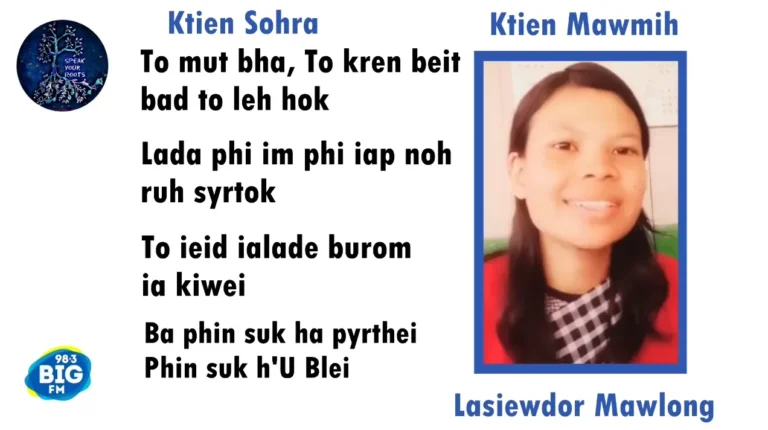
    Khublei ïa phi baroh! Kane ka dei ka jingïakob halor ki ktien shnong (dialect contest) na ki bynta ba pher jong ka ri Khasi kum shi bynta jong ka jingrakhe ïa ka International Mother Language Day, kaba la wanrah sha phi da ka @speakyourroots bad ka Big FM 98.3 Shillong lyngba ka jingkyrshan jong ka @neindiaarchive !

    🟡 Kin don saw tylli ki jingkylli. Kane ka dei ka jingkylli kaba nyngkong!

    🟡 Lada phi tip ïa kane ka ktien la kren ha ka shnong ne ka thaiñ aïu, phah ïa ka jubab da ka text sha une u number 8798997511. Phin ïoh ïa ka khusnam kaba la pynkhreh kynsai!

    🟡 SNGEWBHA AI ÏA KA KYRTENG JONG KA SHNONG/ THAIÑ BAD KA KYRTENG KABA PURA KA JONG PHI RUH.

  • Khasi Rap Song, International Mother Language Day 2023

    Woohooo!! Kane ka dei ka jingrwai rap kaba la rwai da i @hephzibah585 Hephzibah D Pohthmi, i @scolas.d Scholastica Nongbri bad i @ailylvcr09 Balasuklang Lyngdoh Nonglait na ka bynta ka jingrakhe ïa ka International Mother Language Day! 🔥🔥🔥

    Kaba kham sngewtynnat shuh shuh ka long ba ki rap ha ki ktien Khasi, West Kynshi Mairang, Thynroit, bad War Jaiñtia!! 🗣️🗣️🗣️

    Khublei Shibun ïa kane ka jingrwai kaba sngew ïahap shisha na ka bynta kane ka sngi!! 😃🙏

  • Khasi Limerick

    Haba dang mut ba lah shit

    tipma ha ka tapmoh kum lymbit,

    ki lyoh ka lyer ki

    ong wat ang kumto tynghong

    bad puh samthiah ha sngi!

    Balei lah khriat biang? 😥🥶 Haba lah kham sngew syaid te 😅😅

    Da phi lah ban thoh kum kine sa phah ban ïoh sah dak ha ka page!

  • Khasi language accepted in Calcutta University

    In 1903, the Khasi language was accepted as one of the languages that could be used during entrance examinations in Calcutta University, West Bengal.

    Some information about Sir Pedler who is mentioned in the letter is here below (Source: https://en.m.wikisource.org/wiki/The_Indian_Biographical_Dictionary_(1915)/Pedler,_Sir_Alexander):

    Sir Alexander Pedler, F.R.S., C.I.E. (1901), Director of Public Instruction, Bengal (retired);

    Son of late John Standbury Pedler of Drilwich; Born in 1819;

    Education: City of London School and at the Royal College of Chemistry, London; Joined service, 1873; Meteorological Reporter to Bengal Government, 1889; Principal, Presidencv College, Calcutta, 1896; Director of Public Instruction, Bengal, 1899; Additional Member, Supreme Legislative Council, 1903; Vice-Chancellor, Calcutta University, 1904; retired, 1906. Address: 28, Stanhope Gardens, London.

    Khublei Shibun @historian_to_be for this contribution! 😀🙏 It is great to know that the Khasi language was acknowledged by the then British government as a language for entrance examinations.

  • Ka Por Kristmas da i Occyliana M. Syiemiong

    Ki jingpynkhreh kyrpang baroh.

    Naduh najrong haduh hapoh;

    Habar ka ïing lynti syngkein

    Thaba ki rong i phuh i phieng.

    Bun jingbakla dei ban pynbeit,

    Jingmut Kristmas la kum u kbeit;

    Shu her sha suiñ khlem hiar sha tbian,

    Sngew tang rong phong katta la biang.

    Phewse! Kristmas dei ka jingieit,

    Mynsiem pynbeit ba kan suh thied,

    B'u Khrist hangta Un sa wan hiar,

    Ki Jingkyrkhu kin sa tawiar.

    Ka por Khristmas dei por jingkmen,

    Jinglehsynei samla tymmen;

    Hangne baroh ba ïa kmen lang,

    Ka ding jingieit to ai kan klang.

    Khristmas basuk Khristmas bakmen,

    Mynsiem to ai ba kan shong tngen;

    Ki jingkyrkhu kyrhai to shim,

    Khristmas to ai ha ngi kan im.

    -Occyliana Mary Syiemïong

    "Ka Por Khristmas" ("The Time of Christmas") is an original Khasi poem written by @occyliana_ 🌲❄️🎄 Khublei Shibun ba phi la phah ïa ka jingthoh jong phi kaba kren ïa ka jingshisha ba donkam. 🙏🙏

  • Ka Por da Naomi C. Nonglait

    "La biang katto," ka ong ka por,

    Haba u briew la lut ka bor,

    Jingim la ïaid man la ka sngi,

    Mynta la poi te sha sepngi.

    Ani! To ap shuwa ko por,

    Balei pha sei ïa la ka bor?

    Jingim ban shim noh hi bran bran,

    Ngim pat sngewthuh kumno ban san.

    Bunsien ngi beh ïa la ka kam,

    Ngi klet ïa kiba ngi ieid tam,

    Ngi ai pynban ka por kordor,

    Sha kita kiba shet shukor.

    Ki thaba ha ki khmat jong ngi

    Ki pynthame man la ka sngi,

    Khmih ko samla ïa ka lynti

    Ïoh dier noh pat ka por jong phi!

    "Ka Por" (Time) is an original Khasi poem by @carey_lynz who is a teacher and scholar 🤗❤️ Khublei Shibun @carey_lynz ba phi la phah ïa ka poitri jong phi kaba long ka jingpynkynmaw ba kordor 🕯️🪞🕜

    @carey_lynz says about the poem: "Time is a gift and yet a curse to one who does not know how to use it. This poem expresses how time can run out when we are in the rat race of becoming, or achieving or doing things which may not matter. But, while we hanker after the things of this world, they may not be important in another time as we may have lost our focus. For instance, if it is family it is not that we have forgotten them, but it is acts of thoughtfulness like making a phone call or saying kind words that makes a difference. Sometimes we need to look at the bigger picture beyond misunderstandings which may ultimately cost regret and pain. The poem issues a warning of the choices made or the path taken."

    Dr. Naomi C. Nonglait is an Associate Professor in the Department of English,
    St. Mary's College, Shillong, Meghalaya.

  • “Ki kti wad jingsyaid…” da Daiarisa Rumnong (Haiku)

    Ki kti wad jingsyaid

    ïa ding saw kyrkhu arti,

    sla kyrthop ki hap.

    – Daiarisa

    Hands searching for warmth,

    bless a fire with joined hands,

    a ragged leaf falls.

    – Daiarisa

    Ka haiku ka dei ka rukom thoh poitri kaba na ka ri Japan. Katba ngi wad jingsyaid ha kane ka tlang, ngin pyni ïa ka jingieit jong ngi ïa ka mariang bad ka meiramew, katba ka dang khih dang syar ban thaw thymmai ïalade 🌄🏞️🍃🌨️

    A haiku is a Japanese verse form of three unrhymed lines, of five, seven and five syllables. A haiku often features an image, or a pair of images, meant to depict the essence of a specific moment in time.

    Haiku poems are primarily used to express feelings about Nature. Traditional poems dealt with themes like time, nature, emotions and so on. They are meant as words of enlightenment for the readers.

    Despite its many adaptions into multiple languages and styles, the haiku remains a powerful form due to its economic use of language to evoke a specific mood or instance. Most often occurring in the present tense, a haiku frequently depicts a moment by using pair of distinct images working in tandem.

    Haikus written by @daia.risa

  • Khasi words and their English equivalents

    Delay- Pynlat

    Belonging- Deitrai

    Surface- Ka Lor

    A total, a sum- Jymma

    Celebrate- Kyntiewburom

    Appointment letter- Ka Sunod

    We haven't had a list of Khasi words for some time 😄 Kine ki long khyndiat ki kyntien kiba ngi lah ban nang tip bad nang kynmaw, khnang ba ngin pyndonkam ïa ki ha ka kren bad ka thoh 🗣️✍️

  • Dukan kot Khasi

    😄😄 Ïathuh hok, bun na ngi ngim da tip bha naei ban ïoh ki kot Khasi 😆

    Ki kot Khasi ki bun, tangba dang duna ki nongpule. 📖✍️

    We need to develop and grow the reading culture in our indigenous language otherwise our language and literature will not stand the test of time. 🕐🕔 It's happening already. Many Khasi books are out of print. We applaud those who are trying to publish old editions again!👏👏👏

  • Khasi accent

    Kren beit kumba dei ban kynnoh lada dei "gobaarmen" ne "Sketriat" ruh 😂😂

    If we can Anglicise then we should Khasinise too!