Tag: speakyourrootschallenge

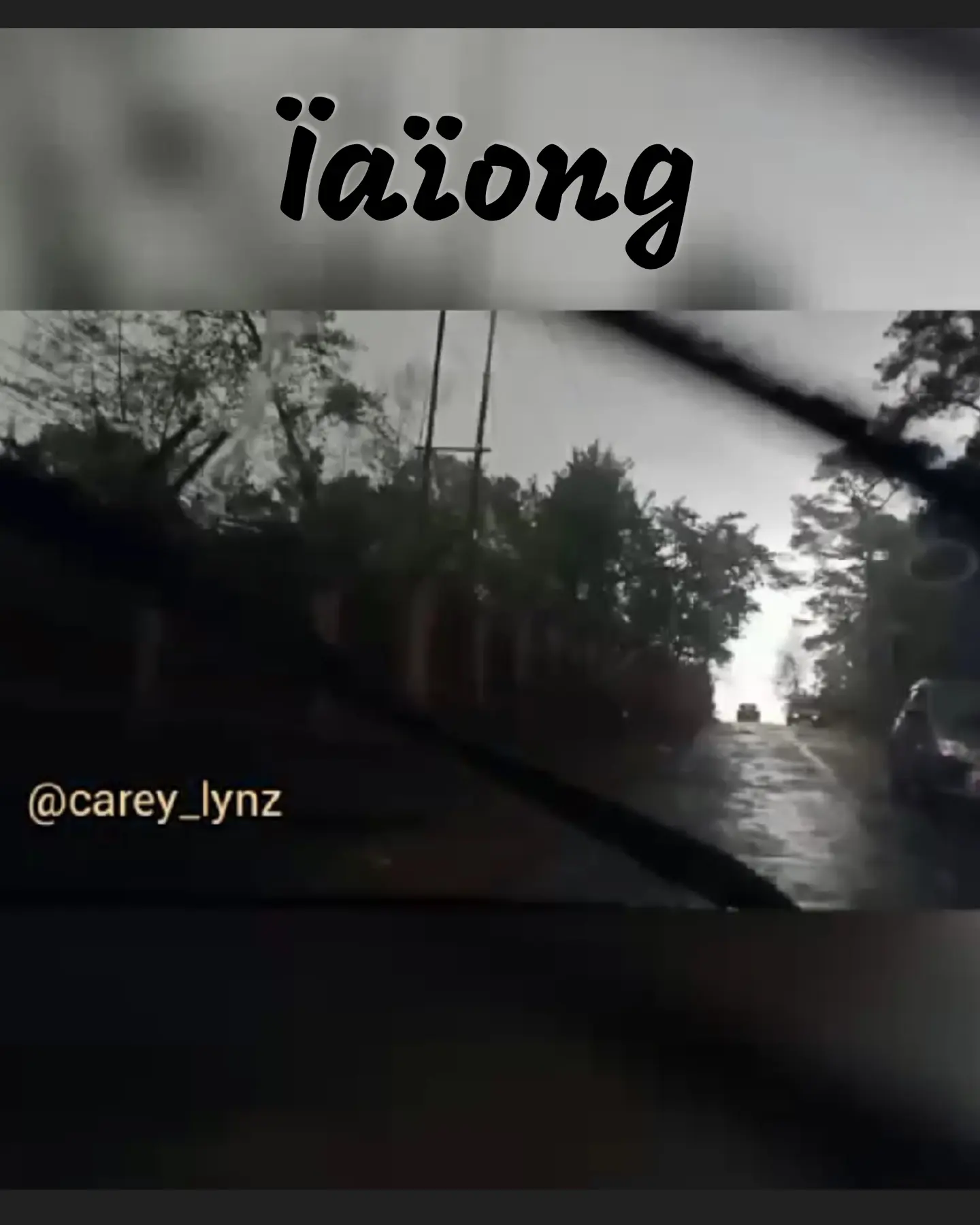
  • Ïaïong

    U bnai Ïaïong u long u bnai uba saw ha ki Khasi uba hap ha ka aïom Pyrem. Ha une u bnai ka ju don ka jinghap slap kaba wan poi, ha kaba ka wan ka jingïong ngit ngit jong ka suiñbneng bad ki lyoh ba dum, ka lyer kaba jur kaba beh bad teng teng u hap u phria ruh.

    Ka don ka jingong ne ka jingkheiñ jong ki Khasi kaba ong ba ym bit ban ïathoh shongkurim ne shna ïing ne ban sdang kano kano ka kam ha u bnai Ïaïong. Hato dei na ka daw jong ka suiñbneng ba la adong kumne ne don kiwei kiwei pat ki daw?

    Hato ngi lah ban ong ba ka ktien Ïaïong ka thew ïa ka ïa ne ka por kaba ïong, kaba dum haba wan poi u slap?

    The month of "Ïaïong" or April is the fourth month for the Khasis which falls in the season of Spring. In "Ïaïong" there is the falling of rain, accompanied by a rapid cover of darkness brought about by grey clouds with strong wind and sometimes hail too.

    There is a saying among the Khasis which prohibits them from getting married or building a house or starting any other work in the month of "Ïaïong". Is the reason because of the sudden dark rainy weather that these prohibitions were uttered or are there any other reasons?

    Can it be said that the word "Ïaïong" refers to a time of darkness (Ïong means black) represented by the sudden approach and falling of rain?

    We all wonder about Ïaïong don't we? Please tell us what you think of this in the comment section. 🌦️⛈️

    Khublei Shibun @carey_lynz for your video of the rain in the afternoon yesterday! 😄🙏 The video was taken on the 9th of April 2022, while approaching North-Eastern Hill University, Shillong. 🌩️🌧️

    Video was made on #InShot
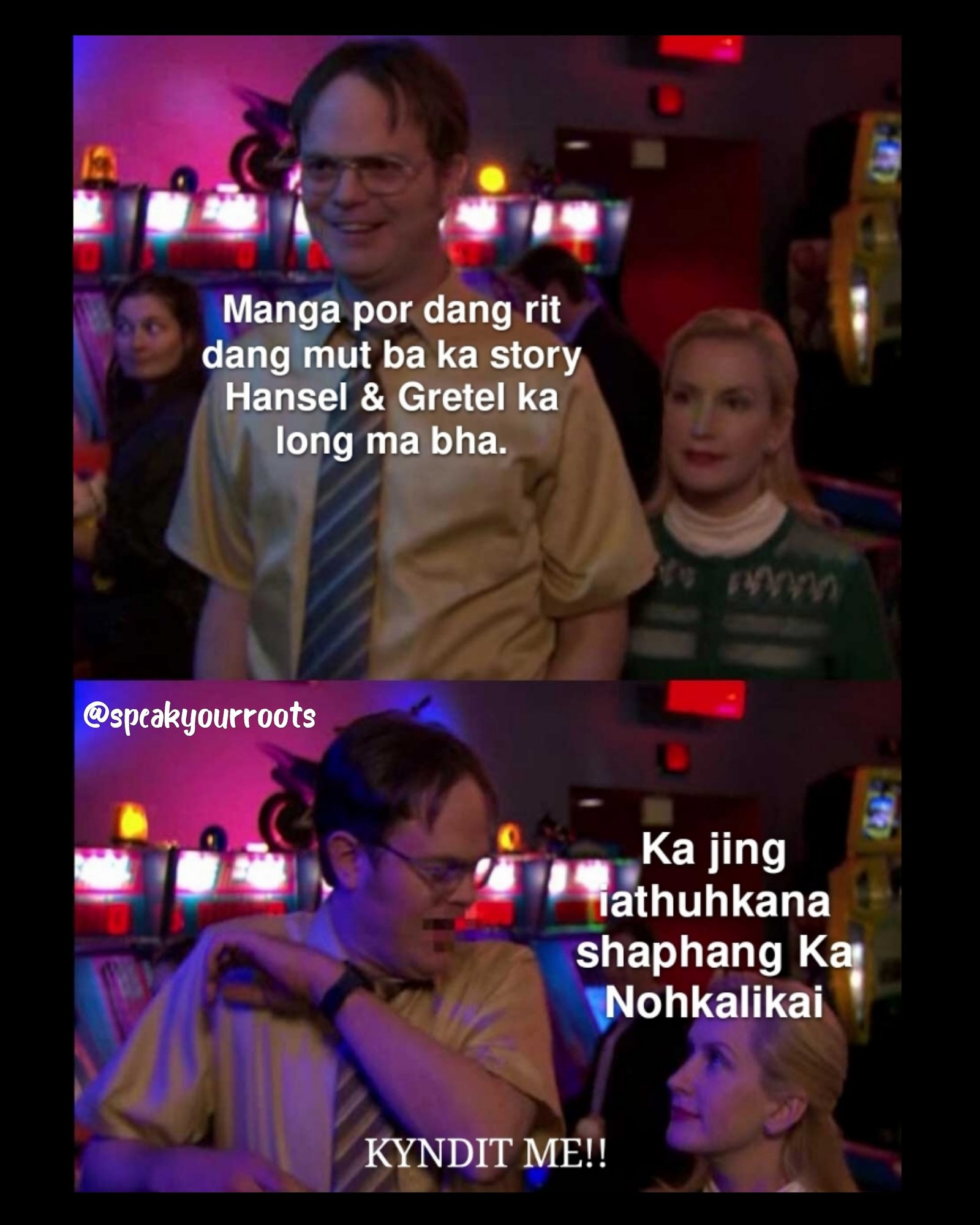
  • Nohkalikai

    Stories are a huge part of our childhood. They mould how we see the world and how we understand life. 🌄✨

    Indigenous folktales present a different world view altogether, with different lessons. Come to think of it, it would be great if there is an attempt at writing Khasi Gothic fiction! 🤩😎😃

  • Lai Li Nam

    "Lai Li Nam" toh i lai mih cha yung yap bru hadien wa da pûndep yei niam yei rukom yow pûntngen ne pûnchngaiñ ya kiwa ha yung ha sem yong kiwa da khlad. I ni toh i wa lai li kûnmo tûmpang, yei nam yei warom wa khroo yong u ne ka wa yap, dei wa em i sneiñ i kroo na ki waheh. Ki Pnar kheiñ ki ka ya ka "Lai Li Nam" kam ka rukom kawa emkam bha ha ka imlang sahlang.

    "Lai Li Nam" ka dei ka jingong Pnar kaba mut ka jingleit mih sha ïing kiba ïap briew, hadien ba la pyndep ïa ki niam ki rukom ban ai ka jingpyntngen bad jingpynshngaiñ ïa ki bahaïing bahasem jong kiba la khlad. Kane ka dei ka jingleit kynmaw tympang ïa ka nam ka burom jong u ne kaba ïap. Ka don ruh ka jingsneng ka jingkraw na kiba lah rangbah. Ki Pnar ki kheiñ ïa ka "Lai Li Nam" kum kawei ka rukom kaba donkam bha ha ka imlang sahlang.

    "Lai Li Nam" is a Pnar phrase which is a visit to a bereaved family after the completion of funeral rites and rituals, to offer solace and comfort to the members of the affected family. This visit is a way of remembering the good name and reputation of the individual who passed away. In this visit, there is also the dispensing of wise teachings by elders. The Pnar community hold "Lai Li Nam" as an important custom in society.

    "Lai Li Nam" is a custom practised by the Pnars, which is a way of memorialising an individual who has passed away. 🙏🙏🕯️🕯️

    Khublei Shibun @xdtnoahjupejackllthmanar for helping with the creation of this post 😄🙏

    🟡 Khasi and English translation by @speakyourroots

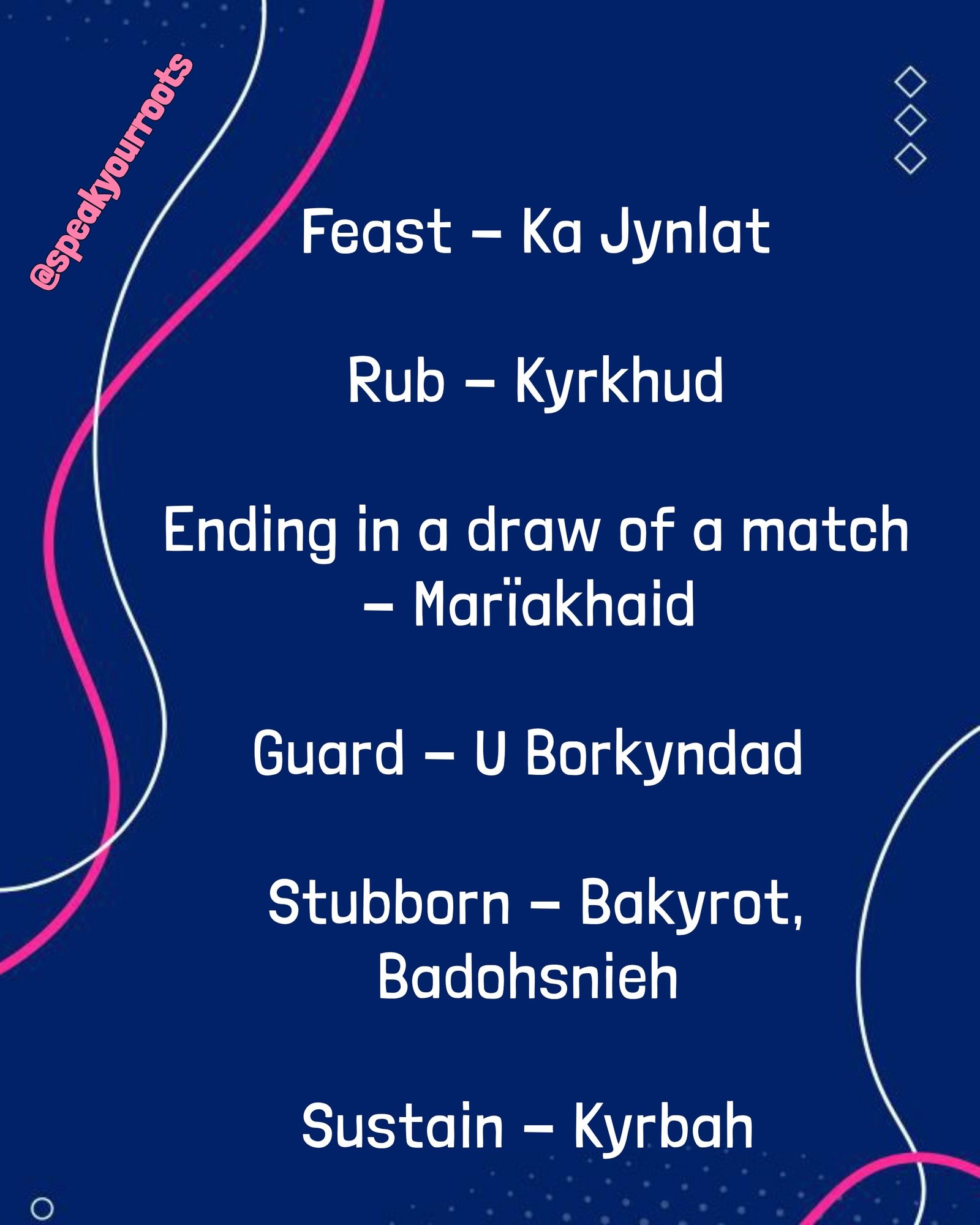
  • Kine ki kyntien ba ngim ju kham pyndonkam shuh

    Feast – Ka Jynlat

    Rub – Kurkhud

    Ending in a draw of a match – Marïakhaid

    Guard – U Borkyndad

    Stubborn – Bakyrot, Badohsnieh

    Sustain – Kyrbah

    Kine ki kyntien kiba ngim ju kham pyndonkam shuh ki dei ban poi biang sha kaba pyndonkam ïa ki ha ka jingkren jong ngi kaba man la ka sngi. Ngi dei ban pyrshang ban pynrung ïa ki ha ki jingïakren bad jingïathuhkhana jong ngi 😃🙏
    Ha kane ka rukom ka ktien kan nang ïar bad suhthied ruh. 🌦️🌄

    Have a great week ahead guys!!

    #khasiwords #khasilanguage #khasilanguageconservation #khasilanguagerevitalisation #indigenouslanguages #indigenouslanguagerevitalization #speakyourrootschallenge #speakyourroots #talklocal

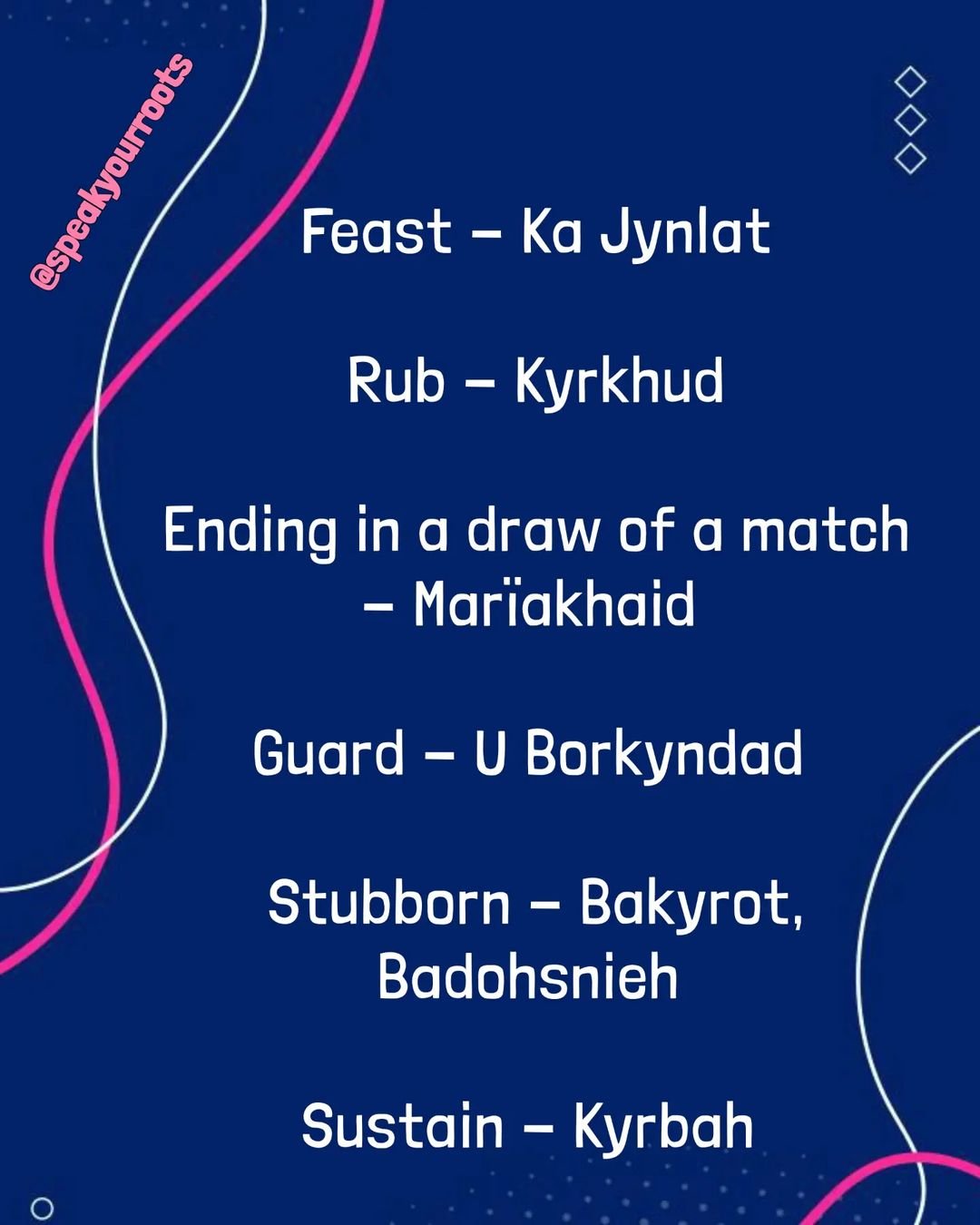
  • Kine ki kyntien kiba ngim ju kham pyndonkam

    Feast – Ka Jynlat

    Rub – Kyrkhud

    Ending in a draw of a match – Marïakhaid

    Guard – U Borkyndad

    Stubborn – Bakyrot, Badohsnieh

    Sustain – Kyrbah

    Kine ki kyntien kiba ngim ju kham pyndonkam ki dei ban poi biang sha kaba pyndonkam ïa ki ha ka jingkren jong ngi kaba man la ka sngi. Ngi dei ban pyrshang ban pynrung ïa ki ha ki jingïakren bad jingïathuhkhana jong ngi 😃🙏 Ha kane ka rukom ka ktien kan nang ïar bad suhthied ruh. 🌦️🌄

    Have a great week ahead guys!!

  • Jahare!

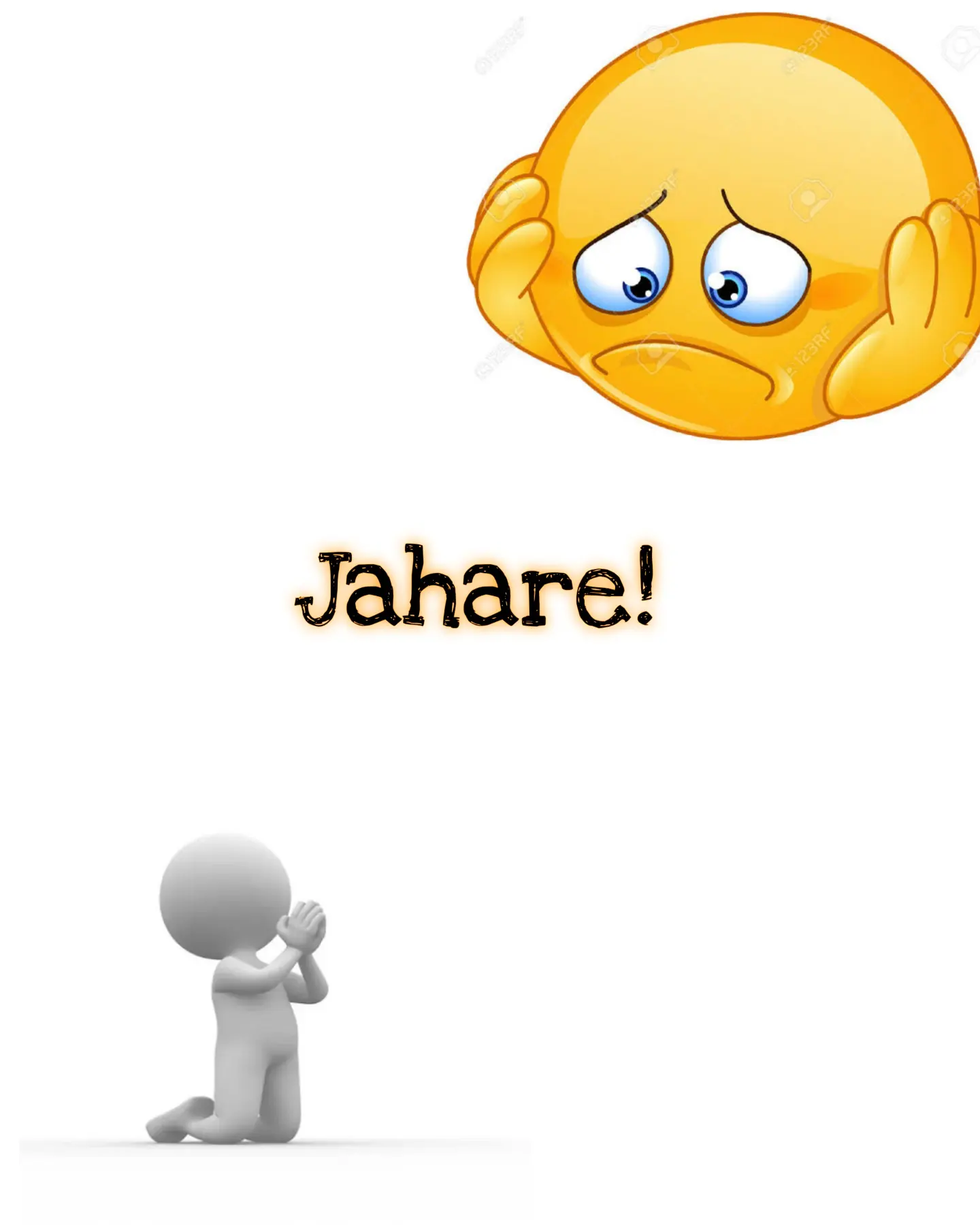
    Jahare!

    Jahare ka dei ka interjection kaba mut "ah-isynei" ne "ah-ïarap!". Ka long ka jingpyrta sngewsynei haba jah eiei ne haba kylla ka jingïadei ha ka kam ka jam.

    Jahare is an interjection which means "have mercy" or "please help!". It is an exclamation for compassion and mercy when something is lost. This phrase is also used when there is an unexpected or unwelcome change in relations during work.

    "Jahare!" 😰😧😨 is one example of the many interjections present in the Khasi language.
    These expressions add a definite colour and quality to the Khasi language.

    🟡 English translation by @speakyourroots

  • Ka Jingduwai Blei U Khasi/ The Prayer of The Khasi

    Ka Jingduwai Blei U Khasi, The Prayer Of The Khasi

    from U Khasi Hyndai (1959) written by Rash Mohon Roy Nongrum

    Naduh mynhyndai ba la mih la don ki symbai bynriew halor snieh i Mei Ramew, ma ngi ki Khasi haba ngi duwai ngi kyrpad ha ki pokjat U Pa Blei Trai Kynrad U Nongthaw Uba dap lut baroh sawdong, Uba ïohi lut baroh sawdong, ngi phai ka khmat sha mihngi bad la ki kti baroh arti, ngi dem khrup bad ngi duwai kyrpad ba Un ai ka jingkyrkhu ka jingisynei halor jong ngi ki symbai bynriew. Im ju dei ban phai khmat sha sepsngi.

    Kane ka long naduh kiba mynhyndai ba ki riewtymmen jong ngi haba ki duwai, ki phai khmat sha mihngi, haba ki jer kyrteng ïa i khunlung iba dang kha ba in koit in shait bha, ki duwai ha ki pohjat U Pa Blei Kyurad U Nongthaw da kaba phai sha mihngi. Ma ngi ki Khasi ngi ong ba kaba sang ban thaw dur ne ban mane ïa ka maw ka dieng ne ïa u para briew ba dang thaw dang buh hi U Pa Blei Trai Kynrad.

    Ngi leh bad ngi tip tang ka duwai da ka ktien kaba khuid kaba sugur ha U Pa Blei Trai Kynrad ka long kaba dei kaba biang.

    Since time immemorial with the existence of human beings on Mother Earth, we Khasis pray to God the Father the Creator who fills all space, who sees all things, by facing towards the east, with folded hands, bending and kneeling down, beseeching for blessings and mercy over humanity. It is forbidden to face the west while praying.

    This has been established since ancient times with elders facing the east while praying. During the naming ceremony for a baby too, performed for the health and well-being of the child, prayers are delivered at the feet of God the Father the Creator by facing towards the east. Khasis deem it sacrilegious as well as forbidden to create idols and to worship stones or trees or other fellow human beings created by God the Father the Creator. What is done and known by the Khasis is that, the words of a prayer are honest and pure, that this is right and deserving to be expressed to God the Father.

    An earnest prayer lightens the heart and clears the mind 😌✨ Many cultures and religions face the east while praying and this is found among the Khasis too 🙏🌞☀️🌄

    Ka jingduwai ka mih na ka mynsiem kaba sngew nguh, kaba dap da ka jingieit bad ka jingkyrmen 🙏✨

    🟡 English translation by @speakyourroots

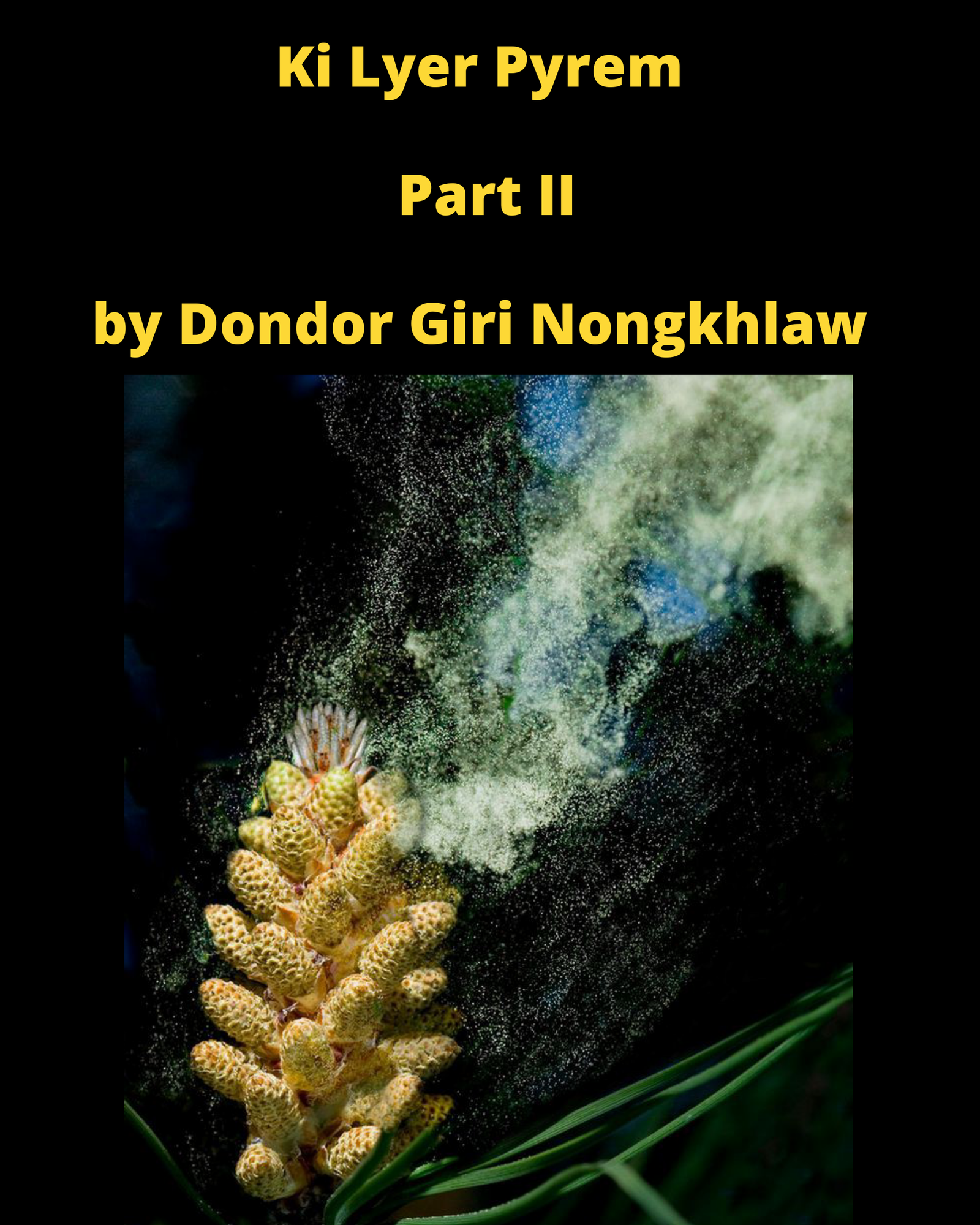
  • Ki Lyer Pyrem (Part II)

    Ka 'Erkhwasi

    Ka 'Erkhwasi ka dei ka jait Iyer kaba kham beh jur ha ki bynta sepngi jong ka bri u Hynñiewtrep khamtam ha ki thaiñ Ri Lyngngam bad Khadsawphra. Haba wan kane ka lyer ki dieng ruh ki khyllem, ki mrad ruh ki her lamwir ha khlaw. La ïoh kyrteng ïa kane ka lyer na u Lum Nokrek u lum uba ki briew jong ngi ha Ri Lyngngam ki khot u Lum Khwasi.

    "Ka 'Erkhwasi" is a strong wind that blows in the west of the Khasi hills, especially in the Lyngngam and Khadsawphra areas. This wind is so powerful that it uproots trees and sends animals into a frenzy. "Er Khwasi'" gets its name from Nokrek Hill which the Lyngngam people call Khwasi Hill.

    Ka 'Erkyllang

    Ka 'Erkyllang ka long ka lyer kaba jur bad khlaiñ bha. Ha ki por ki por ba ka beh jur bad khlaiñ ka jynrat wat ïa ki ïing bad ïa ki dieng ruh. Ka tyllong jong kane ka lyer ka sdang na ka them Umkhrisynñia bad ka rukom beh ka long nangtei sepngi shatai sha mihngi bad ka jah ha ka them jong ka Wah Myntang. Ka 'erkyllang ka wan hadien ar taïew jong a 'erpyrhaw.

    "Ka 'Erkyllang" is another powerful wind, denoted by its name, "kyllang" meaning cyclone. This wind uproots not only trees but houses as well. The root of this wind starts from the Umkhrisynñia valley and the direction in which it blows is from the west to the east and it is absorbed into the valley of Myntang river. "Ka'Erkyllang" arrives two weeks after 'Erpyrhaw".

    Ka 'Erbatesi

    Hadien jong ka jingkhyrwit jong ka "'erkyllang, ka suiñbneng ka long jai jai bad duna lyoh. Ka lyer kaba beh ha kane ka por shuwa ban wan ka lyiur ka long suki jai jai. La ïoh kyrteng ïa ka 'erbatesi na ka jinglong jai jai ne tipsngi jong ka.

    Ïa kitei baroh ki Iyer lakdun haka lyer Pyrem.

    After the intensity of "ka 'erkyllang", the weather is calm with less clouds. "Ka 'erbatesi" blows gently during this time and arrives before the season of summer. "Ka 'erbatesi" gets its name from its calm and tranquil nature.

    All these winds are categorised under the winds of Spring.

    This is Part II of "Ki Lyer Pyrem" or Spring Winds from the book Ka Meirisawkun, Ki Skid Jingim bad Ki Deiriti written by Dr. Dondor Giri Nongkhlaw. 🍃🌻🌀

    The books written by Dr. Nongkhlaw, who is a Geomorphologist, are treasures that contain research that has been meticulously explained in Khasi. What is even better are the words that he has coined using the different dialects of the Khasi language!

    Khublei Shibun Babu Nongkhlaw ïa ki jingthoh jong phi kiba ai jingtip bad jingshai shaphang ka ri jong ngi! 😃🙏

    🟡 English translation by @speakyourroots

  • Pyngrei

    "Pyngrei" ka dei ka jinglehniam leh rukom kum ha kaba pynïapoikha ïa ka mynsiem jong kiba ïap samla (kynthei bad shynrang) ha ka por miet (khamtam shiteng synñia) shuwa ban leit thep ïa ki shyieng sha u mawbah.

    Ki khot ar ngut ki kynja tymmen, ki ai da ka nong ïa u shynrang bad ïa ka kynthei. Uta u shynrang un long u tnga ïa ka suidïap kynthei bad ka kynthei kan long ka tnga ïa u suidïap shynrang. Nangta ki pynïaknieh bam ïa ka ja snaïap bad ki pynryngkang thlong ïa u shynrang bad pynryngkang synrei ïa ka kynthei.

    Ïa kane ka jinglehniam kim ju leh shuh mynta ha kine ki por.

    "Pyngrei" is a ritual of the indigenous Khasi faith in which the spirits of a single man and a single woman are married. The ritual is usually performed at night, especially during midnight, before the bones are placed into "u mawbah", which are the monoliths used as bone chambers or bone depository of a clan. An elderly man and an elderly woman are hired to be in the ritual. The man will be the husband for the female spirit and the woman will be wife for the male spirit. They are made to contend for rice meant for the spirits, with the man jumping over the traditional mortar and the woman jumping over the traditional pestle.

    This ritual is not performed anymore in the present day.

    Rituals at the time of death or at a funeral form an interesting and unique aspect of many communities in the world.

    "Pyngrei" is one such Khasi practice that bridges life and death. In a way, what could not be completed in life, is completed in death.

    Khublei Shibun @duwaki9 for helping to know more about this practice 😄🙏

    🟡 English translation by @speakyourroots

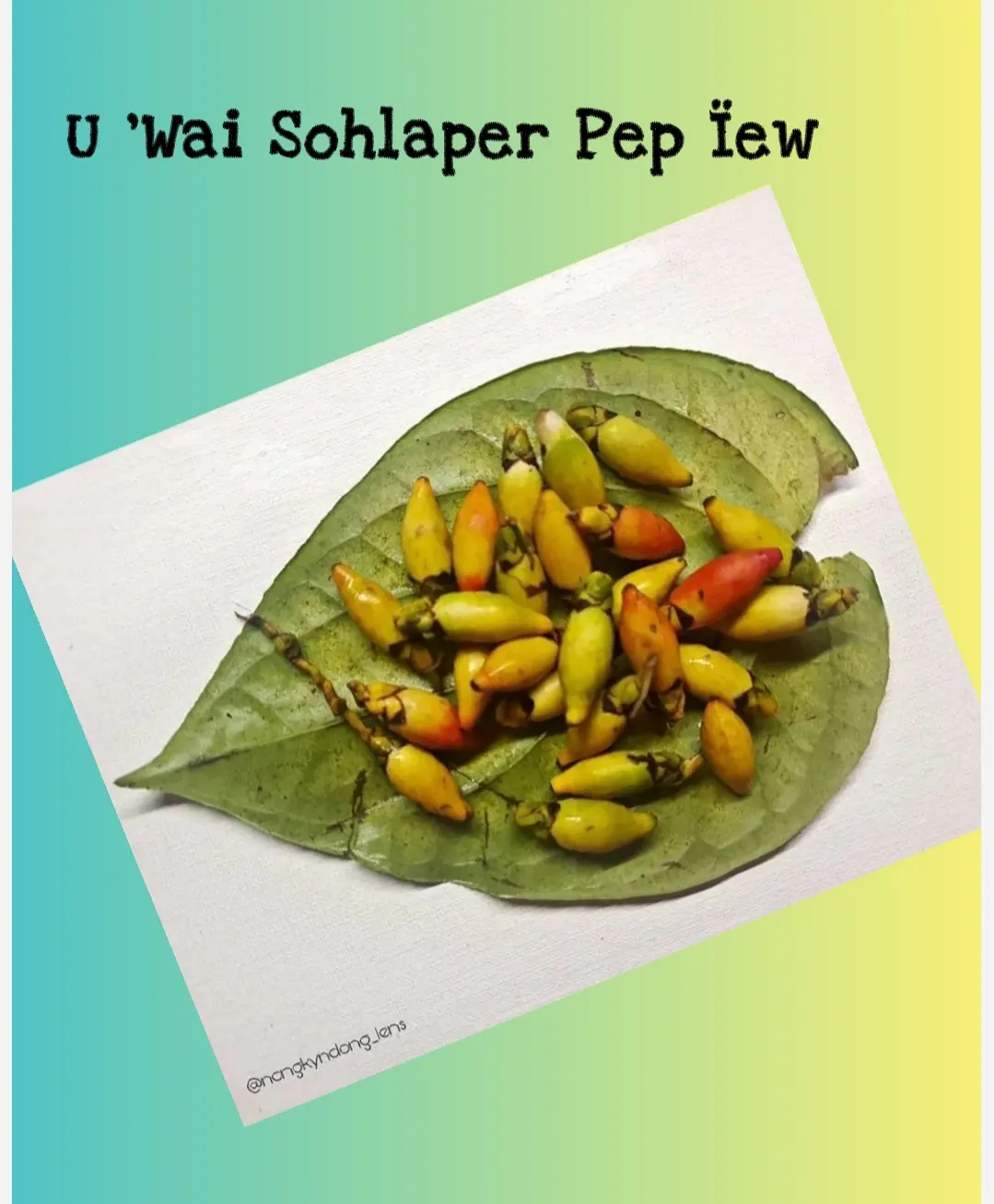
  • U ‘Wai Sohlaper Pep Ïew

    U 'Wai Sohlaper Pep Ïew

    U 'wai sohlaper u dei u sohkwai khlaw uba rit khria-khria bad ïa une u kwai kim ju leit die ha ïew.

    Ka jingong "u 'wai sohlaper pep ïew" ka thew ïa ki briew kiba ïai buh teng ïa ka kam haduh ban da dier ka por bad ban da pep artat.

    "U 'wai sohlaper" is a small variety of betel nut eaten for its good taste, but it is not sold in the market.

    The phrase "u 'wai sohlaper pep ïew" refers to a person who procrastinates, leaving work incomplete until it is too late and ultimately abandoning it.

    The Khasi phrase "U 'Wai Sohlaper Pep Ïew" reminds one of Hamlet and his long-drawn procrastination 😄😅 This phrase is quite apt in the sense that 'wai laper is not sold in the market, so going to market is left for another day 😅

    Photo credit: @nongkyndong_lens
    Khublei Shibun! 😄🙏 Lah ïoh pyndonkam biang ïa ka dur jong phi.

    🟡 English translation by @speakyourroots