Tag: speakyourrootschallenge

  • Nongwar village

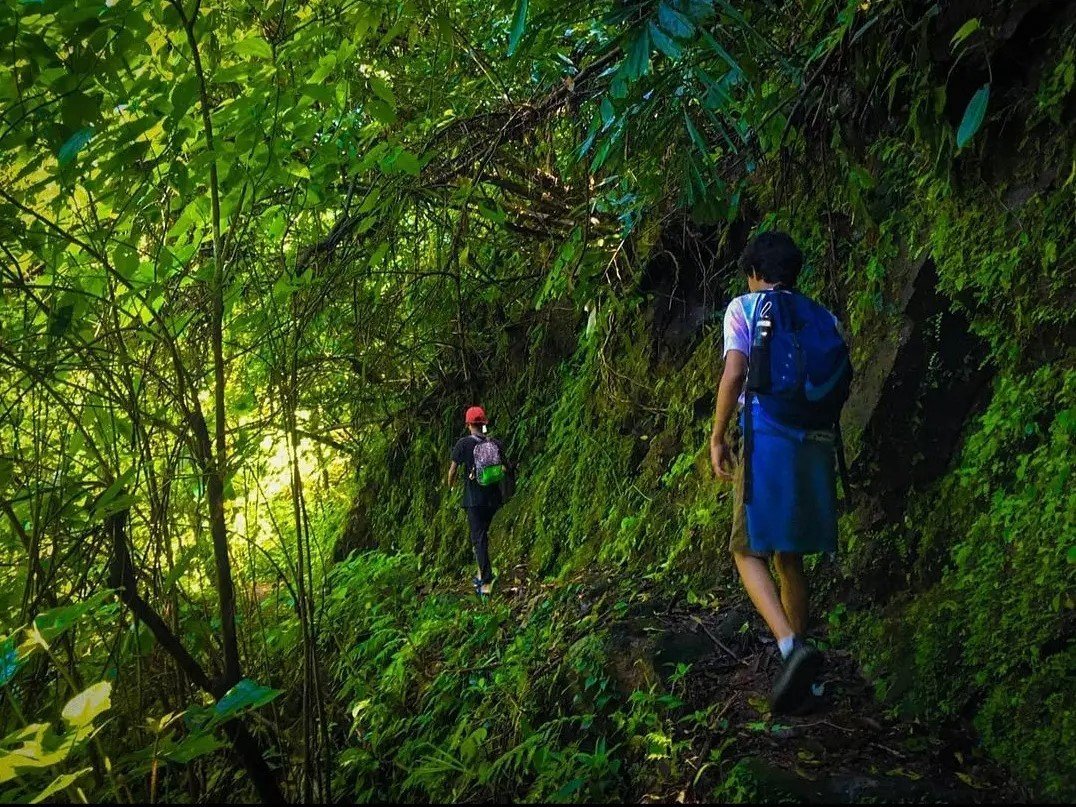
    These pictures of Nongwar village have been sent by @dapp_theguyfromthehills 😀😀😀🌄🌄 Thank you for sending your beautiful pictures!

    Before we travel the world, let's travel our own homeland!

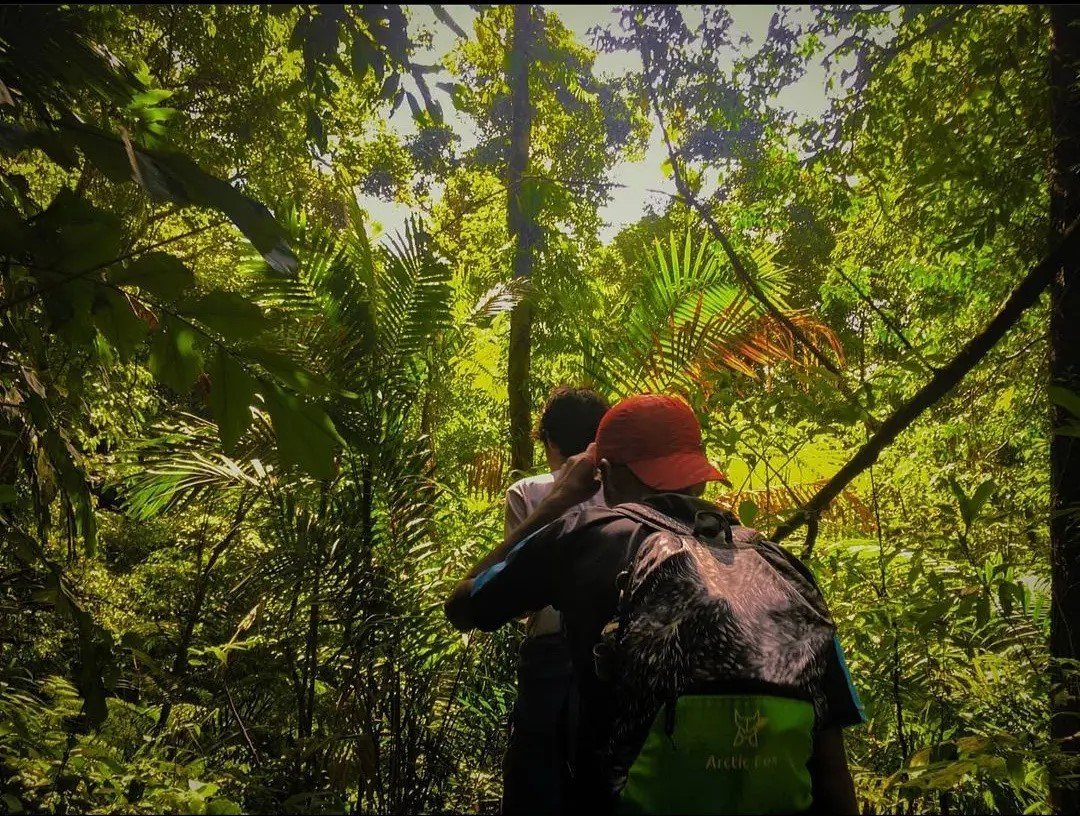
    @dapp_theguyfromthehills says "Nongwar is situated 18 kilometres from the Sub-district headquarter of Shella Bholaganj. The village has a population of 750 people and about 301 houses. Nongwar is surrounded by hills on three sides. The hills of Mawsynram and Nongtrai and the plains of Bangladesh can clearly be seen from the village."

  • Sohpairah

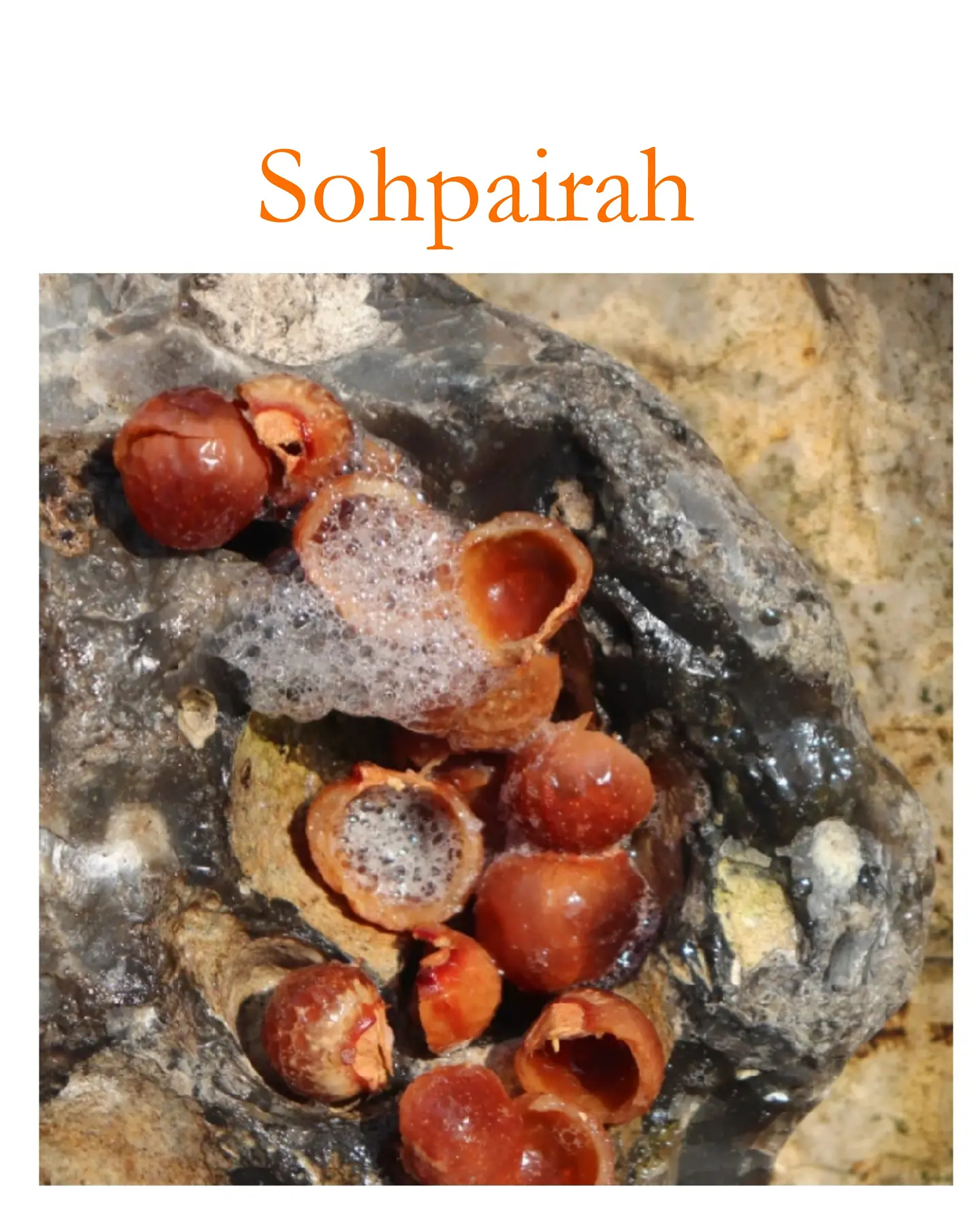
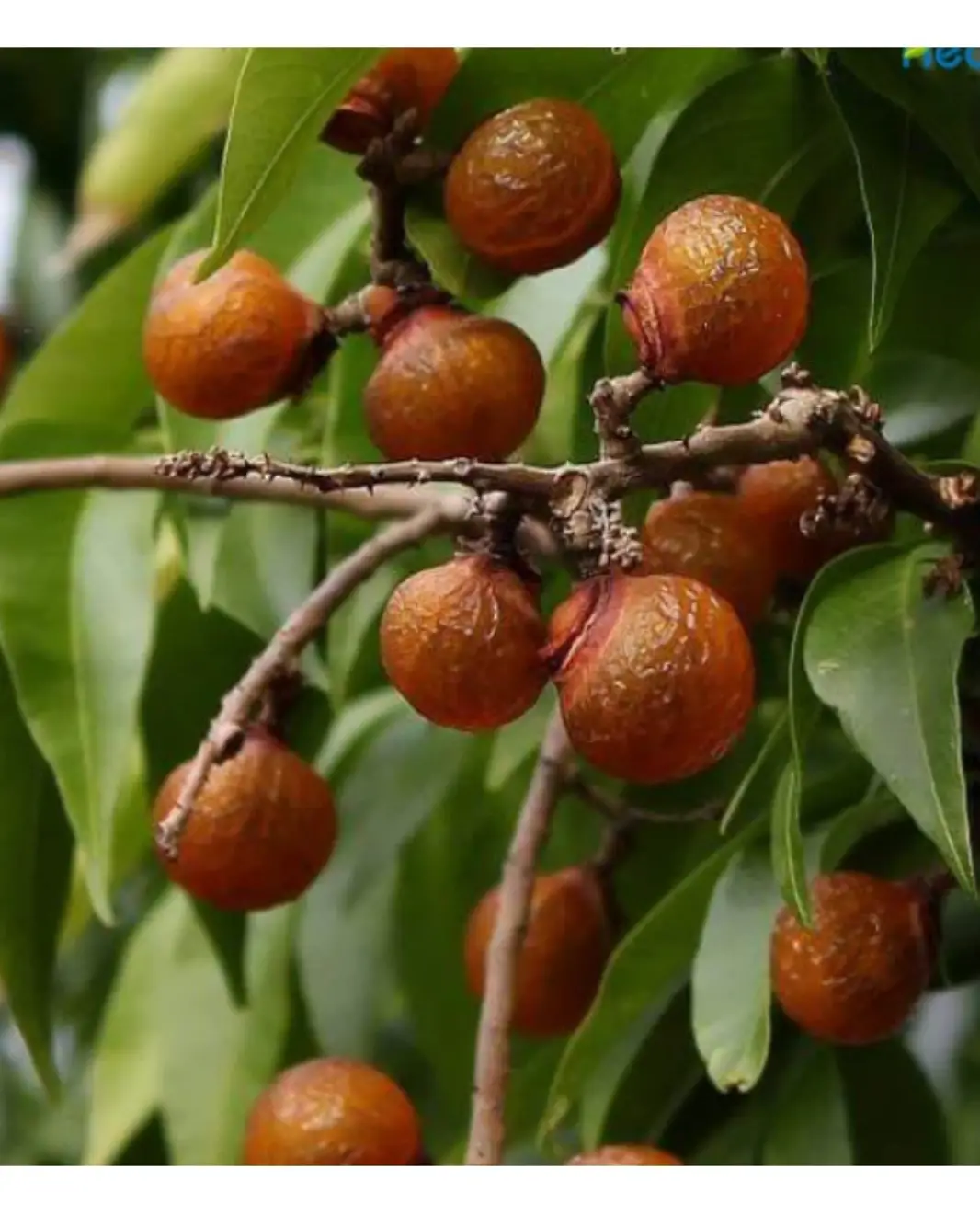
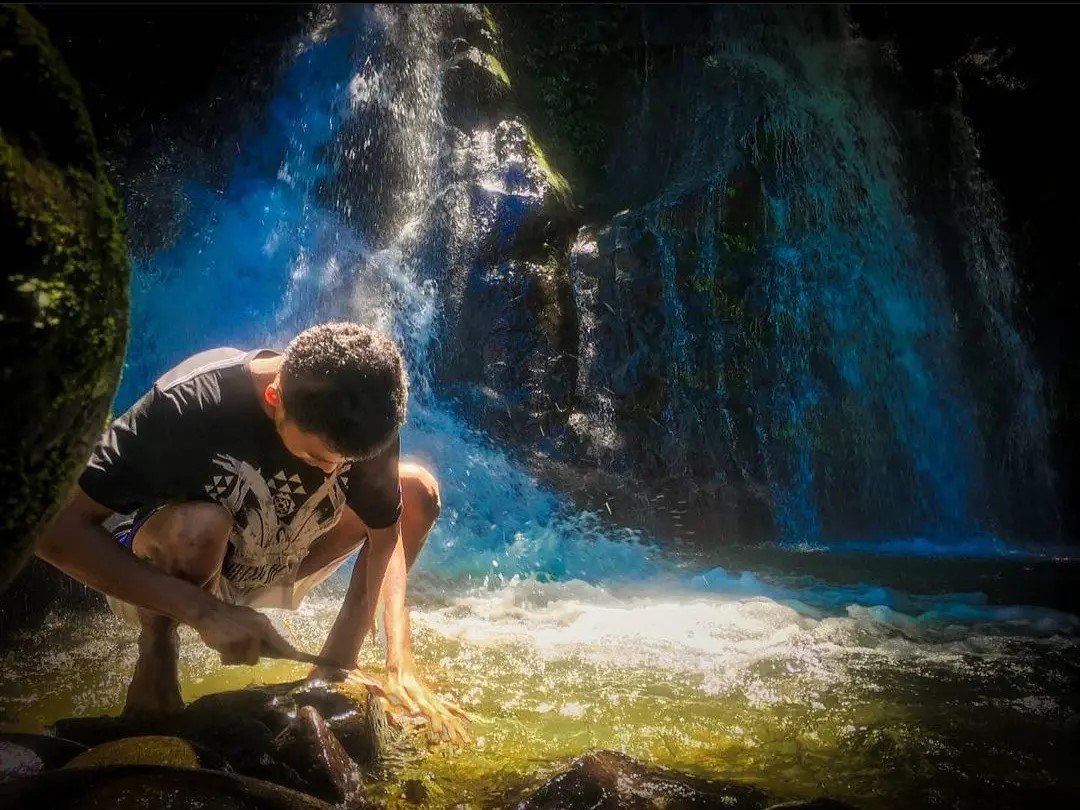
    "Sohpairah '' or soap nut is a wild tree found in some parts of Meghalaya. It is locally known as "Sohpairah" in Khasi and "Sohpinrah'' in Pnar. The fruits (nuts) have been extensively used as soap by the people of Meghalaya for more than centuries. It is believed that during the olden days, the Khasis and Pnars used Sohpairah as a washing agent to wash clothes, utensils, jewellery and also for bathing. In Jaintia hills particularly, Sohpairah was traditionally used for cleansing dead bodies.

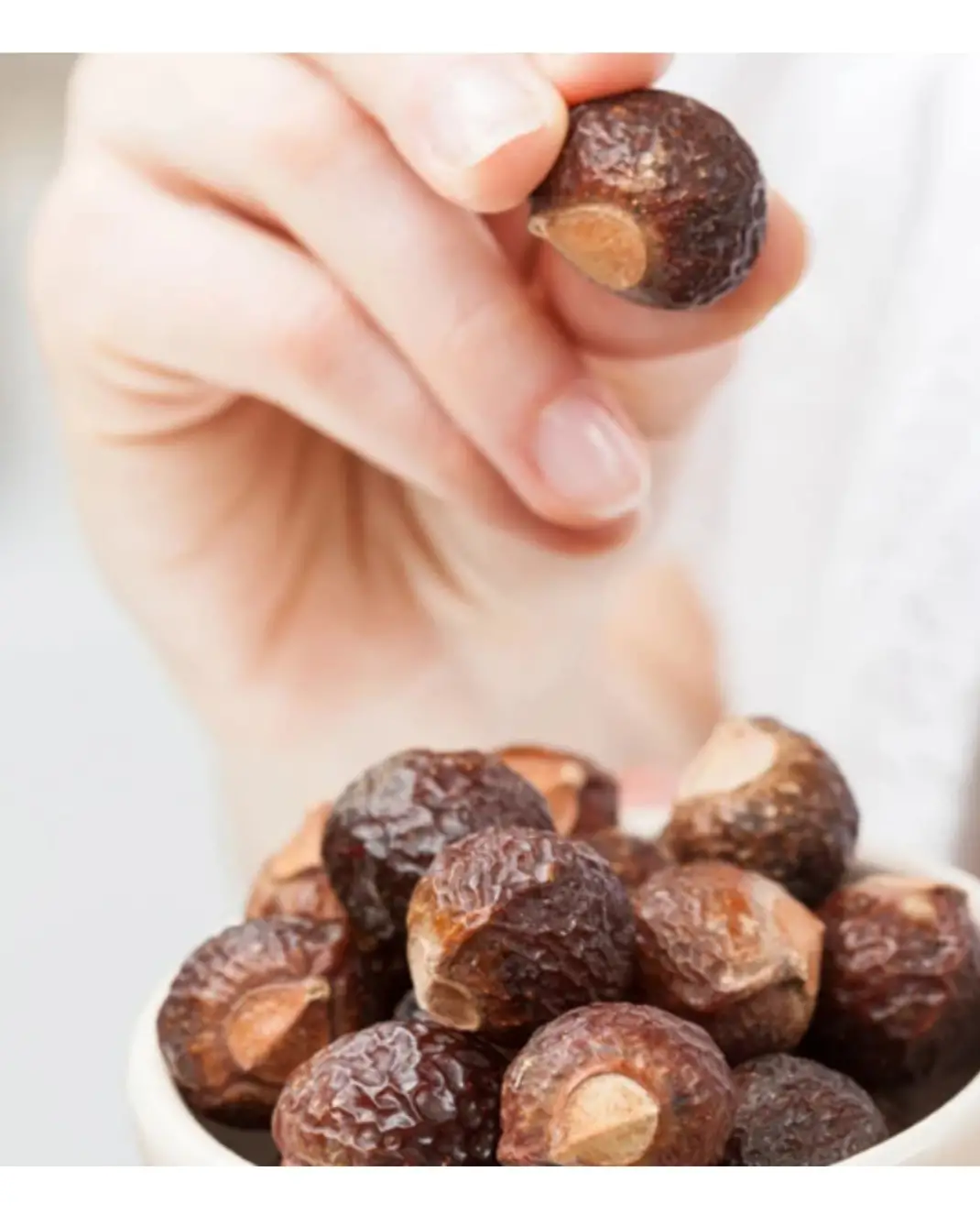
    Sohpairah is an amazing natural detergent due to a natural cleaning essence that is contained in their shell. When soap was not widely available, the Khasis used Sohpairah to wash their clothes and the water soaked in Sohpairah was also used to wash hair. It is the most effective way of washing clothes as compared to chemical detergents. They are soaked in water and this soapy water is then used to wash clothes. This water can also be used to wash hair. So Sohpairah is a great substitute for shampoo!

    The soap nuts are the fruits of a small tree called Sapindus Mukorossi. Once picked and dried in the sun, the shells contain a natural cleaning agent called saponin that produces an effect comparable to soap. The Sapindus tree grows in hard environmental conditions and protects its native areas from erosion. It is incredibly resilient to diseases and does not need any fertilizer or chemical pesticides.

    "U Sohpairah" is a natural organic way of washing that Khasis used in the past. How many of us still use this now? 🧽🧼

    Sources:

    https://earthbits.com/blogs/earthbits/a-guide-to-soapnuts-what-are-soap-nuts-and-how-to-use-them

    https://megbrdc.nic.in

  • “Ka Um Bad Ki Deiriti Ha Ka Meirisawkun” (Water and Culture In the Environment) (Volume II, 2008)

    Ïa kine la sot na ka lynnong "Ka Um bad Ka Tynrai ki Kyrteng Kur" (Water and Origin Of Clan Names) na ka kot Ka Um bad ki Deiriti ha ka Meirisawkun by Dondor Giri Nongkhlaw (2008):

    Katkum u Spiton Kharakor (1981) ha ka kot jong u "Ki Khun ki Ksiew a Hynñiewtrep" la shem ba don ki kur ba la ïoh kyrteng na ka um, ka wah, ka myn bad ka am.

    Ki kur ba la sdang da ka 'um' na khmat ki don khadlai kur bad kine ki long ka kur Umbah, Umblah, Umdong, Umdoh, Umdor, Umdung, Umyiap, Umladkur, Umlong, Umsong, Umsohbar, Umthlu bad Umwai.

    Ki kur ba la sdang da ka ktien 'wah' ki don khaddar kur bad kine ki long ka kur Wahksi, Wahksing, Wahlang, Wahlang mawleiñ, Wahlang pahsyntiew, Wahlang ryntathiang, Wahrait, Wahrih, Wahrit, Wahshah, Wahshrieh bad Wahspeh.

    Ki kur ba la sang da ka 'am' na khmat ki don shiphew kur bad kine ki long ka kur Amkhlaw, Amkhlow, Amksang, Amkoi, Amded, Amdep, Amora, Amse bad Amwai.

    Nangta sa ki kur ba sang da ka 'myn' ki don jin haduh arphew hynñiew kur bad kine ki long ka kur Mynbah, Mynbon, Mynkseh, Mynieng, Mynjar, Mynnar, Myniar, Mynrap, Mynriang, Mynrieng, Mynriem, Mynring, Mynsang, Mynskut, Mynsni, Mynso, Mynso-shangpung, Mynsong, Myntdu, Mynteng, Mynthang, Mynthliang, Mynthlong, Mynthlu, Mynthong, Mynthui bad Myntlang.

    Ban sngewthuh ïa kane ka jingïasnoh ka kyrteng kur bad ki jnit ka mariang bad ruh bad ki deiriti ngin ïa shim tang kawei ar tylli ki kur kum ka nuksa.Tharai, lada ngi shim da ka kur Amkhlaw, Umyiap, Wahksing bad Mynthlong ka biang ban ïa batai bad pyni nia.

    Kat kum ka tyllong kyntien ka kur Amkhlaw ka long ka kyntien ba la oh na ka 'am' bad 'khlaw'. Kane ka pyni ba ka kur ka don jingïadei bad ka um bad ka khlaw. Baroh ar, ka um ne am bad khlaw, ki dei ki jnit ka meirisawkun, kaba mut, lehse, ba ka kur Amkhlaw ka long ka kur kaba la buhai nyngkong ha ka jaka ba jan ka um bad ka khlaw.

    Ka kur Umyiap, katkum ka tyllong kyntien, ka thew ka um bad u shyiap kiba baroh ar ki long ki jnit ka meirisawkun, ha kaba lah ban long ba kine ki kur ki la buhai nyngkong ha ki jaka ba don ka um bad u shyiap.

    Nangta, ka kur Wahksing, katkum ka tyllong kyntien, ka long ka kur ba la ïoh kyrteng na ka wah bad ka ksing. Hangne, ka wah ka long ka jnit jong ka meirisawkun, katba ksing pat ka dei ka bynta jong ka deiriti. Kumta kane ka kur ka la oh kyrteng kur na ka wah bad ka ksing. Hangne ksing ka thew ïa ka deiriti put deiriti tem.

    Nangta ka kur Mynthlong, ka pyni ba ka kur ka long kaba pyndonkam um, kaba pyndonkam thlong ruh. Hangne thlong ka thew ïa ka deiriti dung kum ka dung kba, dungnei, dungsoh bad ter ter. Namarkata ngi donkam ban nang ïaleh ban wad ban thud ïa ki kyrteng, ïa ki jingmut bad thymmei ki kyrteng kur.

    The following is taken from the chapter entitled "Ka Um bad ka Tynrai Ki Kyrteng Kur" (Water and Origin of Clan Names) from the book Ka Um bad ki Deiriti ha ka Meirisawkun by Donor Giri Nongkhlaw (2008).

    Nongkhlaw cites Spiton Kharakor (1981) from his book Ki Khun Ki Ksiew u Hynñiewtrep where he discusses how some clans received their names from the words "um", "wah", "myn" bad "am".

    The clan names that start with the word "um" are 13 in number and some of them are Umbah, Umsong, Umyiap and Umthlu.

    The clan names that start with the word "wah" are 12 in number and some of them are Wahlang, Wahrait, Wahshrieh and Wahksing.

    The clan names that start with the word "am" are 10 in number and some of them are Amkhlaw, Amkoi, Amdep and Amksang.

    Finally, the clan names that start with the word "myn" are 27 in number and some of them are Mynring, Mynsong, Mynrieng and Mynthlong.

    To understand the connection between the clan name and the elements of nature, Nongkhlaw looks at four clans to discuss this.

    The clan name Amkhlaw comes from the words "am" and "khlaw". This shows that this clan must have settled near "um" or "am" which is water and "khlaw" which is forest.

    The clan name Umyiap refers to "um" that is water and "shyiap" which is sand. This shows that the clan must have settled in a place which has water and sand.

    The clan name Wahksing comes from the words "wah" which means river and "ksing" which means drum. "Wah" is connected to the environment and "ksing" is related to the tradition of music.

    Finally, the clan name Mynthlong comes from the words "myn" which is connected to the use of water and "thlong" which is the traditional mortar for pounding and grinding used by the Khasis. The mortar is a symbol for the traditions of pounding rice, sesame seeds, fruits and others.

    Ka Um Bad Ki Deiriti Ha Ka Meirisawkun (Water and Culture On the Environment)(Volume II, 2008) by Dondor Giri Nongkhlaw is such an interesting book with great information on the intrinsic value of water and the environment to Khasis! 🌅🌅

    🟡 English translation by @speakyourroots
  • Ka Jingsneng Tymmen Shaphang ka Akor Khasi ha ka Rukom Rwai Phawar”, Part I (1902) & Part Il (1903)

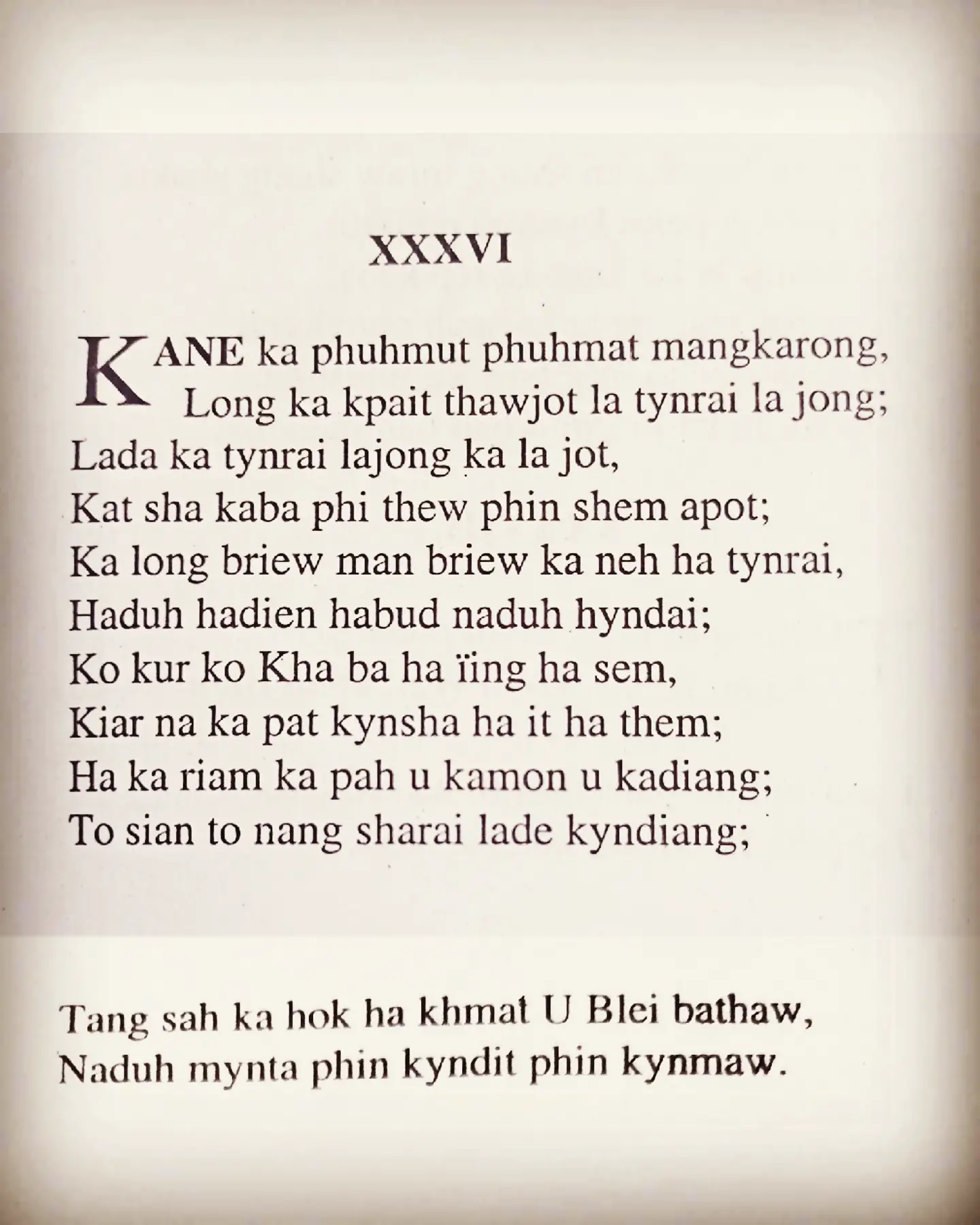
    Kane ka phuhmut phuhmat mangkarong,

    Long ka kpait thawjot la tynrai la jong;

    Lada ka tynrai lajong ka la jot,

    Kat sha kaba phi thew phin shem apot;

    Ka long briew man briew ka neh ha tynrai

    Haduh hadien habud naduh hyndai;

    Ko kur ko Kha ba ha ïing ha sem,

    Kiar na ka pat kynsha ha it ha them;

    Ha ka riam ka pah u kamon u kadiang;

    To sian to nang sharai lade kyndiang;

    Tang sah ka hok ha khmat U Blei bathaw,

    Naduh mynta phin kyndit phin kynmaw.

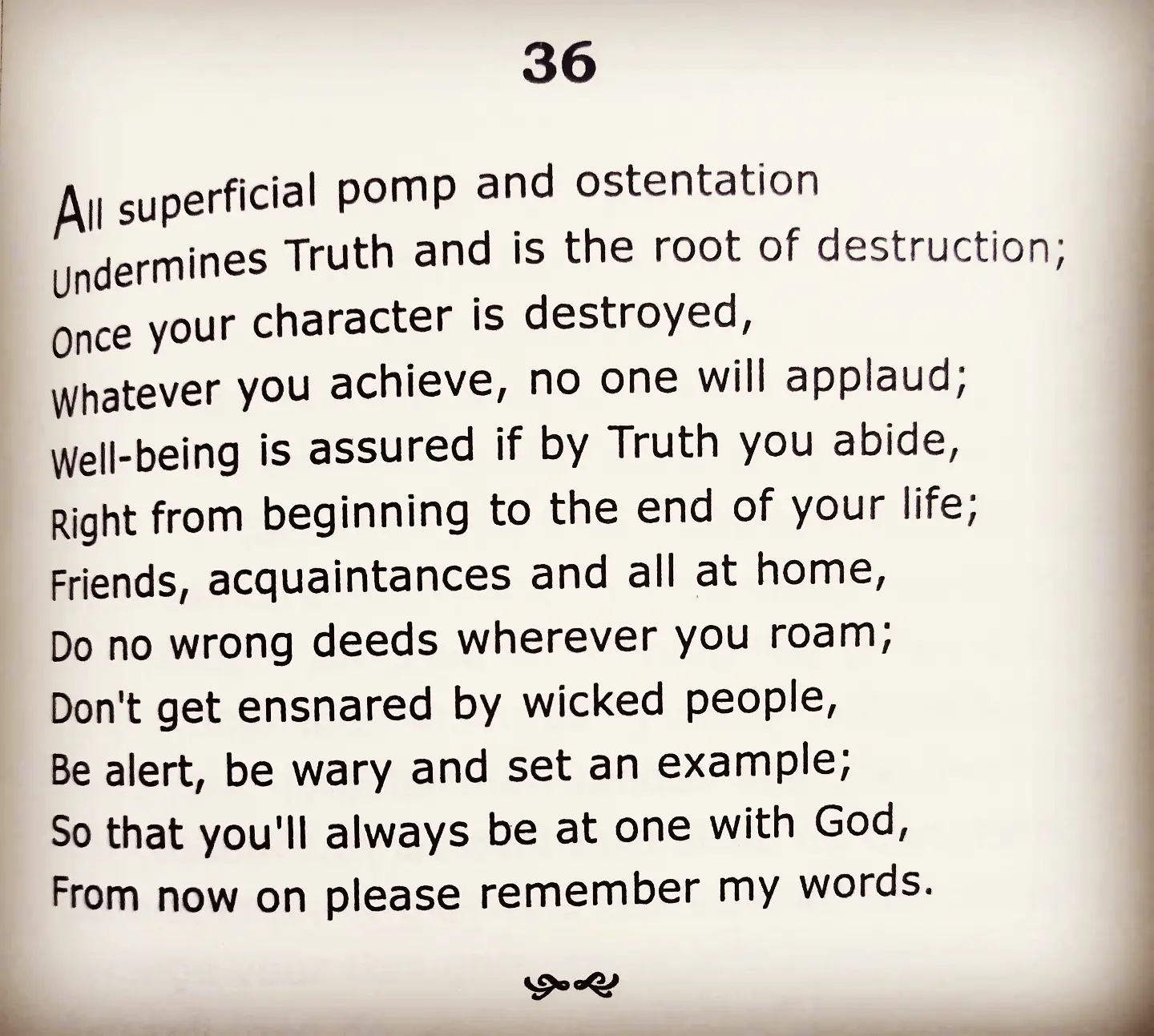
    All superficial pomp and ostentation

    undermines Truth and is the root of destruction;

    Once your character is destroyed,

    Whatever you achieve, no one will applaud;

    Well-being is assured if by Truth you abide,

    Right from beginning to the end of your life;

    Friends, acquaintances and all at home,

    Do no wrong deeds wherever you roam;

    Don't get ensnared by wicked people,

    Be alert, be wary and set an example;

    So that you'll always be at one with God,

    From now on please remember my words.

    Ka Jingsneng Tymmen Shaphang ka Akor Khasi ha ka Rukom Rwai Phawar, Part I (1902) & Part Il (1903) by Radhon Sing Berry Kharwanlang is a unique collection of valuable lessons and teaching on how to live a good and moral life. 📝✒️

    The teachings are given in the form of "phawar” where two lines follow the same rhyme scheme, that is, aa bb.

    Both Part | and Part II have been translated into English by Bijoya Sawian @sawianbijoya in her book The Teachings of Elders: Ka Jingsneng Tymmen, Parts I and II (1997).

    Slide 1: Ka Jingsneng Tymmen Shaphang ka Akor Khasi ha ka Rukom Rwai Phawar, Part I (1902)

    Slide 2: The Teachings of Elders: Ka Jingsneng Tymmen, Parts | and II (1997).

  • Ym lap lieng and Kylla lieng

    Kylla lieng

    Ka jingong "kylla lieng" ka thew ïa ka jingwan shoh tyndep ka pyrthei nemsniew ban pynduk pynshitom ïa u ba don ba em. Ka dei ruh ka jingkylla khongpong ka jingim na ka im suk im saiñ sha ka kordit tam. Shuh shuh, kine ki kyntien ki batai ïa ka jingshah lynshop ha ka jingsniew bok, ba wan ban ka jingpang jingshitom haduh ba u briew um lah bteng shuh ïa ka kam ba u la pyrshang.

    The Khasi phrase "kylla lieng" is the harrowing arrival of famine or an epidemic causing suffering and poverty for even those who are well-to-do. The phrase also refers to the reversal or the turning upside down of an easy life to calamity and ruin. Further, the words also mean to be wracked by bad luck, that is caused by illness to the point that a person cannot continue with his work.

    Ym lap lieng

    Ka jingong "ym lap lieng" ka batai ïa ka jingkyrkieh kum bym don por ne lap briew shuh. Ka kren ruh ïa ka jingsheptieng ba ïoh shah iehnoh bym lap kem shuh ïa ka lieng.

    The Khasi phrase "ym lap lieng" is to be in so much haste that we are out of time or we cannot find the people we need to meet. The phrase also talks about the fear that one experiences in case they don't arrive on time to reach the boat.

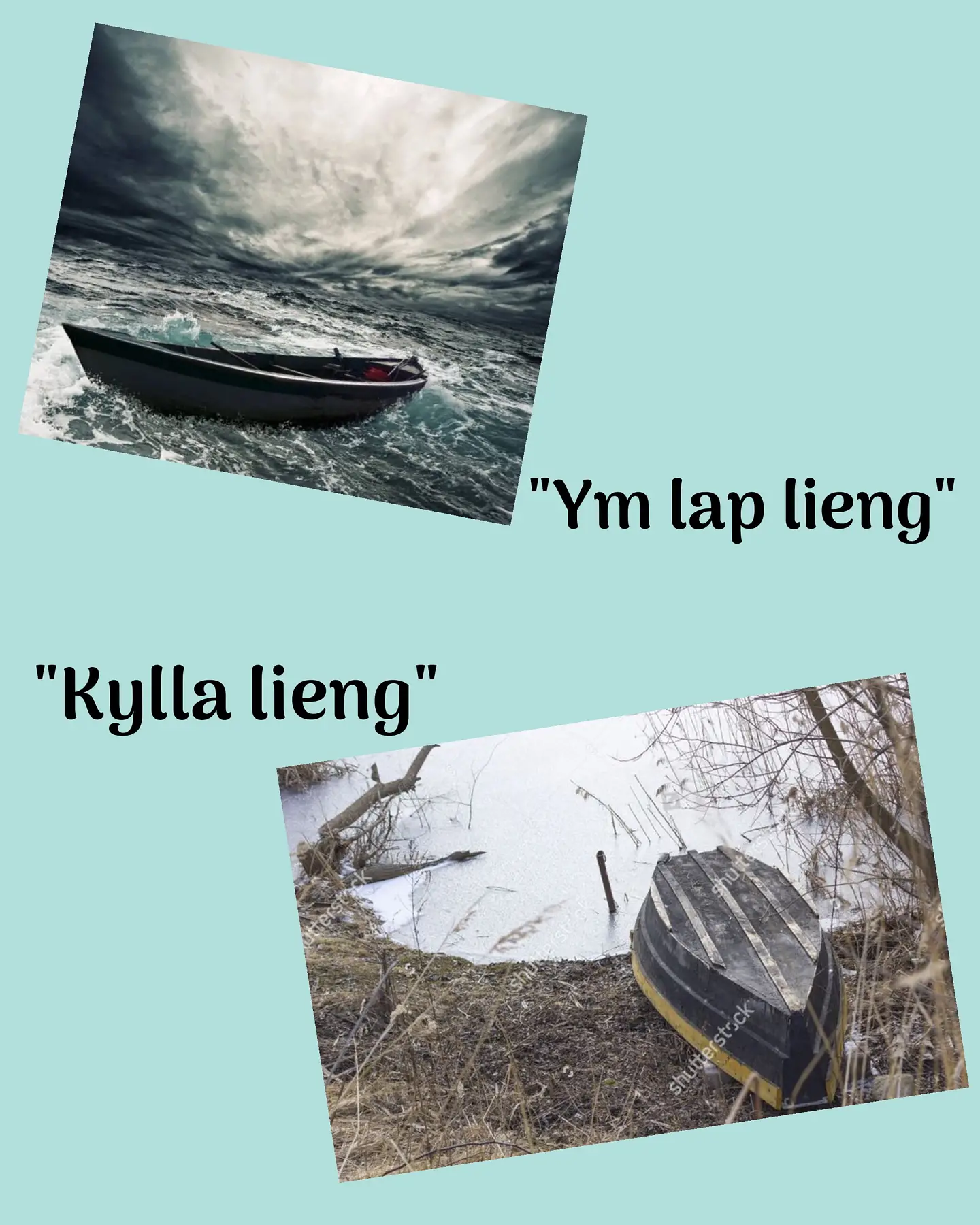
    "Ym lap lieng" and "Kylla lieng" are two Khasi idioms using a boat as the metaphor ⛵🚤🛥️

    🟡 Sources: Rev. Dr. Ïarington Kharkongor and by Primrose G. Gatphoh.

    English translation by @speakyourroots
  • Ka Rngiew: A perspective from Dr. Margaret Lyngdoh, University of Tartu, Estonia

    In the Christian worldview, a person is made of the body, mind, and soul. In the traditional Khasi perspective, a person is made up of met, mynsiem, and rngiew. While met is the body, mynsiem is breath. Rngiew is what invests a body with personhood and it stays with a person through life. It is the quality that allows a person to remain impervious to the evil eye or ka sabuit. Thus the term longbriew means the nature of being "human" or the nature of an entity who is endowed with rngiew.

    There is no English word to approximate this Khasi concept. In its simplest explanation, rngiew is what makes a person human. Further, the Khasi word for breath, mynsiem has been adapted to fit the Western idea of the "soul" or even, "spirit". I cite, Lyngdoh, Margaret (2021). "Landscapes of Enchantment and their Usage: A Critical Case-Study from the Khasi Ethnic Community, Northeast India'' in Graham Harvey and Opinderjit Kaur Takhar (Ed.). "Religion and Senses of Place'' UK: Equinox Publications. (Religion and The Senses) [forthcoming]:

    A being is made up of Ka met (lit. body). ka mynsiem (lit. breath) and ka rngiew. To ‘be' a human being (longbriew), the Supreme Being must clothe the being with a rngiew. I will quote my interlocutor, Sweetymon Rynjah on this, "Ka Rgiew ka dei ka bor maia ba kynja Blei, ba u Blei u la pynkup, pynphong ia u briew ha ka jingwan longbriew jong u' (20 November 2015)".

    I paraphrase: The Rngiew is an ability that is god-like, that the Supreme Being clothes or invests a being with when he/she comes out of the womb initially divine, and then whatever he/she acquires or achieves in a lifetime is dependent on him-/her-self. The rngiew stays with a person through life and is reflected in the person's being and stature. If their (jinglong mynsiem) personality, spirit, essence, strength of character, nature, principles, moral fortitude etc. are in line with, 'Ka tip briew ka tip blei and ka tip hok tip sot' (lit. living a good life in accordance with the Covenant decreed by the Supreme Being), then their rngiew is strong and protects them from those who desire ill or harm to befall upon them.

    All humans and non-humans have rngiew. Ryngkew or guardian deities, have rngiew. This gives a sense of agency to a human or non-human entity. But clans also have rngiew, and in different contexts this can mean different things. But a strong rngiew of a clan can protect a clan from extinction. When we refer to the clan in this context, we use the words “longkur longkha". But rngiew is always a strong, positive quality that remains with humans, places, non-humans (like ancestors and guardian deities) all their lifetime. The first ancestress, Iawbei also has rngiew, especially because they have to look after the well being of a clan and further it's progress and prosperity. Even though we live in a state of rapid transitions, we cannot forget these core Khasi indigenous concepts because this is an essential part of our longbriew manbriew!

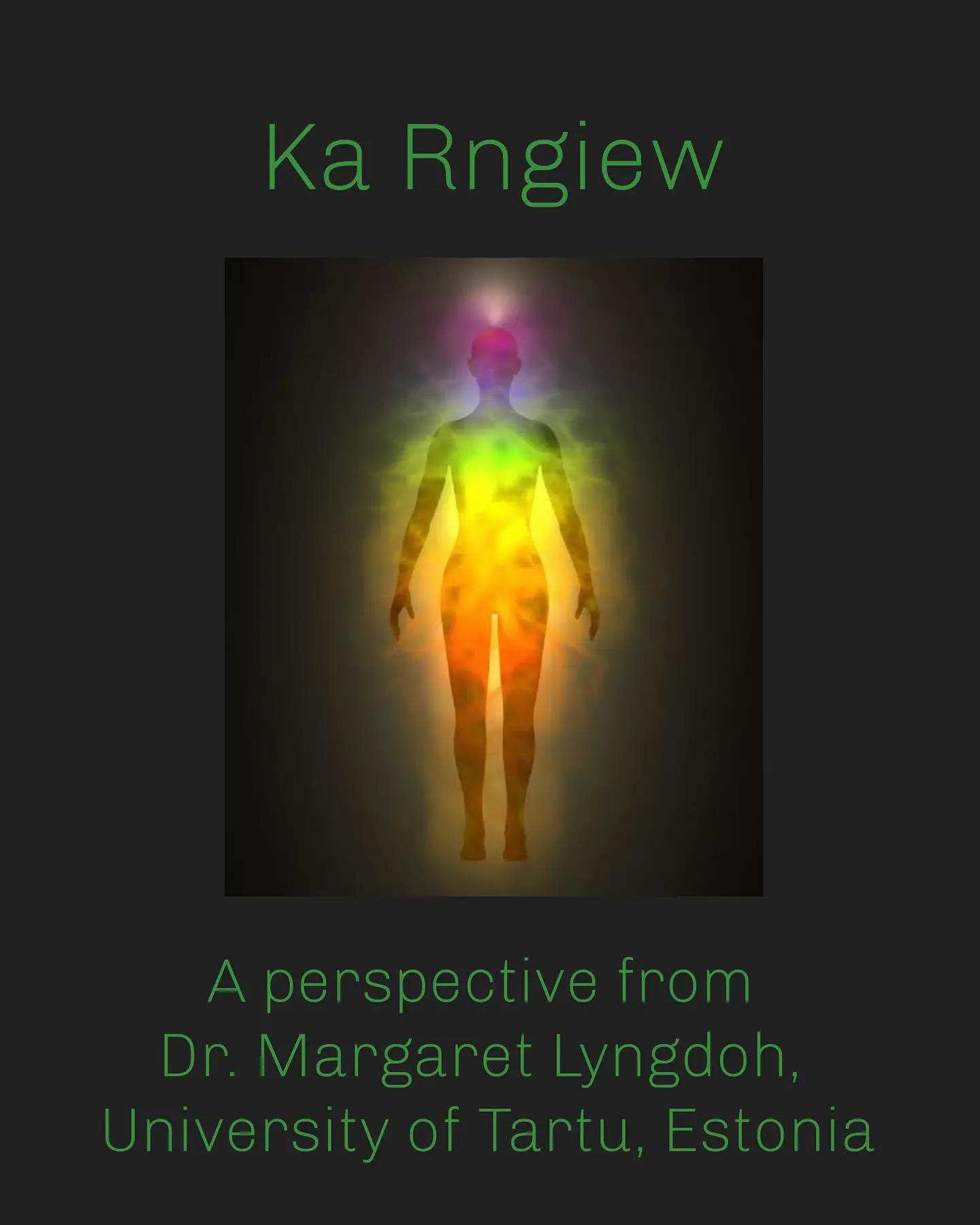
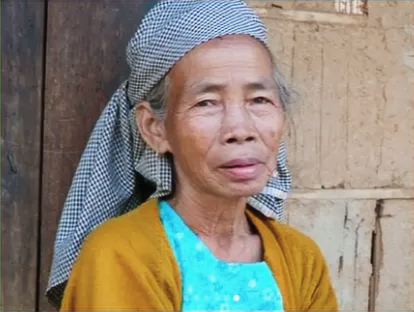
    In the photo is Kre Makri, who is a Khruk, a female weretiger, from Raid Nonglyngdoh, Ri Bhoi. Her rngiew transforms into a tiger and roams around in the alternate reality, Ramïa, where notable ancestors also live. She said that while the male weretiger or sansaram (lit. five clawed) has the function of holding on the laws of the ryngkew, the female weretiger, ka khruk, has the sacred function of holding of the rngiew of the clan. The photo was taken by me and this was in the winter of 2012.

    Dr. Margaret Lyngdoh @lieng_makaw gives us what she has found in her research from the approach of Folkloristics about "Ka Rngiew", showing us that it is a far reaching concept which sheds light on the well-being of the individual, the clan and our worldview as Khasi-Jaiñtia society. Thank you @lieng_makaw ! 😀🙏

    The post on "Ka Rngiew" posted on the 5th of August 2021, garnered a lot of attention and also counter-reaction that has proved fruitful in our understanding of this unique Khasi concept. The expression and discussion of different points of view is something that is important for indigenous culture to thrive.

    No part of this material may be reproduced in any form without the consent of the author. All material for this content has been collected through primary fieldwork.

  • U ‘Wai Laper (U Waisoh Laper)

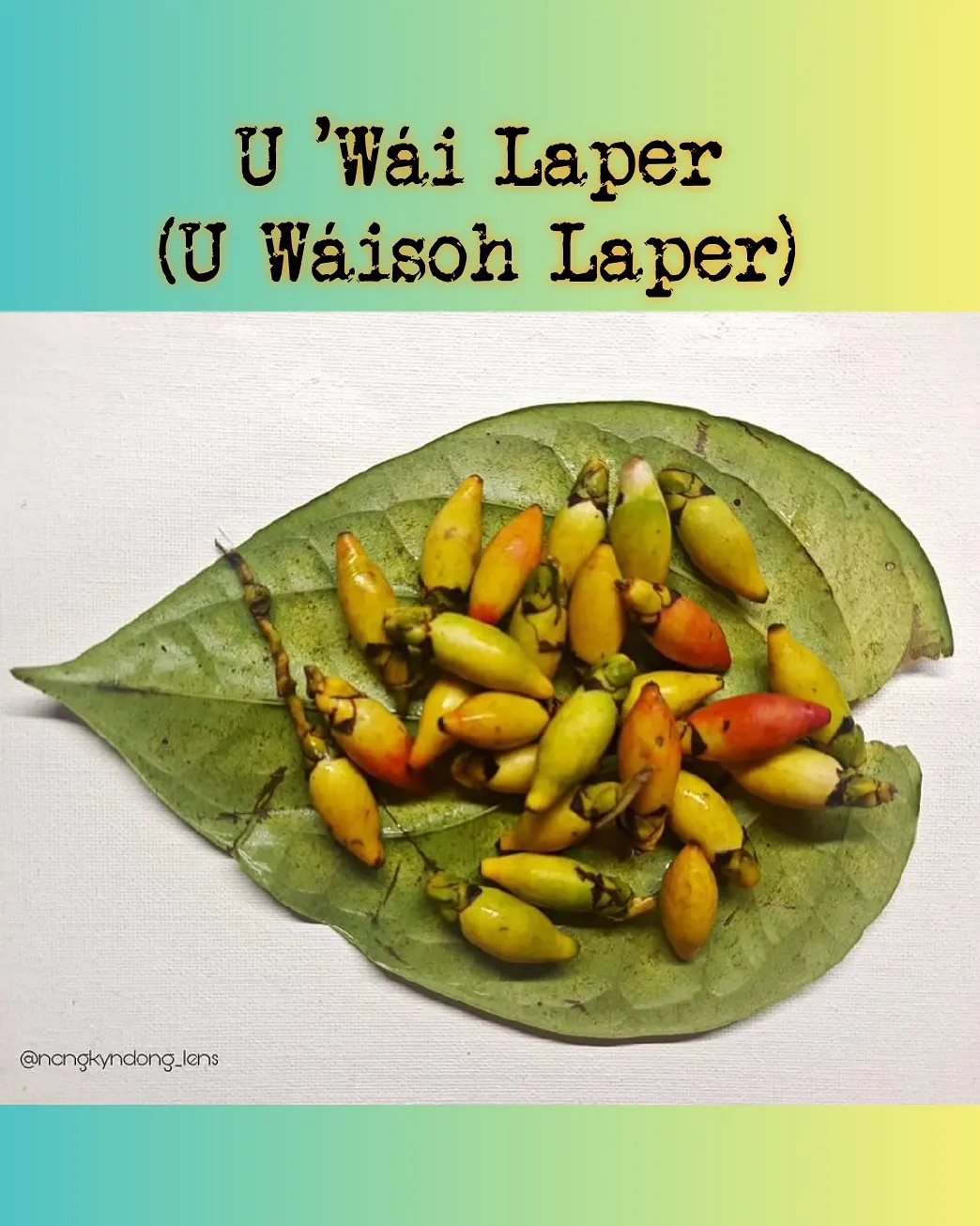
    U Wái Laper is a different and smaller species of kwai or areca nut. The tree of this kwai does not grow as tall as the regular kwai. Growing in the summer season, its cover is thin and it is quite tasty even though it can be hard and tough to chew. This smaller species of Kwai grows in the War Khasi and War Jaintia areas. Please tell us more if you know about U Wái Laper!

    "U Wái Laper" is a miniature version of the regular Khasi kwai (Betel nut) which people say is quite tasty 😀😀

    Thank you @nongkyndong_lens for sending this entry! 🙏

  • Sawdong ka lyngwiar dpei

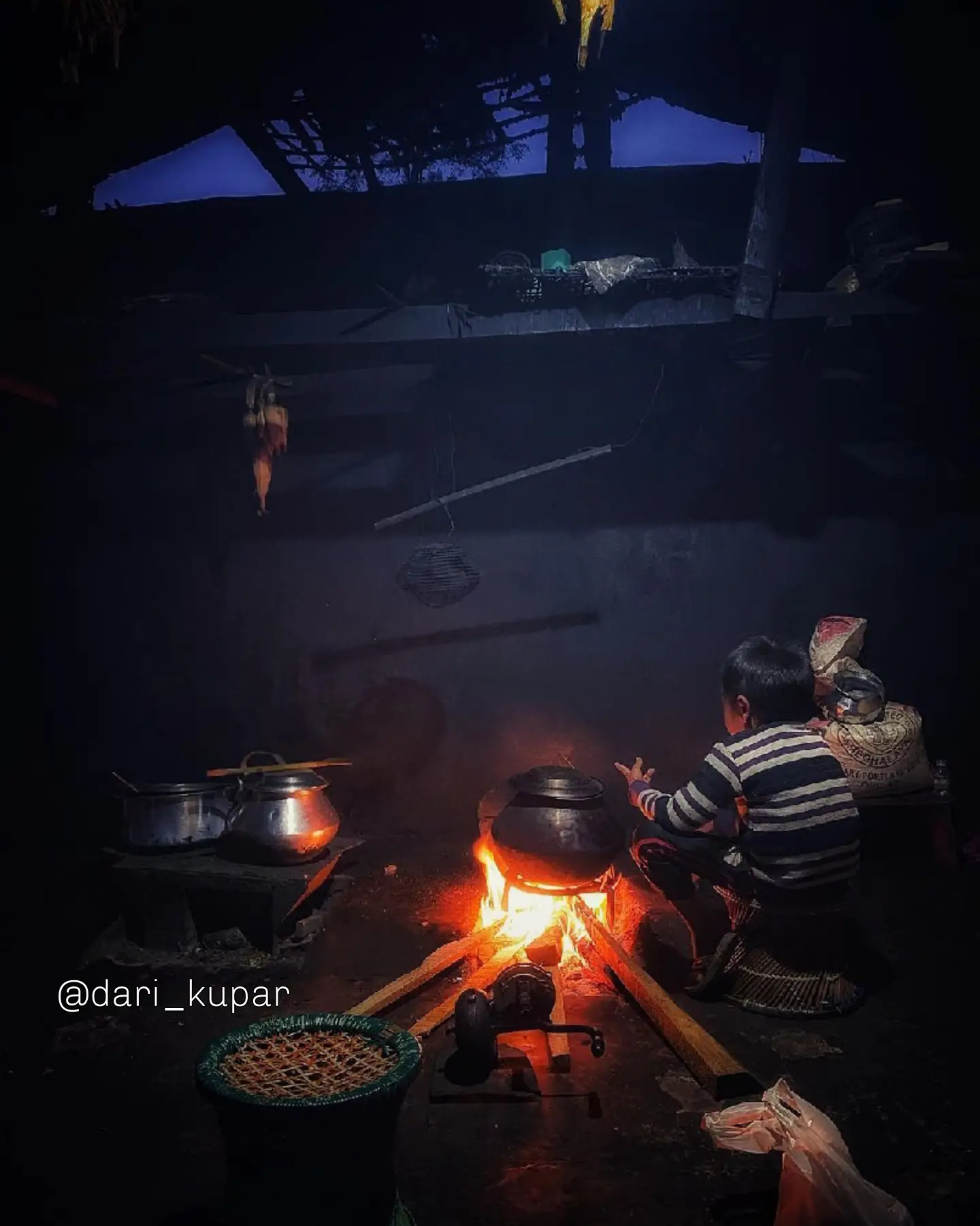
    Sawdong ka lyngwiar dpei.

    Ngi shong syaid ding ban sngap

    khana i mei:

    Ki khana tang khana puriskam.

    Ki jingsneng tymmen, ha ngi i sam;

    Ban pynneh ki rukom ki riti ki

    dustur.

    Ban im ka jaitbynriew bad

    shaphrang ban iai tur!

    @dari_kupar

    "Sawdong ka lyngwiar dpei" sent by @dari_kupar 🌄🔥

    Katno ngi sngew kmen bad sngew myllung ka mynsiem haba ngi iohi ia kum kine ki lyngwiar dpei kiba bun na ngi ngim don shuh ha ïing 💜💜💜

    Thank you @dari_kupar for sending this nostalgic picture and for the heart-warming poem! 🙏

  • Khasi Adverbs

    Btáj-btáj ka mut kaba kynja ba dambit ne bit nah/ soft and sticky.

    Wur-wur ka mut kaba kylluid ne kaba ïar/ something loose or wide.

    Wap-wap, wep-wep ka mut ba jem tlot, kumba jem u briew ba pang swai/ someone who is frail and delicate because of ill health.

    Ryngmang-ryngmang ka mut kaei kaei kaba long kyndit khlem da pyrkhat ne khmih lynti lypa/ something unexpected and unforeseen.

    Jngaiñ-jngaiñ ka mut kaba ïong shikatdei kum ka um ba jylliew/ something dark like very deep water.

    Ngaiñ-ngaiñ ka mut kaba dum tliw bad ka thew ïa ka jingdum jong ka bneng/ very dark and usually refers to the darkness of the sky.

    Pharúh-phareh ka mut ha ka rukom ka bym suitniew/ careless, reckless, clumsy.

    Khasi adverbs bring character and substance to the Khasi language! 💬🗯️💭 They describe actions, colour, emotion and so many things with a dramatic effect that is not easily translated.

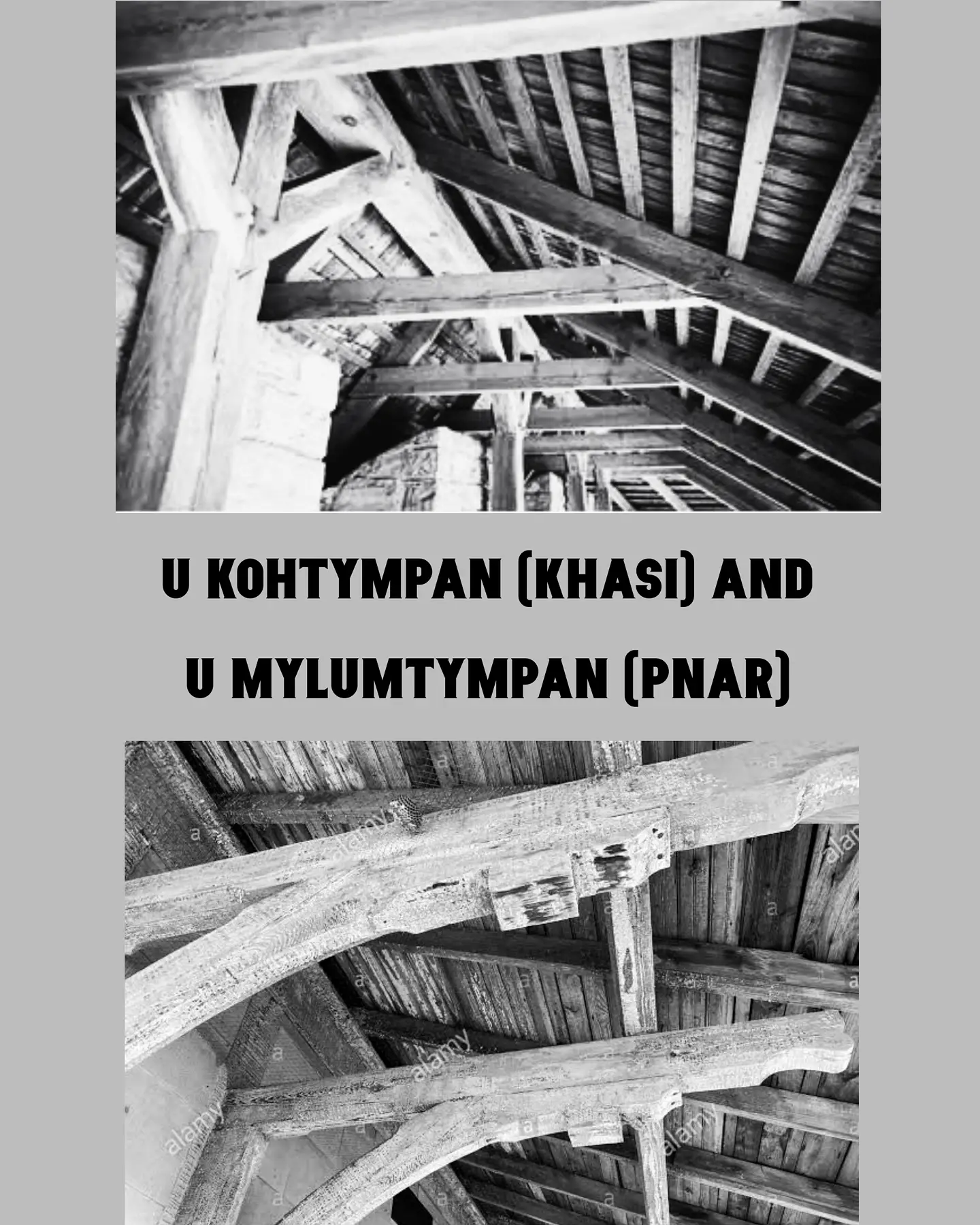
  • “U Kohtympan” (Khasi) and “U Mylumtympan” (Pnar)

    The meaning of "U Kohtympan" (Khasi) and "U Mylumtympan" (Pnar) is not easy to find as the word is not listed in the popular dictionaries that are available. What has been understood is that the word in the literal sense refers to someone who hides in the "tympan ïing" or the rafters of a house. This meaning is usually used from time to time to scare disobedient children by saying that Kohtympan or Mylumtympan will carry them away to a distant place if they continue to be disobedient and stubborn.

    Deriving from this, the Khasi phrase "pyntieng kohtympan" means making someone afraid or fearful based on something unfounded with no factual truth, thereby creating panic. Further, "kohtympan" (which has been used in songs too) in particular, is elaborated to mean something hidden, unseen and unknown, thus leading to the fear of the unknown. The word perhaps is also used in the sense of challenges, difficulties or problems faced by someone.

    "U Kohtympan" (Khasi) and "U Mylumtympan" (Pnar) is taken to mean something hidden and unseen leading to unfounded fear. Thank you @indariwarjri @laloorisa @a_pocketful_of_plums and @vancouvershullai for helping us understand the meaning of these words! 😃🤓