Tag: speakyourrootschallenge

  • Ki Kyrteng Sin Part II/ Khasi Nicknames Part II

    Sympiw (rit khmat/ small eyes)

    Tun tun (sngaid/ chubby)

    Samah (sngaid bad lyngkot/ short and stout)

    Shrieh (khih ksaiñ, balaiñ/ hyperactive, mischievous, oversmart)

    Shyrjei (ima ka dur/ scary looking face)

    Sadman

    Sadmew

    Thamer

    Thohliap

    Tah (from mattah meaning snail; a reference to being slow)

    Krew krew (big eyes)

    Piduiñ (sngaid/ fat)

    Ldoiñ (heh briew bad biej/ big-built and dumb or foolish)

    Kriw kriw (rit briew bad shalak/ small, smart or sly)

    Bah Rai (raikhoh/ thin)

    Bah Kyn jait Roi (ba kynroi than/ prone to having fights)

    Priñ (Pnar) (ba ïong/ a dark complexion)

    Chru (Pnar) (Ka shriew/ Yam)

    Sti (wrinkled looking or used for someone thin)

    Mum (pronounced as Moom)

    Another round of "Ki Kyrteng Sin"/ Khasi Nicknames 😆😂😆😂

    These nicknames have been collected from the comments section of the earlier post on Khasi nicknames. Thank you to everyone who contributed! 🤡🤠🎃
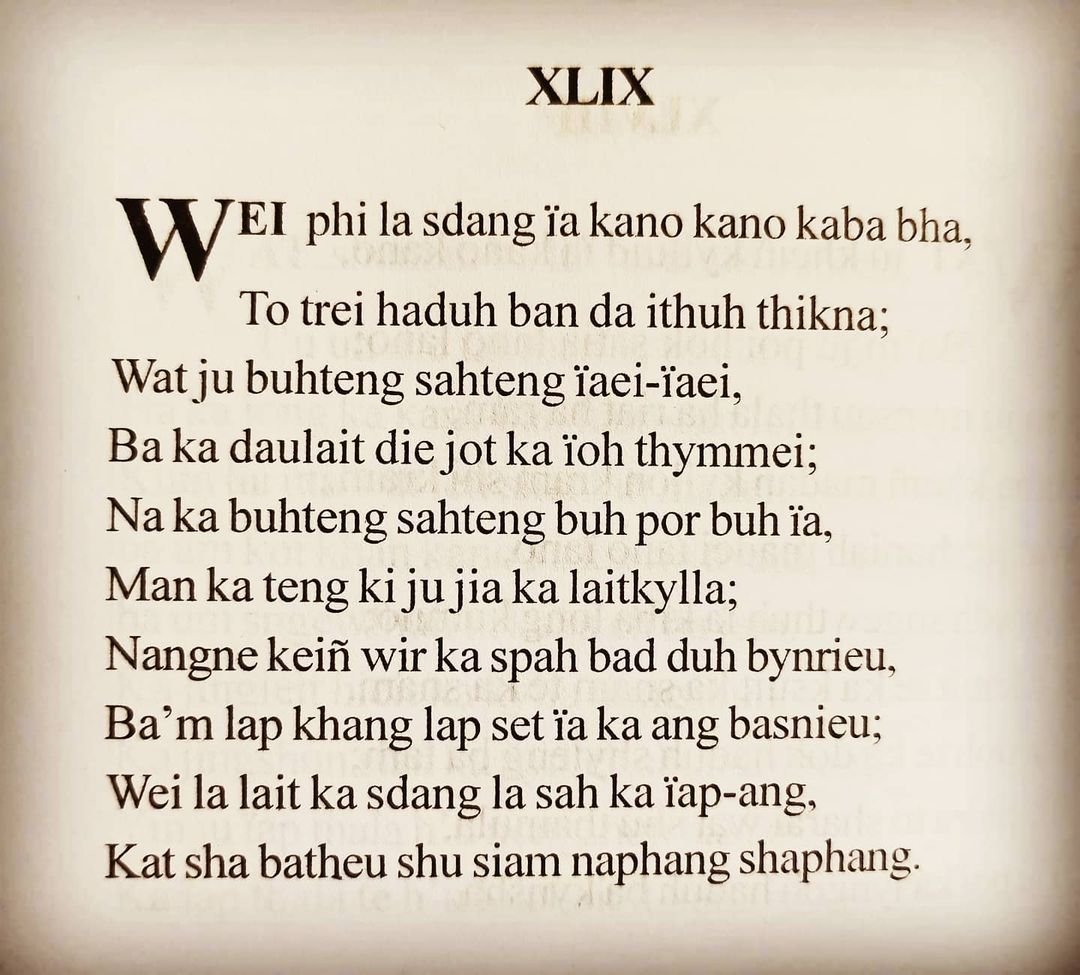
  • Ka Jingsneng Tymmen Shaphang ka Akor Khasi ha ka Rukom Rwai Phawar, Part I (1902) & Part Il (1903)

    Wei phi la sdang ïa kano kano kaba bha,

    To trei haduh ban da ithuh thikna;

    Wat ju buhteng sahteng ïaei-ïaei,

    Ba ka daulait die jot ka oh thymmei;

    Na ka buhteng sahteng buh por buh ïa,

    Man ka teng ki ju jia ka laitkylla;

    Nangne keiñ wir ka spah bad duh bynrieu,

    Ba'm lap khang lap set la ka ang basnieu;

    Wei la lait ka sang la sah ka ïap-ang,

    Kat sha batheu shu siam naphang shaphang.

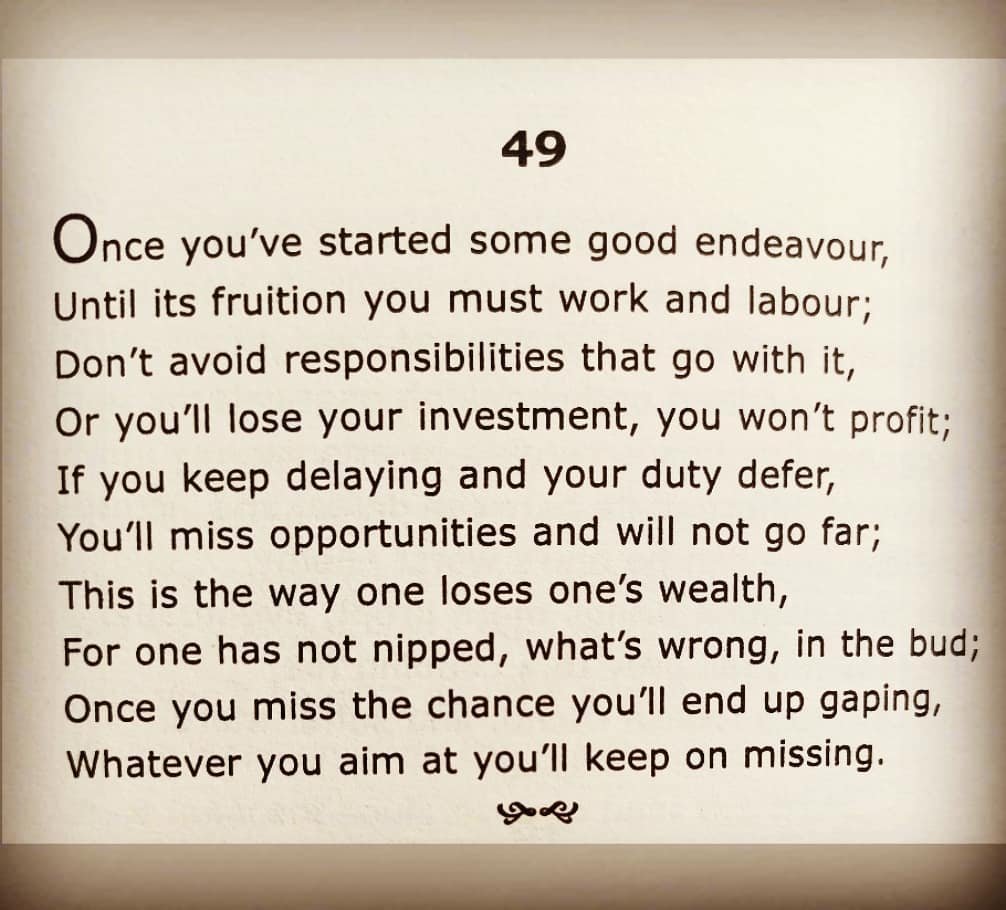
    Once you've started some good endeavour,

    Until its fruition you must work and labour;

    Don't avoid responsibilities that go with it,

    Or you'll lose your investment, you won't profit;

    If you keep delaying and your duty defer,

    You'll miss opportunities and will not go far;

    This is the way one loses one's wealth,

    For one has not nipped, what's wrong, in the bud;

    Once you miss the chance you'll end up gaping,

    Whatever you aim at you'll keep on missing.

    Ka Jingsneng Tymmen Shaphang ka Akor Khasi ha ka Rukom Rwai Phawar, Part I (1902) & Part II (1903) by Radhon Sing Berry Kharwanlang is a unique collection of valuable lessons and teaching on how to live a good and moral life. ⏳📝🏃

    The teachings are given in the form of "phawar” where two lines follow the same rhyme scheme, that is, aa bb.

    Both Part I and Part II have been translated into English by Bijoya Sawian @sawianbijoya in her book The Teachings of Elders: Ka Jingsneng Tymmen Parts I and II (1997).

    Picture 1: Ka Jingsneng Tymmen Shaphang ka Akor Khasi ha ka Rukom Rwai Phawar, Part II (1902)

    Picture 2: The Teachings of Elders: Ka Jingsneng Tymmen, Parts I and II (1997).

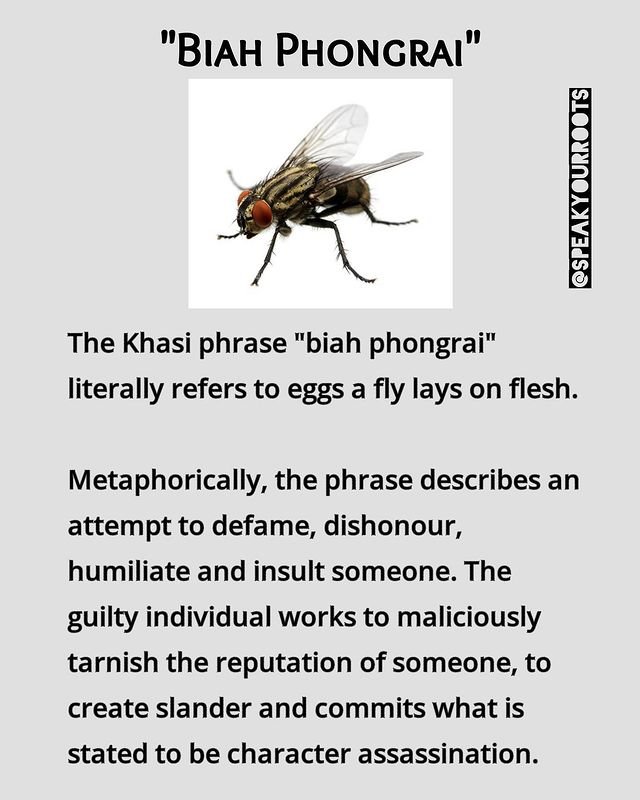
  • Biah Phongrai

    Ka "Biah Phongrai" ka dei ka pylleng ba kha u skaiñ ha ka kynja doh.

    The Khasi phrase "Biah Phongrai" literally refers to eggs a fly lays on flesh.

    Ka jingong "Biah Phongrai" ka dei ka jingpynbud nam sniew, jingpynjah burom bad ka jingleh ñiewbeiñ ïa uno uno u briew da u riewpoh, da kaba pyndonkam da ki ktien khlem akor bad ki ktien lamler.

    Metaphorically, the phrase describes an attempt to defame, dishonour, humiliate and insult someone. The guilty individual works to maliciously tarnish the reputation of someone, to create slander and commits what is stated to be character assassination.

    "Biah Phongrai" is a Khasi phrase which means to taint someone's reputation with malicious slander. Thank you @pyndap_r for bringing this up. 😊😊

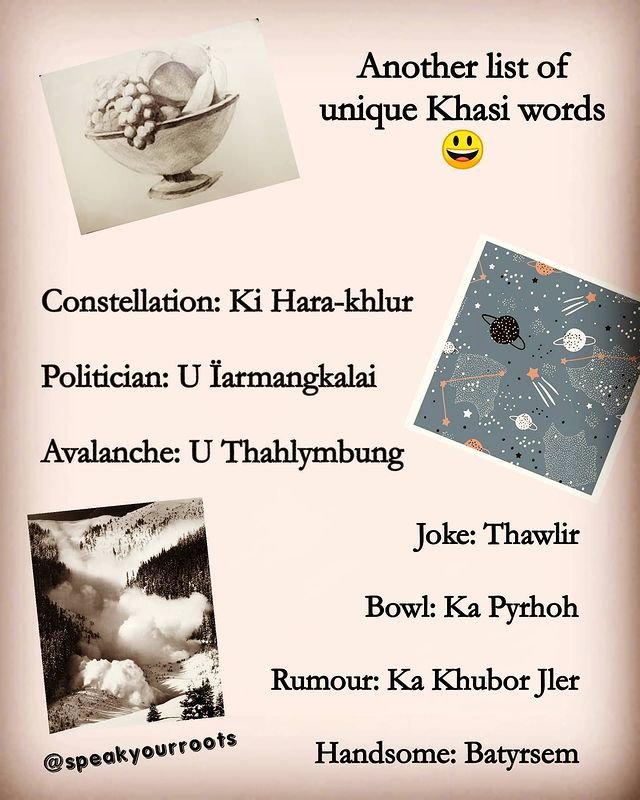
  • Another list of unique Khasi words

    Constellation: Ki Hara-khlur

    Politician: U Ïarmangkalai

    Avalanche: U Thahlymbung

    Joke: Thawlir

    Bowl: Ka Pyrhoh

    Rumour: Ka Khubor Jler

    Handsome: Batyrsem

    Here is another collection of unique words in Khasi! 🤩🤩🤩 The more we dig, the more we find. So men aren't "bhabriew" anymore, you are "batyrsem" 😎😎🤵🤵

    Source: Ka Dienshonhi: The Khasi Encyclopaedic Dictionary by Rev. Dr. Ïarington Kharkongor

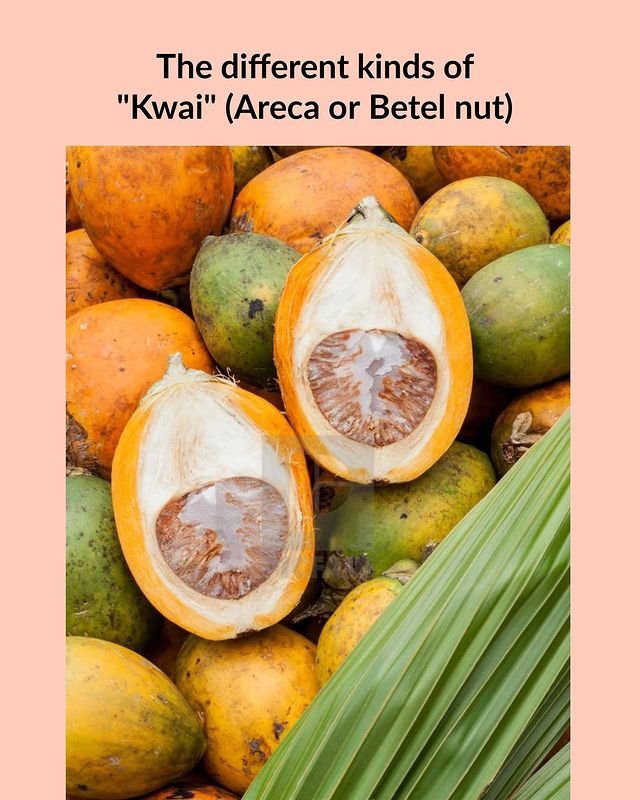
  • The different kinds of “Kwai” (Areca or Betel nut)

    " 'Wáikaa" is kwai that is still on the branches of the tree.

    " 'Wáinat" is kwai that has been plucked from the tree but it has not yet been removed from the bunch.

    " 'Wáiphiah" is kwai that has been cut into two or four pieces and that is to be divided and distributed. This kwai is also given to the bridegroom and his relatives by the bride's uncle on the wedding day. The two parties meet at a designated spot before the wedding as the bridegroom is on the way to the ceremony. This giving of kwai is symbolic of the welcome given to the bridegroom.

    " 'Wáikhaw" or " 'wái-im" is kwai that is the new batch of nuts that still have the outer skin intact. This kwai is eaten in the winter.

    " 'Wáiskop" is kwai that has been soaked and immersed in water for some time so that it is preserved, with the outer skin becoming fibrous. This kwai is eaten in the summer.

    " 'Wáikhud" is kwai that has been peeled and cleaned.

    " 'Wáidong" is kwai that has been folded and rolled with betel leaf.

    " 'Wáidung" is kwai and betel leaf that has been ground especially for old people.

    " 'Wailing" contains two kwai (kwai synrap or twins) nuts in one covering.

    Our beloved "Kwai" 😄❤️ what would we do without you? A staple in all Khasi homes, it is a family member who cannot be forgotten 😀 Immortalised in Khasi folklore, it is an iconic part of Khasi life, culture and community.

    Picture: Google (The kwai in the picture is 'Wái-im)

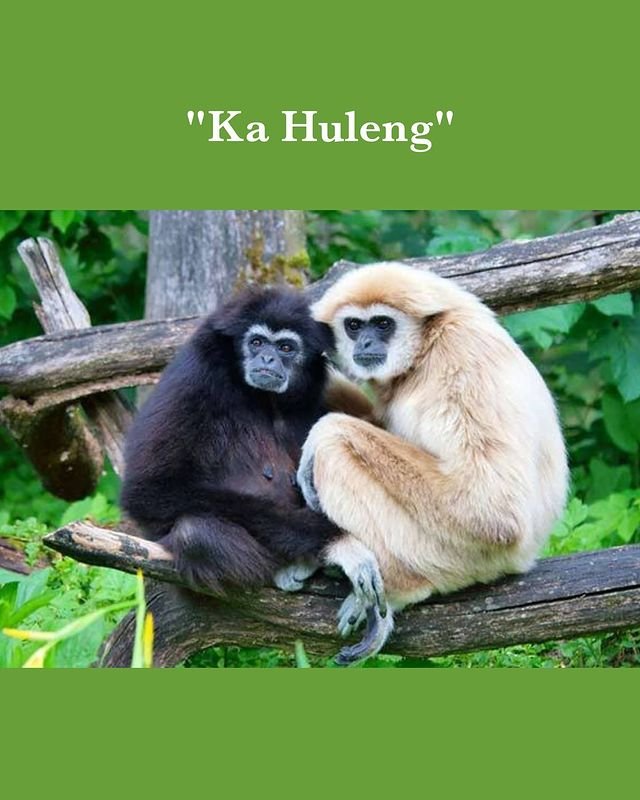
  • Ka Huleng

    The village of Phlangwanbroi which is located in Mawsynram, Tehsil, of East Khasi Hills District, Meghalaya is home to the Western Hoolock Gibbon or what we call "Ka Huleng" in Khasi. Hoolocks are three primate species of genus Hoolock in the Gibbon family, Hylobatidae, native to eastern Bangladesh, Northeast India, Myanmar, and Southwest China. Hoolock gibbons are India's lone ape species. They are both rare and endangered, found only in the forests of Northeast India.

    Phlangwanbroi, four neighbouring villages and an adjoining community forest make up the Khasi native state of Hima Malai Sohmat, one of 25 traditionally ruled Khasi enclaves in Meghalaya that are formally recognised by the Indian Constitution. The 40-sq-km community forest of Hima Malai Sohmat has been home to western hoolock gibbons since "time immemorial", villagers say. The males are black with white brows, while the females have a copper-brown fur, which is darker at the chest and neck. White rings around their eyes and mouths give their faces a mask-like appearance.

    With long and slender arms, hoolock gibbons are swift creatures, swinging from tree to tree at speeds upto 55 km/hr, covering upto six meters in just one swing! Hoolocks are famous for their emotive call that echoes across the forest which is used to attract mates. In Phlangwanbroi, the morning starts with the melodious series of whoops, hoots and tones of "Ka Huleng" that rise in a crescendo. The residents refer to it as "jingrwai huleng" – the hoolock gibbon's song. There is a local saying that as long as you hear the gibbon's song, you are within the boundary of Hima Malai Sohmat.

    "Ka Huleng" or the Western Hoolock Gibbon is found in the village of Phlangwanbroi, Mawsynram, Tehsil in East Khasi Hills District. This is the only ape species in India and we are extremely lucky to have it in our state. 😃😃

    Sources:

    https://www.google.co.in/amp/s/amp.scroll.in/article 926439in-meghalaya-tribal-communities-join-hands-to-ensure-that-the-hoolock-gibbons-song-stays-alive

    https://en.m.wikipedia.org/wiki/Hoolock_gibbon

    https://www.wwfindia.org/about_wwf/priority_species/lesser_known_species/hoolock_gibbons_/

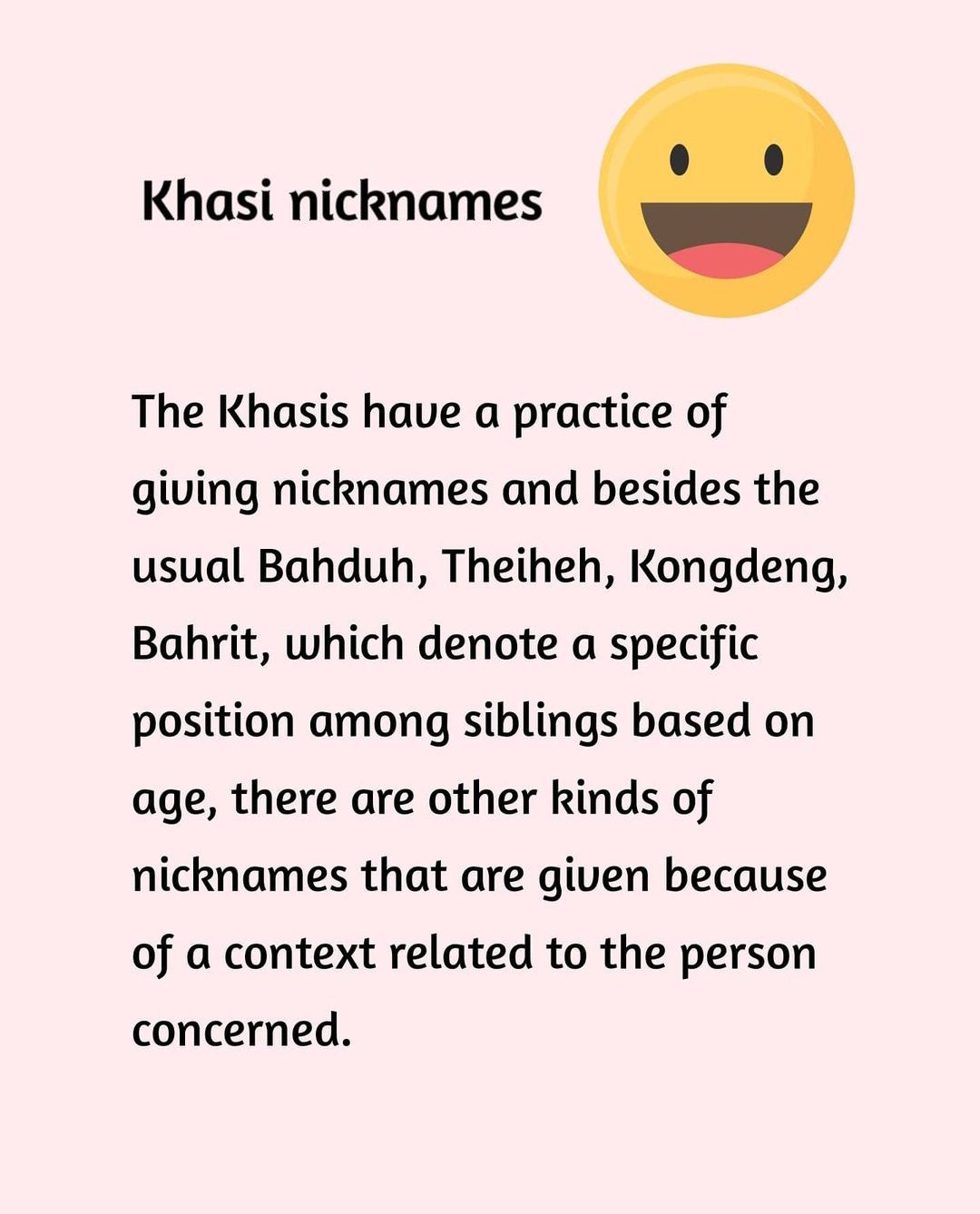
  • Ki Kyrteng Sin Part I/ Khasi Nicknames Part I

    The Khasis have a practice of giving nicknames and besides the usual Bahduh, Theiheh, Kongdeng, Bahrit, which denote a specific position among siblings based on age, there are other kinds of nicknames that are given because of a context related to the person concerned. Here are some:

    Ka Smaw (ba ïong, ba jaing/ being dark and dirty)

    U Satlew (ba heh bad khlaiñ/ big built and strong)

    U Ren (ba bun ka shang/ always going out)

    U Dum (as in lyndum/ bald)

    Ka Taiñtabul (for timetable)

    U Koted (like the air horn of Bedford buses)

    U Buit (rit, buittuh, shu shyit briew beit/ small, wiry, likes to pinch others)

    U Tamuiñ (saw ki khmat bad ka ïambait/ red eyes and a cry baby)

    U Lo (pronounced like the word Law)

    Ka Bon

    U Been Loons

    U Sahep Laitkor

    Ka Samap (raikhoh/ stang shñiuh/ skinny, limp hair)

    U Bring

    Ka Rai (namar ba bang Krai/ because she likes millet)

    Bah Ling Saphu (a girl's nickname because she was scared of a beggar with this name)

    U Ro

    Ka Thre (named after a woman obsessed with cleanliness)

    U Lui

    U Jon Snai (named after a man who stole roosters to make them fight)

    Shnuit

    Ïong (dark complexion)

    'Ngaid (sngaid/ fat)

    Bung

    Lew Lew (from Pyllew/ big eyes)

    Pit Pit (namar ba sympit/ small eyes)

    Mem Syndem (ba syndem/ flat nose)

    Dem (ba syndem/ flat nose)

    "Ki Kyrteng Sin" or Khasi nicknames

    Don't we love our nicknames?! 😄😄😄😂😂😂 Here are some Khasi nicknames contributed by @indariwarjri @carey_lynz @bibianaryntathiang. Thank you for sending them! 😄

    Some have a context and some don't, but please do enjoy them and come up with your own interpretation!

    Please tell us about your funny nicknames! 🤡🤡😎🤓😎🤠🤠

  • Ka Ïing Tynriew

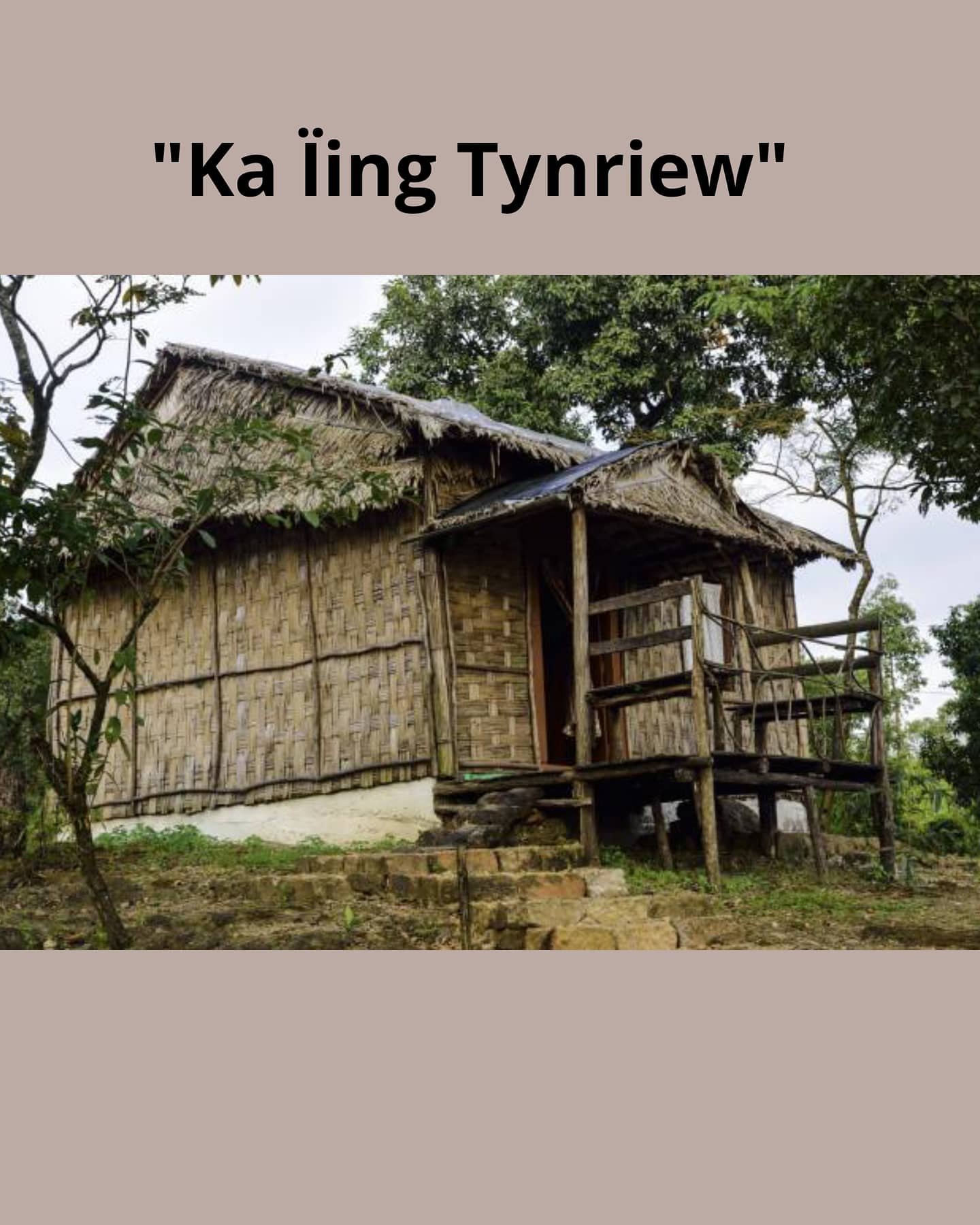
    "Ka Ïing Tynriew" is the traditional thatched house of the Khasis and is made from the leaves of the Tynriew plant. The house in the first slide is an actual house which has a roof made from "sla tynriew".

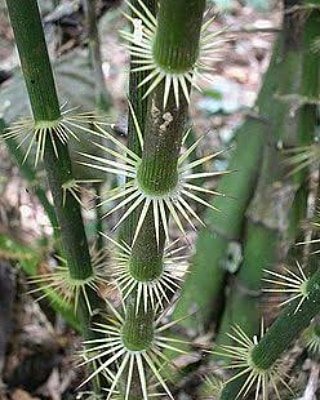
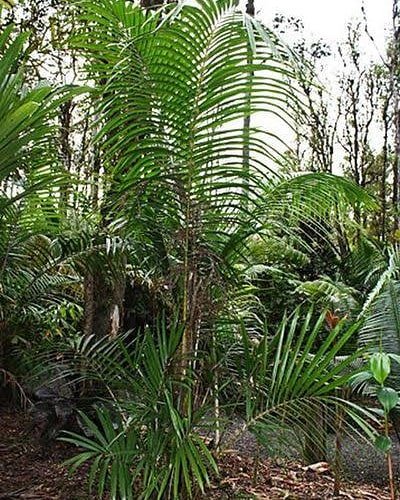
    There is a difference between the "Tynriew leaf" and the "Dieng Tlai" leaf. The Tynriew is a kind of bamboo plant with thorns or spikes and fruits too which are inedible. The Dieng Tlai is a kind of palm tree with one type growing in the War areas and another type in other areas. The Dieng Tlai leaf can be used to thatch roofs just like the Tynriew leaf. The Tynriew is changed once a year. The scientific name of Tynriew is Calamus Erectus and of Ding Tlai is Caryota Urens.

    We express our gratitude to @click.and.vibe and @dappura_chyne for contributing to the write up! 🙏🙏

    Picture 1: @dappura_chyne

    Picture 2 and 3: Google

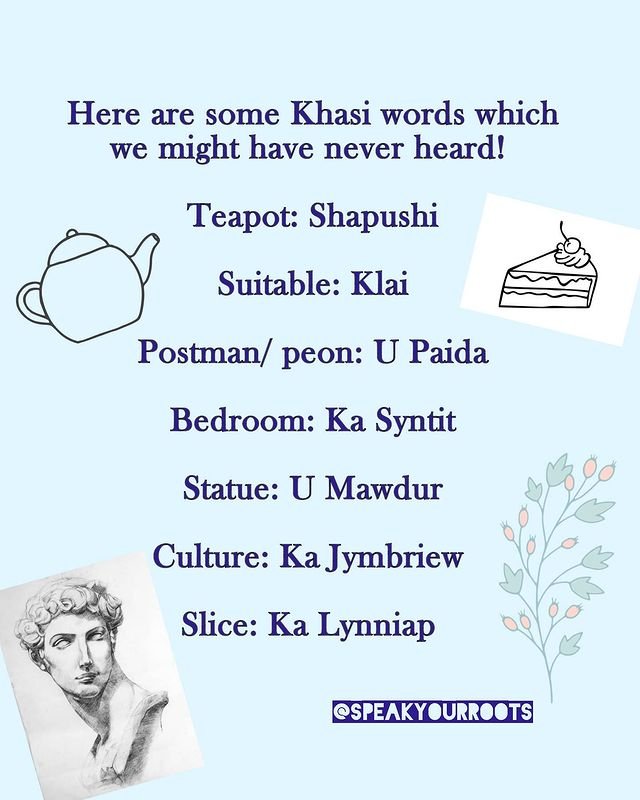
  • Some Khasi words which we might have never heard!

    Teapot: Shapushi

    Suitable: Klai

    Postman/ peon: U Paida

    Bedroom: Ka Syntit

    Statue: U Mawdur

    Culture: Ka Jymbriew

    Slice: Ka Lynniap

    Look at these words! Many of us will not know of them at all! 😲😮

    The Khasi language has a wealth of words which are no more in use today. We should make it a point to find out more words like these and use them in daily life! 🌄🏞️🌲🌤️

    Source: Ka Dienshonhi: The Khasi Encyclopaedic Dictionary by Rev. Dr. Ïarington Kharkongor

  • Ring ‘sai phla

    Ka jingong "Ring 'sai phla" ka thew ïa ka jingïakylli markhmat haduh ban da shem ïa ka jingshisha. Kaba "ring 'sai phla" ka dei kaba pynskhem ïa ka jingïathuh da kaba pyni ïa u sakhi u ban long kum u ksiang.

    The Khasi phrase "Ring 'sai phla" means to meticulously ask a thread of questions in order to arrive at the truth. The phrase implies a direct confrontation and interrogation with the aim of extracting the truth. Furthermore, the answers to the questions are corroborated by witnesses who represent the roles of a judge or a mediator.

    When truth is the most valued of possessions 💡🔦🖊️📃🔍

    "Ring 'sai phla" is a Khasi phrase describing a detailed process of questioning to know the truth.