Tag: talklocal

  • Khasi Words and their English equivalents

    Marmlien – Habituated

    Ka Khilonski – Scaffolding

    Ïakhing – Resist

    Bamuta – Coarse

    Phngar; Palat pud – Extreme

    Kloilan – Extremely quick

    Another list to remind us of Khasi words which we might not be using anymore. ✒️🗣️

  • Different animal names in Khasi

    Different Khasi animal names sent by @ecology_boi 🐯🦊🐵

    These pictures are from the book "Ki Mrad Khlaw ka Meghalaya" by Shining Star Laloo. Khublei Shibun for sending these pictures! 🙏😀

    If you know the English names of the animals please mention them in the comments section!

  • Ki Sakhi by P. Tariang

    Kmen ha jingitynnad jong ka sngi,

    Naba ngim tip kaei ban wan ha lynti.

    Shim ka por jingiwbih ki syntiew ban sieng,

    Ban ring bad pynhiar mynsiem khlem jingsheptieng.

    Pynleit jingmut ruh ia ki ding ki ba ieng,

    Kmen kum lyer jai jai ba beh kylleng kylleng.

    Shim ia u khynnah hikai bad btin lynti,

    Ha ki jaka ba kynjah ban sneng bad pyni

    Pyniaid ha ki shyiap ka rud duriaw bah:

    Hikai ha ki at phyllung jingtriem ba un lah shah.

    Pyni ruh ha u jingitynnad ka suiñbneng,

    Shah un kylli, jubab wat ym leh meng.

    Ai un iohi ia ki lum bah makashang,

    Krem barieh, ki wahduid bad um shyngiar ba bang.

    Pynithuh ki mrad bad ki sim ha ka ri,

    Batai de ba un ym sah biej u bapli:

    Ka dei ka jingshisha! Watla pyrthei ka ma,

    Bun ruh jingitynnad ba ngin shem ha ka.

    Jingitynnad ka jingim ba la pynman kyrpang,

    Ki jingkhraw, jingmaian, shoh mynsiem ka phalang

    Kumno shaphang u bnai bad ki khlur ha sahit,

    Hapdeng ka dum iong ngit phalang jingshai barit;

    Kamram ka dawa ha ngi ban kut jingmut,

    Ban ieit ia ki donkam ban aiti lut;

    Jingieit long shabi ha man la ka ri,

    Ngi donkam ruh ban tip kumno ban ieng sakhi.

    Lada ngi nang pyni tang ka jingijli, jingsniew kan khie im,

    Jingieit kan nang ring sti.

    – P. Tariang

    "Ki Sakhi" is an original Khasi poem by @the_dark_linen_ ✒️🏞️🌲

    Khublei Shibun for sending your poem! 😀🙏 Ka long kaba kit jingmut bha bad kaba don jinghikai.

  • “Kyllalyngkot” da Reaia Phira

    Lyngngoh shisha ban shem

    ba ka jingthrang jong u phria

    kan kynduh bad ki shyieng

    jong ki iing jong ngi-

    Sngew kumba ki ktien

    khubor ruh

    ki bud sur ia u,

    ki kyrhuh bad ki pang.

    Kumba u jumai u bym ju patiaw

    ia ka jingsheptieng kaba ring

    na ki sla kjat jong ki briew

    haba ki wad ki jaka rieh na u-

    Kumta ki ummat shngiam

    ruh ki tuid.

    khlem sngap iano iano ruh.

    Haba ka lyer pjah ka lyngaid

    bad ka sum hapoh ka ding shawla;

    ban wallam ia ka jingsngewtmang

    jong ka mula

    kaba la pynap ha khap jong nga-

    Kumta ruh,

    ka sngi ka kyan lyngba ki

    dpei ba jngi ha suiñ kum

    ki jingmut ba snai.

    Hynrei ha ki por ba ju sawa

    tang ka jingjarjar ka miet,

    nga ju iohsngew diang diang

    ia ka jingsyaid kaba per

    ha ka um kaba sah

    ha ki thwei ka

    mynsiem jong nga…

    bad nga kynmaw

    ieid eh ia phi.

    Original Khasi poem "Kyllalyngkot" by @meat__ball__ ✒️🍃
    Khublei Shibun @meat__ball__ for sending your poem! 🙏😄

  • First language, second language…

    When language is life and everything in between! 😄😂🧡🏞️

    May indigenous languages thrive
    May indigenous languages be revived
    May indigenous languages empower us!

  • Wei La Saw Bha Ka Bneng…

    "Wei la saw bha ka bneng sepngi jan miet phin sa ioh jingrang lashai."

    (La shim na "The Khasis" by P. R. T. Gurdon, 1907)

    Ha ka jingpeit bniah bad jingkhmih jong ka, nga shem ba katei ka jingong ka jia long shisha. Ka jingshem ka jong nga ka long ba ha ka janmiet jong ka 12 tarik U Kyllalyngkot 2022, nga ïoh peit bniah bha ïa ka bneng kaba paw rong saw kumba 5 minute eiei bad ha ka sngi kaba bud, kata ha ka 13 tarik nga shem ba ka sngi ka rang bad shai kdar bha bad kumjuh ruh ka don ïa ka sngi tlang kaba jem bha.

    "A red sky in the west in the evening is the sign of fine weather tomorrow."

    (Taken from "The Khasis" by P. R. T. Gurdon, 1907)

    In my brief observation, I observed that the Khasi saying found in Gurdon's The Khasis is certifiable. It is quite rare to hear these sayings nowadays but when I revisited Gurdon's book on the Khasis I decided to note this saying down and conduct a brief observation. On the evening of 12th January 2022, I observed that the evening sky at sunset was red in shade for approximately 5 minutes or less and then on the following day, 13th January 2022, I found that we were blessed with a dazzling and bright day. Moreover it had that soft winter sun and an amalgamation of both warm and chilly breeze.

    "Wei la saw bha ka bneng sepngi janmiet phin sa ïoh jingrang lashai" 🌄☀️🌲
    Khublei Shibun @_.adegram._ for sending this observation! 🙏😄

    🟡 English translation by @_.adegram._

  • Ka Ramïa

    The Khasi word "Ka Ramia" may be described as a dream or a hallucination or an illusion.

    The following excerpts are from the Doctoral thesis entitled "Transformation, Tradition, and Lived Realities: Vernacular Belief Worlds of the Khasis of Northeastern India" written by Margaret Lyngdoh, University of Tartu.

    **No part of this thesis may be reproduced in any form without the consent of the author. Proper citation should be strictly adhered to when quoting any part of this research. All material for this content has been researched by Margaret Lyngdoh, Ph.D, University of Tartu.

    My research findings suggest that the "ramia" is a dream or vision world, which is inhabited by tigermen and women, ancestor spirits and the tiger deity. It is rather difficult to translate the implications of this term in a western context because the word "ramia" is also used by the Khasis to denote a kind of madness, when a person is not in his or her senses, or is not socially or personally aware of his or her surroundings. So, in the case of divine possession, for example, the person's spirit leaves the body, but the physical body remains and does its daily tasks. But if such a body, without its "rngiew", talks with someone else then the speaker does not make sense and is said to "kren ramia" (lit. 'talk ramia').

    In the Khasi context, a parallel reality is inhabited by the non–human entities and this may be comprehended only through movement into the dream/ vision state, the "ramia". Reality is not dualistically ordered or perceivable only to humans or to the dead. Reality is multiple, and variegated, dependent upon the beings who inhabit it and the purpose for which they inhabit it. The living environment is social and interactive with humans; moreover there exists a reciprocal, intentioned relationship. Human beings can apprehend alternate realities through the dreamworld ("ramia"), the world of the tigermen, the water realm of the spirit deities and the reality of the ancestors. For this to happen, for a human to access the alternate reality, a transformation is required. This is inclusive not only of the human–animal, but of the natural animal. I use the word human-animal, because in Khasi ontology, specially gifted individuals have the ability to transform into animals and deities.

    "Ka Ramïa" is an interesting and important concept of the Khasi worldview.

    Khublei Shibun @lieng_makaw for your research on this concept! 😄🙏

    What we need is to undertake in-depth research of Khasi culture and heritage in order to represent the community in the right light to the world. ✍️📚🏞️
    The importance of "searching and researching" cannot be stressed enough for all indigenous communities!

  • Different Ways of Saying “Thank You” in the Khasi Language

    Ki rukom ong "Khublei Shibun" ba pher ha ka ktien Khasi

    Ka ktien "Khublei" ka thew ïa ka jingsngewnguh bad ka jingkyrkhu. Ka ktien "khu" ka wan na ka ktien "kyrkhu" bad ka ktien "blei", na ka ktien "Blei", kata ka mut, U Blei un kyrkhu ïa phi. Ka ktien "Shibun" ka mut kaba bun bad ka ktien "Khublei Shibun" ka thew ïa ka jingsngewnguh kaba shikatdei ne katta katta.

    The word "Khublei" refers to a feeling of gratitude and is also an expression of a blessing. The word "khu" comes from the word "kyrkhu" which means to bless and "Blei" which means God. So "Khublei" means God bless you. The word "Shibun" means many and in the phrase "Khublei Shibun" it refers to an immense feeling of gratitude.

    "Khublei Shikatnor" and "Khublei Shikhohtyndaw"

    Kane ka rukom ong Khublei Shibun la shim na ka "Shatwaidong" jong ka kot Ka Kolshor Khasi Kumba Paw ha ka Literashor Khasi (2006) kaba la thoh da i Dr. (Sr.) Philomena Kharkakor RNDM.

    This way of saying Khublei Shibun is taken from the Introduction to the book Ka Kolshor Khasi Kumba Paw ha ka Literashor Khasi (2006) written by Dr. (Sr.) Philomena Kharkakor RNDM.

    Ha baroh artylli ki rukom ong ka don ka jingsngewnguh kaba jylliew bad kaba shikatdei haduh katta katta.

    In both instances, the words express a deep and immense sense of gratitude and thankfulness.

    There are two ways of saying "Khublei Shibun" that are different from the usual way of saying the phrase.
    Khublei Shibun @_.adegram._ and @redfm_rjzack for bringing up these two new ways of saying "Khublei Shibun" 😄🙏

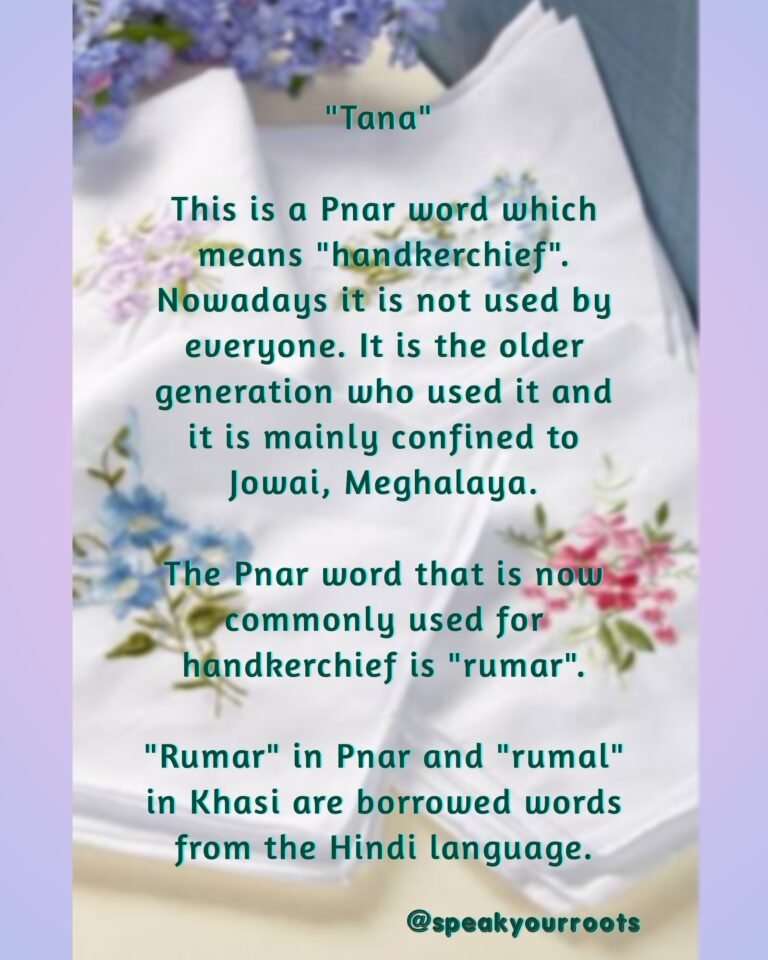
  • Some Pnar Phrases

    Pnar phrases

    "Ka buit ïyrngam"

    "Ka buit ïyrngam" is a cunning idea that a person thinks of.

    "I kam wasmet"

    "I kam wasmet" is a good cause that will help and benefit people and bring a promising future.

    "Sing chylliah"

    "Siang chylliah" is to breathe one's last breath.

    The books of (L) Mrs. P. P. Pasleiñ are a precious find! 😃 Here are some Pnar phrases from her book The Depth of Thwai Syiem (2001) 🍃🌱

  • U sohmarit im

    What we call "u sohmarit im" in Khasi or green peppercorns are a spicy addition to our "ja bad jyntah" (rice and curry). The aromatic crunch is a great "sidekick" (pun intended 😄😂) for lunch or dinner! The bunch in the picture is almost finished! 😋