Category: Khasi Words Usage

  • Lets learn them!

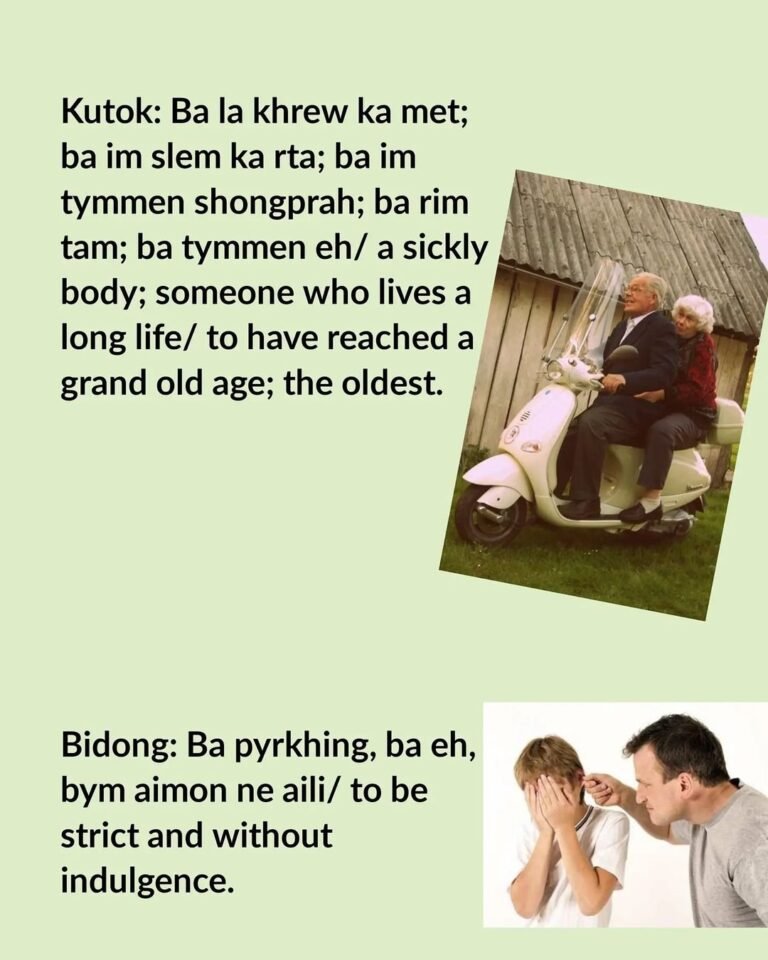
    Syngket ne Taphah ka dei ka riat kaba noh arsut da pynïeng; shám-shám riat; lum mawsiang/ Precipice

    Mikhli ne Milai ka dei ban pynïakhlehlang/ to mix up

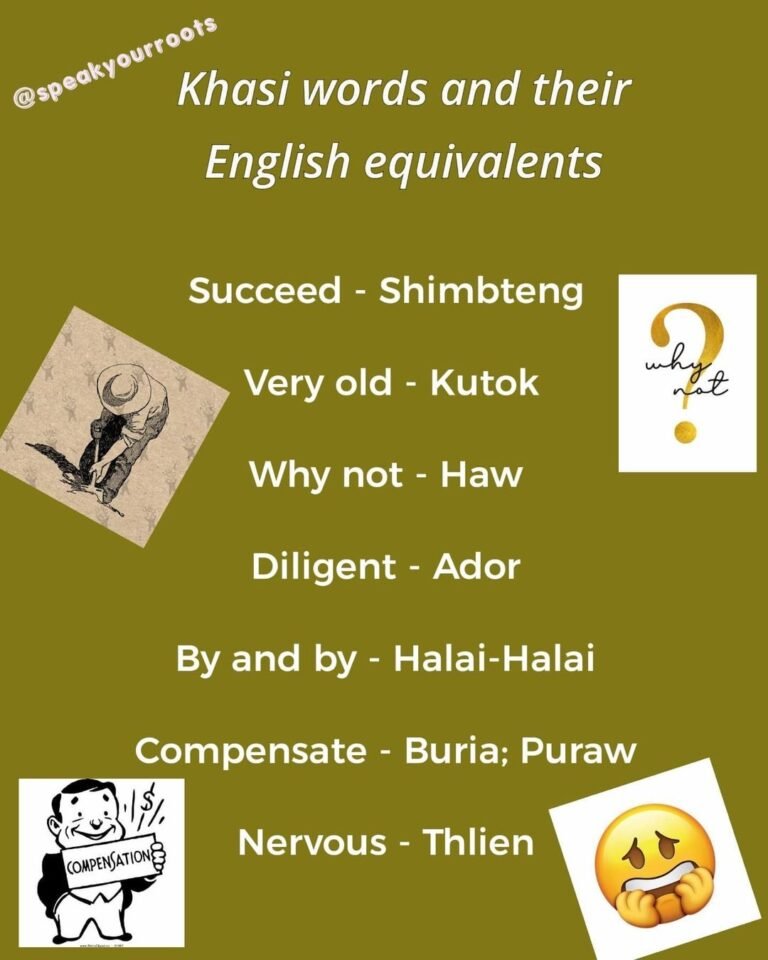
    Halai Halai ka mut suki-suki ne mian-pa-mian/ slowly-slowly or by and by

    Kyrwiang ne Phái war ka mut ban phai sawdong/ to turn around

    Ngi hap ban ïa leh ban kren ne ban thoh da ki kyntien ki ban pynïar ïa ka ktien Khasi. Ki symboh kiba kynshew man ka sngi kin kyrbah ïa ka jingmut bad jingleh jong ngi 😄🙏

    Here are some Khasi words which we can try to use everyday. Grain collected everyday will sustain our thoughts and actions 🌾🌬️

  • Dapkynthei and Dapshynrang

    Ki kyntien "Dapkynthei" bad "Dapshynrang" ki mut haba biang bad pura ka jinglong kynthei ne shynrang.

    Ngi lah ban bynrap shuh shuh da kaba ong ba ki kyntien "Dapkynthei" bad "Dapshynrang" ki thew ïa ka jinglong bad ka maiñ kynthei ne shynrang kaba dappura ha ka jingkoit jingkhiah, ka jingitynnad, ka jingshongkun bad met bad mynsiem.

    Ka dei ka jinglong jingman kynthei ne shynrang kaba pynpaw shynna ïa ka hok, ka bor bad ka jingstad jong ka kynthei ne u shynrang.

    The words "Dapkynthei" and "Dapshynrang" mean the full and ideal essence of being a woman or a man respectively.

    It may be added that the words "Dapkynthei" and "Dapshynrang" refer to an entirety of charismatic presence in health, in beauty and in the dignity of heart and mind. It is a state of embodying the essence of woman or man, in integrity, strength and wisdom.

    The Khasi words "Dapkynthei" and "Dapshynrang" build an image of a woman and a man both in physical, as well as emotional and mental terms. They imply the roles of woman and man in a distinct way, pointing to their well-being in Khasi society. ♀️♂️

    🟡 Khasi and English explication by @speakyourroots

  • Ka Latai

    "Ka latai" ka dei ka tiar kyllaiñ ksai kot kudi ne ka shaka kyllaiñ ksai.

    The Khasi word "Ka latai" is the roller or the spool on which the kite string or thread is rolled.

    Katno ka jingshongshit haba pynher kot kudi! 🪁🪁😄😄 Her lang u dohnud katba nang her ka kot kudi 🪁

    Those sunny days with those steady winds for kite flying 🌬️🌬️🌤️🌤️

    🟡 English translation by @speakyourroots

  • ‘Ñiangbamkot

    Phi lah ju pyrkhat ne em ïa ka kyntien " 'ñiangbamkot"?

    Ka dei ka kyntien kaba la pynkylla beit shisur shidur na ka kyntien phareng "bookworm" kaba thew ïa ki briew kiba khlaiñ bad sngewtynnat ban pule kot. Shuh shuh, kane ka jingpynkylla ka dei ruh ka jingbatai ïa ka kam ne ka jingbam jong ki "silverfish".

    Have you ever thought of the Khasi word "'ñiangbamkot"?

    The word is a literal translation of the English word "bookworm" which refers to a person who has a passion for reading. What's more is the translation emphasises the function of silverfish which is to eat paper. In Khasi" 'ñiang" is a shortened form of "khñiang" which means insect, "bam" means to eat and "kot" means paper.

    It may be said that " 'ñiangbamkot" is a recent translation because Khasis arise from an oral tradition which would not have given importance to being a "ñiangbamkot" 😅📖🐛

    Dedicated to all you worthy ñiangbamkotsss! 😁😂

  • Phlanduman and Thlandaman

    "Phlanduman" ka dei ka kyntien Khasi kaba mut kaba kren ban ïalam bakla ïa ka jingmut da kaba kren kumne kumtai. Ka thew ruh ïa kaba shukor ne thok da ka rukom kaba leh mynleh hok.

    "Thlandaman" toh i kyntien Pnar i wa mut ha wa klam tyngkleiñ yow pynsñiawthooh bakla ya i yïumut wa sakhiat. Jooh ong i pyn thlandaman hawa thok næ chukor da iwa pynyoo kam iwa sakhiat.

    Both "Phlanduman" (Khasi) and "Thlandaman" (Pnar) mean to talk in a roundabout way so as to deliberately make a person misunderstand something or to deliberately divert the person's train of thought. The words refer to the act of lying or deceiving so as to make something appear true.

    "Phlanduman" ( Khasi) and "Thlandaman" (Pnar) are such interesting words 🤓🤓
    They both testify to the dichotomy between appearance and reality, a dichotomy that marks human life, but which is not easily perceived.

    English, Khasi and Pnar expilcation by @speakyourroots

  • Kshaid, Ticha, Dare

    Waterfall

    Indigenous words for the English word "waterfall"

    In Khasi a waterfall is called "Kshaid"

    In Pnar a waterfall is called "Ticha"

    In Garo a waterfall is called "Dare" (pronounced as "Daare")

    The word that most of us will not have heard of is the Pnar word "Ticha" for waterfall 😄 Khublei Chiboon Anvil R. Laloo for telling us about this word! 😄🙏

    Khublei Shibun @kari.on.travels for your pictures! 🙏🙏 Congratulations on your page!

    1st picture: Prut falls is located in Laitlyndop, Sohra. This waterfall emerges from Urwan river formed by the inflowing stream from Khliehshnong Laitlyndop, Umkrem and Madan Umkrem. The Urwan river flows to Mawsiang and reaches upto Shyngoid under Sohra Syiemship. (Source: https://theshillongtimes.com/2021/09/27/sohra-adds-new-waterfall-to-its-list-of-tourist-spots/)

    2nd picture: Weinia Falls is one of the falls located on the Namlang River which, along with the Kynshi river encircles the Nongkhnum River Island – the second largest river island in Asia after the magnificent Majuli. The falls lies on the northern periphery of the river island, about 13km from Nongstoiñ town, the district headquarters of West Khasi Hills. (Source: https://youtu.be/EPIl4nOFz8w by @kari.on.travels )

  • Jakhom

    Ka ktien "Jakhom" ka mut haba mad ïa ka sohsat, ka shitom ne ka mynsaw ha ka jingim u briew. Kum haba ong "Jakhom haba la wan ka 'er kyllang bad u slap."

    The Khasi word "Jakhom" means to experience difficulty and suffering, to be in trouble or to be wounded. When used in a sentence "It is jakhom when a cyclone hits accompanied with rain."

    Katba ngi nang kren, nang pule bad nang thoh ha ka ktien la jong, ngi nang lap bun ki kyntien kiba ngi lah ban pyndonkam ha ka jaka jong kiwei. Ka kyntien "Jakhom" ka long kawei na kum kita ki kyntien. 🗣️✒️📖

    The more we speak, read and write in our own indigenous languages, we will find more and more words that we can use instead of others. The Khasi word "Jakhom" is one such word. 🗣️✒️📖

    Hap kiar mo lok na ka jakhom! Tangba lada ka wan ruh, ngin nang khlaiñ bad met bad mynsiem! 💪💪

    🟡 English translation by @speakyourroots

  • Jymmang, Jympa

    U Jymmang, u bnai uba san jong ka snem, u dei u bnai pyrem. Kumba long kiwei pat ki bnai, u Jymmang u don saw taïew lane arphew phra sngi pura.

    Baroh ar ki ktien "Jympa" bad "Jymmang" ki ïa ïaid ryngkat ryngkat. Ka ktien "jym" ka long ka ktien tynrai. "Pa" bad "Mang" ki long ki ktien bynrap. "Pa" ka mut "per" ne "jngi" halor um bad "mang" ka thew ïa ka "rmiang shyntur" jong ka wah. Namar kata, ka ktien 'Jympa" ka mut kaba per ne jngi halor um katba ka ktien "Jymmang" ka thew ïa ka jingsdang ka um ne ka wah.

    Ha u Ïaiong u slap u la sdang ban hap. U shu hap teng teng tang ban ai um ïa ka khyndew bad ïa ki jynthung. Ka khyndew ha kawei pat ka liang, ban pynum ïalade, ka kjit lut ïa ka um slap baroh kaba hap ha une u bnai. Ki wah bad ki duid ruh haba ki ïoh slap teng-teng ki la sang ban tngen naba la tyrkhong eh baroh shi aiom tlang.

    Ha u Jymmang u slap u la sdang ban ther bad ki wah ruh ki la sdang ban nang kiew. Ki khynnah ap masi bad ki nongrep kumjuh ki sngewtynnat eh ban sum bad "jympa" ha une u bnai namar la "jymmang" ka um. Baroh ar ki ktien "jympa" bad "jymmang" ki thew ïa ka um tangba ki ïapher ha ka rukom jingpyndonkam.

    "Jymmang" or May, the fifth month of the year is a spring month. As the other months, May has four weeks or twenty eight days.

    Both words "Jympa" and "'Jymmang" go hand in hand. The word "jym" is a root word. "Pa" and "mang" are the supplementary words. "Pa" means to float or swim in water and "mang" refers to the mouth of a river. Thus, the word "Jympa" means to float or swim in water, while the word "Jymmang" refers to the beginning of a mass of water or a river.

    In April the rain begins to fall. It arrives intermittently so as to provide water for the earth and plants. The earth, to water and replenish itself, takes in all the rain water in this month. Rivers and streams who have received rainfall are rejuvenated since the dry months of the winter season.

    In May the rain begins to fall heavily with river levels rising. Cow herders and farmers enjoy to bathe and swim or float in water because of the increase in water level. Both words "Jympa" and "Jymmang" refer to water with the only difference being the way they are used.

    The Khasi names for the month of May have multiple meanings 🌦️⛅🌤️🌱🌿
    A knowledge of the seasons and what they entail is important for broadening our understanding of culture and practice. 😃🏞️🌄

    🟡 Source: Rev. Dr. Ïarington Kharkongor
    🟡 English translation by @speakyourroots

  • Syntiew Khmut

    Ha i syntiew khmut

    don ki sma ba har rukom,

    don ki sngew ba har rukom.

    La shoh ka sngi kyrang

    ne la pashat u slap kynriang.

    La ha ka rkhie sahuh

    ne la ha ka ïam pangnud,

    i dei i syntiew khmut

    iba bun ki kam ban phuh!

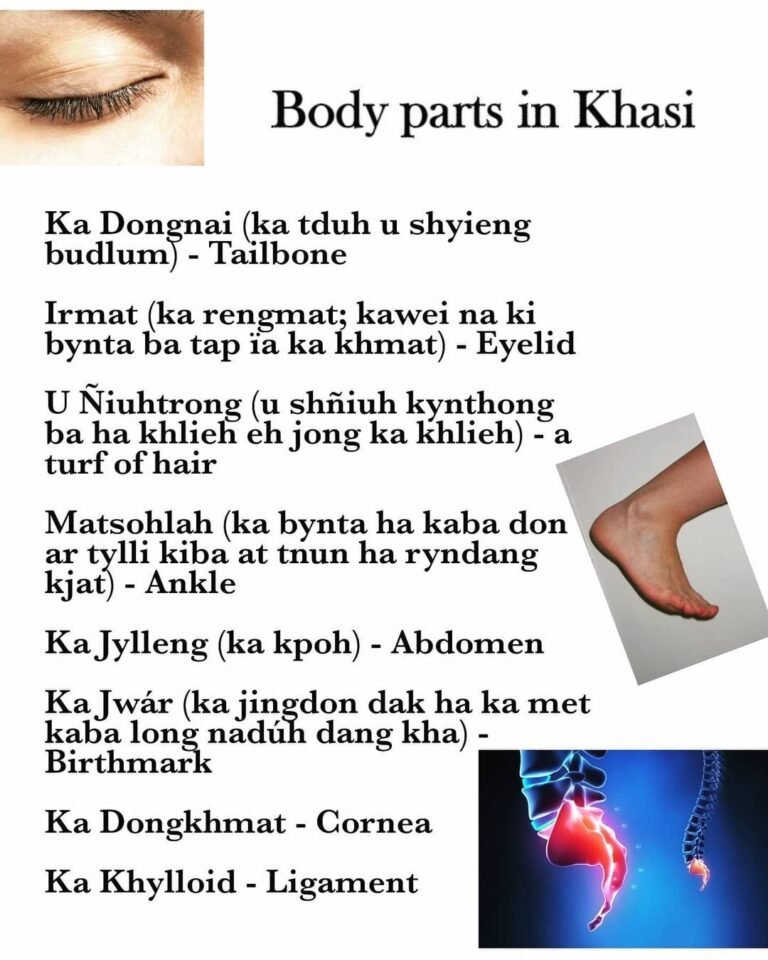
    Ha ka Khasi ïa ka tduh jong ka khmut, ngi khot "Syntiew khmut".

    In Khasi, the tip of the nose is called "Syntiew khmut" or literally "the flower of the nose".

    Don ba kylli balei ki ong "syntiew khmut" mo? 😄😂

    Khublei Shibun @__scorpio__girl @sonitakhongwir
    @uneikin_wanlam bad @badamarboh ba phi la ai ïa ka jubab 😄🙏🙏

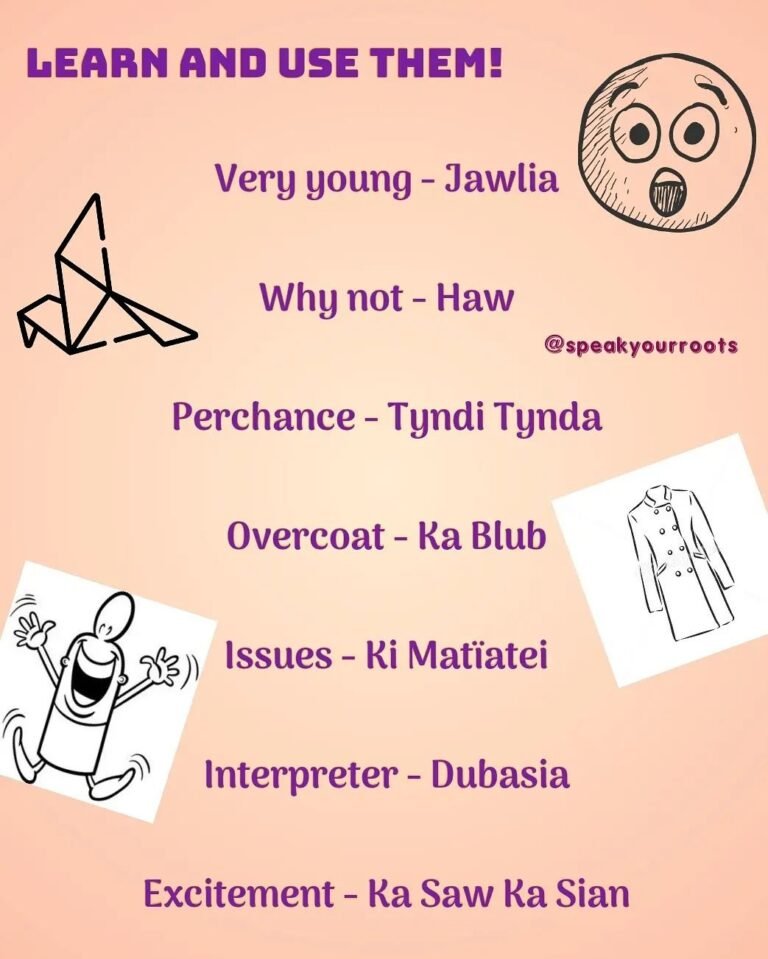
  • Kine ki kyntien ba ngim ju kham pyndonkam shuh

    Feast – Ka Jynlat

    Rub – Kurkhud

    Ending in a draw of a match – Marïakhaid

    Guard – U Borkyndad

    Stubborn – Bakyrot, Badohsnieh

    Sustain – Kyrbah

    Kine ki kyntien kiba ngim ju kham pyndonkam shuh ki dei ban poi biang sha kaba pyndonkam ïa ki ha ka jingkren jong ngi kaba man la ka sngi. Ngi dei ban pyrshang ban pynrung ïa ki ha ki jingïakren bad jingïathuhkhana jong ngi 😃🙏
    Ha kane ka rukom ka ktien kan nang ïar bad suhthied ruh. 🌦️🌄

    Have a great week ahead guys!!

    #khasiwords #khasilanguage #khasilanguageconservation #khasilanguagerevitalisation #indigenouslanguages #indigenouslanguagerevitalization #speakyourrootschallenge #speakyourroots #talklocal